




For you do not give me up to Sheol
or let your faithful one see The Pitt.
-Psalm 16
Every day someone dies; every day someone miraculously pulls through. The emotional whiplash would be too much to bear if it weren’t for the revolving door of the weak and wounded streaming in. Some cases are urgent, others are common. In one room, there is laughter and levity. In the next room, a devastating diagnosis is delivered. This is the last place you want to be. But it might be the only place that can save you.
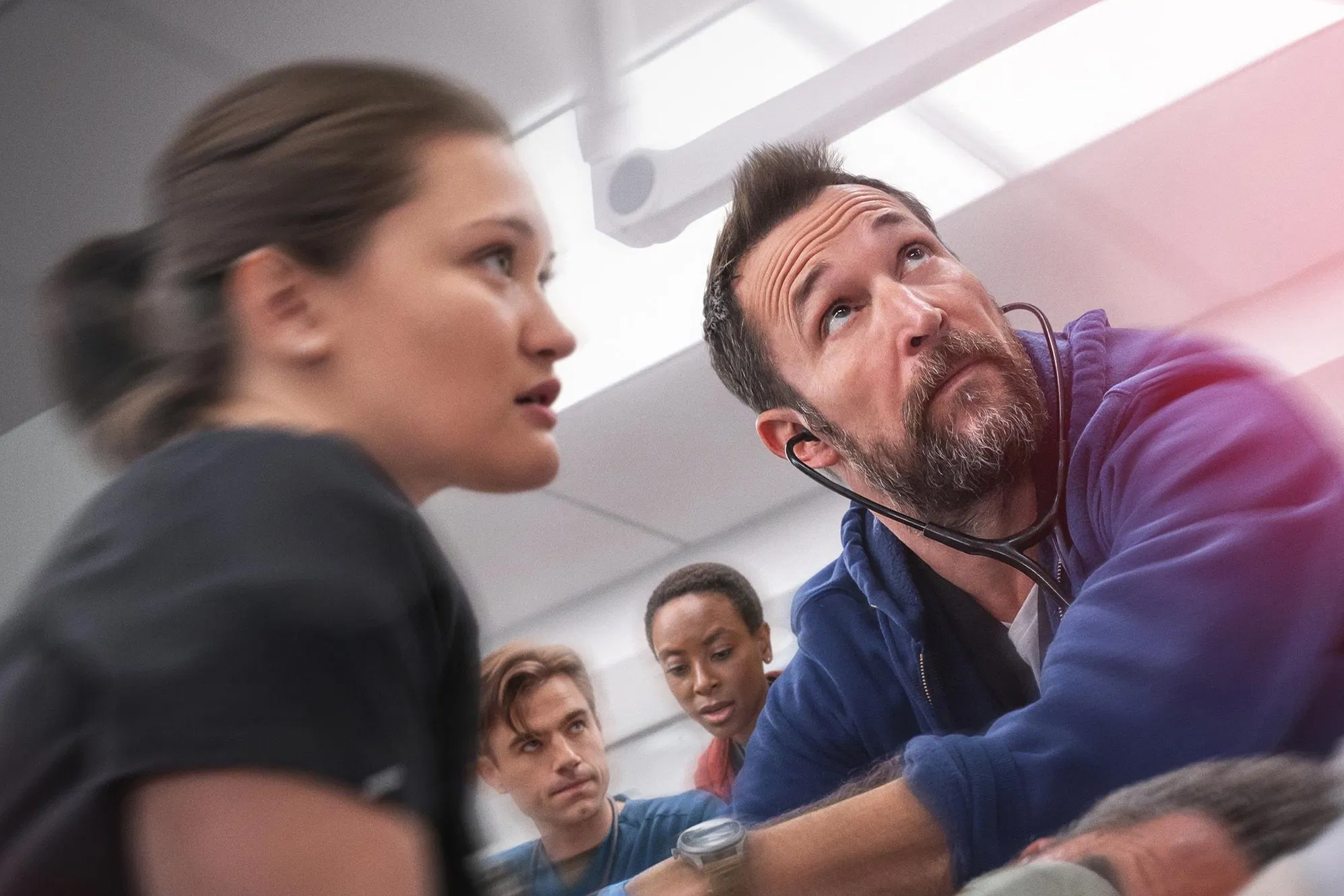
Welcome to downtown Pittsburgh’s emergency department, also known as The Pitt, the Emmy Award–winning show that is worth every bit of the hype. According to my friends in the medical world, the show captures all the struggle, beauty, and nuance that happens inside a hospital. For many, it has helped restore a sense of dignity to a healthcare system that is widely considered failing. Several reviews have commented on how surprisingly soothing it is to watch a team of competent people do their job well.
And yet, these are no caped superheroes. Each doctor is a wounded healer, just as flawed as their patients. They have god complexes and nervous breakdowns. There is petty infighting and deep-seated competition between them. The senior attending rides his motorcycle without a helmet. The charge nurse smokes in the alleyway. The senior resident goes to rehab after being caught stealing prescription drugs from patients. They all have chips on their shoulders. They also genuinely care about people.
As the episodes have passed, what has impressed me most is the resilience required of these hospital workers. Each day is like bailing out a leaky canoe while simultaneously rowing on a never-ending endurance race. There’s little chance for R & R, and you never know if the next minute will demand the next eight hours of your life. Every new case that arrives through the double doors requires a different skillset, a different knowledge base that cumulatively stretches you to the limit — a foot rash, labored breathing, an abandoned baby, an eye glued shut — each patient requiring a doctor’s undivided attention.
Of all the metaphors for the church — a boat, a house, a vineyard, a flock — a hospital for sinners is its best working analogy. And as much as medical professionals see themselves in Noah Wyle’s weary stare, I find the show mirrors my own experience as a pastor. Yes, ministers are spared having to deal with intractable vomiting or blocked bowels. Those who opt for white collars over white coats are concerned with “matters of the heart” that thankfully do not require knowing the difference between a right atrium or a left ventricle. Still, there is likely to be as much figurative blood on the floor of a church as there is literal blood on the floor of a hospital.
Like a hospital, a well-functioning church is forever ushering in a steady stream of need. Those entrusted with the cure of souls are always on call. At any moment, a new patient may be admitted. The first step to care is not unlike a medical screening exam. “Tell me where it hurts,” the pastor says before providing care as best they can. Instead of a stethoscope, a listening ear; instead of pain killers, a comforting word. How does a minister tend to a never-ending parade of patients, sick and sore? When I was first ordained, I asked a seasoned priest how to avoid ministry burnout. “You don’t,” he said. “You just burn out. And then you hide away for a day or two and hopefully you recover.” Like a seasoned physician, an experienced pastor knows it never gets easier.
In both medicine and ministry, there is an undying illusion that life will level out. The fantasy that one day our problems will resolve and peace will be restored is forever elusive. This past Holy Week, after each member of our family fell like dominoes to a ruthless stomach bug, I spiraled into self-pity. Wasn’t this week stressful enough? Didn’t I have enough on my plate already? “Welcome to life,” my wife casually quipped, sipping some watered down Gatorade from behind a mountain of laundry she was folding. It was a very rude thing to say.
In truth, both the medical and ecclesial systems will always be broken. As honorable as The Pitt portrays its healthcare workers, the tenor of the show is never optimistic. “There’s simply no way to watch The Pitt and feel good about the way society is currently functioning,” Sophie Gilbert wrote in the Atlantic earlier this year. Likewise, the church is, at best, a struggling hospital. It has and will always be a flawed and extremely inefficient system. Everyone has a theory about how to fix it. But fixing the system has never been the priority. The priority is the patient.
Energy is a finite resource that must be recharged. So what keeps life’s first responders going? A direct intravenous line connected to the grace of God. After all, one can give only what one has received in Christ. Jesus tends to the sick, who then turn and tend to the sick. In other words, a life of dependence is one of seemingly endless supply.
Life in medicine and ministry will always resemble the famous line in Macbeth, “Each new morn, new widows howl, new orphans cry, new sorrows strike heaven on the face.” The revolving door of the weak and wounded will never cease to spin. Thankfully, the ultimate destination for all of life’s struggles is not the hands of a preacher or a doctor, but the hands of the Great Physician. He is always on call and tirelessly tends to our needs. He looks at each patient as if they were the only one in the emergency department. Like our flawed systems, he was broken too. He himself took our infirmities and bore our sicknesses. Through his death, death itself has been put into remission. And by his wounds we are healed.








Sam,
Thanks for the article and connection from The Pitt to the Church. Great show, but the media does what the media does best. In episode 5 on abortion, a teen seeks abortion pills, and Dr. Robby consents while falsifying ultrasound records (his good deed) so this young person can proceed without parental consent. Her mom arrives, furious about the abortion, and is made out to be a raving lunatic. The key argument is that this teen deserves to have a life. So let’s kill a baby. More pro-choice echo chambers.
Hi Sam, I’m a family doctor. While I haven’t watched The Pitt (OG Scrubs delivers the hyperbolic comedy that coats much needed pathos and makes the medicine go down), I had a similar experience as yours watching the latest Knives Out movie. That phone call the pastor takes from Louise (?) reminded me of why I keep going to work every day. It’s the beauty and privilege of those ordinary, holy moments. Lately, as I pray for my patients, I’ve been asking Jesus to give me what I need, too. I need that IV line of grace as I bear witness to the world’s sorrows, hold hands with my patients and weep tears with them. And I have burned out and went away for a couple days, too. Many times. Jesus meets me there. May the Lord bless you even as you bless others.
Sam, I, too, am a pastor and my wife and I really love the Pitt. Wonderful points of connection. The divergence that might be pointed out is the joy we also find in the Church, the glory, the hope. There is loss, there is exhaustion and pain, surely … but because the Pitt mirrors the world, not the church, not the true hope we find in Christ, it’s universe never gets beyond the weak, fleeting, exhausted gaze of the world
I just started The Pitt. So only 4 episodes in but tonight we begin at 5. (duh). I am a 79 year old married woman who has been brought through the last 25 from a sparkly “clean Sunday best” faith to Grace. Have followed Mockingbird since its inception. I LOVE this article. It provides the “look” of what I crave…an earthy street Christianity. Always thankful when a nugget of Grace hits my inbox. Thank M-Bird. You never fail to deliver.
I guess I left out YOU…it’s an age thing. 😉
Sam, another excellent and thoughtful writing! Thank you!!
A couple years ago I heard it put like this, “the church is not a resort for saints, but a hospital for sinners, and we all enter through the emergency room”. I live in California, but always hear 3 sermons on Sunday. My own church, Christ Episcopal, Charlottesville and Calvary St George in NYC. Thanks Sam , for all you do.
I work in an ER as a nurse practitioner and have always thought at least I am not a pastor they are the ones that have really have it bad. This article put it in perspective that the grace of God is what sustains us all.