




Welcome to a new Mockingbird interview series! With so many debates around Christianity focused on high-level sociological, political, and moral topics, we thought we would zoom in and discuss some of the more nitty-gritty issues involved in just being the Church in specific contexts. To that end, over the coming months, we will be talking to some of our favorite veteran ministers from around the country about what they’ve learned in the course of their careers as to what is actually working in American Christianity today and how to do church well. Our first interview is with Aaron Zimmerman — long-time contributor, former board president, and co-host of the Same Old Song podcast. -Ben Self
Mockingbird: Aaron, so good to have you on. I guess we’ll just start with the basics: Where do you currently work and how would you describe your congregation?
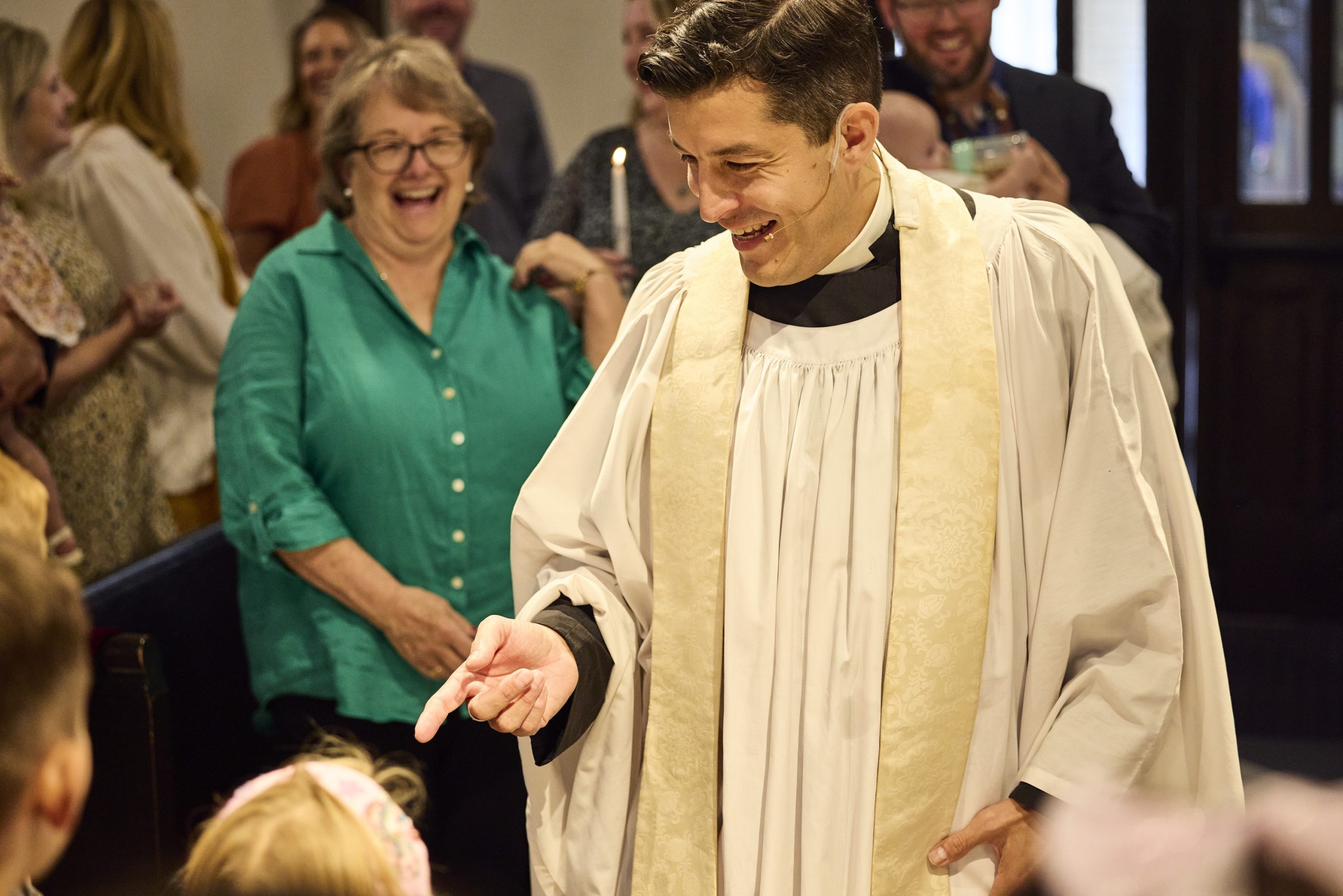
Aaron Zimmerman: I’m the rector of St. Alban’s Episcopal Church in Waco, Texas, in the Episcopal diocese of Texas, and I’ve been here for twelve years. Waco is right between Dallas and Austin — Dallas is 90 miles north of us, and Austin is 90 miles south of us. It’s a town that is really diverse — ethnically, culturally, socioeconomically. It’s a real patchwork of areas of high poverty and areas of wealth.
St. Alban’s is a congregation of about 500 on an average Sunday, while probably 1,000 people call St. Alban’s their church home. We have everything from big-deal college professors to people just trying to figure out what they want to do with their life; people who are sort of in a struggling situation alongside people that are, at least in human terms, doing quite well. We have a real mix of age groups — a lot of people joining the church who are young families or young single people, but also a ton of retirees and empty nesters. I think we’re a down-to-earth kind of church. Waco is not a place where you can brag about your zip code. It’s not a place that comes with a lot of pretension, and that’s really nice.
The Episcopal Church itself is a traditional liturgical kind of church, and so sometimes we have been called elitist, but I think, at least at this congregation, we try to be down to earth. The liturgy is the liturgy, but there’s a lot of warmth and humor possible within that framework; and I’ll just add that we’re a place that intentionally has an emphasis, theologically, in our preaching and our ministry and all the things we do, on God’s grace in Jesus Christ. That’s our message over and over.
M: Sounds like a great church. Is there like a quirk that you would say your church has that distinguishes it from surrounding churches? You mentioned the liturgy and focus on grace.
AZ: I mean, we are swimming in a sea of Baptists and nondenominational churches — which one of my friends likes to say are just Baptists who don’t like labels. And there are lots of different kinds of Baptists. That’s certainly something I’ve learned since I came to Waco. But I’d say the bigger churches in town tend to be on the so-called conservative end of the spectrum. I think, though, what I hear is unique about St. Alban’s in this context, and this could be true for almost any Episcopal church, is yes, the liturgy: there are 300-plus Baptist churches in Waco and three Episcopal churches, so any church that’s liturgical and sacramental is going to be different than what most people are used to. But also our growth. There are plenty of liturgical and sacramental churches in this town that are not seeing the growth we’ve seen in St. Alban’s. I said we’re a church of about 500 people on a given Sunday, but we were at about 150 people ten years ago. So there’s been significant growth.
I think the emphasis on grace is a big part of that growth. You’re never going to hear a message of get out there and try harder to be better. I think there is a default in so many churches — and I would say this is true not just in Waco but in most churches, whether they are so-called liberal or so-called conservative — that the emphasis is always on what you need to do to change your life to be a better human being. Now, what it means to be a good Christian might look different on the left or on the right. But every sermon ends with an application. The emphasis is always on what you need to do better.
I heard of a church where the message of the pastor was, basically, if you don’t leave here feeling worse than when you got here, I didn’t do my job. As if the role of the preacher is to just make you feel convicted about what is going wrong in your life, and that will somehow motivate you to get better. But I think the real message of the Church, which is obviously something that I got from my time in seminary with Paul Zahl and was the first message I heard when I became self-consciously somebody who was following Christ, is this message of grace and forgiveness full stop, and the unconditional love of God.
I would also say, in the Episcopal world, St. Alban’s doesn’t necessarily fit the stereotypes of that denomination. We don’t wear progressivism on our sleeve in a really in-your-face, confrontational, performative way. We have people that are on the left, people on the right, and people in the middle. We tend to not major on those things. And so, if people show up to our church because it’s an Episcopal church, and they think it’s going to be sort of a public radio fundraiser and that everybody votes straight-ticket democratic, like, that’s not who we are. And I’ve heard from people on the left and the right that they like that we don’t really talk about those kinds of issues that much. I think one of the other things that we try to do, which is not always the reputation of the Episcopal Church, is to be playful and to have fun, which is that down-to-earth piece that I talked about. That doesn’t mean we do folksy, tacky liturgy. But within that context, in the preaching, in just the air we breathe, the way we talk to each other, the way we go about our work, whether it’s a staff meeting or a coffee hour, there’s a lot of humor, a lot of grace, a lot of playfulness, which people find really refreshing.
Finally, I will say, and this is probably more a local context thing, being an Episcopal church in a town where most people come from more evangelical or fundamentalist backgrounds, we generally have a higher comfort level in our tradition with asking questions, with ambiguity, the fact that we don’t have to be 100% certain about everything. You know, we major on the majors — the tenets of the Nicene Creed — those are our non-negotiables, but after that, there can be a lot of room for conversation. And many people who join our church didn’t come from Christian congregations or communities that allowed that freedom to kind of explore and ask questions, and so it can be really refreshing for them.
M: Yeah, that feels important. For the record, I’m from Kentucky and I was baptized in a Cooperative Baptist Fellowship church, so I’ve been around a few Baptists.
AZ: There you go, the most Episcopalian of all the Baptist denominations.
M: I mean, pretty much! Anyway, how many services do you have at St. Alban’s and how do they vary?
AZ: During the academic year we have five services. In the summer we go down to four. But Labor Day through Memorial Day, it starts with the 7:30 a.m. Rite I Holy Eucharist, but with no music, and that’s 20 to 30 people. For non-Episcopalians, Rite I means it’s the more traditional language, “thees” and “thous,” that kind of thing. It is a communion service.
Then at 9 a.m., we have Rite II Holy Eucharist, so communion with a little bit more contemporary language, choir, organ, Anglican sacred music — kind of your typical Episcopal church service from the Book of Common Prayer. Then at 9:10 a.m., in our parish hall, we have a service that we call the 9:10 service, and it is the same liturgy, Rite II Holy Eucharist, but it has a folk or Americana-style band. And because it’s in a different space, it feels a little less formal and, for people who are not familiar with our tradition, feels maybe less intimidating. Then at 11:15 a.m., back in the church, we have another Rite II service of Holy Communion, with the choir and organ. The 9 and 11:15 services in the church are identical. Then at 5:30 p.m., we have a service of choral evensong, evening prayer, which is based on the 1662 Book of Common Prayer, so a very traditional but almost contemplative service. We have communion there once a month, but mostly it’s just evensong, evening prayer.
M: Of those different services, is there a particular one that you’ve found is most successful at attracting newcomers? Or one that caters more to families and young people?
AZ: No, I would say that — other than the 7:30 a.m. and the 5:30 p.m. services, which, because of their time and style are going to be more niche options for people — I’d say the 9, 9:10, and 11:15 services are all growing, and I think we have young families that want to be in each type of service. Some want their kids around the more traditional style of liturgy and music. And then there are people who want their kids at the less formal 9:10 service. And there are retirees and single people at all of them. So I think what people are looking for is varied, but the preaching of the gospel is central.
I think people are often looking for a religion that’s not so industrial-strength in terms of its political fire and brimstone tenor. They don’t want to get yelled at, they don’t want misogyny, and they don’t want all the cultural, political stuff tacked onto the gospel. And then there are people who just really find the sacraments meaningful. So yeah, there’s not one service that’s growing more than the others. I don’t think there’s one kind of person we’re attracting more than another.
M: Right. When new people do come to your church, how do you make them feel welcome? How do you help them get connected so they keep coming back?
AZ: The first thing is that the senior leadership of the congregation has to be intentional and self-conscious and self-aware of that part of the mission of the Church. I occasionally visit other churches, and I’m sometimes kind of stunned by how little thought seems to have been given to what the experience of newcomers will be. I mean, I don’t mean to sound arrogant or insufferable about that, but the first thing I did when I got to St. Alban’s was to think through how would I feel if I had been raised in a different church or no church, and I took a risk to come to this church — on my first time here, would I be able to participate, and how hard would it be? I think some of that comes from my childhood. I grew up in the Episcopal Church, but we only went a few times a year, and that was in the days when you’d get a bulletin that listed page numbers for the Prayer Book, hymn numbers for the hymnal, and there was a separate insert for the scripture readings. And so you had four pieces of paper and several books that you were juggling. It’s like that old line from Garrison Keillor: “I don’t have the manual dexterity to be an Episcopalian.” There’s just so much you have to know how to do. The old folks have it all memorized, you know, they know where to look, what to do.
But we have a bulletin that prints everything you need for the service from top to bottom. It has footnotes and little marginal notes, for example, about where people make the sign of the cross if you want to do that. We have a section about why we do that, and that all may, some should, none must. Right under the first page where it says Holy Eucharist, we tell them what “Eucharist” means, because nobody knows what that means! I mean, even saying “Holy Communion” is a stretch for a lot of people. They don’t know what that is, because many churches these days don’t do it. It’s just song, song, scripture, sermon, song, song, and then you’re done. Everything we do in Episcopal services is a foreign language to folks, and so I try to make it really clear in the bulletin what we’re doing and why we’re doing it.
When I go to other Episcopal churches, and there’s nothing in the bulletin that says anything about what the church year is — the front of the bulletin says “The Fifteenth Sunday After Pentecost,” like what the heck is that? There’s nothing in the bulletin about what the expectations are if you have a small child with you, where the nursery is, or there’s nothing in about who can take communion and how it’s distributed. Those are the things that I think we try to really do here, and I think that’s part of why we’re growing. People come to church, and it’s such an anxious thing for them the first time they come, and we do everything we can to lower that anxiety, because if they’re made to feel dumb, like they messed up, or they don’t belong, they’re likely not to come back.
M: So does that include printing the music in the bulletin? Or do you still use the hymnal?
AZ: Yeah, we print the music. We don’t use the hymnal.
M: Wow.
AZ: And I realize that for some churches, for cost or other reasons, that may not be feasible, or you don’t have the staff to do it. I used to be one of only two full-time staff members at St. Alban’s. I was the priest, and then we had a parish administrator. And so I did a lot of the bulletins myself. And then we’ve grown, and now we have some help with that. But even if you can’t do all that, like, if you are just going to print page numbers and hymn numbers in the bulletin, then you’re going to have to take time during the service to explain things to people on a regular basis: The Book of Common Prayer is that red book in the pew in front of you with a big cross on it, and we’re going to start on page 323, and give people a moment to find it. You’ve got to walk people through it. You don’t have to do everything the way we do, but just know that if you’re going to grow, it’s going to be with people that have no idea what the Episcopal Church is, or even what that word means. It’s just so foreign to folks.
Another thing is the announcements, which I feel are often an unappreciated element of the service about making people feel welcome. I always mention: if you’re a guest here, here’s how you get connected … Just acknowledging that they’re here, which also sends a signal to the people that have been here for a long time, that there are people next to you that maybe are new here, and it might be worth saying hello to them. So that’s another place where you can inject a lot of warmth and humanity into the service.
Oh, and one more thing I will say is that I think it’s important that your music be good and authentic — whether it’s choral and traditional sacred music, or whether it’s a more contemporary kind of music. I think that’s another thing that has driven our growth and our vitality. I don’t think it’s ever any one thing. I would put at the top of the list the consistent preaching of the gospel in a way that really connects and makes people feel seen, known, forgiven, and loved. But I also think the music being something that feels transcendent and really beautiful is so important. And that, again, doesn’t mean that you have to have, as we do, a really nice organ and a choir,
M: So what are your offerings, on Sundays or otherwise, for children and youth, and how have those offerings had to evolve? What’s your best advice for how to do youth group?
AZ: When I got to St. Alban’s, we had a nursery, which was okay. And then we had a room for any other kids, and it was an old office that had a broken photocopier, a TV with a built-in VHS player and VeggieTales videos, and old pew cushions so they could sit on the floor. It was dank.
So we got some volunteers together, raised just a little bit of money, went to IKEA, bought some nice furniture, put some paint on the walls, and did kind of a cosmetic facelift of the place. We recruited more volunteers to teach Sunday school, and just little by little we grew. I think maybe the third year I was here, the giving was increasing, and we got the vestry to take a risk and approve a budget line item to hire a part-time children’s minister so that you could begin to have some consistency. It’s hard to run a program with just purely volunteers forever. We also had some other rooms that were unused on the church campus in an old school building that we have, and we converted those spaces to have more offerings for children’s ministry.
Anyway, we have Sunday school at 10:15 for all ages but divided by age group. And so there are four children’s and youth classes running, and we’ve used different curricula. We’ve used Sparkhouse, we’ve used What’s in the Bible, we’ve used a ton of StoryMakers stuff, and that continues to be part of what we do. We do have the Godly Play materials as well. For youth, they also have their Sunday School class, and they’re usually going through a book of the Bible with our youth minister, and some volunteers help with that as well. It’s during that Sunday school hour for all ages. We also have a Wednesday night youth group called Midweek. They get together, have a meal, high school and middle school, and then they split off to do whatever their lesson or program is. Sometimes it’s just a game. There’s lots of silliness and that sort of stuff.
As I’m talking to you, I realize, this is not new, this isn’t rocket science. This is how churches have done youth ministry and children’s ministry for a long time. I think one of the keys is having the adults creating a space, again, that just is rooted in the gospel. Especially for young kids, not much of the content is going to stick, but what they will remember is how they feel when they’re in that space. So is it a place where they are shamed, cajoled, manipulated, or controlled? Or is it a place where they feel loved, and that it’s a fun place where there’s somebody who really cares for them leading that class? That’s how we approach it.
M: Fun is probably a big part of it. It would be hard, like you said, to get deep in the weeds in some Bible story with little kids. And I have to say, there are way too many classrooms that are decorated with the scenes from Noah’s Ark or whatever.
AZ: Yeah, an instrument of judgment.
M: Exactly. One of the most difficult stories in the entire Bible. Okay, what’s your best advice on preaching, other than keep it short?
AZ: Well, I would say brevity is important, but it doesn’t do anything by itself. I think it’s acknowledged that people can pay attention max 20 minutes, but that may be an old study. These days, probably 15, 18 minutes is pushing it. I think one of the things that many preachers fail to realize when they begin their sermon is that you are already facing major headwinds. There used to be a time when people would get in the pulpit and everybody would sort of lean forward, and think, what’s he going to say? Maybe John Wesley experienced that, or Billy Graham, or Aimee Semple McPherson. People were just waiting to hear every word.
I think the preacher has about 30 seconds to make it interesting, to communicate to the congregation why you should care about what I’m about to say. And there are different ways to do that, but I think being surprising works, being a little funny, or telling them something that they’re not expecting.
If you begin your sermon by saying, “As the apostle says in 1 Corinthians 7 …,” everybody’s now asleep. So, you’ve got to begin with something that grabs them and in a way that’s authentic to the preacher. I always know what I want to say. I always have one thing I want to say in the sermon — it is the gospel, or something related to that message of God’s grace for sinners, Jesus Christ as the friend of sinners — and I want to communicate that in some way. That could be a theme about God knowing who we actually are versus who we’re pretending to be. It could be a theme about the fact that we are fully loved in our brokenness, not when we fix it. Whatever the idea is going to be, something from the text.
But I need to find a way to get there. I need to get people’s attention in the beginning. So I’m always looking for an example. I’m into music, so often that just comes to me naturally. My brain is a collection of scripture and song lyrics, and it’s all sort of mixed in there. And they’re probably not expecting me to begin with something about REO Speedwagon and the best/worst music video of all time — so beladen with metaphor, it was laughable — but it’s also great, and there are a lot of perms on men in it. Starting there, now your audience is like, I don’t know where this guy’s going, but that’s not what I expected him to say, so maybe I’ll listen to him for another two minutes.
I also follow a pretty standard outline format, and I don’t write manuscripts. I’m not a big fan of manuscript sermons, because they often feel to me like somebody’s just reading an essay, which is the least interesting thing. People pay tons of money to go listen to comedians and TED Talk people, and those folks feel like they’re talking to you because they’re not reading off a page. I’m not going to go watch John Mulaney read his jokes off a piece of paper at a podium. It sounds like a nightmare. I think having an outline in front of me keeps me knowing where I’m going and gives me some guardrails, but I also can speak more conversationally, which I think is important. It just feels direct and more dynamic and energetic.
I try to say one main thing, and I always sort of give an illustration of what that actually looks like, what that might look like in life. And I don’t give an application, because I trust the Holy Spirit to be able to lead people. Really, the application is always pretty obvious. Everybody knows they’re not supposed to be jerks to each other, and most sermon applications are some version of that. Sometimes it’s a spiritual discipline, like read your Bible, or pray more, or walk the labyrinth. But the point of that, I think, is ultimately you want them to not be jerks to each other. So any sermon that ends with some application, some version of don’t be jerks to each other, that is not new, like, we all know that. And so I try to end with the surprising news, which is that God acts even when you don’t, that God loves you even when you’re unlovable, that you are forgiven before you’ve asked for forgiveness. And I try to give an example of what that looks like, to give some emotional hook. If I’ve just talked about a theological concept, what’s a parable basically that kind of gets that emotional resonance, so that people can feel it for themselves. So I’m always listening, reading, watching whatever it is for these little examples. I always keep a little open file in my Notes app, and when I come across something that grabs me, that speaks to me, I write that down, and those things eventually find a way into my sermons.
M: That’s great. You’re giving very thorough answers.
AZ: No sound bites here!
M: Haha. So as a church that preaches grace, how do you deal with difficult people? What are some effective guidelines, and how do you protect the rector’s time?
AZ: Excommunication. Haha. No, I think grace is treating people with forgiveness because they’ve sinned. So when there is a church member or a staff member who is hurting other people, it is not gracious to those other people to allow that person to continue to do the thing. One of the things about the gospel is that, as Luther said, it says what a thing is. John the Baptist tells people you’re a brood of vipers. Jesus says to people all the time what is true about them, he names the thing that’s going on in their life. Yes, you do not have a husband, but you’ve had seven, and the guy you’re with now is not. He names what a thing is. I think one of the things that the love of God and Jesus Christ enables us to do is to be honest, fearlessly. And so we can name what a thing is. If there’s bad behavior, you absolutely can name what that thing is and then address it in an environment of care and compassion.
Whether that’s going to somebody and saying, “Steve, I know you would never want to cause offense to anyone, and I know you have the best intentions, but when you said this thing it was really hurtful and we can’t have that.” You know, I’ve had people on staff who were joking in a way that was really offensive and hurtful to folks, and the gracious thing for me to do was to let them know and to say that that’s not okay. And if they were able to stop, then they could stop. If not, then maybe it’s time to find them a different ministry.
There are a lot of difficult people that don’t rise to that level. And I think Paul Zahl used to say, you got to be like Mr. Magoo — he’s this old cartoon character who couldn’t see very well. And so there would be some pit bull that’s barking in his face about to tear his head off, but he’s looking at it and it looks like some sweet, kind, old lady, and so he just treats it like a sweet, kind, old lady, and that totally disarms the pit bull, and Mr. Magoo’s always fine. And I think in ministry, sometimes the imputation effect of the gospel — the fact that you can treat people as beloved even when they’re difficult, just as God treats us as beloved even when we’re difficult — I think that can be very effective as well in dealing with difficult people in church.
M: What are your best fundraising tactics? What’s your advice for how to approach fundraising in a grace-centric church without turning people off, without making it feel like another side of the law?
AZ: I think that’s a great question. I really enjoy raising money. I am not scared to talk about money, because it’s just another thing. Jesus talks about it all the time. I think the taboo weirdness we have around it comes from our own issues. So if there’s a clergy person that has a hard time with it, it probably has some real roots in their family of origin, or their own experience and finances. And I think getting some help with a therapist or somebody to work through that can be helpful and transformative for people.
It’s just money, and everybody has it, and everybody else out there is asking them for it. And I really believe in the work of the gospel and what St. Alban’s is doing. So I am not ashamed at all to say what they already know, which is that we are a church that is funded by its members. I always tell folks it would be a dysfunctional family where they never talk about the finances of the family. Those secrets make you sick, and lead to all kinds of bad behavior. I want this church to be a healthy church, and I say that to the people and we talk about these things openly and honestly. We are Christians. We can be forthright. Again, the gospel allows you to say what a thing is. So if people aren’t paying their pledges, I’d say, look, some of you are, and thank you, but some of you aren’t — I’d usually get the senior warden or the treasurer to say that. But you know, if I were in your shoes I would want to know what’s going on in the church that I’m a part of, and if I have forgotten my pledge that I made, please remind me and tell me. I think it’s about being direct and not pushy, not mean, not manipulative.
When we do capital campaigns, I’ll meet with parishioners, and I’ll say This is the project, this is why I’m so excited about it. I think everybody at St. Alban’s wants to be a part of this project. You can pray for it, you can give towards it. If you can give, is this an amount that you could give? And I will name an amount. And I’ll say, I don’t know if that’s the right amount, you know what the right amount is for you. But yeah, I have no problem asking. I think the gospel to me means that I’m freed up to ask for money for what I believe God has called us to do. And people are free to say yes or no to that, because ultimately, it’s not me. I’m not manipulating anybody. I think if I were sitting in the pews, I would want to know what it takes to run a healthy church, and I think it is leadership’s responsibility to help them know what’s going on. And we can have fun with it, too. And that approach has born great fruit. We’ve done two-and-a-half major capital campaigns, and we’ve seen a growth in our annual giving every year, because I think people are excited to give towards what they see God is doing here.
M: That’s really cool, and honestly, that very direct approach feels refreshing. Just a few more questions. What do you wish you’d known when you first started ministry?
AZ: That ministry is managing. It’s event planning. It’s fundraising, and it’s recruitment, it’s all that all the time. And I think nobody told me that in seminary. It was all theology and pastoral care and preaching, which is very important and you need all that. And I don’t know that seminary could have taught me how to be an effective recruiter of volunteers, which is a constant thing in churches, or how to hire the right kinds of people, or whatever. But it would have been nice for somebody just to tell me that those things are going to happen.
I think one of the other things that I didn’t realize is how powerful and damaging a word of criticism can be from a minister, especially from the rector, but any clergy person. For example, there was somebody who was a lector for us who had sort of dropped the ball on several Sundays, repeatedly. It was clear that this person had not prepared, wasn’t saying the words right, and it was anxious for them and anxious for the congregation. And I wrote a long email where I tried to be gracious, but it was like, “You’re not doing this right, this is really important, please work to do it better,” and I gave some suggestions or whatever. And I think my heart was in the right place, for the most part. But, first of all, that was the wrong way to do it. It should have been face-to-face. Second, it should have begun not with you’re wrong and I’m going to tell you how to fix it. It should have been more “You’ve been reading the scripture for us — how’s that going for you?” And just let them talk and see what they say. Then you say, “How can I support you in that? What would help you?” As opposed to me coming down like a lecturer, telling them how to get better. And that person left the church. When a minister criticizes someone, I think it’s received even more powerfully because people feel so vulnerable in church, and they’re coming here trusting and trying to serve. Even if they mess up, they want to be here doing this. I think that’s something that would have been helpful to know.
M: What would you say are the biggest mistakes that churches are consistently making in 2025, other than what you’ve already mentioned?
AZ: One of the biggest mistakes that churches are consistently making is presenting God as some sort of transactional being, and that our spiritual life is something that is a quid pro quo. Sometimes they say it directly and sometimes it’s more implied, but I just know from the many, many people that are washed upon the shore of St. Alban’s, broken and bleeding, they are coming from places where they have been made to feel, explicitly or implicitly, from the preaching and from the teaching, that their actions determine how God feels about them, and it’s always kind of a never ending treadmill of making God happy. Which to me is antithetical to the ministry of Jesus Christ and the message of the gospel.
I wish churches were preaching the gospel and not filling people with semi-Pelagian burdens of drudgery for the Lord. It’s just so misguided and so off-base, and I think one of the things that’s so clear in scripture is the one-way action of God to save. Jesus Christ says, “No one comes to me unless the Father draws him.” The way that we see Jesus go out to people who are not seeking him and calls them into discipleship. You know, Levi’s collecting taxes, Peter’s catching fish, all these people are just minding their own business. They’re not preparing and praying and fasting for what the Lord will do in their life. Jesus just comes and grabs them. I think I would much rather see an emphasis on God being the one that chooses, God being the one that calls. And don’t call me a Calvinist, but what I’m saying is, most churches emphasize your action, and I wish churches would emphasize more God’s action.
I think also I would just like churches to stop giving people reasons not to come. So many churches do stuff that they think is important to them, but it’s a repellent to so many people. And that can be overtly or even sometimes almost an arrogant, subtle way of saying, we have things figured out and you don’t. That can be in the way they talk about political or cultural matters. It can be just really bad, cringy liturgy. It can be some of the bad theology I’ve mentioned. It can be announcements that go on forever. It can be sermons that are 35 minutes long. It’s already a difficult proposition to get people to come to church, and I see so many churches do so many things that make it even worse. Like making new visitors stand up the first time they’re there and introduce themselves, or making them sign in at a kiosk when they walk in the front door — give me your information even though I don’t know who you are. All these things. Just think about what you would want if you were there for the first time, and if there’s something that would make you feel bad, then don’t do that thing.
M: That’s good advice.
AZ: It’s like what Dwight Schrute said: “I think about what an idiot would do. And then I don’t do that thing.”
M: Last question: what aspect of your job do you love the most?
AZ: Oh, man! I love it all. But I think probably the best thing is when you see the penny drop, when something clicks with someone, when you can see the Holy Spirit move. Whether it’s in church on Sunday in the way somebody looked — I, as the minister, can look out and I can see like their facial expression, their whole affect, has changed from the beginning of the service to the end — or if it’s somebody in my office, or I’m visiting somebody at home, and you see that there’s a release, there’s a shift. It doesn’t mean they’re a brand-new person and everything in their life is fixed from that moment on. But I think when somebody grasps God’s love for them, the kind of epiphany that happens in that moment I think is really meaningful. I love that.
M: That’s great. Bonus question, what is the best sandwich?
AZ: I love a Reuben.
M: A good biblical sandwich there.
AZ: That’s right. One of the lesser appreciated tribes of Israel.
M: Thank you so much, Aaron. This has been great.








And, we are blessed to call Aaron our rector!
After reading Aaron’s comments on his church and his preaching I am sure he loves the verse in Titus 3:5 which says, ‘He saved us, not on the basis of deeds which we have done in righteousness, but according to His mercy…’
What a blessing for you. I’m considering moving to Waco just for the church!
Thanks, Aaron – this is a fantastic interview! I’d like to get it to all the clergy in our diocese, plus to our seminaries. I love it! Although, um… “7” husbands? Just sayin’.
Thanks, Jim. Math was never my strong suit.
Thanks, Lori! Come on down! Till then, check us out at http://www.stalbanswaco.org
[…] worked at her former church, House for All Sinners and Saints. It reads like an expert add-on to the interview with Aaron Zimmerman that went up yesterday (which, if you haven’t read, make it your… mission). […]
This was great—thank you so much. I’m forwarding the whole interview to my vestry because I agree with it all so wholeheartedly!
I love the idea of radical grace… well, mostly. The truth is, I still want to give people an application. Honestly, I want to give myself one—as if we didn’t already know what we’re “supposed” to be doing! (As you pointed out, we all do.) The congregation doesn’t need me to tell them what to do—there’s already enough of that in the world. What they really need to hear is that they are loved more than they could ever imagine. Crazy.
That said, my one worry about preaching such radical grace is that it could somehow diminish it. I know in my head that’s not possible, but I still struggle with it. Sometimes it leads me back into thinking of grace as a kind of quid pro quo with the Lord, even though I know that will never work. As Jake would say, “How’s that working for ya?”
Anyway—thanks again for taking the time to share. Peace and grace,
Wonderful messages. Thankful for Aaron, our leader and his multiple skill set. Love the Mr Magoo story!!