




1. School is now in session for the entire country (at last!), which means the kids are out of the house (finally!) and back where they belong: with their peers. At least, we hope they belong. My chief prayer for my boys at this time of year always has to do with friends — not only that they’d find them but find the right ones. A good friend in their class can make a kid’s year, to say nothing of childhood itself. A bad friend can turn things inside out and possibly even set them on the dreaded “living under a bridge” track. Or so it seems to us parents.
Cue Russell Shaw’s fantastic article, “When Your Kid’s Best Friend Is a Great Big Problem.” I don’t go to the Atlantic for lessons about law and grace either, but here we are.
A lifelong educator, Shaw identifies the difficult predicament many parents face when it comes to who their progeny hang out with. He’s seen time and again what happens when mom and dad bring the hammer down, the way the law increases the trespass, how social mandates inspire rebellion and resentment. Thankfully, that doesn’t mean abdication is the only recourse. There is always the counterintuitive power of grace — in this case, the allure of fluorescent-colored snack food and the superabundant embrace it represents. I’ve said it once and I’ll say it again, but praise God for high fructose corn syrup:
Parents unhappy with their kids’ friends typically contemplate two approaches: prohibition or passive resignation. Both are suboptimal. On the one hand, mandating separation from certain friends can backfire. “Reactance theory” posits that when people believe that their freedom is threatened, they frequently grow more motivated to pursue the forbidden activity or relationship. Tell a teenager that they can’t see certain friends, and those relationships tend to become more appealing and influential than they would have been otherwise […]
On the other hand, standing idly by while a kid makes concerning choices can feel like an abdication of parental responsibility. When a child adopts troubling behaviors, values, or attitudes, the typical instinct for caregivers is to intervene. How can we just watch kids make what we believe are poor decisions? The answer lies in understanding how influence actually works — and playing a longer game than the one teenagers and their friends are playing.
One of the most effective strategies for parents troubled by peer influence is to strengthen the gravitational pull of home. This doesn’t mean vying with friends for your teenager’s attention. Instead, it means making home a place where your kid and their friends genuinely want to be. In our household, we keep a cabinet drawer stocked with snacks: Fruit Roll-Ups, Pringles, Pop-Tarts, an ever-present box of Lucky Charms. We consciously choose to sacrifice nutrition for a sense of welcome … Our goal has never been to be our kids’ best friends or to compete with peer relationships. Rather, it is to remain a steady, positive presence in their life while they navigate the complicated work of figuring out who they are and whom they want to become.
Fortunately, Shaw is careful not to neglect the parents themselves, extending the same gracious understanding in their direction:
When a parent doesn’t like their kid’s friends, it can feel like a referendum on their parenting and a preview of their future. But more often than not, these friendships are part of the messy, complicated process of adolescents figuring out what they believe and care about. A child’s earlier, formative relationships and the sense of self they’ve developed over the years don’t disappear the moment they start spending time with kids you don’t like.
A parent’s job isn’t to control, but to remain a loving caregiver who ultimately trusts their child’s capacity to make good choices. Sometimes that means watching them learn lessons the hard way. But it also means being there when they need a parent most—which is typically long after the friends who worried us so much have faded from the picture.
2. Social science study of the week month year has got to be this one, on “Exploring the Effects of Prosocial and Self-Kindness Interventions on Mental Health Outcomes,” published recently by the American Psychological Association. The jargon is thick, but the gist is that a bunch of psychologists at UCLA decided to look at the differences between me-centered approaches to well-being and other-centered ones among folks suffering from depression, anxiety, and loneliness. The people in their study who focused on being kind to other people experienced a far more significant decrease in those afflictions than the participants who prioritized kindness to self. Ya don’t say.
These findings may not be especially revelatory to churchgoers — or those in recovery programs — but they jive nicely with both the Huberman Lab interview with David DeSteno that RJ mentioned on the Mcast the other day, as well as Rebecca Heiss’ piece this past week in the Wall Street Journal, “I Study Stress. This Cure Surprised — and Helped — Me“:
A study of workplace interventions to reduce stress, published in Industrial Relations Journal in 2024, revealed a startling truth: Of the 90 different stress-reduction strategies tested in corporate settings, which included meditation, massage and breathing exercises, only one consistently mitigated the negative effects of stress: serving others.
People experiencing their own stress […] all instinctively relieved this pressure by helping someone else … They weren’t following any wellness program or stress-management protocol. They were simply, and perhaps unconsciously, responding to their own anxiety by extending kindness to another person.
This helped me see how we’ve been approaching stress relief backward. Instead of turning inward with bespoke wellness practices, we do best when we turn outward — toward the needs of others. This doesn’t mean meditation and self-care are useless, just that they are incomplete solutions.
3. While we’re on the subject of “prosocial” attributes, is there anything more prosocial than humor? Lord knows it was the glue that held my own childhood friendships together, both the well- and ill-advised ones. My adult ones too for that matter. In fact, I remember my chief aversion to Christianity during my twenties had nothing to with doctrine and everything to do with humor — specifically, its lack. It wasn’t until I ran into a group of genuinely funny Christians that I felt there was a space for me in the faith. Looking back, it wasn’t so much that I was desperate for amusement and more that I didn’t trust people who couldn’t laugh easily and often. They seemed, well, a little inhuman.
That’s where my mind went when reading Joshua Rothman’s fascinating piece in the New Yorker, “Why Are Kids So Funny?”
I didn’t know … that humor is among the first aspects of personality to emerge in children. In fact, babies begin making jokes before they can use words.
The river of laughter in which we swim begins in infancy; it springs up simultaneously with the river of thought. Aristotle thought that human beings were distinctive because they were rational; Wittgenstein believed it was language that made us special; Sartre argued that our humanity flowed from the exercise of our wills. But the speed with which children embrace humor suggests that it, too, is fundamental to human nature. We laugh, therefore we are.
“What is its purpose?” [Dr. Elena] Hoicka asked, of humor in kids. She pointed to research she’d conducted with another psychologist, Burcu Soy Telli, which showed that “humor development predicted socio-cognitive development six months later, but not the other way around.” Joking around, in other words, helps kids learn to think about what other people are thinking. To get a joke, Hoicka said, “you have to read intentions,” merging them with what you know about the world; to find it funny when your mom puts a cup on her head, you first have to understand what a cup is for, and then to ask yourself what she might be thinking when she uses it the wrong way. “You also have to read their emotional expressions,” Hoicka went on. “You have to understand their knowledge, their beliefs.”
4. Speaking of jokes, James Donald Forbes McCann continues to be my top go-to destination for all things comedic, whether that be his new collection of poetry Disquieting Levels of Egg (for a taste, see “Happy”, “Whatever Happened to Stanley Tucci?”, and “Outback Steakhouse”) or his unhinged new YouTube special Black Israelite. Elsewhere, Reductress made me laugh with its headline “How to Recover from Perfectionism the Right Way.” There were also heaps of zingers in Sloane Crosley’s hilarious, biting rundown of the celebrity picture book boom. “Having a child,” Crosley writes, “qualifies you to write a children’s book the same way that using a toilet qualifies you to be a plumber.” Ha.
5. I forget who said it, but one refrain that’s been echoing around my head this past month is “Never forget that, whoever you are, you are someone’s most difficult person to deal with.” Woof. It’s true: we operate on the assumption that it’s always other people who are difficult, never us.
The same applies to the not-so-modern-after-all phenomenon of ghosting. In the calculus of self-justification, you and I draw boundaries, it’s only others who cruelly “ghost.” Writing in the New Yorker, Kyle Chayka digs into the topic, observing that while abandonment has always existed, the internet has clearly supercharged it. Yet he cautions against self-righteousness:
“At a certain age, we have all been ghosted at some point in our lives. Indeed, we’ve all likely ghosted somebody in turn,” [Dominic Pettman] writes. The author means this in the larger sense of abandonment — of a parent, of a friend, or even of a boss. We may aspire not to ghost, knowing the pain it causes, but technology has made ghosting, in its many forms, all but inevitable.
“We all look down on people who ghost. And yet we are all obliged to deploy this option on semi-regular occasions, given the over-connected world in which we live.” Despite its negative connotations, ghosting is necessary and can even be merciful, when compared to a prolonged fade or the slow drip of superficial digital interaction that some call “breadcrumbing.”
The postponed reply isn’t a new invention, but the jilted once had plausible excuses that could soothe their nerves. A letter returned to sender might be the result of a mistaken address; an unanswered voice mail might be the sign of a busy schedule. The online ghoster, however, is often caught in the act, their attention to the message signaled by a tiny checkmark showing they read it but did not write back. The ghosted feel omniscient but not omnipotent; technology has not yet invented a way to compel a response. That may be the true source of ghosting’s frustration: these days, we’re haunted by knowing too much.
The hidden kicker to the piece is a stray observation about AI, in which the corollary to matters divine becomes extra uncomfortable: “Other people can always ghost. What will never ghost is an A.I. chatbot or the endless stream of content offered by digital platforms.”
6. Over on Substack, Nadia Bolz-Weber unpacked her suspicion of that scourge of the nonprofit world known as the Mission Statement. As a case in point, she discloses how things worked at her former church, House for All Sinners and Saints (RIP). It reads like an expert add-on to the interview with Aaron Zimmerman that went up this week (which, if you haven’t read, make it your … mission). Preach:
At one point during my 11 years as their pastor, I realized that the congregation just seemed to be really good at loving each other. It was wild. But it wasn’t because LOVE was the focus. It was because GRACE was the focus. Some things only happen as a result of focusing on other things, and yet as Americans we want to approach everything head on. I know for a fact that, if new folks were welcomed with “the thing we want you to know about this community is that we love each other well!” we would have failed to become a community that ended up being pretty good at loving each other, but we for sure would have succeeded at becoming a community that was endlessly disappointed in ourselves and others for everything said or done that could be deemed “not very loving”. I know the following claim does not fill anyone with sparkly inspiration, but I think it is true: aspiration so often becomes the raw material of accusation.
Instead, when we would have a Welcome to HFASS Brunch for newcomers, folks were invited to say what drew them to the church – or for the old timers, what has kept them there. “I love the inclusivity, or the sense of community or the singing, or the fact that I don’t have to believe certain things in order to belong”, etc. … And that’s when I would say “I love all those things too! But what I need you to hear me say is this: this community will disappoint you. We will fail to live up to your expectations of I will say something stupid that hurts your feelings. We invite you to stay after that happens, because if you leave you will miss the way that grace flows in to fill the cracks left behind by our failures.”
I’ve seen it. It’s real. I’ve seen grace fly in with healing in her wings and fill in the cracks – and I’ve seen how it softens me and leaves me with a cleaner heart than just getting it all right from the beginning (because I aspired to do so) — ever has. Some of the best things in this terrible/beautiful life happen without us trying, and in fact could never happen as a result of us trying. That’s grace and it is absolutely everywhere.
7. Finally, a beautiful devotion to see us through the weekend, “The One Who Promises” by King-Ho Leung in Plough. Taking TSwift’s engagement as a jumping off point, Leung explores what we’re doing when we make vows and what that might have to do with “the nature of the God who reveals himself to his people in promises — or even as promise.”
In the history of Western philosophy, the God who discloses his name as “I am who I am” or “I will be who I will be” in Exodus 3:14 is often understood to be “Being itself”… However, at the same time, God’s very act of revealing and giving his name to his people can also be understood as an act of establishing some form of relationship with his people: a relationship which God promises to honor and uphold, because God is a faithful God — for “I will be who I will be” is not just a divine name but also a divine promise. Indeed, one might even say, God himself is promise — for God promises himself to his people in the very act of revealing his name to them. According to this reading, God is not simply an abstract philosophical principle of “Being” par excellence, God is “faithfulness” or “promise” par excellence. God is not simply the idle object to whom one makes promises in vows, but also one who makes promises and always keeps them because he is faithful.
Unlike the disloyal human lover in Taylor Swift’s “All Too Well,” who is said to “call [her] up again just to break [her] like a promise,” God is not someone who would ever break his promise. God’s promise to us cannot be broken; it is intrinsically interwoven with our very being: for God called us into being by making a promise (Rom. 4:17) … We can make vows and promises only because God first made us a promise, because God is the faithful one who keeps his promise, because God promised himself to us, because God gave us — and continues to give us — his Word.
Strays:
- I greatly enjoyed speaking with Matt Salyer on his Rest Roots Renewal podcast – about middle age, relief, low anthropology, and ministry.
- John Van Deusen you guys. These songs (from his forthcoming As Long As I Am In The Tent of This Body I Will Make a Joyful Noise, Pt 1) are keeping me alive. Read his notes about it here.
- On Substack, Freddie deBoer sounded off about “Poptimism and Type-of-Guy Anxiety,” issuing the trenchant reminder that “every effigy the internet makes of a type of person they don’t like will result in an equal and opposite type of person, who they very well may like even less.” Truth.
- Matthew Milliner highlighted some very fascinating (if incomplete) overlap between Eastern and Western theologies of grace in his newsletter on Evangelicals and Zen Masters.
- I forgot about this wonderful Fred Rogers vignette that Alan Jacobs highlighted this week on how people change. “I think people don’t change very much when all they have is a finger pointed at them. I think the only way people change is in relation to somebody who loves them.”
- Olga Khazan’s “The Big Lebowski Friendship Test” in the Atlantic hit very close to home. Say what you will, but at least it’s an ethos.
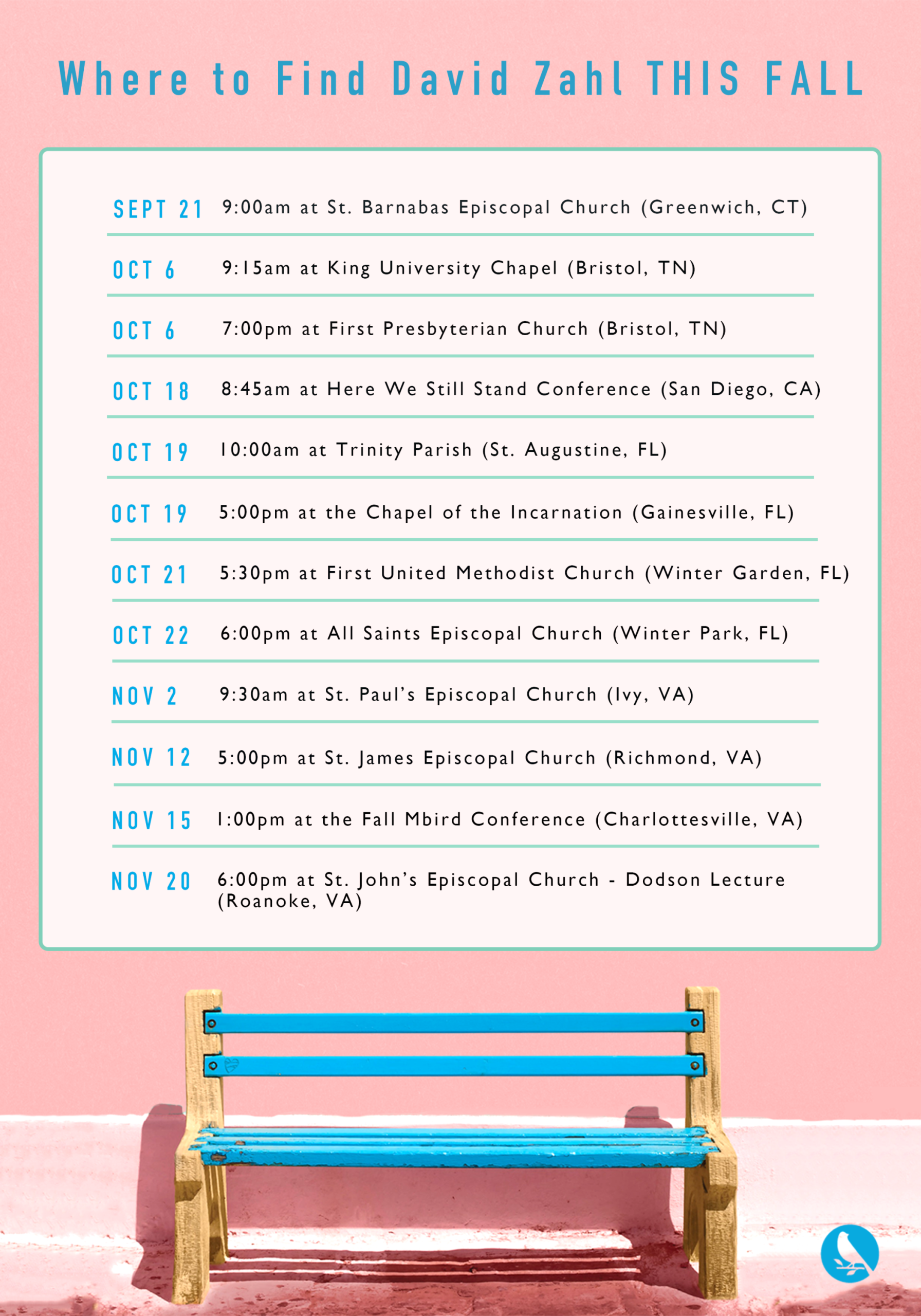
- Finally, don’t call it a book tour but if you’re looking for me between now and December:







Junk Drawer Jesus was a “find”. Fully grace laced. I loved it. Only problem was that I kept getting my tongue tied saying the title.