




A Shy Soul
For the last eighteen months, I’ve been in a spiritual formation program. A prerequisite to becoming certified as a Spiritual Director, I thought I didn’t really need it when I enrolled. I wanted to skip over all that formation stuff and get right to helping people. But to think that I didn’t need it — a (re)formation of my beloved self in a Trinitarian God — was just one of the fig leaves I had used to cover up my true self.
When I walked through those doors eighteen months ago, into a room full of 33 people that I didn’t know — 33 people I’d be spending a year and a half with — the air was tender but nervous. We all enrolled for different reasons. Some of us pastors and clergy, some of us leaders of non-profits, and some of us just wanting something more. Our teachers had kind and patient eyes, sober with the seriousness of the journey they would be leading us on. We were all out in the “hallway,” as C. S. Lewis puts it in his introduction to his book, Mere Christianity. This is a blessed and sacred hallway where all that really matters is Father, Son, and Holy Spirit and their begetting love for us. We flew in with the wind of the Spirit and out of our ecumenical rooms. Out in the hallway, all that merely mattered was suddenly visible, almost blinding. How could we listen to our lives if we’ve been stuck in a room that has become an echo chamber? The blizzard of the world swirls around in our churches because it swirls around in us. Systems of consumerism and capitalism, grasping and controlling, freeze and deaden us. Shame hides in our corners because we’ve shut and locked the doors behind us, trembling in fear. Anxiety so deep we don’t even know where to start. For those of us who’ve lived in and served the Church for a long time, Christ’s body can start to feel heavy. To come out into the hallway is a gift. As Lewis wrote in the introduction to Mere Christianity:
“Mere Christianity” is like a hall out of which doors open into several rooms. If I can bring anyone into that hall I shall have done what I attempted. But it is in the rooms, not in the hall, that there are fires and chairs and meals. The hall is a place to wait in, a place from which to try the various doors, not a place to live in … It is true that some people may find they have to wait in the hall for a considerable time, while others feel certain almost at once which door they must knock at. I do not know why there is this difference, but I am sure God keeps no one waiting unless He sees that it is good for him to wait. When you do get into your room you will find that the long wait has done you some kind of good which you would not have had otherwise. But you must regard it as waiting, not as camping. You must keep on praying for light: and, of course, even in the hall, you must begin trying to obey the rules which are common to the whole house.
And above all you must be asking which door is the true one; not which pleases you best by its paint and paneling. In plain language, the question should never be, “Do I like that kind of service?” but, “Are these doctrines true: Is holiness here? Does my conscience move me towards this? Is my reluctance to knock at this door due to my pride, or my mere taste, or my
personal dislike of this particular door-keeper?”When you have reached your own room, be kind to those who have chosen different doors and to those who are still in the hall. If they are wrong they need your prayers all the more; and if they are your enemies, then you are under orders to pray for them. That is one of the rules common to the whole house.
They handed us all a piece of paper with at least two hundred emotions listed. “What does your soul feel like this afternoon?” they asked. No one had ever asked me that before. I’d grown up with the language of the heart and mind, but never the soul.
When it came my turn to share, I landed on the emotion of shy. “Shy,” I said slowly. “Yes, it feels shy.”
In his book, A Hidden Wholeness: The Journey Toward an Undivided Life, Parker Palmer talks of souls as something more than mere substance. The soul, he contends, is
like a wild animal — tough, resilient, savvy, self-sufficient and yet exceedingly shy. If we want to see a wild animal, the last thing we should do is to go crashing through the woods, shouting for the creature to come out. But if we are willing to walk quietly into the woods and sit silently for an hour or two at the base of a tree, the creature we are waiting for may well emerge, and out of the corner of an eye we will catch a glimpse of the precious wildness we seek.
In that spiritual formation cohort, there was no crashing through the woods happening. There was no demands for answers, explanations, or defenses. There was no shouting to show your face and prove yourself.
There was breath and space — space cleared by our teachers’ hands. They were tender and scraped up, but steady. They knew, as Leonard Cohen did too, “The blizzard of the world has crossed the threshold, and it’s overturned the order of the soul.” They knew our souls were heavy and quite beat up, and some of us were tired and wanted to sit in the quiet woods at the base of an old steady tree.
Don’t You Care?
That’s what I did for about the first six months. I sat next to that tree. I let myself sink into feelings of anxiety and fear, and I felt them slip away in the relational presence of Christ’s body. My soul sunk into a slow, patient, and attentive work of God. With precision and care, he assessed and sutured my wounds. I let myself be seen in his presence. No fig leaves.
This is the hidden work that the Holy Spirit is always ready and willing to do. I am often caught off guard by my own brashness and hurry, my own short-sightedness. The truth is, I have a tendency to run around on the fringes of God, casting stones all the while demanding God turn those same stones into bread to feed me. I read of and digest the incredible pain and violence going on in the world, and I am angry. I share quotes and pictures on my Instagram stories for just a chance to get one tiny sliver of my outrage out. Suddenly my everyday, pretty comfortable life, feels trivial. I want to get up from the base of that old steady tree and stomp and shout, “Where are you, God? Don’t you care? Why are you hiding?”
I picture Michelangelo’s Pieta as I sit in silent prayer. I have no words for the heaviness of the world. I have no words for the heaviness of his body, the Church. All I see is Mary, holding Christ’s heavy and dead body in the streets of Gaza, Rafah, Israel, Papua New Guinea, Venezuela … the list goes on.

Michelangelo’s Pieta. The Grotto, Portland OR.
It usually takes an act of grace to bring me back to myself and the present. A breakdown, my child screaming for my attention, a headache, tears. I find there is a re-ordering happening within my soul. God is there, leaning on the other side of that old steady tree. He is waiting for me to come out from hiding. I had run to the edges of the forest looking for Him. It turns out, He is very alive, waiting for me where I was all along. At this time, He was asking me to stay here with Him awhile.
But God, what about them? Those dying, being burned and stomped on by the heel of vengeance and power? I want to tell him how he should love us by being outraged and grievous over horrendous things.
But I cannot do the work of helping, of peacemaking and justice, until I can sit in silence and know my belovedness in God — not just my brokenness. To be able to be still and know will take a very long time. But thankfully, as Kate Bowler says, God is not great at math. He is not efficient, even though most of the time that’s all I want from him. Do your work, God. If you could cut out steps two through nine, and skip right to ten, that would be great. But in the meantime, I’ve become Peter and cut off the soldier’s ear while Jesus is telling me to put away my sword while healing the soldier’s ear.
Jesus is so personal and attentive that it’s almost maddening. He could be in a swarm of chaos and respond with “Who touched me?” to the slightest hand reached out in faith. If all Jesus desires is to love us so personally, never looking away in our shame and guilt, then couldn’t his Spirit reach to the depths of the dead (surely the arm of the Lord is not too short to save, nor His ear too dull to hear) and the heights unreachable with a touch so swift, so sudden, that all we could do is whirl around and gasp — Who touched me?
Separation Anxiety
There is one thing I did not expect to feel during these past eighteen months — an awakened grief. God is not all candy and rainbows. We might know this in theory, and sometimes our message carries undertones of this. While we do find meaning (and some purpose, and barely any reasons) to walk with Jesus in this life, it seems the older I get and the longer I walk with him, there is a weighty expansiveness unfolding. I start to see places of wounding that I never noticed before. I start to notice places within my own soul that have become a wasteland. There is also some grief over not knowing how to share about all of this with dear friends who truly want to know me. There is a new sort of loneliness, and I wonder if I just need to get used to it. Maybe I need to get used to my fear of exposure and standing out. There is a certain kind of loneliness that comes with that. I find comfort in what Edwin Friedman writes in his book, A Failure of Nerve: Leadership in the Age of the Quick Fix:
One of the major limitations of imagination’s fruits is the fear of standing out. It is more than the fear of criticism. It is anxiety at being alone, of being in a position where one can rely little on others, a position that puts one’s resources to the test, a position where one will have to take total responsibility for one’s own response. Leaders must not only not be afraid of that position; they must come to love it.
There is a both/and happening here. In one sense, God has grown deeper roots within me while sitting with him in prayer and journeyed alongside my cohort. There is a deeper sense of calling and identity, along with a newfound vulnerability and exposure. I’m starting to understand the sobriety I saw in my teachers’ eyes at the beginning of the program. Tender leaders wondering, Will they run when they start to feel the heaviness of Christ’s body? Will they cover themselves under the shadow of the cross? Will they still have the audacity to not only believe but live as if Jesus really did come back from the dead? That death is not the end of any of our stories?
Could I have the courage to still carry Christ’s heavy body when it feels dead? I was struck by what I read recently from author and teacher A.J. Swaboda on his Low-Level Theologian Substack. Titled The Body of Christ is Heavy, I felt in my own body an affirmation. How true this is. The immense amount of pain we carry by participating in and serving the church. Our bodies are heaviest when they are dead. Swaboda writes of his own experience:
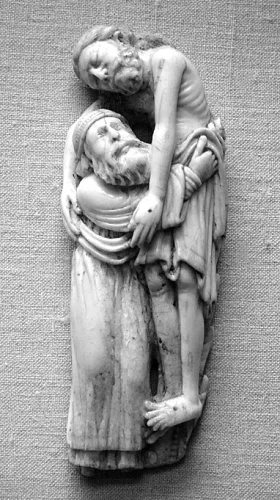
When my father-in-law passed away, I was presented with the unenviable task of gently placing his worn body in a body bag. It took nearly thirty minutes to move him a few feet. Anyone who has ever carried a human body knows it to be something they’d never want to do again. Bodies are heavy. And the experience of carrying them is not quickly forgotten.
Do you remember how Joseph of Arimathea asked Pilate if he could be the one to take down Jesus’ body off the cross? I wonder if he had help. Or if it was just him who took out those nails and draped Christ’s heavy body over his own. I imagine the death of so many dreams and ambitions within Joseph as he carried Christ’s corpse. Was this all worth it? Or was it all just a waste?
Should I have known better?
Swaboda continues:
Joseph had no clue when he woke up that Friday that part of his journey of following Christ would entail carrying his heavy body. The body of Christ — it is a heavy body. From time to time, though, we have to carry it. We do it for a particular reason. We do it because we are a people who believe in the resurrection; who hold firmly to the fact that the body in our arms that feels so dead will not be dead forever. We carry that heavy body of Christ because we dare to believe that Friday isn’t the end of any story.
While loss makes itself known as I help carry this body, it is still worthy of being carried. Because within this body is the substance of the Godhead for whom we were redeemed.
I am grateful for the ones who stay. Who show me how to care and how to pray. Who sit at the base of a tree with me for eighteen months. I’m grateful for the ones who pull out the tubes and wake me up, who aren’t afraid of my anger because they know that can move me. I’m grateful for the ones who sit with us in our wastelands and water it anyway.
Christ’s body is still worth carrying. You are still worth carrying, and so am I.








Janell, this was incredible. Thank you for sharing your gift and for persevering with this heavy body.
Thank you Ian
Wow – so many incredible lines here. Thank you for your vulnerability and voicing so many things that helped me articulate things I was feeling but didn’t know.
Thank you for sharing your soul so vulnerably with us here. This is beautiful.