




The guitarist stepped up to the front of the stage and his Gibson Flying V shimmered in the spotlight. With a greying beard and unusually long hair that concealed his receding hairline, he began shredding a solo with all the glory of Slash or Eddie Van Halen. The fog machine turned off, and soon a band appeared alongside him with drums, piano, bass, and cello. A hidden fan began to blow, and the guitarist’s hair now whipped behind him as the music crescendoed to a blare. The spotlight. The fog. The guitar. The hair. The song was “Carol of the Bells” by Trans-Siberian Orchestra. This wasn’t a concert. It was church on Christmas Eve, and more than a few people thought this was the best way to begin a celebration of the Incarnation. I wish I had taken a picture.
Bad ideas, inadvertent cringe, and foolishness passed off as wisdom. Church can be a strange place sometimes.
Music is always an easy target, usually composed of volunteers or part-time staff. The organist who plays “A Mighty Fortress Is Our God” painfully too slow probably didn’t have the time to rehearse it in between the piano lessons she teaches. That fresh-faced contemporary music leader definitely doesn’t know what he’s doing, but working with the youth group three-quarter time doesn’t help the cause. The choruses are repeated for a fourth time because that’s when he figured out how to play the song. Choir directors choose the most obscure hymns because they don’t know any better, because their boss doesn’t know any better, or because they’re bored with their job. Either way, they’re unsingable to anyone without a professional degree.
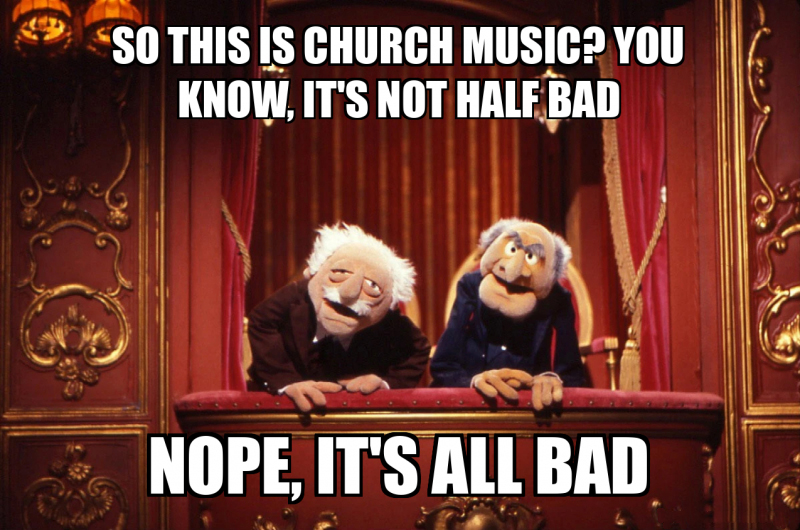
Sometimes the weirdness is intentional, of course. I once attended a Pentecost service where the processional featured polyester birds on twenty-foot poles flailing about above the heads of worshipers like background stage dressing on a Broadway play. It was dramatic but not the kind intended. The birds came within inches of hitting the chandeliers hanging from the ceiling. I went to a confirmation where the chrism oil was laced with glitter and perfume. Judging by the glee with which he smeared excessive lubricant on the heads of youth and adults, it seemed to be the bishop’s idea. The kneeling confirmands fought back tears — not of joy, but wincing pain as the oil dripped into their eyes. The bishop failed to notice his path of destruction. I knew a retired American priest who spoke with a distinct British accent when he said the liturgy. His R’s disappeared, his A’s softened, and his consonants sharpened. I always wondered if he believed that God was an English gentleman.
No pastor can regularly preach their best sermon every week, but I’d settle for average. Trying to sound profound isn’t the same as actually being profound. To take a not-so-hypothetical example, it doesn’t count as a sermon if you read The Runaway Bunny in its entirety and add an “Amen” at the end. It was over before I noticed it had begun. Nor does it count as a sermon when you repeat near verbatim the funeral homily you heard the day before. I can tell when a six-year-old sermon has been repurposed, when the preacher had 30 minutes to prepare that morning, and the precise moment when a pastor veers into their usual hobby-horse diatribes.
I am, to put it mildly, what my neighbors call a professional Christian. With three academic degrees in theology and a couple decades of different ministry experience, I am an unusual churchgoer by any measure. Acolyte, preacher, youth minister, music leader, sound engineer, officiant … the only thing I haven’t yet done is count the money. It is difficult to not notice when something is amiss on a Sunday morning. It is difficult to not become a religious Statler and Waldorf, sitting in my elevated pew of judgment.
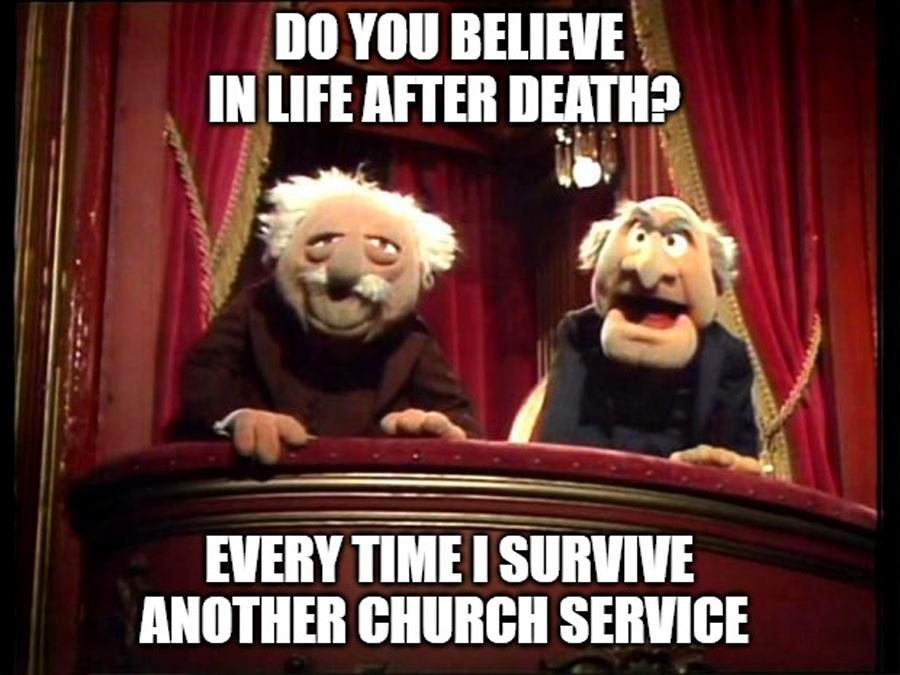
But the Muppets analogy also only goes so far. Because I’ve also deserved plenty of negative reviews from the peanut gallery. I’ve been that unprepared, part-time worship leader. I’ve been that preacher hastily scribbling sermon notes on the half hour drive to the church. Though I’ve never spoken with a fake British accent, I have tripped over my words, made bulletins with multiple typos, left microphones on mute, spilled eucharistic wine, and announced the wrong hymn number.
You might say that everyone makes mistakes, that even pastors deserve grace. To an extent that’s true. In a world where everyone gets star ratings, those charged with shepherding the eternal fate of our souls should be given more grace than an Instacart shopper who grabs green bananas. But making grace a backstop for failure still upholds perfection as the impossible expectation. You can’t simultaneously believe in grace while demanding the excellency of corporate worship. Grace doesn’t “fix” our mistakes, like a release valve that expels impurities. Grace instead turns the ideas of perfection and excellence on their heads. It does not make allowances for inefficiencies but nullifies the economy of efficiency altogether.
From its very beginnings, Christianity has been a religion of cringe. The New Testament has a great deal to say about evil in the church, but when it comes to the qualifications and performance of its first leaders, their resumes are terribly thin. This is a beautiful feature of early Christianity rather than a sign of its immaturity.
The most accomplished apostle, Paul, brilliantly wielded his pen in letters across the Mediterranean. That much has to be said. His preaching, however, left much to be desired (and that’s probably an understatement). The Corinthian church complained, “His letters are mighty and powerful, but he himself is weak and his preaching is of no account” (2 Cor. 10:10). And by his own admission, Paul did not preach with “lofty words or wisdom” (1 Cor. 2:1). Acts of the Apostles records that a man named Eutychus fell asleep while Paul was preaching, plummeting out of the window to his death. Paul’s mastery over the written word did not extend to the spoken word. By the standards of his day, he was unremarkable, if not boring.
The other apostles weren’t any better. Matthew may have been a scribe, but the rest were uneducated fisherman or common laborers. For their new jobs as apostles of Jesus, they possessed no transferrable skills. They were not gifted orators or trained in rhetoric; they had no experience balancing a budget or in community development. In the years spent learning from Jesus they were most known for their dumb questions. They certainly weren’t promising students who would go on to great things.
Did this motley crew of disciples grow into their new roles as ambassadors for Jesus? Maybe, but probably not. The rise of the early church was always attributed to the work of the Spirit — and never once to the apostles’ skillsets. Their ineptitude was the prerequisite for the power of God to be revealed. Somehow these unsophisticated, uneducated, bumbling band of fools changed the world.
Is it too much to ask for the bulletin to not have errors? For musicians to not play bad notes? Is it too much to ask the pastor to prepare a sermon that doesn’t make you reach for your phone? Why yes, it is indeed too much to ask. When Sunday morning feels like a well-performed show, it says that imperfect sinners need not apply. The more dignified the worship, the less approachable God becomes to those who feel they have no dignity.
God chooses fools to shame the wise. He chooses the lowly and despised to overturn the haughty and powerful. He did not enter into Rome in triumph but stumbled up a hill to Golgotha to save the world. Those who gather in praise of this crucified carpenter cannot do so in the name of excellence, sophistication, or even beauty. God does not need our perfection. In fact, he far prefers the humble offering of our cringe. The only reverence he desires is contrite hearts that cling to his grace and nothing else.
When I next visited the church with the long-haired, flying V wielding guitarist, I barely recognized him. He still noodled away at solos as he had before. But he had shaved his head, beard and all. He did so to support a youth group fundraiser for a mission trip. A cringe idea, perhaps, but an invaluable gift nonetheless.








“When Sunday morning feels like a well-performed show, it says that imperfect sinners need not apply.”
Love this! Thanks, Todd!
This insight is extremely important when change is inevitable, existential and aesthetic…I think that our God created humanity is often forgotten in our desperate desire to go beyond it. THANKYOU
Todd, you forgot to mention getting the names of the bride and groom wrong because you xeroxed your wedding sermon from your previous wedding. Just sayin’…
Ooof! Or stumbling over the bride’s name while preaching at your friend’s wedding because your brain keeps wanting to say the name of the previous girlfriend…
I laughed, I cried, I cringed, I felt convicted and then comforted. This is an almost invalidatingly good piece, Todd.
Loved this – I was one of the pastors of at a prominent church in NYC and the word “excellence” (only as it pertained to musical, artistic, educational, and theological things) was a regular mantra. I hated the word, not only bc it was never applied to broader areas (fashion sense, fitness level, humor, etc) but bc I was the guy who once sweat into the communion cup at a wedding (they still drank it) and the guy who made a joke to comfort the bride and groom at the lighting of the unity candle but ended up blowing it out in my delivery (they are still married) – in sum, I’m thankful God uses despite us ! Thx again for this refreshing take !
Thank you for this! Can I humbly offer a continuation of your thoughts and potentially another way of considering this? The critique of “cringe” in the church names something real. When churches confuse sincerity with depth, or attempt to manufacture emotion through borrowed language, forced relevance, or sentimental aesthetics, people feel the dissonance immediately. Cringe emerges when emotion is engineered rather than evoked, when polish replaces coherence, and when aesthetics are used to produce meaning rather than serve it. In that sense, the rejection or “BS radar” many feel (myself included) is not toward emotion or beauty themselves, but toward inauthenticity and manipulation.
Yet the implied alternative often goes unexamined. Minimalism, emotional restraint, and stripped spaces are not neutral postures. They are aesthetic choices that communicate their own theology, often one shaped by suspicion of the body, desire, and excess. We are aesthetic creatures because we are incarnational beings. God does not reveal himself as an idea but through bodies, stories, bread and wine, water and oil, sound and silence. Scripture, creation, and the long tradition of Christian worship assume that beauty, craftsmanship, and sensory richness are not distractions from truth but among its primary languages. The problem is not excellence or aesthetics in the church, but disintegrated excellence. When beauty is severed from truth, goodness, and humility it becomes manipulative. When it is integrated, it creates space rather than pressure, inviting attention rather than demanding belief. The question, then, is not whether the church will shape people through aesthetics, but whether it will do so honestly, coherently, and in a way that forms desire toward the life of God rather than away from it.
“When Sunday morning feels like a well-performed show, it says that imperfect sinners need not apply. The more dignified the worship, the less approachable God becomes to those who feel they have no dignity.”
I’ve never come away from a worship service that went smoothly thinking that God was less approachable, and I’m not particularly dignified; as a leader I’ve made more mistakes than most! But I think we tend to hold ourselves to a lower standard than we should. Mistakes and imperfections draw attention away from God, which does not serve the congregation.
This is so good, Todd. Thank you.
Thank you for making me laugh out loud, and for reminding me that my criticism of unsingable hymns, and everything else I judge, can be left at the door.
Todd’s argument and Ryan’s both have merit, in my opinion. I find dull much of the modern worship music I’ve heard, as well as much of the CCM when I was young, but even if I was convinced that the music was truly lacking and not that my taste is too limited, there remains the fact that it does move many others. It functions, in other words, for those who enjoy it, as it was designed to function, as a conduit for God’s love, and for praise and thanksgiving in return. So who am I to criticize what the Holy Spirit uses? And yet excellence glorifies God all by itself — it’s an added good — and should be held up as an example and striven for. So the act of criticism (whether right or wrong), to the extent that it’s well-intended and not snobbish, glorifies God as well.