




With all its barren landscapes and enforced solitude, January feels like a good month for poetry. But then again, what month isn’t good for poetry? Below are just a few of our favorite devotional poems (loosely interpreted), ones we hope you’ll carry with you through the rest of the year.
“A Call“ by Seamus Heaney: This poem about a call home to the parents of the late great Irish poet Seamus Heaney is ostensibly about missed opportunities, unexpressed love, and mortality. Yet, I’ve always read it as a poem about prayer, about God’s love and care for us; about the time between our prayers, “Where the phone lay unattended in a calm.” The ticking clock in the hall, never morbid, but a certain waiting, until we are face to face. “Next thing he spoke and I nearly said I loved him.” We are ever in God’s thoughts, our Savior’s love is always, unlike the poet’s, expressed, unalloyed, and without hesitation or regret. – Joshua Retterer
“An Alcoholic Enters the Gates of Heaven“ by Czeslaw Milosz: It took me a while to get used to the idea of being angry at God, but boy, when I did I realized I had a lot of venting to do. If you’ve ever read The Big Book of AA – the closest thing to the 20th century’s contribution to the biblical canon – you know there’s always hope for alcoholics (and every other sort of sinner), but for those who never get sober, I can imagine it feels like a hell of a curse, as if God had chosen you to suffer “like a caterpillar impaled on the spike of a blackthorn.” Even so, Milosz (the alcoholic) writes, “I pray to you … / Because my heart desires you … / And so it must be, that those who suffer will continue to suffer, / praising your name.” – Ben Self
“As Kingfishers Catch Fire“ by Gerard Manley Hopkins: Brad Leithauser writes: “It might be said that [Hopkins is] difficult only if you try to understand him.” Yes. I imagine a glassy ice surface covering this poem; underneath, I imagine sparks and flashes of creation – in the kingfishers catching fire and the dragonflies drawing flame. Each mortal thing fiercely individuates (“Crying Whát I dó is me: for that I came”). But Hopkins has more to say, and this is where the gospel and a new kind of creation meets us: “The just man … Acts in God’s eye what in God’s eye he is,” reflecting the thousandfold pieces of Christ. We are this beautiful to God: sparks and flashes and force, as well as justice, grace, and loveliness of limb: in other words, as beautiful as Christ. – Sarah Gates
“Ash Wednesday“ by T. S. Eliot: This poem continues to teach me. In its famous last lines (that harken back to the early days of Mockingbird) – “Teach us to care and not to care / Teach us to sit still / Even among these rocks / Our peace in His will / Even among these rocks” – I am situated again between the now and not yet. It teaches me how to see and listen. To look for the things and people Jesus cares about. Which is to say, teach me how to pray. Where is His peace among the rocks? This world isn’t entirely a wasteland. I’m constantly trying to find peace in the in-between. Between the urgent, do something now! voice, and Julian of Norwich’s “all shall be well.” Between the I and the AM is a breath, where the Spirit teaches me how to care, here and now, holding all things together. – Janell Downing

“Ask Me“ by William Stafford: A few years ago, I was at a church near my house (a church I only darken the door of out of convenience on rare occasions, as it is very hit-or-miss in the sermon department, and the congregation isn’t especially friendly), not expecting much. When one of the pastors used this poem in his sermon, the opening lines, “Some time when the river is ice ask me / mistakes I have made. Ask me whether / what I have done is my life,” cut me to the core. How often do we define ourselves by the mistakes we’ve made? How frequently do we look upon our works and situations as evidence of the kind of person we are, and how often does that paralyze us, freeze us? This was winter in Minnesota, and a time in my life when I felt professionally stuck, so the imagery of the hidden current under the seemingly static surface of the river – “We know / the current is there, hidden; and there / are comings and goings from miles away/that hold the stillness exactly before us” – helped remind me that even in times of supposed stagnation, God is still at work in ways we are not privy to, but which are efficacious nonetheless. – Joey Goodall
“The Awakening (after Milosz)“ by Mary Karr: Karr’s riff on this Czeslaw Milosz poem recounts one of those rare interludes of preternatural peace that descend upon us unexpected and then leave us off where they found us, back in the swim of everyday life with its sorrows, muddles, and aggravations, but deepened, feeling we’ve been intimately addressed, knowing we’ve been loved. Karr experiences a “baffling stillness” that envelopes her “once-orphaned flesh” in “The belly of a plane nosing west,” and leaves her “wanting nothing,” eyes and mind for once content to rest on “the actual surface of things,” free of self-referential judgement. Most moving is the manner in which she’s called back to quotidian reality with its “familiar agony” and desire: by the sight of a drooling baby’s face — by the pity it evokes. – Ken Wilson
“The Bat“ by Jane Kenyon: I like to picture Jane Kenyon at the New Hampshire farm she shared with husband and fellow poet Donald Hall. I can see her reading (one cold winter’s late afternoon) a book about “rationalism.” I like to imagine her rational bubble shattered by the sudden sound of “wings overhead.” I like recreating the slapstick scene with Jane and her cats (!) trying to chase the bat out of the house! Jane does not trouble us to deduce the meaning of her metaphor. The bat who “evades” her, she tells us, is “like the identity of the third person of the Trinity … the one who astounded Mary by suddenly coming near.” Come Holy Spirit – startle us (and our cats)! – Larry Parsley
“Because We Hunkered Down“ by Malcolm Guite: I had the privilege of hearing Guite read his poetry in 2015 and again in 2023. Both times, I was reminded that poetry is meant to be heard aloud, punctuated by meaningful pauses, and energized by the author’s accent, personality, and presentation. A few years ago, a friend shared this poem with me as I was experiencing a very challenging few months of seasonal depression, punctuated by a challenging period in my faith, a transition in my career, the failure of a relationship, and the beginning of the pandemic. Sometimes, healing comes in the form of medicine and sometimes, it comes with words that serve as a balm to a brain that can be both too loud and too quiet. “Slowly, slowly, turning a cold key, Spring will unlock our hearts and set us free,” says Guite. Those words felt like the Holy Spirit breathing on my heart, thawing me out with the warmth of grace. – Grace Leuenberger
“Briefly It Enters, and Briefly Speaks“ by Jane Kenyon: The child of a Methodist preacher, Kenyon rediscovered Christianity in her adult life, and many of her poems reflect her theological imagination, once saying, “My spiritual life is so much a part of my intellectual life and my feeling life that it’s really become impossible for me to keep it out of my work.” I love this poem so much because of the myriad ways it hints at the presence of the divine. The speaker assumes various roles, embodying both the creator and the created, the giver and the receiver. “I am the musk rose opening / unattended, the fern on the boggy summit. … / I am the one whose love / overcomes you, already with you / when you think to call my name. …” – Meaghan Mitts

“Church Going“ by Philip Larkin: Wendell Berry’s Jayber Crow brought me back to church, but Larkin helped me grieve. I grew up attending a church for about eighteen years. The church was also a school, and I spent eighteen years there, too. After it had breathed its last breath, somebody new and fresh with suits for Jesus thought how ugly everything was and wanted things like purple pews and a giant Bible verse plastered on the wall above the baptismal font. By this time, I had moved on. But one day I was driving by and felt myself turning into that parking lot I knew so well. The doors were open. I remember standing in that dark sanctuary, with so much orange light streaming through the broken stained-glass windows. Oak and walnut being replaced for lighter wood. New and updated windows void of color were about to be installed. There I stood, in a hall of shrapnel. My childhood faith was wrapped up in that place. I am still wrapped up in that place and those people, and I am fractured in the same way the oak splintered with the swings of the sledgehammer. Friends said you can have your Jesus in the wreckage. Time and prayer eventually told me plaster and purple pews never fix anything. So all that is left is a “serious house on a serious earth” that meant so much and nothing at all. – Janell Downing
“Comfort“ by Robert Service: I stumbled across this poem in college a decade ago, and to this day it’s the only poem I’ve committed to memory. Its imagery is so tangible that whenever I see a “sky so blue” or catch some “dancing shadows” or sniff the “flowers-flinging all their fragrance on the breeze,” I’m caught up in reciting the poem to myself, and reminded again of the delightful gifts of common grace that surround me. This poem is both playful and childlike while also profound and sober, ultimately landing us right in the middle of God’s love — the greatest comfort we could find in life’s trials. – Kate Wartak
“Contraband“ by Denise Levertov: On the toxicity of an overdose of reason. – Tony Robinson
Dancing in the Dragon’s Jaws by Bruce Cockburn: Yes, I know it’s a whole two sides of music on vinyl, but Cockburn’s 1979 album is a unified piece of Christian poetry sans piety — church stuff without being churchy. At eighteen I found in it a language higher and greater than Bible camp rah-rah-ing for Jesus. Witness these lines from “Northern Lights”: “I’ve been cut by the beauty of jagged mountains / And cut by the love that flows like a fountain from God. / So I carry these scars precious and rare / and tonight I feel like I’m made of air.” Theology of the cross before I knew such a thing existed. – Ken Jones
“East Coker“ by T.S. Eliot: Reading Eliot’s Four Quartets for the first time, I felt lost, frustrated that I couldn’t crack the code of this modern poetry collection that everyone who’s anyone admired. The lightbulb turned on for me in the second quartet, “East Coker,” in one of the only sections of his poem that is rhymed and metered. Here, the master poet described the Christian life of death and resurrection in all its beautiful, counterintuitive, upside-down glory. It has remained dear to me for nearly fifteen years, a staple of my Holy Week reflection: “The dripping blood our only drink, / The bloody flesh our only food: / In spite of which we like to think / That we are sound, substantial flesh and blood – / Again, in spite of that, we call this Friday good.” – Bryan Jarrell
“Eleven Addresses to the Lord” (Address #1) by John Berryman: Each of Berryman’s Eleven Addresses to the Lord is a burst of genius, but the only one I can recite from heart is the First Address. While all of his refrains issue from the depths of middle age, I fell for them a few decades prior, probably out of some misplaced romantic notions about his self-destruction (and a love of The Hold Steady). Yet as I sort through the thicket of midlife myself — what he refers to as “impassable, sometimes despairing years” — his semi-crazed devotions seem less crazed than ever, and his alcoholism more tragic. “Unknowable, as I am unknown to my guinea pigs” is just one of ten phrases that sticks in the head. The boring moon, too! Sublime and true and unbearably hilarious, Berryman’s verses increase my own praise. – David Zahl
“Far Memory“ by Lucille Clifton: In this poem from her collection The Book of Light (1992), Clifton reflects on painful personal experiences in new ways by assuming the identity of a nun, and she does so deeply, with vivid acuity and empathy. “Come to wrestle with you again / passion, old disobedient friend / through the secular days and nights / of another life.” To me, this poem can be read as an oblique meditation on all kinds of memories. “We carry our baggage / in our cupped hands / when we burst through / the waters of our mother.” The final selection, “Gloria Mundi” reads to me like a page out of my own journal, and in that way it is a deep consolation — to find a poet who has wrestled with the same questions with which I wrestle. – Meaghan Mitts
“God’s Grandeur“ by Gerard Manley Hopkins: I know this poem is featured in a million anthologies and best-of lists, but it really is a perfect poem. In just a few memorable lines, Hopkins walks us through his awe at the astonishing bounty and beauty of the world we inhabit, his despair at how we have wrecked it, and his hope that all is not lost, for the simple reason that “the Holy Ghost over the bent / World broods with warm breast …” – Ben Self
“Good Bones“ by Maggie Smith: I recently heard a comedian say that all of the forty-year-olds play video games, and all of the teenagers are on anxiety medication. And I did not laugh. Raising children in an era that purports to be the worst is like telling a baby bird to swim. Maggie Smith manages to capture the despair of parenting at this moment and also the beautifully belligerent call to keep going. – Sarah Condon

“Letters from a Father“ by Mona Van Duyn: The next time you have a spare eight minutes, I recommend getting a friend to read you this poem. Lay back in a comfy chair, maybe stare up at the ceiling or out the window, and just relax (it’s not one of those poems that you need an MFA to understand). It’s a delightful look into how God can rescue a person from self-pity and loneliness and woo them back into loving the life that God has given them. And it will make you want to buy a bird feeder. – Sam Bush
“The Little Black Boy“ by William Blake: This poem encapsulates longing so well, in this case the longing for racial equality superimposed upon a longing for eternity, the only place where true reconciliation will ever fully occur. The reader feels the pain of the narrator juxtaposed with the recognition of God’s perfect love. My favorite part of it is the one Anne Lamott quotes in several of her books, though she changes the line from “bear the beams of love” to “endure the beams of love,” which illustrates, for me, a lot of what life is: learning to endure God’s mighty love, which may not always feel loving but very much always is. – Stephanie Phillips
“Love (III)“ by George Herbert captures a dynamic both near to my heart and, I believe, universal — the drama of Jesus’s pursuit of us even as our guilt and shame make us want to move away from him. The scene is an imagined conversation between an invited guest to a feast (take it eucharistically and/or eschatologically) who insists he’s not worthy and his persistent host, Jesus (personified as Love). The speaker keeps coming up with reasons he shouldn’t be there — or should be there as a servant (c. Luke 15:19), but Love, of course, has the last word. I can’t think of a higher-proof distillation of the gospel. – Will McDavid
“Making the House Ready for the Lord“ by Mary Oliver: Especially lovely for Advent. – Tony Robinson
“Manifesto: The Mad Farmer Liberation Front“ by Wendell Berry: I first heard this poem during my junior year of college, read by my favorite English professor and now friend, Collin. The poem begins in a startling way, describing a life that feels safely self-serving, distinctly American, and sadly familiar — even for Christians. In true Wendell Berry fashion, the reader is invited to consider a countercultural way of being that challenges us to “every day do something that won’t compute,” vibrantly illustrated with lines like “Ask the questions that have no answers,” “Invest in the millennium,” and my favorite, “Plant sequoias.” This poem has taken on a devotional quality to me because it reminds me that 1) a life of faith is animated by mystery, 2) God is patient in his work, and 3) the gospel is a beautiful invitation to a way of being that won’t always make sense but is always worth accepting. – Grace Leuenberger
“No, It’s Not“ by Anya Krugovoy Silver: This is an impossible poem to find, and I only heard about it on the Christian History Almanac podcast a few years ago. In it, Silver (who died of metastatic breast cancer in 2018 after fighting it for fourteen years) confronts her son’s skepticism with, first, frustration, followed by a recognition of a form of faith in him that she hadn’t expected, and she ends the whole thing with a prayer/benediction. When I face my own children’s doubts (and my own!), I think about this poem, and how God’s grace is so much bigger and more penetrating than I often give it credit for. He never gives up on us. – Stephanie Phillips
“Poor Richard’s Almanack, 1734” (excerpt from January) by Benjamin Franklin: Simple words about simple things, and yet there’s a comfort in pleading to the Lord who just might care about them. We talk plenty of God delivering us from Satan, sin, and death. But an aching head? A smoky chimney? This poem helps me remember God delivers us from the complex salvific matters and sometimes even the simple day-to-day life. – Blake Nail
“Postscript“ by Seamus Heaney: There are moments of overwhelming beauty that only poetry seems up to the task of description. Beauty is a real-world representation of extravagant grace, free for the taking. Seamus Heaney revels in both the beauty and the attending duty of the task of recording this extravagance. “By the earthed lightning of a flock of swans, / Their feathers roughed and ruffling, white on white,” this beauty, these expressions of grace can be condensed in fleeting moments, seen in our minds, and often remembered, repeated in their generous giving. Like the wind in County Clare, the beauty of grace comes “as big soft buffetings come at the car sideways, / And catch the heart off guard and blow it open.” And grace never fails in its task. – Joshua Retterer
“Quarantine“ by Luci Shaw: I could have picked any number of Shaw’s poems as devotions, but this one has continued to bear the weight of whatever my heart is burdened by. She starts by naming what is true for most of us, a sunrise after a long night that brings hope but does not solve all problems, names our longing for connection, and at the end gives words to my prayer that hope would spring up within us to spill out into the world. Jane Hirschfield writes that “hope is the hardest love we carry” and this poem by Shaw reminds me that even in the most mundane or horrible circumstances, we are never without hope. – Jane Grizzle
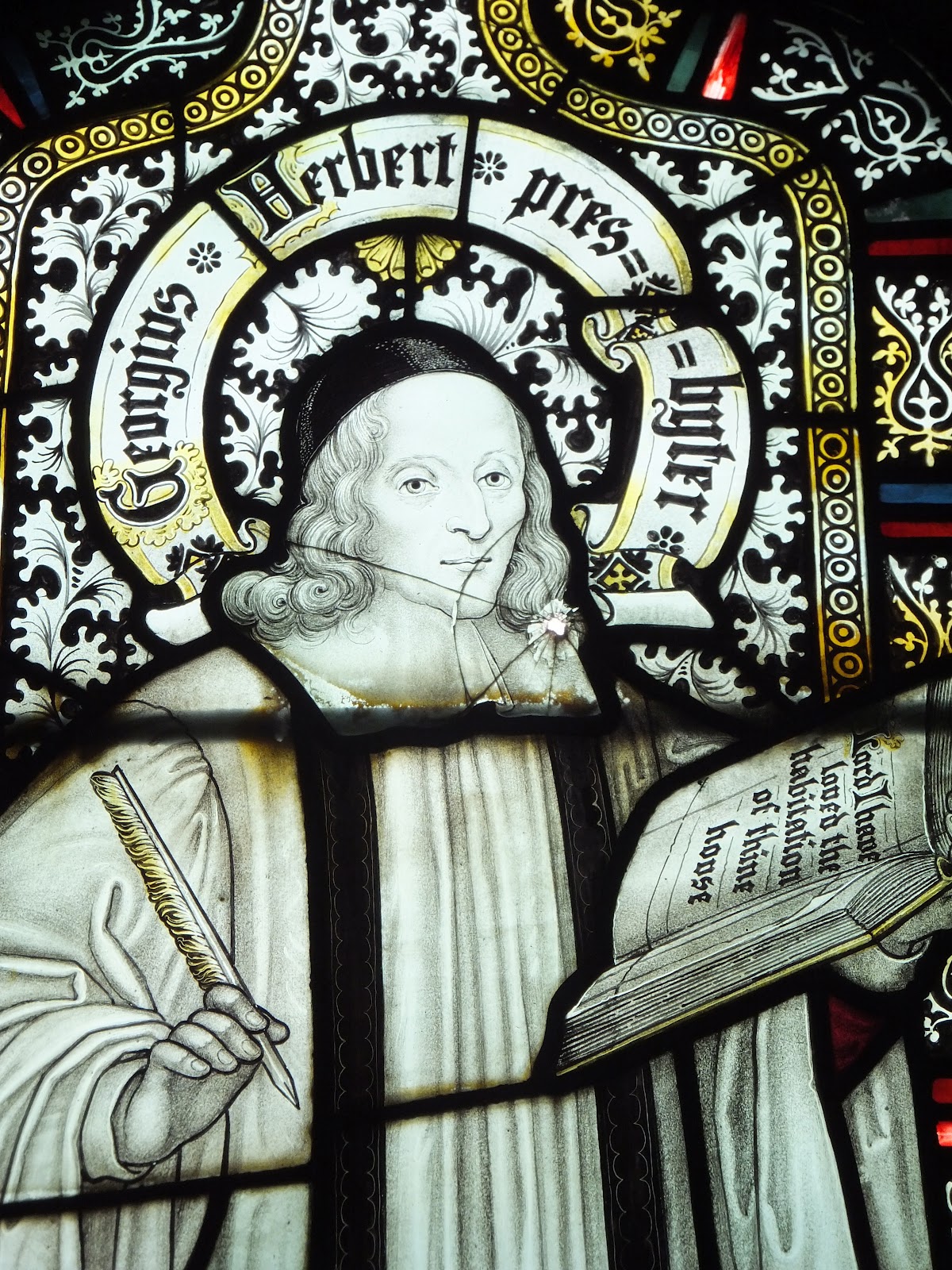 “The Sacrifice“ by George Herbert: Did you know that the clearest picture of Jesus in the Old Testament portrays him as a man of sorrows, acquainted with grief? This image feels strikingly at odds with the way we tend to caricature the man from Nazareth. How timely, then, is the gift of George Herbert’s poem “The Sacrifice” to help us grasp the profound depths of the inner life of God. Nearly every one of its 63 stanzas ends with the haunting question: “Was ever grief like mine?” The answer, found in the poem’s closing lines, clarifies how the uniquely Christian understanding of a God who doesn’t simply stand alongside us in sympathy — but has entered into our grief and made it His own: “Never was grief like mine.” – Davis Johnson
“There’s a Certain Slant of Light“ by Emily Dickinson: Using the imagery of “a certain Slant of light, Winter afternoons,” Dickinson captures how the knowledge of death casts a shadow over life. She draws a religious parallel between this slant and the oppressive “Heft Of Cathedral Tunes,” and refers directly to “Heavenly Hurt.” I read this to mean: There is an inevitable despair, felt in nature and in churches, brought on by the brokenness of life. One could end there, but this is not how I read Dickinson. Because she grapples with this despair, she can also grapple with mystery and joy (and this is why I love her). Even in this poem, this Slant of light is so eerie and profound that it causes Shadows to “hold their breath.” What could be more mysterious than that? – Sarah Gates
“The Voice of God“ by Mary Karr: A salient feature of Karr’s poetry is its hard-bitten humor, and this concise, wry beauty almost gives me an excuse to buy a good cigar. We all want to win the lottery of life, she says — we want the dramatic and permanent fix — but the voice of God giving counsel is closer to a monk’s tender acquiescent chant than an Old Testament prophet’s grand pronouncement. “Small and fond and local,” it suggests “the most obvious crap,” practical steps for fixing “ninety percent of what’s wrong with you” — not with a cigar, alas, but a hot bath or a simple sandwich. Thank you, Mary. Point taken. – Ken Wilson
“Von guten Mächten“ by Dietrich Bonhoeffer: I was introduced to this poem as a hymn sung at my Bavarian friends’ wedding — in itself a profound act of faith. Imprisoned for sedition by his Nazi captors, Bonhoeffer wrote “Von guten Mächten” (in English “By Gracious Powers So Wonderfully Sheltered”) while anticipating execution. He sent this poem to his fiancée, Maria, with Christmas greetings. He declares both his deep desire to be reunited with his beloved and an equally deep faith in God’s promises. Over and against the powers that seek to separate us from God’s love in Christ, it is perhaps the greater act of sedition. – Ken Jones
“Wake Now My Merry Lads! Wake and Hear Me Calling!“ by J.R.R. Tolkien: I could include almost any of Tom Bombadil’s (‘er Tolkien’s) songs in The Fellowship of the Ring, but this one – calling the Hobbits away from the Barrow-wights – is a favorite. It makes me think of Lazarus’ own awakening, and mine, and adds a little compassion to Jesus’ words, which is maybe seen more in his tears than the straightforward command for Lazarus to come out of the tomb. Still, a concise, death-effacing chant of grace is all that’s needed. No séance, no lengthy battle, no qualification, no hard work from me. Just a song of love, sung by the one who calls himself “The Gate” (Jn 10:9), and who invites the undeserving dead through it. – Chris Wachter
“Walking Prayer“ by Jeffrey Skinner: This is my current favorite poem, featured in the latest issue of The Mockingbird magazine. With each read something new jumps out to me. It also appears in Skinner’s newest book Sober Ghost, which I also highly recommend. – CJ Green
“Who Am I?“ by Dietrich Bonhoeffer: I’m running true to my predictable Lutheranism here. But this is a great poem from one of the greatest saints of the church — easy to admire in his humanity, yet this shows how wobbly his sense of self is. To all of us who are wobbly in selfhood at even the best of times (not, say, rotting in Tegel prison and likely to be executed horribly), it’s a comfort to be reminded that our “who” is invested in God’s knowledge of us, not in our own knowledge of self. – Sarah Hinlicky Wilson








Thank you all so much for this article. I read it because you mentioned Mary Oliver in the first description, and I read on because so many of you had such deep things to say about so many poems and poets you love. Now I will have to buy more slim volumes of poetry and not forget to read them!
[…] though we’ve already done some recent literature-themed lists (e.g., 21st-century novels and devotional poems), it was inevitable that we would get around to a list of our favorite works of theology. Sure, […]