




“Water, water, every where, nor any drop to drink.” I first learned these words some twenty years ago in high school English class. When I first heard them, I thought, That’s dumb. Why would you say it like that? I didn’t want to read “The Rime of the Ancient Mariner.” I didn’t think that old poetry had any relevance to my young life.
Little did I know that those words would lodge in my brain for two decades — whether I wanted them to or not. Even now I can’t forget them. There is something about the sound of those words and the balance of that line, the picture that it paints of a crew lost at sea, dying of thirst. Water, water, every where, but none that can help or keep someone alive.
Today, I believe that those words carry a new significance. They echo in my mind away from their original context. It’s not an ocean of water that surrounds us but words. Words encompass us like an ocean. We are not at a loss for words. There is no shortage of words.
At the seminary where I teach, students may feel as though they are drowning in words. The syllabi, the lectures, all the books with all their pages with all their words — why are there so many words? Words to read, to hear, to think about. Words, words, everywhere. And everybody has something to say. Everybody has an opinion. Turn on the TV. Open social media — content, news, ideas, opinions. Add to this that now we have AI. Enter a question, a request, and voilà: more words about anything than you would ever want to read.
Words are all around us. But I think the question is Can any of those words help us? Can they save us? Can they replenish our lives as human beings? Can they satisfy our hearts?
One of the questions humans have been asking themselves for millennia is Who are we? Stated differently: What does it mean to be human? I’d like to suggest one answer: We’re the creatures who are capable of poetry. “Of all the creatures both in sea and land,” George Herbert wrote, “Only to man thou hast made known thy ways, / And put the pen alone into his hand, / And made him secretary of thy praise.” Human beings are those creatures capable of art.
One hundred one years ago, G. K. Chesterton published his book The Everlasting Man. It’s a wonderful read. His opening chapter is called “The Man in the Cave.” It’s about “cave men” — perhaps the earliest moments of human history — but the title is also a play on Plato’s Allegory of the Cave. Chesterton complains that all the chatter in his day was about “the man in the cave,” stemming in part, no doubt, from Darwin’s Origin of the Species. All the attention was on “the man in the cave” and not what he was doing in there. Isn’t it interesting, Chesterton muses, what we see the cave man doing. He is not piling up the bones of his enemies or hoarding pirates’ treasure. He’s painting pictures, making art, re-presenting the natural world.
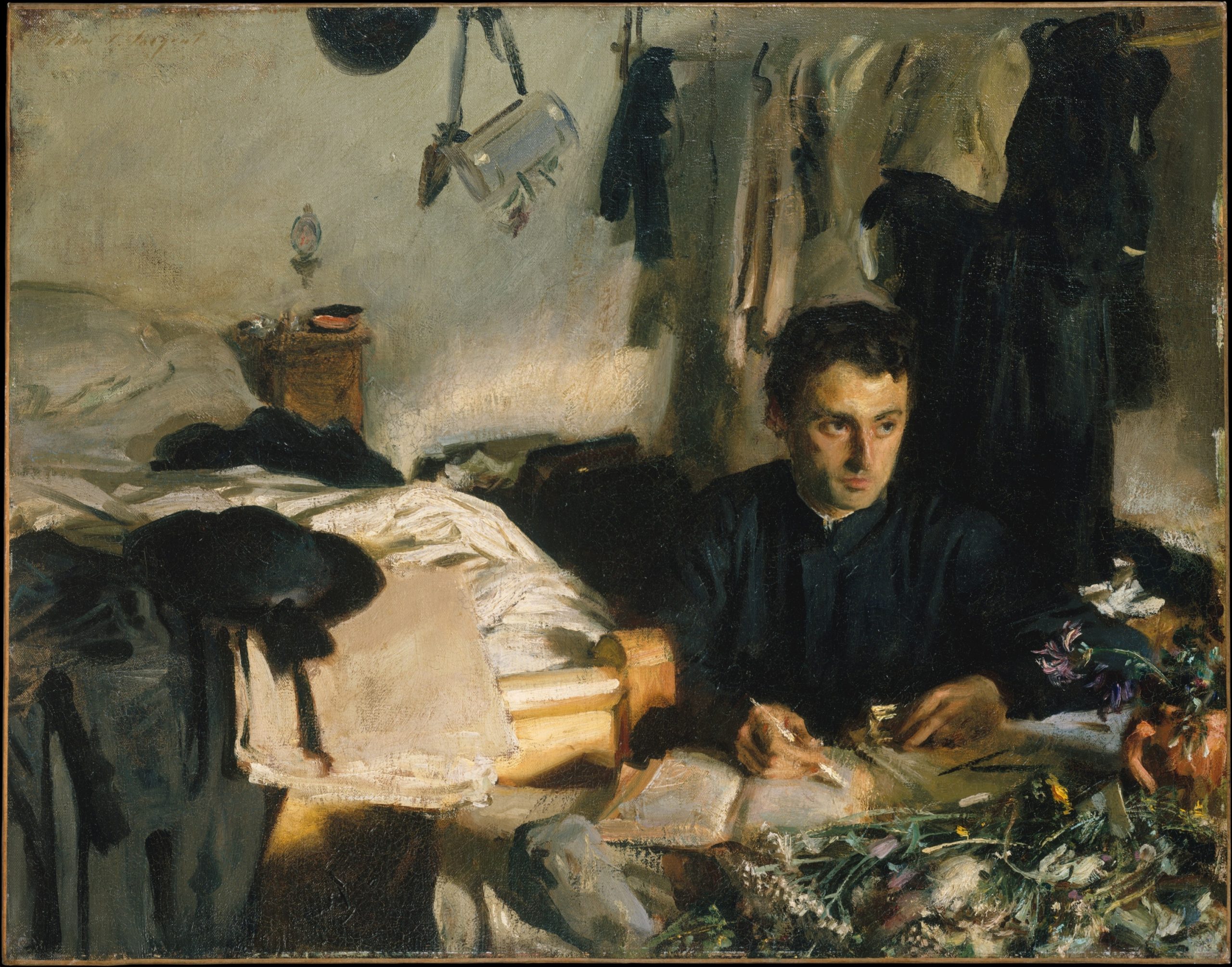
John Singer Sargent, Padre Sebastiano, Oil on canvas, ca. 1904–6, Rogers Fund, 1910.
Human beings are part of the earth, but at the same time, they transcend it. What other creature makes art or writes poetry like we do? Chesterton notes the difference: Human beings are not just creatures; we are co-creators. We stand apart. So, we alone of all the creatures wander restlessly upon the face of the earth, as if we were made for another world.
Christians shouldn’t be surprised by the fact that we’ve found art on cave walls — in France or wherever. We see something similar in our origins story. Do you know what the very first thing a human being in the Bible says? Sure, there was some talk behind the scenes — the man talking to God, the man naming the animals, but none of those words are recorded for us. The first time we get a direct quotation, do you know what it is? It’s a love poem. “This at last is bone of my bones and flesh of my flesh” (Gen. 2:23). It’s as if the man reaches for words but reaches for more than words — for form and power of expression, a way of singing that conveys the wonder that is in his heart. The new wineskins of the new creation that he finds is poetry.
It likely surprises folks that about one-third of the Bible is written in verse. It’s surprising because we tend to think that poetry isn’t as serious as prose. No lawyer would write a legal contract into a limerick. No doctor would write out a prescription in the form of a sonnet. And what is more serious than the Bible? Surely, the Bible should be all facts, prose, bullet points, and information dump. But a third of the Bible is verse — the psalms, writings, much of the prophets, not to mention all those little poems scattered throughout the Bible, like Moses’ song in Exodus 15, or Hannah’s prayer in 1 Samuel 2, or Mary’s Magnificat in Luke 1. Poetry is all over the place.
We could give reasons for this, for why we need poetry. Poetry showcases the variety of human experience. It appeals to different people in different ways. Poetry taps into a more affective domain. It illustrates the diversity of God’s inspiration. I like what one author said: You know how most poetry is justified left, so the left side of the words is straight and clean, but the right side is jagged and uneven, since the lines break at different places. He said it’s sort of like that rumble strip on the side of the highway. What it’s saying to us is slow down.
Poetry has a lot to offer us. But maybe as much as anything, it teaches us to use our words well. To speak well and to listen well. To weigh our words.
You and I might think that we have all the words in the world at our disposal. Speaking is as easy as breathing. Writing is as easy as texting or typing. Most of us can produce as many words as we want whenever we want. And yet the truth of the matter is that our words are limited. When all is said and done, each of us will only have had so many words. It makes me wonder what is the quality of the words I use? What will be their worth and impact?
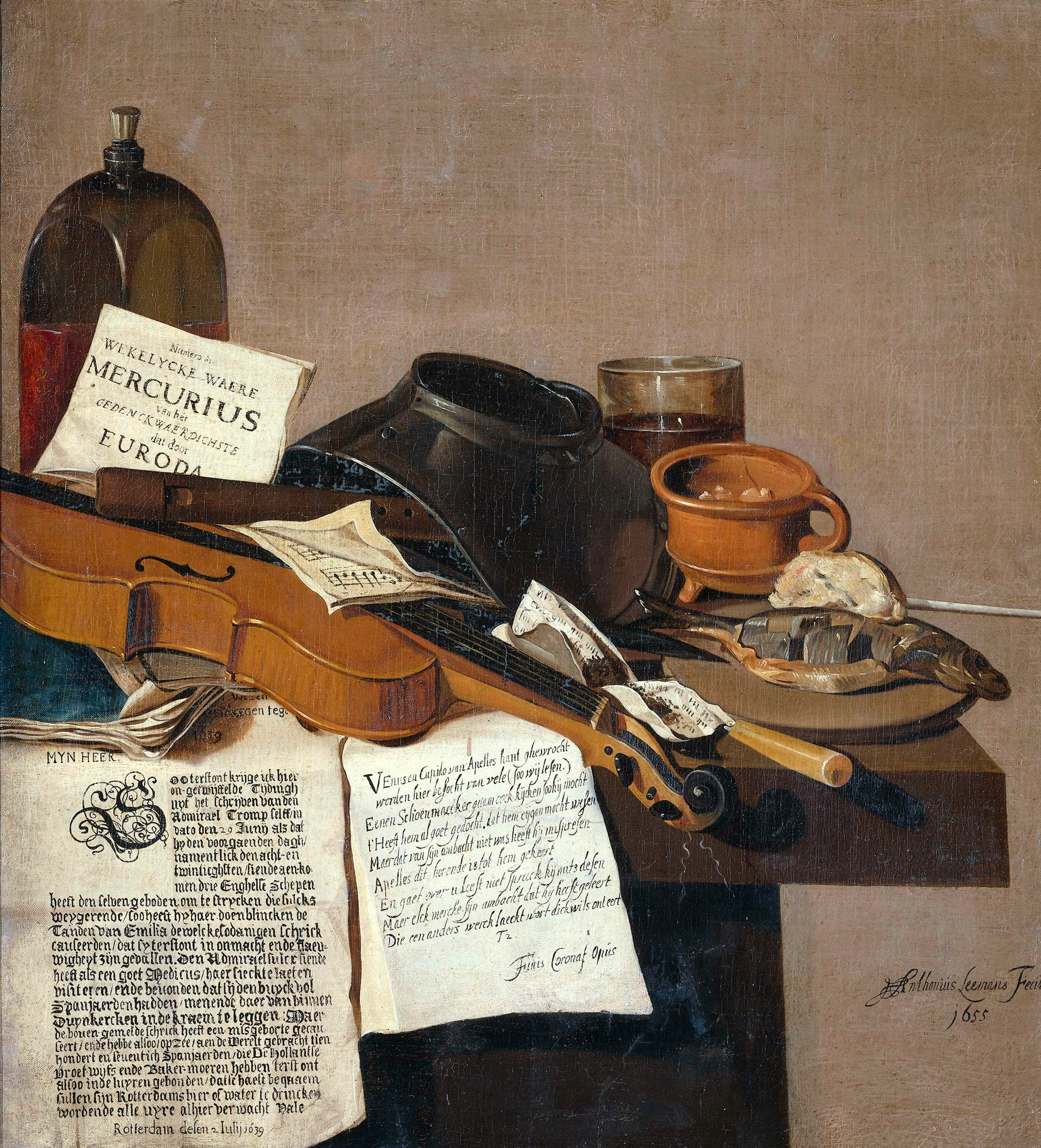
Anthonius Leemans, Oil on canvas, 1655. Courtesy of Rijksmuseum.
Poetry helps us value words again. Not many of my readers will become poets, and — as much as I would like it — realistically, not many will make reading poetry part of their routine. Still, we might learn from the poets that what the world needs is not an abundance of words or the heaping up of empty phrases but truth spoken well. I think of the proverb that says, “A word fitly spoken is like apples of gold in a setting of silver.” Ezra Pound said that great literature is “language charged with the utmost meaning.” Something like that ought to characterize Christian speech too.
What’s amazing about us as creatures is not just that we can speak. Other creatures communicate — dolphins, birds, perhaps even the rocks cry out. What’s amazing about us as creatures, I think, is that we can speak well. We’re the sort of people who don’t just use words; we’re the ones who use words well. Quintilian said the ideal orator was “the good person speaking well.” I think that captures who we want to be as Christians. Good persons speaking well.
After all, what we need to be Christians, to be truly humans, is not just the truth (which by itself is dangerous and clumsy), we also need grace. Jesus came full of truth and grace. Maybe that’s why Paul says, “Let your speech be always with grace.” “Beauty and beauteous words should go together,” as Herbert wrote. Truth alone is too heavy for people to hold, too loud for people to hear, too bright for people to see. We don’t just need truth but grace, wisdom, eloquence, restraint, and prayer.
So, I think of what Mary Oliver said about poetry. “Poems are not words, after all, but fires for the cold, ropes let down to the lost, something as necessary as bread in the pockets of the hungry.”
Years later, a line like “water, water, every where, nor any drop to drink” is still there in my pocket. And there are others, for days when I’m happy, days when I’m sad, days when I’m scared, days when I’m lonely, and days when I’m hungry for more than what this world has to offer.
“‘Tis better to have loved and lost than never to have loved at all.”
“‘Hope is the thing with feathers / That perches in the soul / And sings the tune without the words / And never stops at all.”
“Love is not love / Which alters when it alteration finds, / Or bends with the remover to remove. / O no, it is an ever-fixèd mark / That looks on tempests and is never shaken.”
“And can it be that I should gain / An int’rest in the savior’s blood? / Died he for me, who caused his pain? / For me, who him to death pursued? / Amazing love! how can it be / That thou, my God, should die for me?”
I thank God for words like these. They have helped me along the way. And I pray that my own words might be gracious enough to stand apart in a world of noise. I pray that my words — and ours — might be “ropes let down to the lost” and “bread in the pockets of the hungry,” that they might last a little while and help others who, like me, are “wrestlers with the troubled sea.”
Matthew D. Love teaches preaching and ministry at Harding School of Theology.




