




When I was 23 years old, I wrote a letter (handwritten, duh) to my home state hero, Wendell Berry. It is a mercy that I no longer remember what I put in my letter, that I neglected to make a copy of it before sending it out (something I definitely would have done at the time), because I think 39-year-old me would feel embarrassed. Embarrassed to see what 23-year-old me assumed the agrarian man of letters might find interesting about my dreams and pursuits. One thing is certain: I wanted him to tell me exactly what I should do with my life.
He wrote me back! He told me it was a “good letter” (swoon) and in a stroke of real generosity, said something to the effect of “It appears you have some things you’d like to pursue if you decide to pursue them.” We exchanged letters three or four times over the span of the next year as I met my soon-to-be wife, and he actually invited us to come visit him. Wendell and Tanya were known for taking visitors on Sundays, so we picked a Sunday and drove to Port Royal from my parent’s house in Lexington. It’s a memory I’ll cherish forever, even if I was too starstruck to ask the right questions.
Maybe you know this already, but along the CHILL-to-EARNEST spectrum, Wendell Berry fans lean hard to the latter. I was (still am?) no exception. Caring people, maybe a little intense. People who might have scruples about grocery bags or community radio, who might have at points in their lives written romantic poems featuring barn boards. People who are interested in the recovery of craft. In short: slightly smug, mostly white English majors and hip seminarians. For this select population, Wendell Berry is the OG, an emblem of righteousness. Not just because he was a serious writer with a profound moral vision — he, unlike most people in the history of planet earth, seemed to live it.
A lot of the fires Wendell Berry reignited in the American imagination were later so widely adopted as to become almost commonplace now. Most people think small farms, local economies, and home vegetable gardens are good, just like most people have some concerns about GMOs and mountaintop mining. It is difficult to think of these concerns being revolutionary. But Wendell Berry was pretty punk rock about it, and it’s this activism that newspapers remember him by.
But to position Wendell Berry as merely an activist on behalf of environmental causes misses the deeper strata of his life’s work. He was repetitive in his writing, and he returned again and again to themes that anchored his (very biblical) poetic imagination — love, greed, knowledge, death, time. Especially in his poetry, he writes with the anguish and rage and longing of an old prophet in exile. Sometimes he is tender, sometimes apocalyptic, like he needs to shake the world upside down, like John the Baptist, like the Beatitudes.
One of his persistent themes is the majesty of and invitation to the Wild. Berry’s poetic universe is confined to the woods and river bordering his farm. He is always talking about how we need the Wild, not because it is a nice escape or because it is beautiful, but because it reminds us of our place in the world. As he says in an early essay, “We need now and again to go to places where our work is disallowed, where our hopes and plans have no standing. We need to come into the presence of the unqualified and mysterious formality of Creation.” The existence of the woods, unfarmed, untended, is a necessary rebuttal to our instincts to control a place, to own it, to dream it to be otherwise. There’s a favorite poem of mine which begins,
One day I walked imagining
What work I might do here,
The place, once dark, made clear
By work and thought, my managing,
The world thus made more clear.
I walked and dreamed, the sun in clouds,
Dreamer and day at odds. (1989, IX)
He admits the human propensity to buck limits, to take more than we need. He appreciates the tension that exists between “the farm” and “the wild” — the dividing line between what is our responsibility, and what is not. I love that, in this estimation, God moves in the dark, wild mystery of the woods beyond the border of our work. And sometimes, God takes some of his boundary land back, as Berry writes in another poem:
I go by a field where once
I cultivated a few poor crops.
It is now covered with young trees,
for the forest that belongs here
has come back and reclaimed its own.
(2007, IX)
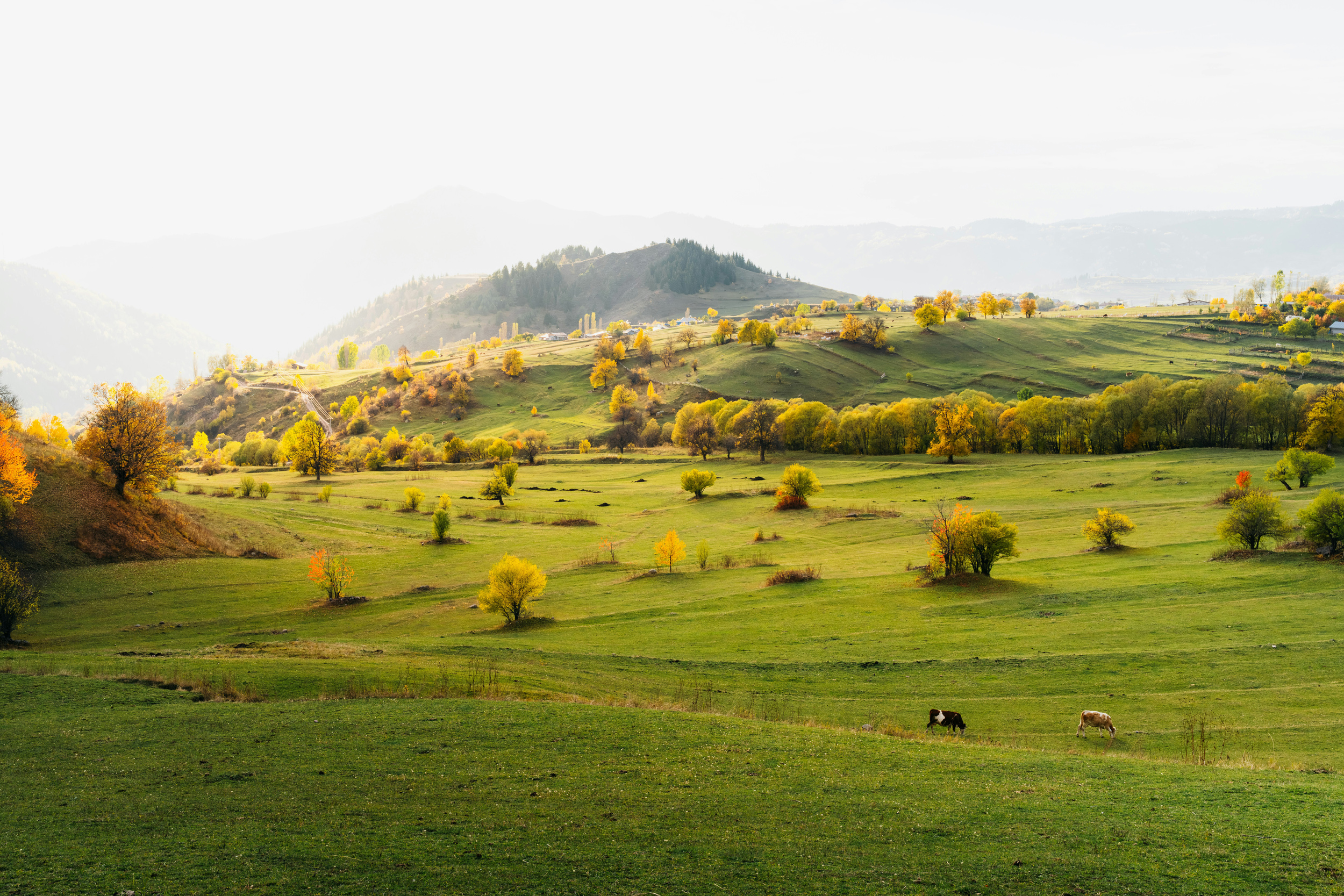
Within this frame, a field is a necessary use, just like a home. It is a place of comfort and toil. A place that requires our work, and will not stop requiring our work after we are dead. Within the confines of the field or farm, we do the best we can to plan, to cooperate, to use its resources with tenderness and constraint, according to our own limits. Farms can be run well or poorly — a well-run farm is one which has acknowledged limitations and knows it exists in an interdependent relationship with the Wild. A farm can also bloat with the thirst for more, a refusal to acknowledge limits, which affects the life of the farmer, the lives of those around him, and his own relationship with the Wild. Wildness, then, becomes an adversary to beat or own.
But then there is the Wild, which just exists sui generis. It is a place outside the toil of the farm. This is the primary setting for Berry’s “Sabbath” poems. All week I’ve worked, and I now leave my work — the end of my field, my expertise, my responsibility — to walk into what is not my mine. I step into the Wild to remember what cannot be earned, what cannot be made by my mind or my hand. I come as a temporary guest. There are no wages in the woods, only gifts.
I go among the trees and sit still.
All my stirring becomes quiet
Around me like circles on water.
My tasks lie in their places
Where I left them, asleep like cattle.Then what is afraid of me comes
And lives a while in my sight.
What it fears in me leaves me,
And the fear of me leaves it.
It sings, and I hear its song.Then what I am afraid of comes.
I live for a while in its sight.
What I fear in it leaves it,
And the fear of it leaves me.
It sings, and I hear its song.After days of labor,
Mute in my consternations,
I hear my song at last,
And I sing it. As we sing,
The day turns, the trees move.
(1979, I)
So much of Wendell Berry’s work — the elegies, the Mad Farmer rants, the essays, the stories from Port William — hinges on the acknowledgement of this ancient marriage: the land we map out for ourselves and our loved ones, and the wild Wilderness which contains us, sustaining us and waiting, invites us to find our rest.
Who makes a clearing makes a work of art,
The true world’s Sabbath trees in festival
Around it. And the stepping stream, a part
Of Sabbath also, flows past, by its fall
Made musical, making the hillslope by
Its fall, and still at rest in falling, song
Rising. The field is made by hand and eye,
By daily work, by hope outreaching wrong,
And yet the Sabbath, parted, still must stay
In the dark mazings of the soil no hand
May light, the great Life, broken, make its way
Along the stemmy footholds of the ant.
Bewildered in our timely dwelling place,
Where we arrive by work, we stay by grace.
(1983, IV)
It’s funny. When my wife Hannah and I visited the Berrys, we weren’t married yet. We had no children. We were fresh out of college, with big dreams and none of the constraints, none that we were really aware of at the time. It was easy to imagine living a life like theirs, one without the toil and all the poetry, “hope outreaching wrong.” I could see a wide clearing of farmland for us, and how we “made it” was up to us. We hadn’t learned yet that the dreamer and the day are at odds, how the wild country of marriage would soon enclose our careful plans with births, deaths, jobs, a suburban mortgage, and Legos. We didn’t know a thing about the woodlands about to hem us in. At the time it wouldn’t have seemed big enough, beautiful enough — so much work and so little time. We couldn’t have known how we’d wonder at it now, the abundance of our “timely dwelling place” and the Wild wilderness waiting for us beyond.








Gosh I loved reading this. Thanks E. I may not have much familiarity with Wendell’s work but I’m so grateful for the familiarity I have with folks who loved him, which includes so many of my favorite people. I remember when you went to visit him!
This is amazing, Ethan! Next time I see you, I’ll bring a (clean) handkerchief for you to touch…from the hand that shook Wendell’s!
<3<3<3
So beautiful Ethan. Even though you were young, you knew what a special man he was. And how special he took visitors on Sunday’s. His words make me cry. Thank you.
I so much appreciate your essay, you have captured so much of what I understand Wendell to be and knowing that Hanna and you visited him means all the more to me since I’ve known Hanna since she was little kid. I suspect once your beautiful children are grown you and Hanna will be living near the wild and walking through it on a regular daily basis.