




Like many, I first came across Flannery O’Connor in my required curriculum reading in high school. My witty and hilarious English teacher, Dr. Kidd, elected to read the entirety of “Good Country People” aloud to us in a comical backwoods Southern accent. The class was laughing hysterically throughout his reading, partially because of his ridiculous accent, and also because of the absurdity of the story. “Good Country People” tells the story of a self-righteous, ugly — or in O’Connor’s words, “large hulking” — girl named Hulga who stumps around on her artificial leg and has an exceedingly odd experience with a scheming Bible salesman crudely named Manley Pointer.
This short story is not an outlier compared to her other stories. All of her stories center on outcasts, self-righteous proper Southern ladies, backwoods criminals, people with physical deformities, and often just weird and frankly ugly characters. To say it another way, O’Connor had no interest in writing about pretty or put together people. What she did have interest in doing was violently hitting her self-centered characters over the head with grace.

Born to Roman Catholic parents in Savannah, Georgia in 1925, O’Connor grew up in the heart of the South. Under live oak trees and Spanish moss, young Flannery learned about church ritual, sacraments, and the love of Christ while attending daily Mass. From a young age, she was intimately familiar with both faith and suffering. When she was a teenager, her family moved to an isolated dairy farm in Milledgeville where her father was diagnosed with disseminated lupus, an incurable and debilitating disease. He died when she was just fifteen. Flannery would later return home to Milledegeville after getting her Master’s in creative writing, having fallen ill to the same disease that took her father’s life. Here she stayed for the remaining thirteen years of her life, mostly on crutches, her bones brittled and joints ravaged by lupus. Still, she wrote ferociously.
Her acute suffering, as well as her father’s early death, gave her life and writing a sense of palpable urgency; she was not afraid to look death in the eye. She herself said that she wrote “for an audience who doesn’t know what grace is and doesn’t recognize it when they see it.” Or, as she stated more starkly: “My audience are the people who think God is dead … To the hard of hearing you shout, and for the almost-blind you draw large and startling figures.”
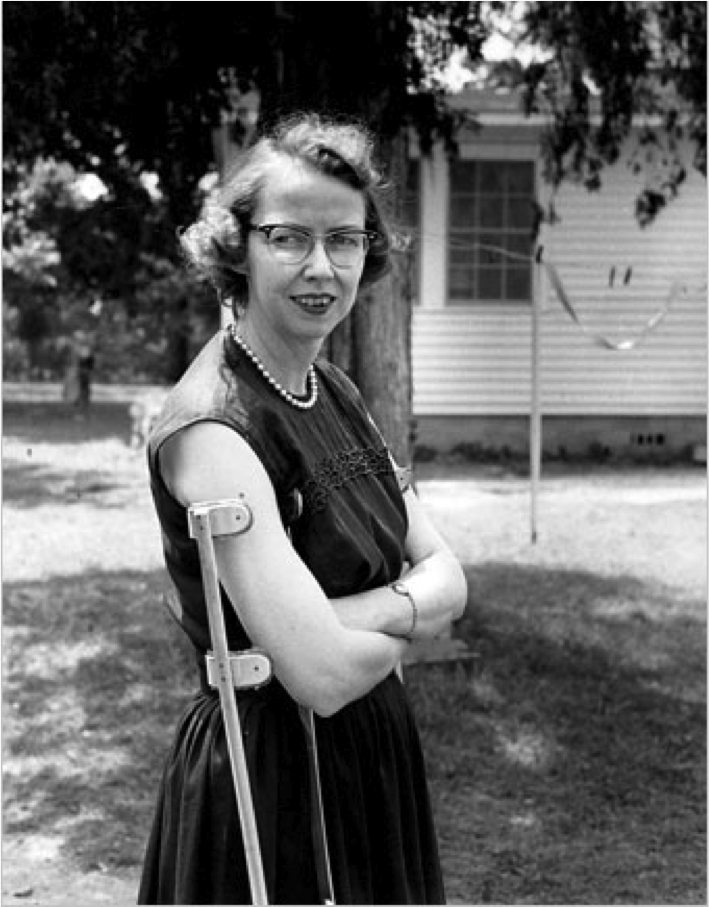
Consequently, O’Connor wrote about death and suffering in strange and jarring ways, drawing large and startling figures. She was not in denial of her own mortality and she only had the energy to write a few hours at a time, so she didn’t beat around the bush in her stories. She shouted. Her characters’ divine moments of grace often come at gunpoint, as is the case for the grandmother in “A Good Man Is Hard to Find.” (*warning heavy spoilers ahead)
In this short story, a dysfunctional family is on a road trip to Florida when the grandmother convinces them to take an off road to see an old plantation house. They subsequently crash their car and come across three criminals on the side of the road. This diversion soon turns to tragedy as the family is all shot to death by a criminal, known as “The Misfit,” and his two accomplices. Pretty dang bleak. So where’s the grace in that? Where’s the hope?
For O’Connor, violence and grace were not unrelated; in a 1963 speech she gave explaining this very story, she said: “I have found that violence is strangely capable of returning my characters to reality and preparing them to accept their moment of grace. Their heads are so hard that almost nothing else will work.” She views violence as a way to shake characters out of their ordinary existence and ignorance, and a chance to open their eyes to the divine. In this story, the hard-headed character at the center is the grandmother, a proper Southern lady who considers herself morally superior and frequently passes judgment on those around her:
Her collars and cuffs were white organdy trimmed with lace and at her neckline she had pinned a purple spray of cloth violets containing a sachet. In case of an accident, anyone seeing her dead on the highway would know at once that she was a lady
The grandmother’s desire is so absurd, it’s difficult not to laugh. And that is totally the point. She is preoccupied with a very twisted sense of goodness that mainly consists of having money, manners, and white lace-trimmed cuffs. When she suddenly finds her life in the hands of The Misfit, the two characters have an unexpected conversation about goodness and Jesus. In a plea for mercy, the grandmother tries to tell him that he is a good man, that if he prays Jesus would help him. But The Misfit doesn’t “want no hep.” Instead he explains to her:
“I found out the crime don’t matter. You can do one thing or you can do another, kill a man or take a tire off his car, because sooner or later you’re going to forget what it was you done and just be punished for it. […]
“Jesus was the only One that ever raised the dead,” The Misfit continued, “and He shouldn’t have done it. He thrown everything off balance. If He did what He said, then it’s nothing for you to do but thow away everything and follow Him, and if He didn’t, then it’s nothing for you to do but enjoy the few minutes you got left the best way you can — by killing somebody or burning down his house or doing some other meanness to him. No pleasure but meanness.”
Ironically, his analysis is pretty accurate. The first part he gets wrong, but his logic is accurate in a surprising way. That is, in Jesus’ eyes “the crime don’t matter” either; but instead of punishing us for it, he accepts the punishment himself and offers us offenders, us criminals, grace. His grace does not discriminate; there is no crime for which his grace is not great enough to forgive.
And the second part of his argument, grim and low anthropology as it may be, stands true: if Jesus did what he said he did, then the only proper response is to throw away everything and follow Him (see Mt. 19:21), and if not, well then there really is no hope, no higher meaning to life. Because if he didn’t raise the dead, and if he himself didn’t raise from the dead, then death wins. I would like to think that the removal of Jesus wouldn’t be quite as dramatic as killing and burning and “no pleasure but meanness,” but I think one look at the news sufficiently teaches us not to place our hope in humanity’s innate goodness.
Some — including me, in all honesty — may be offended by this bluntness, this utter bleakness in regard to human nature, but O’Connor didn’t mind being offensive. No, O’Connor reminds us that grace is offensive. Grace is jarring. It’s offensive because it points to the deficiency in each of us. It’s jarring because it shakes us out of our ordinary, everyday reality of ignoring our sin and forces us to grapple with the weight and reality of sin. But even more offensive than our need for grace is how much it costs. Death. Painful, brutal, even grotesque death on a cross. That the only sinless man to ever walk this earth took the punishment that sin demands for the rest of us who are sinners is most offensive of all.
The violent moment of grace in this story comes when the hard-headed grandmother, in crisis, finally realizes her own need for salvation and is filled with compassion for The Misfit at the height of his evil:
His voice seemed about to crack and the grandmother’s head cleared for an instant. She saw the man’s face twisted close to her own as if he were going to cry and she murmured, “Why you’re one of my babies. You’re one of my own children!” She reached out and touched him on the shoulder. The Misfit sprang back as if a snake had bitten him and shot her three times through the chest.
A beautiful moment of grace followed by tragedy and violence … where is the hope in that?
In the same aforementioned speech on “A Good Man is Hard to Find,” O’Connor makes clear that the crux of this story is the grandmother’s moment of grace:
The heroine of this story, the Grandmother, is in the most significant position life offers the Christian. She is facing death. And to all appearances she, like the rest of us, is not too well prepared for it. She would like to see the event postponed.
Indefinitely. […]
[…] The Grandmother is at last alone, facing the Misfit. Her head clears for an instant and she realizes, even in her limited way, that she is responsible for the man before her and joined to him by ties of kinship which have their roots deep in the mystery she has been merely prattling about so far. And at this point, she does the right thing, she makes the right gesture. I find that students are often puzzled by what she says and does here, but I think myself that if I took out this gesture and what she says with it, I would have no story. What was left would not be worth your attention. Our age not only does not have a very sharp eye for the almost imperceptible intrusions of grace, it no longer has much feeling for the nature of the violence which precede and and follow them. […]
… in this story you should be on the lookout for such things as the action of grace in the Grandmother’s soul, and not for the dead bodies. […]
With the serious writer, violence is never an end in itself. It is the extreme situation that best reveals what we are essentially, and I believe these are times when writers are more interested in what we are essentially than in the tenor of our daily lives. Violence is a force which can be used for good or evil, and among other things taken by it is the kingdom of heaven. But regardless of what can be taken by it, the man in the violent situation reveals those qualities least dispensable in his personality, those qualities which are all he will have to take into eternity with him; and since the characters in this story are all on the verge of eternity, it is appropriate to think of what they take with them. In any case, I hope that if you consider these points in connection with the story, you will come to see it as something more than an account of a family murdered on the way to Florida.
O’Connor wants us to focus on the action of grace, the moment of transformation, not the dead bodies. Admittedly, it’s nearly impossible to ignore the dead bodies. Postponing death indefinitely doesn’t sound all that bad. And yet, I’m not convinced O’Connor was as interested in giving us earthly hope as she was in giving us heavenly hope. She certainly didn’t have hope that she was going to live long. She knew death was coming early for her, and the actual physical writing of these stories probably brought her pain and discomfort because of the disease she suffered from. O’Connor was far more interested in shaking us out of our everyday ignorance, in using violence to “shout” at us until we spiritually awaken, our eyes opened to Jesus and sharpened to the “imperceptible intrusions of grace” around us. She brings us to the moment of violence — the moment of grace — and leaves us there, scratching our heads. Many of her stories end suddenly this way, without a pretty or hopeful bow to tie up the disturbing events.
It seems that to O’Connor — someone living and writing with such closeness to death — death was far less fearsome than not knowing the grace of Christ. If she didn’t have hope in her physical health and longevity, her hope had to be in something else: in the One who defeated death. O’Connor wrote urgently because she wanted us to know the reality of God’s grace before we die, and as she knew all too well, death can come too quickly. She wanted us to know this grace much earlier in life than the grandmother. Before the gun is pointed, so to speak, at our chests.
At the end of the story, The Misfit has a curious and seemingly dreadful revelation: “She would of been a good woman,” The Misfit said, “if it had been somebody there to shoot her every minute of her life.” Harrowing, but surprisingly hopeful in light of the gospel. If we really lived with the understanding of what we deserve as punishment for our sins — death — we would be overwhelmed with humility and gratitude that Christ took the punishment for us. We would overflow with grace for those around us. For the Christian, violence and grace are related, too: it was Jesus’ violent death on the cross that granted us absolution, after all. In a sense, living our lives at metaphorical gunpoint, or as O’Connor says, on the verge of eternity, brings us to the foot of the Cross. When we lose all our hope in ourselves, when we find ourselves at the end of our ropes, that is where Jesus meets us, giving us hope in himself instead.








Thank you! A nice, rich steering through O’Connor’s story.
Thank you for your thought provoking analysis of O’Connor’s story. While I read the story before, I had never made the grace connection.
[…] on “Grace at Gunpoint: Flannery O’Connor on the almost imperceptible intrusions of grace” (Mockingbird), and Mary Grace Mangano on “Katherine Anne Porter’s Place in the Catholic Literary […]
[…] pleasant, happy, even sweet. Not always. Grace has a side to it that is shocking, even violent (see: Flannery O’Connor). So it should come as no surprise that Kingsolver’s grace for her people has another side to it […]