




Welcome to the sixth edition of Mockingbird’s preacher interview series! Since the fall, we’ve been interviewing some of our favorite ministers from around the country to find out more about what is working in American Christianity today and how to do church well. (See also eps. 1, 2, 3, 4, and 5.) Our sixth interview is with longtime Mockingbird contributor, keynote speaker at this year’s NYC conference, and Christian Reformed Church pastor Tim Blackmon.
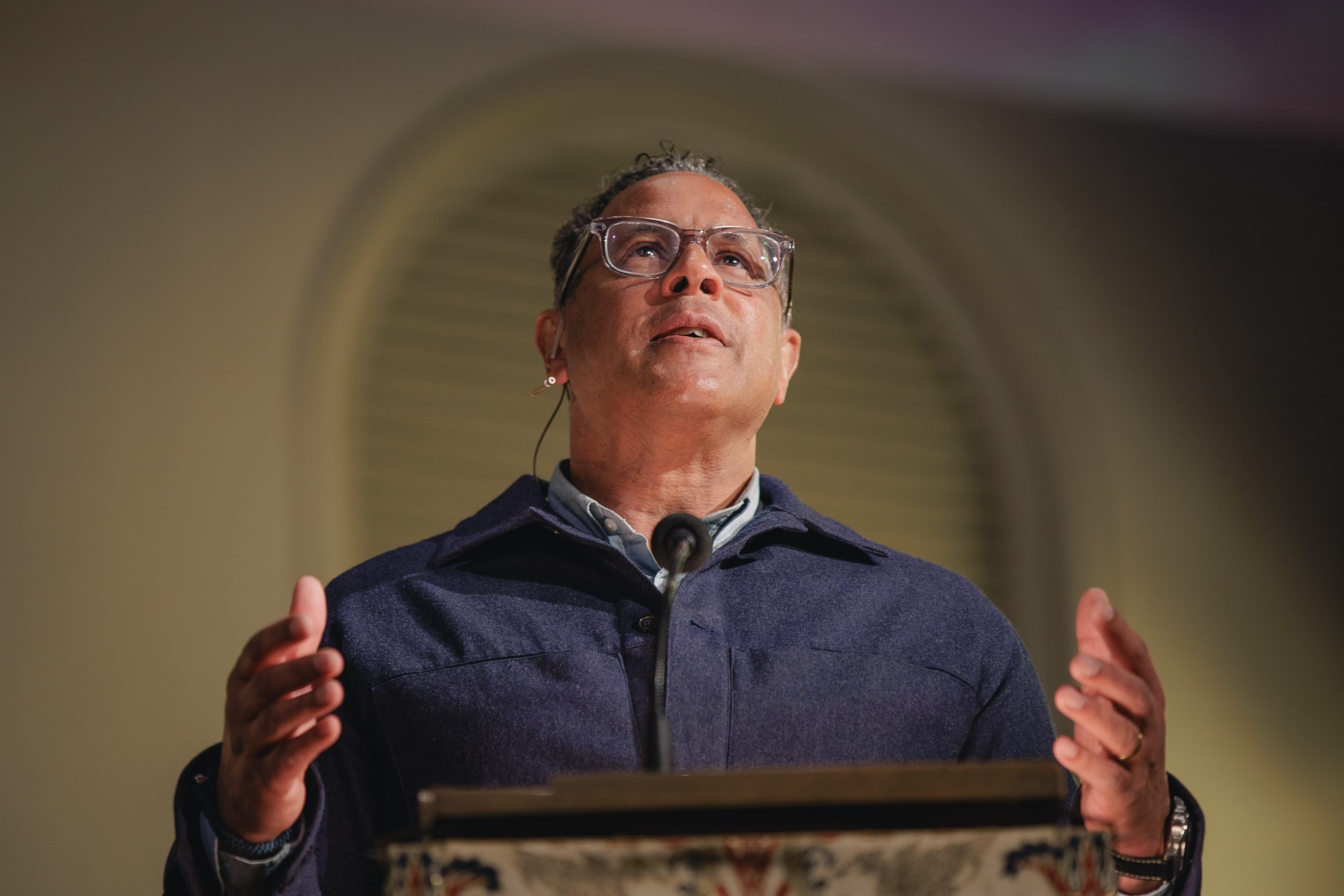
M: Hey Tim! Thanks for joining us.
TB: Absolutely. I appreciate the invitation.
M: I know you have an interesting international background and have had a wide-ranging career in ministry, but let’s start with the basics: where do you currently work, and how would you describe your congregation?
TB: For the last three-and-a-half years, I have been at the Second Christian Reformed Church in Grand Haven, Michigan. So to kind of locate that: the Christian Reformed Church is primarily a denomination that came out of the European Reformation, particularly in the Netherlands, and a lot of the immigrants moved to West Michigan. So the headquarters of the Christian Reformed Church in North America is just 45 minutes up the road from us in Grand Rapids. And our church has been here in Grand Haven since the late 1800s, so we’re about 145 years old. Even though I’m originally from the Netherlands and I’m in a denomination in America that has Dutch roots, that was primarily accidental, or providential. But I’ve been a pastor in the CRC for 30 years now.
M: Awesome. So your church has one main Sunday service, the 10 a.m. service. How would you describe it? What’s the music like? What’s the liturgy like? Paint a picture for us.
TB: Probably the best way to describe the ethos of this church is to talk about Wimbledon. I’m a huge tennis fan, and you know how Wimbledon has this storied magic? There’s this combination of reverence for tradition mixed with excellence and innovation mixed with grass and roof. They take their particular way of having a tennis tournament incredibly seriously. It matters so much how it’s done. And, not to get too deep into Wimbledon, but the assumption is that tennis is fascinating and you don’t have to make it fascinating. So if you’re bored by tennis, that means that you don’t fully understand the game, you don’t fully love the game. We’re not going to cloud the center court with ads. We’re not going to have blaring music. Because that stuff is only for people who are bored by tennis. And I think that’s the best way to describe what this church is like. It has a long, storied history of beautiful and rich liturgy, very thoughtful music and hymnody.
At the same time, I’ve only been here for three years, but in the previous 20 years, the church had gone through quite a bit. You had the COVID period. Before that, they had a young pastor who was actually a friend and former colleague of mine. Before that, they had a four-year interim period. And because it had such a storied but unique style and slightly high-church approach and liturgy, they also planted a church across town in the 1990s that ended up becoming very contemporary. And so in the late 1990s, you had a lot of people leaving for that church. So really for 20 years or so, the church had not grown significantly, and it had aged significantly. When I got here, 70% of the congregation was over 70. In church on Sundays, there were maybe 150 people, and almost nothing going on during the week — very few ministries, very few children, very few youth, but still this core of incredible warmth and reverence for the tradition.
One of the things that often happens with CRC churches in most towns in West Michigan is that you don’t just have one Christian Reformed Church. We’re the “Second.” There’s “First” Grand Haven CRC, then just up the street, there’s “Ferrysburg.” There are so many other options in town. And after a while, each congregation develops its own flavor. So, I don’t know exactly how this happened, but a lot of the doctors, lawyers, and university professors in town ended up coming here. So pejoratively, people would refer to us as the “church of the shiny shoes,” and there is certainly a bit of a highbrow component to it. But it’s Wimbledon, not the US Open. They want things done a certain way. And that cultural context shows up in interesting ways.
M: Before we move on, I have to ask about your time in the Netherlands: is there any life in the church over there these days?
TB: That’s a great question. I grew up there. I lived there from 1970 until 1988 when I graduated from high school. And, even more so in subsequent years, you could really see in the Netherlands what deep secularism looks like, where the plausibility structures of Christianity simply don’t work anymore. In my mother’s lifetime, that country went from 70% Protestant church engagement to a total of 17% congregational engagement, which includes Roman Catholics and Muslims. So, literally in her generation, there was this epic shift in the plausibility structures — where people didn’t just think church was weird, but believing in God became simply unthinkable.
So then when I came back to the Netherlands in 2008 to be a pastor there, it had been long enough for people to live in that deeply secular world that they began to experience — I guess David Zahl calls it “seculosity” — Charles Taylor calls it being “cross-pressured.” They realized that they were actually still just as spiritual. There were so many times where, particularly at a funeral, I would hear a completely secular person all of a sudden say something like, “Oh, I’m going to meet them on the other side” or “when they get to a better place.” And all of a sudden you realize they actually have a pretty fertile eschatological imagination. Who knows where that comes from? But it is a country that is haunted by Calvinism. I mean, they say that even the pagans and the Roman Catholics in the Netherlands are Calvinists, and they just don’t know it. There is still something that keeps the country together. And one of the things that’s happening now, particularly in the larger cities, is that you have a lot of churches made up of immigrants who are first-generation believers. A lot of African churches, for example, are thriving, and they tend to be charismatic. They tend to have a strong emphasis on worship and the works of the Spirit. So yeah, you do see a lot of life there.
One of the things that’s also very interesting — I’m currently in a PhD program right now for a Dutch university, and they are part of a confessional Reformed denomination. And as far as I can see, they’re thriving, they’re growing, and there is an appeal in the clarity and the consistency and the tradition of The Three Forms of Unity — you know, the Heidelberg Catechism, the Belgian Confession, and the Canons of Dort. I see a lot of young people. I think the enrollment in my seminary grew by 100% last year.
M: Whoa.
TB: There are 78 PhD students from all over the world coming there because it has a unique and incredibly consistent combination of confessional doctrine mixed with academic excellence. So, I’m somewhat hopeful that we’re turning a corner.
M: That’s awesome. Getting back to your current role: when new people show up to your church in Grand Haven, how do you make them feel welcome and encourage them to keep coming back?
TB: Well, another thing I love about my particular church is that there is a real interpersonal warmth you feel when you walk in. You are going to be genuinely welcomed. What’s highly unusual about that in this context is that there are so many people in this church that have been here their entire lives. I mean, we have multiple 90-year-olds who were baptized as infants in this congregation and have never left. So you would think that a church like this would experience a high level of relational saturation: we know each other, we’re married to each other, we’ve got kids and grandkids and great-grandkids here.
M: In other words, we don’t need new friends.
TB: Right, we don’t need new friends. Yet, for some reason, that is not the case here, which is a bit of a modern miracle — that a church as tight-knit as this one would genuinely be open.
Another one of the things that we try to do, and that I certainly try to do as a worship planner and as a preacher, is to do everything with the highest level of excellence and commitment to facilitating an encounter with the living God. But without feeling the need to put on a show. We like keeping church churchy. We like keeping church weird. If you’ve never been to church in your life, it’s okay that you see things and that you hear things that you’ve never heard before.
You know, we’re not trying to be similar to the 18-screen movie theater or a Hollywood production. So to some, it might seem that the production value of our services is incredibly low, but that’s because there is a genuine belief that God is here and that he can work through the ordinary means of grace. And I think that lends itself to a certain kind of authenticity.
M: Do you have a particular person that you rely on to be a kind of welcoming maven? Or is it just a more generally welcoming atmosphere?
TB: Yeah, two things on that. There is actually one person that comes to mind. I call her the Cookie Lady. Her name’s Sharon. Every week she makes home-baked cookies, and she has an uncanny ability to scan the room to see who’s here for the first time. So if you’re new here — and this is not even an official function of our congregation — she will track you down, you will get some cookies, and she used to own a flower shop, so she often prepares the flower arrangement in church. And so you will walk out with a fresh bouquet of flowers and some cookies and a super friendly chat from a genuinely kind person.
M: That’s lovely. That’s what you need.
TB: That’s the first thing that comes to mind. The other thing is something that I’ve tried to do in the service, and this came squarely from one of my mentors, Ray Ortlund, who is in Nashville. He begins every service with this incredible welcome: “To all who are weary and wonder if God cares, to all who mourn and long for comfort, to all who fail and desire strength, and to all who sin and need a Savior, this church opens wide her doors with a welcome of Jesus Christ. He is an ally to his enemies. He is the defender of the guilty. He is justifier of the inexcusable. And he is the friend of sinners. Welcome.”
Every week we start with that. And I think that genuinely sets the mood. It’s a way to say we’re not just welcoming you. More than anything, we hope that you experience the welcome of Jesus Christ.
M: So, in your mind, what’s the single most important thing that happens in church on a given Sunday?
TB: I think it was A. W. Tozer who said, “The single most important thing about you is what comes to mind when you think of who God is.” And I would say that’s true for us as a church as well. The single most important thing that comes to mind for our worship services is what we believe about God. So I actually believe that God welcomes us, God reconciles us, God forgives us, God comforts us in the words of absolution. I actually believe that the triune God of the universe speaks to us, elects us, sanctifies us, and ministers to us through the preaching of the word. I actually believe that he feeds us and nourishes us through the sacraments. And I actually believe in the living God of the universe meeting with his people. That’s the most important thing. Then we try to respond accordingly.
M: So, that expression of what we believe about God, and that meeting of God with his people, it just takes different forms. It’s not necessarily one thing.
TB: Yeah, but that’s not only a theological mindset. I actually just walked you through our entire liturgy. That’s literally the order of our service.
M: Ha. I didn’t catch that. That’s good.
TB: In a Reformed service, there is a strong sense that worship is dialogical, right? So, you begin with a welcome from God, which is seen as an official act of ministry, and the people respond to this with worship. God summons us to adoration, and we respond with a song. God calls us to repentance, we confess our sin, and then God responds with the words of comfort and assurance. God speaks his word to us. We respond with praise and generosity. God sends us out into the world, and we leave bearing witness to the gospel. So there’s this constant back and forth. That’s literally the order of our service.
M: I love that. I don’t think I’ve ever had that explained to me. So what is your vision for children and youth ministry?
TB: One of the first things we did when I got here was to make the faith formation of the next generation priority number one, not even so much as a means of institutional survival, which I guess technically it also is, but really as a way of helping parents and grandparents see that they are the primary faith formers of their children. We as a church come alongside to help equip them to catechize, to inculcate the faith, recognizing that they are in some sense already being catechized, whether or not they’re in a Christian school or a public school. So there is a counter-catechesis that we are after that goes against the norms and values of the vision and the social imaginary of the environment in which they live. It’s in the air, it’s in the water supply. And so at church, we are intentionally offering a counter-catechesis that starts from day one.
We’ve recently added an unbelievable children’s ministry director who has transformed the downstairs part of our building into a kind of ancient Middle Eastern village for the kids. It’s multisensory, and the idea is that we want the imagination of the world of the scriptures to become part of their way of looking at the world. So it’s this intergenerational, highly intentional approach to catechesis for kids 0 to 18.
M: I love that, but I have a follow-up: A lot of the children’s religious content I’ve encountered is very moralistic, and it’s focused on us and not necessarily about what God has done or is doing. The takeaways are often things like don’t lie, don’t steal, or be nice. And so, I do feel like it would be a challenge sometimes within the context of American Christianity — with the children’s Sunday school materials that are available — to provide that kind of counter-catechesis, emphasizing God’s grace and God’s initiative. How does your church deal with that challenge?
TB: That’s a great question. Growing up kind of in a barely evangelical mainline church myself, I think the main tenet of our faith was God is nice. Be nice. Isn’t that nice? That’s literally what I was raised with. But one of the core theological tenets of a confessional Reformed church, certainly in the Christian Reformed tradition, is a strong emphasis on understanding Creation, Fall, Redemption, and Consummation as the overarching framework through which we understand the scriptures. So you get this incredible clarity about how to read the Bible from the perspective of progressive revelation and a biblical theology in which Christ is the center. So having scripture begin in creation and end in the new creation, and having Christ preached on every page — I think it’s Luke 24 where Jesus says all of the scriptures, the prophets, and the law bear witness to him — that approach you will hear not only on Sunday mornings but also in every lesson.
That approach locates us very specifically in an understanding of where my morality, my ethics, and the exhortations you might find in scripture fit in the grand scheme of things. And the perfect complement to that is one of our confessional documents, the Heidelberg Catechism, which begins with “What is your only comfort in life and in death?” and then explains the law and the gospel. It has great clarity about that — the function of the law and the function of the gospel. So that mindset is in the air that we breathe here. That strong gospel-on-every-page emphasis is found in both the Sunday morning service and in all our work with children and youth.
M: That’s great. So, according to Todd Brewer, you’re a fantastic preacher.
TB: Haha. May his tribe increase.
M: What would be your preaching advice for a newly ordained pastor or priest?
TB: I started preaching when I was 16, and then between 16 and when I started seminary at 21, I had a fair bit of experience preaching. So, let’s just say I had no little confidence in my ability. But when I got to seminary, I remember preaching a sermon in a homiletics class, and I felt like I was the bold proclaimer of a prophetic truth. In reality, I was a 21-year-old nincompoop and didn’t really know what I was doing, was far too arrogant, far too confident in my own abilities. And so after I give this prophetic drive-by massacre of a sermon, my homiletics professor looks at me and he says, “Tim, I am so mad at you right now, I feel like I could slap you in the face. Because you think that you can get by on your gift of gab and on your natural charisma and on your eloquence, but I suggest that you shut your mouth and go home and study until you’ve got something worthwhile to say.”
M: Wow.
TB: And this is in front of fifteen classmates who are also preparing to preach in class. I remember walking home that day from that complete mic drop of a professor’s rebuke, and I said to myself, “That is the word of the Lord to me.” From that day on, I said, “I will never be accused of getting by as a preacher based on natural giftedness or eloquence or the ability to spin a phrase.” So that’s the day that I decided to read and study five hours a day for the rest of my ministry. And everywhere that I’ve gone, everybody’s always said, “Oh, there’s no way you’ll have time for that.” And I have carved out somewhere between three to five hours every single day of study and careful preparation, and I think that has made a huge difference.
You know, 30 years into it, I would love to go another 30 years if the Lord would have it. I am so pumped about the ministry of the word. So that’s one thing I recommend to preachers: it’s just a life of study and exploration, working at this so hard. And here’s why: if a young preacher understands the assignment, it changes what they’re doing. This is how the Second Helvetic Confession puts it, and this is a very important Reformed principle of preaching: “The preached word of God is the word of God.” And I think there’s tremendous biblical precedent for that. But if that’s true — if the preached word of God is the word of God — then you better act like it. You understand the assignment. Your assignment is not to put on a show. Your assignment is not homiletical pyrotechnics. Your assignment is to preach the word, to manifest God to the people, to do the electing, saving, sanctifying, redeeming, justifying work of God through the text to the people in a person and act like it. And if I believe that, well then I want to study, I want to be ready. So I spend a disproportionate amount of time each week getting ready for that.
M: Okay, two follow-up questions. First, how do you actually carve out that much time? And second, what kinds of things do you actually read to prepare? Is it mostly biblical commentaries?
TB: Early on, I think one of the things that’s very important for any preacher to do is to figure out how their own body works. When are you at your sharpest? Whenever your body and your mind are at their best, those are the hours that you dedicate to study. And so for me, that’s usually in the morning. My office manager knows that except for Wednesday when I have a staff meeting, basically I don’t take appointments in the morning. I will not respond to email. My phone will be on silent. I am either at home in my study or here at church, and when the door is closed, no one comes in.
But it’s taken years for me to carve that time out. And of course, sometimes something will happen, so I think it’s important that you pay attention to your intention. That time is sacred for me, and so getting to my calendar first to block out that time is incredibly important. Because here’s the dynamic in a church: your congregation wants you to be a fantastic preacher, but they also want you to be available whenever they happen to stop by the church. They want your door to be open all the time and for you to be basically omnipresent at everything. And so, I think you have to send the signal to say, no, this is actually my number one job. So let your calendar reflect that.
M: But there’s clearly a tension that arises for many pastors between the preaching side and the pastoral side of the job. So I guess you really have to get the balance right?
TB: Yeah, although I resist the word “balance” a little bit. I’m trying to live a decidedly unbalanced life. I want to have a singular focus on being a minister of the word. That’s my number one job. Now, I realize that that also manifests itself in pastoral visitation and lots of conversations and disciple making. But I’m not looking for a balance. I’m looking for a completely lopsided calendar.
M: So what kinds of things do you read?
TB: One of my mentors is Neal Plantinga, who used to be the president of Calvin Seminary. He has written one of the best books on sin, Not the Way It’s Supposed to Be. That’s maybe his most popular book. But in 2003, he offered a class called “Imaginative Reading for Creative Preaching,” and he essentially showed a bunch of preachers how a wide swath of books and literature is conducive to thriving preaching. So I read everything from theology to spirituality to novels, poetry, and children’s books. I read everything that’s interesting. Probably what I read the least is biblical commentaries. I don’t find them nearly as conducive to the ministry of the word as some might say. But I really try to read everything. And so, part of that means either having access to a great theological library near you or having a disproportionately large book budget.
M: Ha. That was in your contract?
TB: Always is.
M: So, in a church that preaches grace, how do you deal with difficult people?
TB: I think this is something that I wish every young leader of a church or of a nonprofit would learn: very early on, somebody introduced me to Edwin Friedman’s book A Failure of Nerve. He was a Jewish psychiatrist who used Bowen Family Systems Thinking and applied it to organizational leadership. And he writes about these core principles like “every leader should expect sabotage,” or “the number one job of a leader is to manage their anxiety about other people’s anxieties,” and about how important it is to understand how certain patterns with difficult people can sometimes hold an entire pastor’s ministry or an entire congregation hostage, such that they end up functioning not just like a difficult person but like a congregational terrorist.
What do you do when there is sabotage, and how do you regulate your own sense of calm? How do you maintain a non-anxious presence? Figuring that out becomes job number one, because you know that the moment that you start leading, the moment that you have a clearly differentiated vision and clarity about what matters to you and what you will not tolerate, there is going to be resistance. It’s not a matter of if but when.
If I were a new church leader, I would do a deep dive into understanding — if anxiety is contagious in this organization — how do I manage it? Because if I become incredibly anxious myself, or if I don’t know what games are being played in my organization, then I will lose clarity. I will lose focus, I will be easily manipulated, and there will inevitably be a mission drift.
I was also an early fan of the work of Dallas Willard, who taught at USC and did a lot in spiritual formation. At a small gathering with a bunch of pastors, I once asked Dallas, “If you were the pastor of a church, what would you do?” And he said, “I would invest most of my time in people that are spiritually hungry, and the rest I would endure with good humor.” And I think that makes sense, to invest most of your time with the people who are really eager to live life with God and are hungry for the gospel. There are always going to be people who don’t really want all that, right? And they’re welcome to stick around, but I’m not going to spend a disproportionate amount of time worrying about them or thinking about them. Haters gonna hate.
One of the amazing things about this congregation I’m in now, and it might be an extended honeymoon, is that there is something about the DNA of this church that is unbelievably encouraging. I wish I could find out what the magic formula is for cultivating a culture of encouragement, because I think that makes life for ministers so unbelievably rich. As Ray Ortlund often would say, “Encouragement is to the soul what oxygen is to your lungs.” Encouragement is what the gospel feels like. And if you model that and show that and inculcate that in a congregation, it makes a difference. I think it’s just not as much fun to be a difficult person in a congregation where most people are genuinely encouraging.
M: I love that. You mentioned that when you first started at this church, there wasn’t much happening in terms of during-the-week programming or activities. How has that changed? What’s your vision for outreach and programming beyond Sunday morning services?
TB: There are two things that I did nearly immediately after I arrived. I started initially with a Wednesday night Bible study that would go a little deeper into what I was preaching on. And then, once a month after a church service, I started what I call “the Afterword,” a kind of a talk-back session where people could have an opportunity to ask questions and follow up.
A year into it, we found out that on Wednesday nights, there’d be only about 35 people present, out of what was a congregation, at the time, of 150 to 200 Sunday morning attendees. So one of my staffers said, “Hey, if we want to engage younger people, younger families, we really can’t have a Wednesday Bible study that starts at 7:00 p.m. We need to come up with something that starts earlier.” And so we thought, okay, what if we have a shared meal at 5:30 p.m., and the meal goes to, say, 6:30, and then we have an hour for children’s ministry, youth ministry, and several options for a Bible study, and you’re out on the sidewalk by 7:35? We thought even parents with very young kids could probably swing that.
So we first tried that two-and-a-half years ago, and unbeknownst to us, that became the key to what now feels like complete congregational renewal. I think the first time we did it, we probably had 95 people show up on a Wednesday night, and the dinner was so fun: You’ve got lonely elderly people, many of whom have buried spouses and children, now coming out for a shared meal. You’ve got young families with children who are sitting in an intergenerational space where somebody who just loves to hold a child is holding your child while you’re having dinner and an adult conversation. And all of a sudden, we had several adult offerings of in-depth Bible study at different levels of theological mastery.
So we’ve basically made that a regular part of our programming. We do it three times a year: seven weeks in the fall, five weeks in the winter, and five weeks in the spring. And you might think that’s not that much — it’s only seventeen nights a year — but now our attendance is probably on average 145 to 150 people on a Wednesday night for a full-on dinner, and it’s unbelievable. It’s electric. People come and bring friends. So we now have people who are either de-churched or completely unchurched coming in through the side door of this ministry, and it is by far the most effective thing we’ve done.
And once those seventeen weeks are done, then we can do other things. You know, there will be a new membership class, or more time for pastoral visitation. So it’s a sustainable pace.
M: What do you wish you had known when you first started ministry?
TB: I would probably go back to my previous comments about Edwin Friedman. I wish I’d known that early on. I also wish I would have had a better understanding of how work gets done. I think so much training for ministers is theological, but it is not organizational. And about four years ago, I became a licensed consultant for The Table Group, Patrick Lencioni’s organization, primarily with his Working Genius program. It’s this approach that helps you understand not only what energy and passion you bring to your work, but it frankly shows you how work gets done. And that’s something that I think a lot of preachers don’t know.
How do you lead a meeting? How do you get a strategic plan done? What are the gifts you bring to the table — are they primarily ideological, are they in the area of activation, or are they primarily in the area of implementation? Well, if you don’t know that, then you don’t know how to put a team together. You don’t know who you should hire to complement your skills.
“Working genius” is this idea that everybody has several areas where they naturally show up with passion and ability. And then there is an area of your working competence — you’re good enough at it. And then there’s an area of working frustration. Well, if it’s true that a good leader is a self-aware leader, knowing where your frustrations lie and where your competencies lie and where your genius lies is unbelievably helpful. And it also helps you know how to lead meetings and that kind of thing.
M: Interesting. What would you say is the biggest mistake that most churches, mainline or otherwise, consistently make in the year 2026, and what should they do instead?
TB: I would say there is always a temptation to believe in something other than the ordinary means of grace, the thought that you have to do something spectacular. I remember when I was a church planter, a friend of mine was wondering why a church plant across town was growing faster than our church. And he told me, “Hey, Tim, go find out what they’re doing.” And so I found out that for their grand opening service, they decided to pick Super Bowl Sunday, and in a classic California cheeky way, they decided to cancel the first service. You know, it’s kind of irreverent, kind of cute — let’s not be your mama’s church, your grandma’s church, we’ll cancel the first service. And then on top of that, they had a raffle for two big screen TVs and a washer and dryer. Well, guess what happens? 800 people show up at this grand opening, which is a Super Bowl party, and it’s the early ’90s, so of course people in Southern California are going to show up at this giveaway.
My friend’s takeaway was, “Man, why didn’t we think of this?!” But I had a very different takeaway. I think you have to trust that the word can do the work. If you believe in the supernatural work of God through the word, if you believe in the resurrecting power of the Lord Jesus Christ, if you believe in the sacraments, act like it, and don’t feel that you need to employ cunning, underhanded ways of adding some pizzazz. Trust the word to do the work.
M: Jesus didn’t need a TV giveaway.
TB: Yeah, as they say, what you win them with is what you win them to. So if you start with a Super Bowl party giveaway, what are you going to do next? What are you going to do the week after? You don’t need all that. People will come.
M: Last question: what aspect of your job do you hate the most, and what aspect do you love the most?
TB: Well, related to the question of “working genius,” I generally try to delegate when it comes to the detailed minutia of my job or of running a church, whether it’s filling out an expense report or dealing with health insurance or tax-related things — anything that gets at a very granular level of decision-making. Or it could be things like, oh, we need a new security camera, or we’ve got to replace an old coffee maker. I try to stay out of that world as much as possible, and I have an incredible staff that makes sure very little of that sort of thing now comes across my desk.
And it’s that space that allows me to be the philosophical-theological motivator, to help people uncover their suppressed desires for God through the teaching ministry of the word and through the pastoral ministry of the word. That’s what I love to do. Keep me away from the details and allow me to teach, preach, be with people, and lead. That’s what I love.
M: That reminds me of how, when Barack Obama was in the White House, he had only two types of suits — blue suits and gray suits, and the idea was that it would cut down on his decision fatigue. I can imagine that as a pastor, there are so many people in your congregation who just want you to offer input on one thing or another, and oftentimes you just have to say, look, I trust you to make that decision.
TB: Yeah. My answer so often is either, if we disagree on something, “Okay, we can arm wrestle about this, but I’ll probably win,” or I’ll quote the Apostle Paul, who says, “The Lord has not given me any wisdom on this.” Like, I don’t really know. If we have a meal, I don’t care what color the centerpieces are. I’ve got a florist in the congregation who cares, though. I was not trained in these matters. Or, if we need new doors on the east side, there are people in our congregation who are expert builders and they will consult us on what doors to get. I think if you have the right people handling those kinds of decisions, and I think if you have organizational clarity — here’s our mission — and if you have vocational clarity about what your job is as a minister of the word, well, that eliminates a lot of these kinds of things. I’m going to try to stay in my lane, which is busy enough as it is.
M: That makes a lot of sense. Tim, this has been a fantastic conversation. Thank you so much.








I thought that was the most encouraging and inspirational interview I have read in all my 85 years actively often engaged in ministry in the CRC and RCA church. Thank you, Pastor Tim!
Thank you so much!