




The Staatliche Kunstsammlungen Dresden (the State Art Collections of Dresden) in Germany this month announced the return of a painting by the great Reformation painter Lucas Cranach the Elder that has been missing since 1945. The small portrait of Elector Frederick the Wise, who safeguarded Luther and the Reformation itself, had been sequestered with other works in a stone quarry as the Nazi powers reacted to the Soviet army’s advances in the east. Lost for over 70 years, it came to light again at auction in France and has been brought home to the once bombed-out city on the Elbe River.
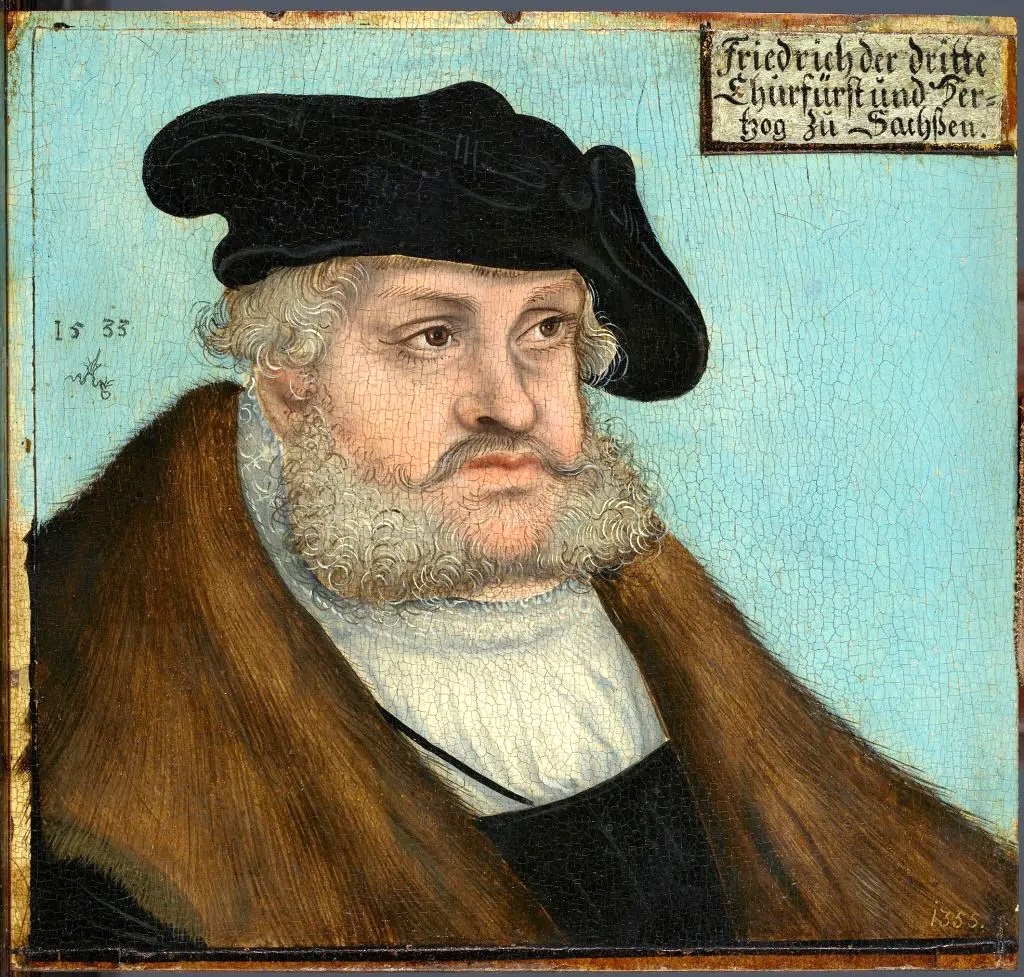
The announcement of the reappearance of this painting of Luther’s prince, with his bushy beard and regal fur collar (and with the spot-it-if-you-can flying serpent that functioned as the artist’s signature), is fitting because this month marks the anniversary of Frederick’s death on May 5, 1525. So much of what happened in the early Reformation had ties to the Elector of Saxon that it’s no exaggeration to say it may not have happened, if not for Frederick.
The Prince Elector came into his office in 1486 with his primary seat at Torgau. Another of his holdings was the fairly inconsequential city of Wittenberg. Frederick had another castle there (among several others), and he wanted to raise the city’s profile. Two projects ensued: first, he rebuilt his castle, bringing it back from some disrepair. Attached to the castle was the All Saints Church, to whose doors Luther is said to have nailed the 95 Theses, igniting the whole Reformation fire.
More important, though, is that Frederick founded the University of Wittenberg in 1502. He hoped to increase the city’s renown and have it claim a place with universities in Heidelberg, Erfurt, and Tübingen as a center of scholarship and learning. It was Frederick’s school to which Luther was appointed by his Augustinian monastic order as a Bible professor in 1512. Luther regarded Wittenberg as Nowheresville and took up his university post reluctantly but obediently. His position as a doctor of the church, that is, as one of its public theologians, both demanded that he speak out and also provided a platform to do so.
The 95 Theses were written from a sense of obligation (and with some indignation) to raise questions about the validity of the church’s practices. Most people know the Theses were written in response to Johann Tetzel’s indulgence-mongering drive in nearby territories. Tetzel promised the penitent donors to Rome’s capital campaign to build St. Peter’s Basilica that their coins would gain a loved one’s release from purgatory.
But Frederick was also tied to the Theses. The prince owned nearly 19,000 relics — objects of veneration, like martyrs’ bones, a drop of the Virgin Mary’s breast milk, or a splinter from Christ’s cross. The prince’s holdings were opened up for viewing annually and, like indulgences, venerating the relics could knock off hundreds of years from your time in purgatory. These practices seemed to Luther counter to the promises he found in scripture about Christ’s actual benefits. Indulgences and relics provided no relief, and their empty claims (even those offered though his own Prince) meant people were sold a bill of goods.
When the 95 Theses exploded across Europe, Rome’s eye was drawn to the backwater university town in Frederick’s Electoral Saxony. It was, perhaps, more attention than Frederick wanted for his city (or, with its infamy, the wrong kind of attention). But the prince was a personage of some influence. As one of the Electors of the Holy Roman Empire, he was among the seven people who chose the emperor. Frederick had been the leading candidate for the job, but he cast his support to the young prince Charles V of Spain who was elected in 1519.
Rome needed the Empire’s support, and to move against the upstart friar and professor in Wittenberg meant asking Charles to make the poor political move of threatening a subject of the man he owed his position to. Charles’ options were limited. What’s more, he needed to raise armies and funds to battle the warlord Suleiman the Magnificent, whose forces were moving up the Balkan Peninsula. Frederick had both soldiers and coins to contribute and could protect his suddenly famous monk with some impunity.
When the Empire pushed back against the Turks, Charles had enough breathing room for a maneuver against Luther. The reformer was called to defend himself in what was nearly a show trial at the imperial diet at the city of Worms in 1521. It was there that Luther delivered his “Here I Stand” speech and where the Edict of Worms against him was drawn up. The edict condemned Luther, demanded that his books be burned, and threatened anyone who supported him.
Because of his political power, however, Frederick the Wise — who was present at the diet — never signed the document. The result was that Luther was wanted dead or alive throughout the Holy Roman Empire, except in Electoral Saxony. The Reformer and, thus, the gospel promises he preached and taught were protected.
It was Frederick who worked behind the scenes through members of his court and friends of Luther to arrange for a fake kidnapping outside of Eisenach, where the prince held another castle, the Wartburg. Because of Frederick’s protection, Luther could lie low in the mountaintop fortress where he grew out his tonsure and beard, wrote continuously, and produced his German translation of the New Testament (in just eleven weeks). At the end of the decade and five years after Frederick’s death, Luther holed up at the Coburg Castle (as good an example of a mighty fortress as you could find), the Saxon prince’s southernmost holding during the Diet at Augsburg, which was outside the territory and where Luther wasn’t safe. Frederick’s power and influence held even when he was gone from the scene.
When the prince died on May 5, 1525, the transition to the new Elector, Frederick’s brother John the Steadfast, was one of a string of important events that made the year one of the most important in Luther’s life. John was, if anything, even more supportive than Frederick. With that succession in place, Luther contended with the rebellion of the peasants in southern German who claimed him as their inspiration. He responded to the humanist thinker Erasmus of Rotterdam’s argument against him by writing what Luther considered one of his best works, On the Bondage of the Will. And that summer, he found himself marrying the escaped nun Katarina von Bora just down Kollegienstrasse from Frederick’s castle and church in Wittenberg.
Among the many paintings that Lucas Cranach produced, the portrait of Frederick the Wise that has come back to Dresden is not the most significant. Frederick’s death created a market for these portraits, and this is one of over thirty we know came out of the Cranach studio. It was easy money. Compared to the artist’s major paintings, it’s a wee turquoise thing. But its size belies the greatness of the person within the frame.








I believe there is a date typo concerning Fredrick’s death 🙂