




Is it more terrifying to suddenly encounter Death alone or as part of a shocked mass of persons?
There is likely not a single correct answer to a question so awful. It is a question that should not have to be asked. And it is an indictment against our species that the violence and degradation that characterizes our history provokes us to ask it.
It is a further indictment, and a dreadful historical irony, that the atomic bomb was utilized to annihilate the city of Hiroshima on the same day as the Feast of the Transfiguration: August 6, 1945. In this overlap there is a darkness that masquerades as light, as well as a light that discloses the glory humankind needs for their flourishing.
In both instances, an agent seeks to change the world. But in one, an agent submits himself to death in order to accomplish the change and in the other, an agent unleashes death upon those who will not submit themselves to it. In one, a man is revealed to be more than what simple appearances would suggest, and in the other, human beings are reduced to nothing — vaporized by the splitting of the atom and therefore subjected to an agonizing and deadly poisoning unleashed in that split.
It is crucial that the truth of the atom bomb be straightforwardly pronounced. Thomas Schelling uttered this truth, characterizing the atomic bombs that annihilated Hiroshima and Nagasaki as,
… weapons of terror and shock. They hurt, and promised more hurt, and that was their purpose … Hiroshima and Nagasaki represented violence against the country itself and not mainly an attack on Japan’s material strength. The effect of the bombs, and their purpose, were not mainly the military destruction they accomplished but the pain and the shock and the promise of more.
(Thomas Schelling, Arms and influence [New Haven, CT: Yale University Press, 1966], 15-17.)
Unfortunately, however, Schelling judges that the atom bomb was a worthwhile strategy in the game of global dominance. And even more unfortunate, he is not alone. These attacks have been depicted as tragic, but necessary, measures for bringing the war with Japan to an end. They have been credited with saving lives through the liquidation of others. But this has never been true. These bombings were acts of state terror so horrible that their perpetrators had to convince themselves and the world there was no other way to avert further disaster and bloodshed.
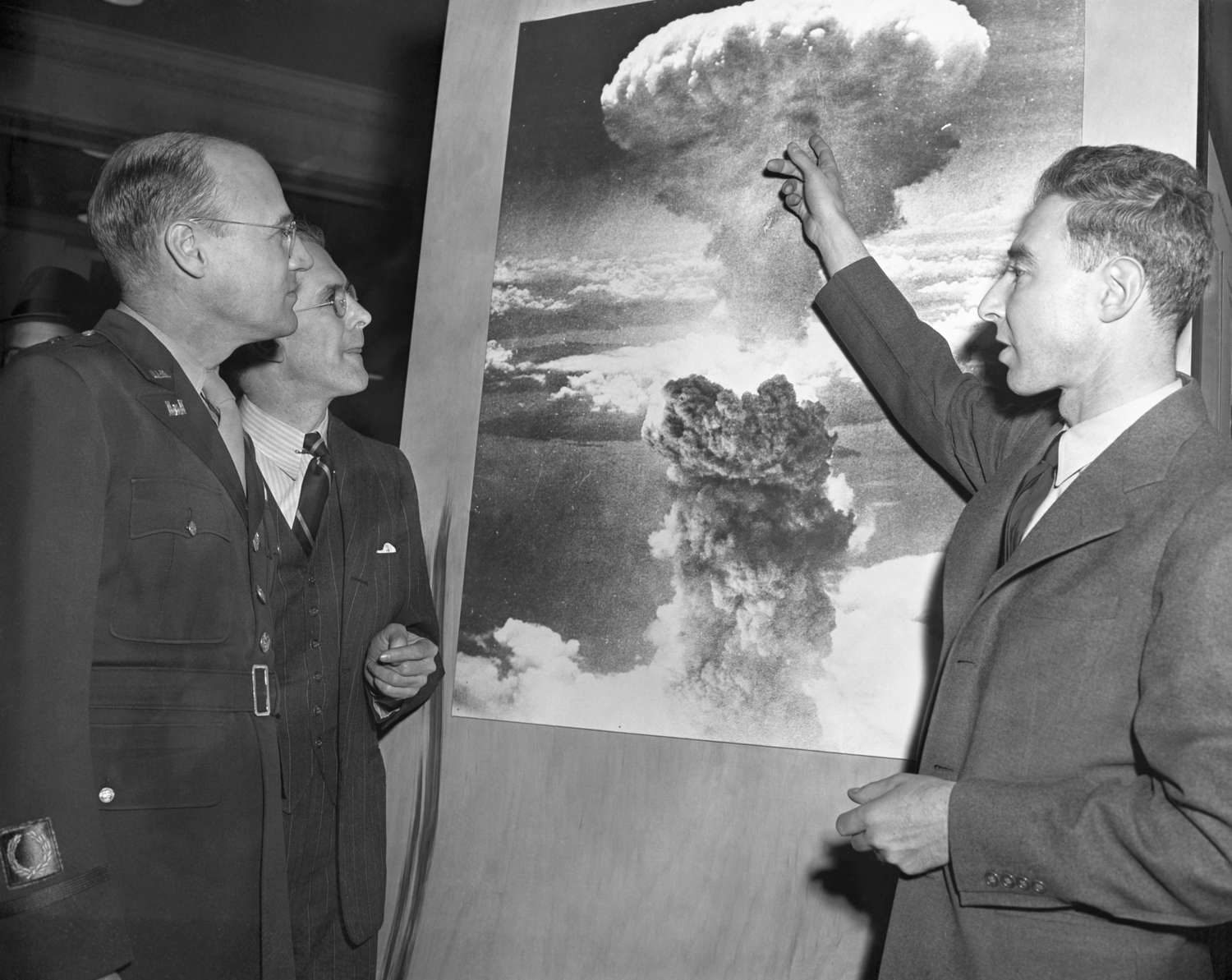
Brigadier General K. D. Nichols and Professor H.D. Smythe listen as J. Robert Oppenheimer discuss the atomic bomb in February 1946.
President Harry Truman asserted that Hiroshima was attacked in order to avoid the killing of civilians. This was a lie. The United States Strategic Bombing Survey reported in 1946 that “Hiroshima and Nagasaki were chosen as targets because of their concentration of activities and population.” The report further concluded that,
… the Hiroshima and Nagasaki bombs did not defeat Japan, nor by the testimony of the enemy leaders who ended the war did they persuade Japan to accept unconditional surrender … [These leaders] had decided as early as May of 1945 that the war should be ended even if it meant acceptance of defeat on allied terms.
Atrocity is never necessary. It is a choice, one unsanctioned by God. And the forces that compel us to manufacture justification for atrocities do not and never will reflect the grace and glory of God.
The bombing of Hiroshima coincided with the commemoration of the Transfiguration. While that coincidence was surely unintentional on the part of Hiroshima’s executioners, the Transfiguration is a moment in which the only agent that is unreservedly worthy of changing the world receives the strengthening he needs to face Death and to do so alone.
After the appointment of the apostles, Jesus unveiled the trajectory of his mission, and it is one his followers cannot comprehend. For though he is the long-awaited Christ (Lk 9:18-20) he will die a humiliating death and calls for all who would follow him to bear in themselves the same crucifixion he will undergo (9:21-27).
This was deeply confusing and shocking for his disciples. Hence why Jesus selected three of them — Peter, James, and John — to witness an unfiltered glimpse of the glory he shared with his Father before the creation of the world (Lk 9:28-36). Before their eyes, the man they knew was transformed, radiating light and glory like they had never before seen. But this was not to impress them: it was to act as a ballast against the darkness that was to come. For death awaited their master — cruel, excruciating, humiliating death. And if that death was to be understood as anything other than defeat, they had to witness an event that demonstrated Jesus had not been taken by surprise or simply overpowered by the forces of this world.
On the mountaintop these men were allowed to peer into the inmost being of God to witness what is most fundamental to him: inexpressible glory and invincible love that takes up its cross. Having witnessed this, they will be able to recognize, however haltingly, however disoriented with fear and anguish they may be, that the darkness to come is willingly taken up by Jesus.
The man they have followed is humble, even to the point of death by crucifixion (Phil 2:8). But this is not all he is. There is something else about him that comes from beyond the normal givens of this world, an inexhaustible flood of glory that is always operative, that can be concealed or revealed at any moment. Jesus’ being gushes with the torrent of life and light and love that is God himself. This is what will hold against the torments of death, against the state’s attempt to liquidate this opponent of the regime. He will not be confined to the ash heap of history, disavowed and forgotten. He is the ineffable and pulsing current of life itself, subverting death to accomplish its defeat.
Apart from this, the coming cross is a terror and an overthrow. But taken together, as they must be, transfiguration and cross form two foci of an ellipse. For Moses and Elijah speak to Jesus about his coming death. They are present to encourage him and his disciples both, for the cross is only rightly interpreted in the light of the transfiguration. Contrary to the assumptions of fallen humanity, the glory of God is not above the ignominy of weakness and crucifixion. For there is never a time, in the history of the creation or in the mind of God, in which his dignity and his mission to save have not belonged together. There is no time at which God has not determined to assume the hard wood of the cross for humanity.
The residents of Hiroshima also beheld a brilliant, never before seen light. For many of them, however, that glimpse lasted less than a second as the explosion’s blast consumed them from the face of the earth, rendering the city a hell-scape, and etching shadows into sidewalks and buildings where people had stood only a moment before.
This naked display of power echoes an incident that shortly followed the Transfiguration in which two of the disciples who witnessed it fail to reckon with the character and purposes of their Lord. When a village refuses admittance to Jesus and his disciples, John and James indignantly ask Jesus, “Lord, do you want us to tell fire to come down from heaven and consume them?” (Luke 9:51-56). Jesus rebukes them for even considering such an idea. His glory is not the brittle egotism to which we and his disciples are accustomed.
A theology of the cross does not repudiate the glory that properly belongs to God; it simply defies the conventional notions of glory assumed by rebellious creatures. Not all glory is truly glorious. The glory disclosed at Hiroshima and Nagasaki is the empty glory of mankind (δόξαν τῶν ἀνθρώπων, Jn 12:43) that is oriented only towards vanity, avarice, and death. The glory disclosed in the Transfiguration, however, is the light, life, and love that is God’s inmost self.
There could not be a more stark contrast, therefore, between this one and the belated deliverers of later centuries, for whom peace typically requires the destruction of noncombatants and the devastation of land. The way of Jesus Christ, however, confronts and exposes “necessary evils” as necessary only to the powers and interests that are inimical to the Kingdom of God. The glory sought by these powers has nothing to do with the glory of the one who is both creator and redeemer, full of grace and truth (Jn 1:14).
Not all light is indicative of God’s presence or blessing and not all darkness is from the Evil One. Jesus warned, “be careful lest the light in you be darkness” (Lk 11:35). The evil that ravages God’s creation often masquerades as an angel of light (2 Cor 11:14) and must be opposed however attractive it presents itself to us. Diametrically opposed to this is the light of the world who made his home in the darkness that opposes him and his love. Sin and Death deceive with false illumination, whereas the grace of God authenticates itself in the gifts of freedom and life. The glory that accords with coercion and dominance will give way to death. But the glory of God rises out of death to renew the objects of its love.








Good commentary on the Transfiguration, but a horrible interpretation of Hiroshima and Nagasaki.
The war with Japan was a war against Imperial Japan that had waged war and wrecked devastation, conquest, death, slavery and rape upon Korea, China, Southeast Asia, and Pacific Islands. Japan dragged America into WWII. Hiroshima was a military and an industrial target. The fact is that the Japanese leadership did not surrender in April, or May after Germany surrendered, or June or July 1945. They did not surrender until after the second bomb was dropped on Nagasaki.
Appreciate the comment, Bill, but it is incorrect about the bombings, as the report from the Bombing Survey I quoted shows. Japan did attempt to surrender prior to Hiroshima and Nagasaki but the US would accept nothing less than unconditional surrender. Japan was hoping for the Soviet Union to mediate a surrender but that hope was abandoned when the Soviet Union declared war and launched attacks Japan-ward. Hiroshima and Nagasaki devastated but did not bring pacify a still militant Japan: they were already defeated and knew it. And above all else, if we’re speaking Christianly, the ends don’t justify the means. That’s the biggest point: even if it was the bombings that accomplished Japan’s defeat, it doesn’t make it right. Given that they didn’t, it makes the bombings all the more atrocious.
I’ve changed my mind on this so many times. Today I’m with Ian. “It doesn’t make it right” sounds about right to me.