




You can learn a lot about someone by how they are buried. The way a person is memorialized can often indicate how that person lived. Being buried with military funeral honors, for example, sets a very different tone from having Frank Sinatra’s “My Way” sung at a person’s celebration of life. How does a person want to be remembered? As successful, influential, accomplished, caring?
The irony of legacy is that it is the enemy of love. The more we get caught up in how we will be remembered, the more we become focused on ourselves (and, subsequently, the more insufferable we become while we are still alive). While legacy lives in the future, love lives in the present. Only one of them, according to the Bible, never ends.
In her short poem called “On Burial,” Mary Ruefle writes, “There are only two tombs: the tomb of Jesus and the tomb of Tut. Roll away one stone and you will be given everything: food, clothing, shelter, gems, cloth, seeds and oil, a replica of the world in pure gold. Roll away the other stone and there’s nothing.” The poem is as striking as it is brief. In two sentences, we are given two kings from two vastly different kingdoms. Their tombs provide everything we need to know about them.
King Tut’s is as good a tomb as anyone in his day could have hoped for, filled with everything one could ever want in the afterlife. Five rooms of treasures including thrones, statues and arms. The innermost layer of his three-piece sarcophagus was 240 pounds of solid gold. Tut was not only hoarding such ludicrous amounts of wealth for the hereafter, but showing how great a king he was. Preserving one’s legacy was the way to ensure immortality. Even though King Tutankhamun ascended the throne at nine years old, he would have begun planning his burial immediately. While his life would be prematurely cut short, his tomb would be a grand attempt to live forever. In order to assure his spirit would be sustained in the afterlife, it was a memorial made to last through the ages.
And yet, within a few years of Tut’s burial, his tomb was robbed twice. To make matters worse, the Valley of the Kings is subject to periodic flash floods and the entrance to his tomb was eventually covered in sediment, rendering it inaccessible. While his memory has, indeed, lasted through the ages — his treasures will likely be on the museum circuit until kingdom come — Tut’s significance is only as a collection of historical artifacts. While his memory lives on, King Tut remains indisputably dead, his tomb now emptied of its adornments.
Even more, the worldly items that promise life ultimately lead to death. If legacy is the enemy of love, possession is its grave. We yearn to get our hands on the things we think will sustain us — wealth, abundance, basic necessities — in order to assure ourselves of our own survival. We all have a hunger to complete whatever is missing in ourselves and, like Tut, we try to fill the void with whatever we can get our hands on. We may try to stockpile our souls with worldly goods, but our need is never-ending. This is what Plato meant when he said that human love is the child of poverty. We may sign checks with our love and affection but they soon come back marked as “insufficient funds.” As soon as anything – a person, a career, possessions – becomes a means to self-fulfillment, it is doomed. It will fail to survive under the weight of our wanting or the sands of time.
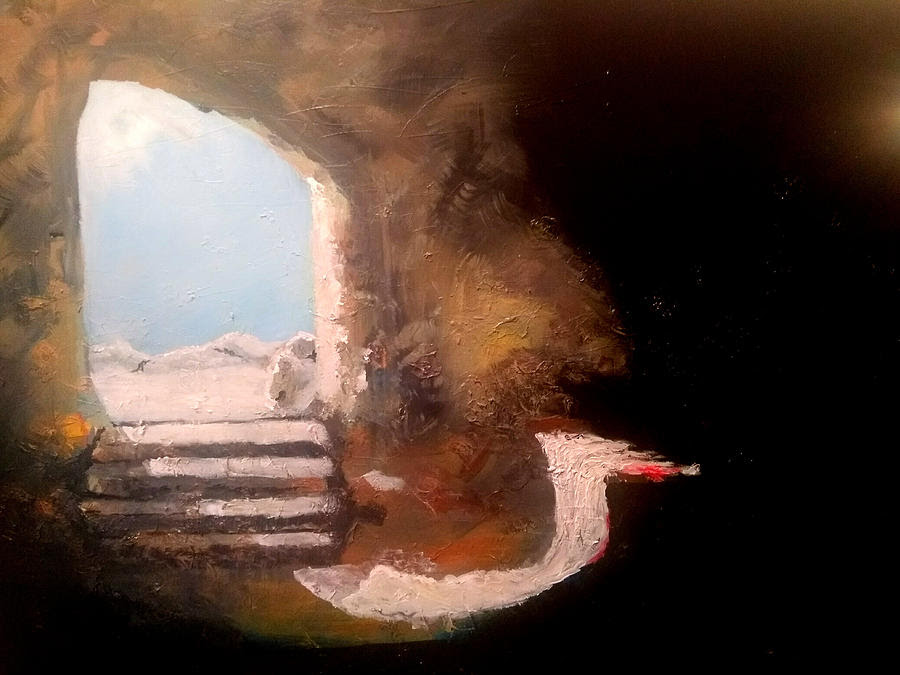
But then there is the other empty tomb. It was not designed for its sole occupant, but, rather, borrowed at the very last minute. Foxes have dens and birds have nests, but the Son of Man did not even have a place to lay his own dead body. It was not laid to rest in a valley of kings, but in a garden tomb next to Skull Hill. Hardly a bad place to rest in peace, but nothing worthy of a king. There was, of course, a threat of grave robbers — the religious leaders made sure to have the tomb guarded in case Jesus’ followers wanted to steal the body of their rabbi back — but there would not be any gold or gems to steal. Nothing but spices covering the already-decomposing corpse. Who would want that? And yet, this vacant tomb has generated far more than the curiosity of a few archeologists.
Even in its aftermath, Jesus’ resurrection is still far less glamorous than King Tut’s burial. Where there once was a dead body, there is now a vacuum. He was not even there to announce his own immortality. It’s a bewildering surprise when the man dressed in white tells the women at the tomb, “He has been raised; he is not here.” The words themselves are as casual as if he were explaining to Jesus’ mom that he had hitched a ride home from school with a friend. Jesus only announces his resurrection by his absence.
At first glance, Jesus’ resurrection is as disappointing as his unceremonious funeral. Burying a hero in honor and allowing him to rest in peace is far more dignified than having him be raised and then mistaken for the gardener. What kind of legacy is that?
Thankfully, Jesus could hardly care about legacy. Legacies, after all, are for dead people. And why do we seek a legacy among the living? Unlike Tutankhamun (and us, for that matter) Jesus heeds not riches nor man’s empty praise. He does not need any drawn out eulogies or an earnest epitaph to give meaning to his life. Jesus knew all along that there was no need to obsess over his grave knowing that it would only be used for the weekend anyway.
Love is a far greater currency than legacy in God’s eyes. Not only do the greatest tombs fall prey to robbers and natural erosion, but they are stuck in the past. Jesus, however, is alive and well. He surely does not need a tomb to speak for him. He who has been raised speaks for himself.







[…] “A Tale of Two Empty Tombs,” by Sam Bush […]