




Welcome back, boils and ghouls, to the next installment, the second of Mockingbird’s spooky summer series! Blaine, Blake, Caleb, and I have lit the fire and set up the projection screen in the backyard to watch Jordan Peele’s NOPE (2022). Grab a drink and set up your seat: it’s showtime, and you don’t want to miss Peele’s Western-inflected examination of the monstrousness of spectacle.
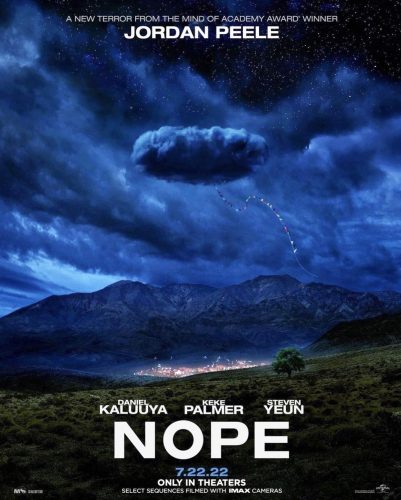
NOPE, advance poster, 2022. © Universal Pictures / Courtesy Everett Collection
Ian: I think what prompted me to pick NOPE was, well, pressure from Blake.
Blake: You know you loved it!
Ian: No, I did, it’s just that one scene — that one — rivals Quint’s demise in Jaws for me. So I also most definitely hate it.
Blake: YOU KNOW YOU LOVED IT.
Caleb: Hey, I’m just glad to see someone from TMZ eat it.
Ian: That scene is so funny to me because someone could say, “This is caricature,” but I would counter that lots and lots of people live as caricatures rather than real and aware moral subjects.
Blake: BURN.
Blaine: Yes! I think that is embedded in the film. It’s part of the reason Jupe created a shrine to the most traumatic and horrifying experience of his life that he exploits for financial gain.
Blake: What the — Is this just how you think? In mind-altering ways?
Ian: Blake, you know this! But to his point, what does Jupe sound like? “Dupe.” He tries to sell a story to others, but first he duped himself.
Blake: Well! To add to it, I would say that the whole film, I think, is engaging and commenting on spectacle in our world. We are all, to some extent, becoming less human and more spectacle, whether that is becoming consumed by ideology or by fame or fortune or power. The creature is a reflection of us. It does not consume when it is not viewed. We stop consuming when the cameras are off. The narrative itself shows our protagonists trying to get the “Oprah Shot,” who is the epitome of spectacle.
Ian: I noticed many more times this viewing how often the word “spectacle” is actually explicitly uttered.
Blake: To be seen by the world is a quality, I would say, in opposition to being seen by God.
Ian: In that vein, your Father sees in secret. That’s why we go away to our closet to pray, to not be seen by others.
Blake: ACTUALLY, my father is dead.
Ian: Yeah, well, you have to pray to be seen praying…
Blaine: One hundred percent, Ian. I think that’s why the eye/mouth of Jean Jacket [the creature] is a camera lens.
Ian: 💯💯💯. Let that not be lost on anyone!
Blake: It’s genius, the creature design.
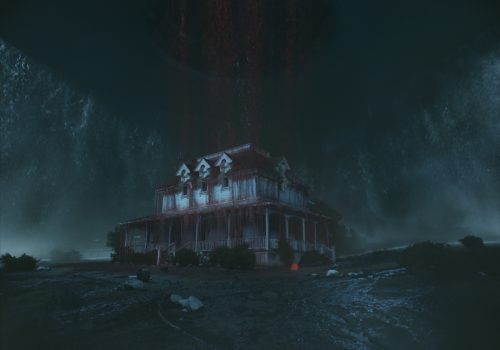
Ian: That is a frightening reveal — we retroactively realize that our initial glimpse inside of the monster was one in which it was looking at us the entire time.
I’ve alluded to this already … yeesh. It makes me deeply, deeply uncomfortable, but I think it’s an important scene that we see the audience at the Star Lasso Experience getting eaten by Jean Jacket. The thing is, what we see is the movie’s analogue of spectacle: what it does is it eats you alive and it spits you back out. It grinds you into paste and excretes you. That’s the threat of Jean Jacket explicitly, on-camera, but it’s the threat of spectacle itself. Such that TMZ guy is pleading for his camera, befuddled why OJ isn’t filming what’s going on. It does not compute for him how OJ isn’t trying to capture the spectacle of this monster and its imminent devourment of him!
It isn’t first and foremost, it is the only thing on his mind as he is about to be consumed, and that is what I mean where someone might say, “That’s a caricature; this is just allegorizing what it is like to be beholden to the Spectacle.” The problem takes other forms in other epochs, but right now the problem is that we are beholden to the spectacle and incentivized to behold and participate in it, such that beholding and participating is the only thing on our minds, and we go willingly to be eaten alive.
Blake: Incentivized and yet never gratified.
Ian: Right! It’s so fitting. It seems to me that the ethos of our time is “I am to the extent that I am an exhibitionist of my life.” And there are monsters — there are literal monsters — that make their living off of that. That is how they exist, how they feed, how they persist.
It’s consuming and being consumed. NOPE, I think, portrays the emptiness of that relationship because you don’t arrive at something. We want to be seen, we yearn so desperately to be seen, and being sighted is enough, even though inevitably you are going to be sucked up and squished as the camera monster flexes and turns you into blood rain. Participating in the economy of Spectacle is a covenant with death.
Blake: In light of NOPE’s commentary on spectacle, everything creating spectacle, from one’s own past to being addicted to getting proof of Jean Jacket, I would like to make the argument that proof — within the rationalist, Enlightenment mode — is a version of spectacle because it demands sensory information that can be clearly relayed to another so as to put their doubt to rest. Essentially getting the Oprah Shot.
The desire to deliver proof about reality or ontology is such that it will inevitably devolve into spectacle because it is an item to be sensed (viewed, read, felt, etc.) and because of what we have said about spectacle thus far. Proof then makes the retriever and the receiver consume and be consumed by something that ultimately does not “objectively” confirm nor negate the reality of something.
Ian: That can be contrasted with “Come and see.” That’s what the very first disciples hear from Jesus in response to their question, and that’s what they begin to tell others as they are seeking to draw them to their master. “Can anything good come out of Nazareth?” “Come and see.”
What kind of proof are we talking about? I think that’s one of the biggest problems with scientism. I said earlier that I am to the extent that I exhibit. But scientism similarly believes a thing is only as real as its quantifiability, which is spectacle, because a thing is only worth acknowledging as much as it yields itself to my mastery, to my organizing concepts, which are treated not as attempts to grapple with what is but simply, nakedly, as what is.
Blake: “Come and see” intends not just “proof” that avails your doubt but the inherent giving over of yourself and the dangers inherent in that for you by going to see. That kind of proof is a fully embodied proof.
Ian: Precisely this, exactly this. There’s no detachment in “Come and see,” like there is in the presentation of the Oprah Shot as a demand to surrender.
Blake: Alright. I shall shut it so Caleb and Blaine can speak to this stuff.
Caleb: Oh gosh, I don’t even know where to begin … I wonder if spectacle might not necessarily be a bad thing though. Peele explicitly makes this movie as a celebration of spectacle, too. It’s Spielbergian in some sense. It causes us to feel awe and wonder. And it’s finally giving us the black cowboy hero we’ve overlooked for 150 years.
Ian: For sure.
Caleb: Like you say, Ian, “Come and see” is a command to enter into joy and reconciliation. The spectator is not necessarily always a bad entity. Jean Jacket may be a godlike figure that destroys through voyeurism, but that is not the God of the Bible. That God, in the Old Testament, is named by the outsider — abused Hagar and abandoned Ishmael — as El Roi, the God Who Sees (and saves) us in our distress. And Zacchaeus is a great sinner who desires to spectate the Lord from a tree but finds that the Lord already had his gracious eye fixed on Zacchaeus, whom he grants salvation that very day.
Ian: Great points, Caleb, but I think there’s a distinction between awe-inspiring sight and spectacle. There is substance in one and emptiness, consumption, and life’s opposite in the other.
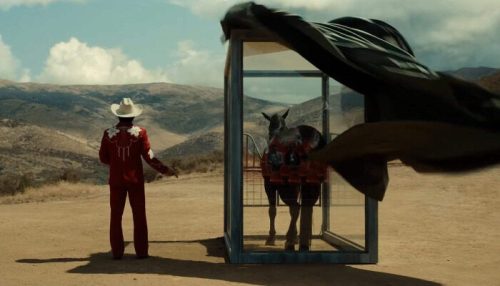
I caught it much better this time around — probably because I had the volume up higher since my oldest kids were spending the night elsewhere — that Antlers says we don’t deserve the Oprah Shot and even dies to keep it out of human sight. The ending feels a little Pyrrhic to me, since capturing the impossible shot seems to rank about as high as defeating Jean Jacket.
Blake: However, Em does not care about the Oprah Shot in the end because OJ is alive. Which is the emotional payoff for me when it comes to denying the spectacle in favor of those we love.
Ian: Yeah, good point.
Blake: Can we just take a minute to celebrate Michael Wincott? His rendition of “Purple People Eater” chills me to the bone.
Ian: Cheesiest moment of the film for me.
Blake: I love it.
Ian: I just don’t get why. It feels so nonsensical to me, a dramatic reading of “The Purple People Eater.”
Blake: Look, I like Michael Wincott and his raspy voice, and it’s just unadulterated joy tinged with fear among friends before they endeavor on the most dangerous task of their lives.
Ian: It’s the only point in the movie for me where it stops feeling like something with stakes and feels like people in a movie doing a self-conscious, self-referential thing. I thought for sure we were going to commiserate how forced that part was.
Blake: I mean, I get your critique. It just didn’t gall me the way it did for you.
Ian: I think that if, in a planning session to achieve the Oprah Shot, I began whisper-singing “The Purple People Eater” in a grave and gravelly manner that you would rightly say, “…What? Dude, what are you doing? Do you think you’re in a movie or something?”
Blaine: I feel like I remember seeing or reading someone in the film industry who essentially said there are a ton of DPs who dress/act/speak like that. Which is hilarious.
Ian: Boys, let’s get real. Does NOPE feel summer-y to y’all?
Caleb: Totally, it’s summery in that it’s about big, sunny action movies and is itself a big, sunny action movie.
Blake: Yes, in the same way most Westerns do. The heat and sun just exasperates the violence and the tensions.
Blaine: No. Because I don’t hate it. But! I can’t let this conversation close without simply stating: Akira slide = 10/10. It’s one of the few times I’ve audibly cheered in a movie theater!
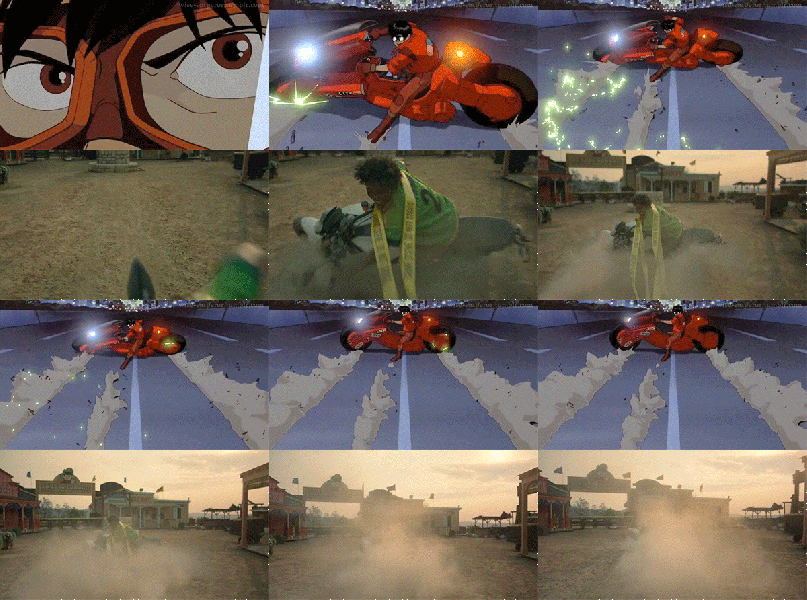
Ian: TETSUOOOOO!
Blaine: KANEDAAAAAAA!
Caleb: On the Akira homage, what other explicit references or implicit influences did y’all see?
Blake: I mean, its central aesthetic and textual tie is to the cinematic tradition of the Western. Just with elements of horror worked in.
Caleb: I think I detected some John Williams in the score.
Ian: I don’t know that there’s a specific image that did it, but I felt echoes of Close Encounters at points.
Caleb: Yeah, Ian, I felt that, too!
Ian: Also implicit, the Star Lasso Experience brought to mind King Kong. Which also features commodified mastery making a show of having understood and bested a wild thing.
Blake: Which was likely intentional. The Shining with the blood flood, I would say.
Ian: Even the blockbuster valence of its echoes make it feel summery.
Caleb: Oh, definitely!
Ian: Good golly, and the Jean Jacket in the room is Jaws, come to think of it. Because this isn’t just a big thing that ate some people. You think you’re hunting it, but its hunting you. And it’s going to eat you.
Blake: I think you’re gonna need a bigger horse…
Thanks for joining us, folks! We hope you said “Nope” to the naysayers and enjoyed the film and our discussion. We’ll be back next week with Emma Tammi’s The Wind (2019) and all its High Plains frightful fun. Be there and be square!







