Did you know that 2023 is the ten-year anniversary of Frozen? It’s true. The movie came out in 2013 and yet it’s still incredibly relevant. I can probably count the number of days my daughter hasn’t requested to listen to “Let It Go” on one hand. Honestly, I don’t know how many times I’ve watched the film at this point — enough to recite the entire thing from memory. Maybe it’s just my daughter, but I don’t think so.
Part of it is the catchy tunes, obviously. Part of it is the loveable Olaf. Part of it is the cool ice-powers. Part of it is the plucky, headstrong, and gullible lead. But at its core, what makes Frozen worth watching again and again and again, at least for me, is how it very clearly shows the folly of antinomianism — thinking we can be free of or outrun the Law.
Think of the law as the little voice in the back of your head that tells you that you must be doing to finally arrive at some measure of contentment. You don’t work enough. You aren’t a good enough parent. You don’t pray enough. You aren’t in good enough shape. The law always promises that just a little more will solve every problem, great or small. By contrast, Antinomianism posits we can be free of such thinking by our own effort. But the law always finds us out; Frozen shows us as such.
As the story goes, Elsa is a princess, born with magical ice powers. She can make it snow, freeze water at hand, and shoot ice out of nowhere. It’s all impressive (and fun) until she accidentally hits her sister Anna in the head with an errant shot of ice. After some impressive work by a troll elder, the family agrees to cover up Elsa’s powers. “Conceal, don’t feel” is the mantra or Law.
Elsa’s life is ruled by the Law. Control the magic. Control her emotions. Conceal her powers. The castle is closed; relationships are cut off. Disciplined restraint with everything, lest the danger burst out unexpectedly. But despite the extreme measures, it doesn’t work. Her body rebels against it and emotions only make it worse. Elsa dons a pair of gloves to help to keep it at bay, but their help only goes so far.
Sadly, the King and Queen perish in a shipwreck, leaving Elsa and Anna alone. Elsa is to be queen, but she can barely get through the coronation ceremony without her powers making an entrance. Surrounded by dozens of curious guests, Elsa’s self-discipline dances on the edge of a knife. When learning of her sister’s fast-moving relationship, a dispute ensues and it all proves too much. Trying her best to control her emotions, resorting to self-talk, Elsa finally succumbs and lashes out accidentally throwing needle-point icicles for all to see. Exposed and afraid, Elsa flees to the mountains.
It’s at this point that Elsa begins to sing the now famous earworm, “Let it Go.” This song won awards at the Grammys and the Oscars. It was the first Disney song to chart in the Top 10 of the Billboard Hot 100. For many, my daughter included, it is the most memorable part of the movie.
In the song, Elsa sings about the shackles placed on her didn’t prevent the public from finding out about her powers. Instead of concealing and not feeling, she’s going to let “it” go: let go of her powers and let go of trying to control them. “No right, no wrong, no rules for me. I’m free!” she sings at one point.
This sounds empowering at first blush. Her powers were treated as a curse and confined by the rules her parents (mainly dad) set up to try and limit the damage. But instead of helping her flourish, the Law only isolated her and left her feeling hollow. Now she’s free. She’s let it all go and she can be herself. Happily ever after, right? You can flee to the mountains in solitude, but you can’t ever outrun the law.
Perhaps it’s because how just how catchy the song is, or how much its message of freedom and self-empowerment reflects broader cultural ideals, but it seems that everyone forgets where song falls in the story of the film. If Frozen were a Broadway musical, “Let It Go” would be the villain’s song, where the antagonist reveals their evil plan and dangerous philosophy of life. Elsa has found freedom and cast away her fears, but became something of a villain in the process.
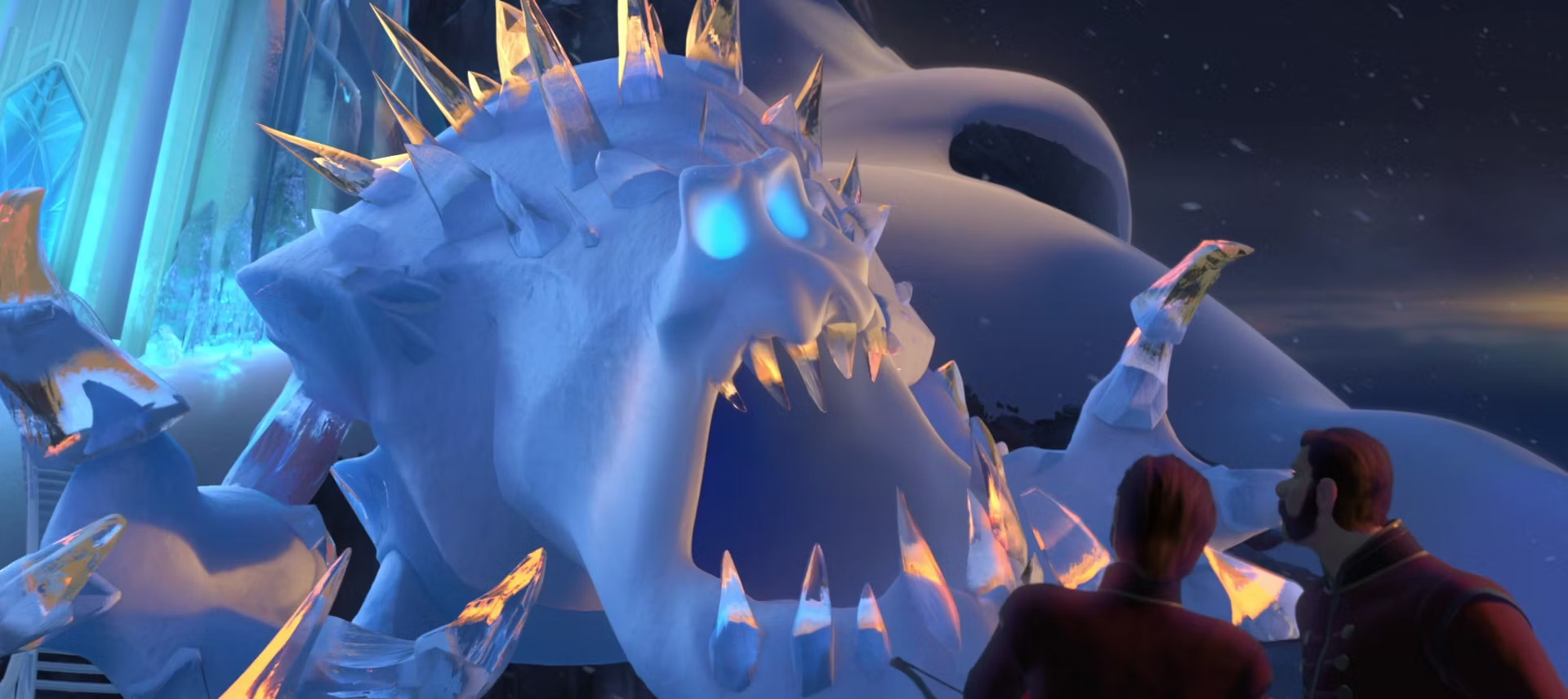
In her emotional outburst at the coronation party, Elsa unleashed an “eternal winter.” It’s the middle of summer and the kingdom is thrown into the depths of the worst winter this vaguely Northern European country has never seen. When Anna finds Elsa and tries to convince her to come back and fix the mess Elsa made, the Ice Queen acts out again — this time shooting ice into Anna’s heart, a terminal diagnosis.
Elsa tried to outrun the Law. She thought she was free of it, but it found her anyway with tragic results.
And that’s the problem with antinomianism: it doesn’t work. We can’t outrun the Law because it is incredibly malleable and always finds us out no matter what. The end of the Law isn’t found in us singing along with Elsa, “No right, no wrong, no rules for me, I’m free.” We can’t outrun the Law into the mountains and be free of it. It will chase us there, coming back with a vengeance.
What we need is someone to else to free us from its power. It’s been ten years, so I have no problem telling you that Anna does this for Elsa. Anna takes Elsa’s place when the demands of the Law, in this case a sword coming down on Elsa, on herself. Of course, in this act of true love, there is both death and resurrection: Anna doesn’t actually die but comes back and further frees Elsa by suggesting love as the source of power, not rules/the Law.
This is the work of Christ. He took on the demands of and freed us from the Law in the Cross, his own act of true love to break its curse. We can’t outrun it, but the Law lost its power to condemn and make us feel “less than.” You can’t outrun or let-the Law-go. Elsa shows us as much. But now, because of Jesus, you don’t have to. Instead of being dead because of the Law, we are made alive for God.
And that’s probably something we can sing about too, even ten years later.