




On my computer at work was a roadmap to a financial destination. We were currently short-staffed and overtime was aplenty. As a one-income family, I grabbed my pickaxe and headed West for the gold mine. I charted the whole month and filled my weeks with the maximum hours I could fit in. My wife and I were sick of scrubbing fried egg off our toxic pans, and I was going to live the dream with the witchcraft of Caraway nonstick ceramic. Maybe finally put some money away for the fence we’ve wanted since we moved in. We’re raising wild children and they need to be contained, for their safety, of course, but primarily for our own sanity. It was clear. My vision, my goal. Then before it even began, it all fell apart.
If you’re a parent, you are certainly aware of the downward spiral a household can be sucked into. No sooner had I constructed my golden calf of overtime than my demise was sealed. First, my daughter was hit with some virus which resulted in blistery lips, labored breathing, and bumps across her fingers. Next, my son woke up with double pink eye, followed by my wife catching what my daughter had.
This was not the ideal, romanticized version of marriage and family we’ve been sold. There was a storm wreaking havoc in my home — interplay between the uncontrollable sicknesses of children, concern over whether I was going to catch something and have to miss work, and wondering if I’d miss out on overtime and thus miss my fated day with the Caraway nonstick pan. Is my wife exhausted? How is her mental health? I was trying to understand these questions in my limited awakened state and moments of sanity. Also these: Is my wife upset at me? Does she think I’m working more than I should? Should I be helping out more? Was that tone meant to imply something? Does this food taste weird? Is she poisoning me? You know, the typical questions that circulate in your mind.
This isn’t the idyllic ’90s television family I grew up watching. It’s a real-life, boots-on-the-ground family — something we’re all acquainted with. I remember growing up with movies depicting issues in the home, but they were sugarcoated with cheesy music and an ending where smiles were galore and all was well. Did Hollywood lie to me? Impossible.
In the recent movie Eternity, we see a fresh take on the romantic comedy. It’s a film with a wacky and absurdist take on the afterlife. An elderly couple dies, and they go to “heaven,” which is a godless, Americanized, and capitalistic society with numerous options for your afterlife needs. Brochures and convention-style booths display what each afterlife offers to the prospective soul in the airport terminal–like lobby. Director and co-writer, David Freyne, envisioned a place with substantial human influence:
It was really important to me that this junction, this kind of limbo, feel very real and very human and very bureaucratic. That it had layers and boredom and tedium, and it has its own mechanics and works in a certain way. It didn’t need to feel celestial or otherworldly. It just felt very human, and we built it that way.
And in a lot of ways, the majority of our modern depictions of heaven are exactly that: human. Over centuries, the imagery of heaven has developed as theologians, artists, and laypeople attempted to understand the mysterious idea of life after death. From mere ascension to a place in the stars to Greek ideas of the Empyrean, we attempted to give heaven a true location or visual aspect for us to understand. The Renaissance and medieval eras, with their beautiful paintings and great literature contributions, also stuffed baggage and transported it to our present times. Icons or imagery in order to understand a truth are important to the faith and yet can also lead astray. Once blended with modern culture, heaven became an idealized, almost American dream-esque idea where your deepest desires come true. Suffice it to say, this couldn’t be further from the biblical idea of a new heavens and new earth, in which the afterlife is depicted as a re-creation of all things according to God’s desires and is very “earthy” as opposed to “out there-y.”
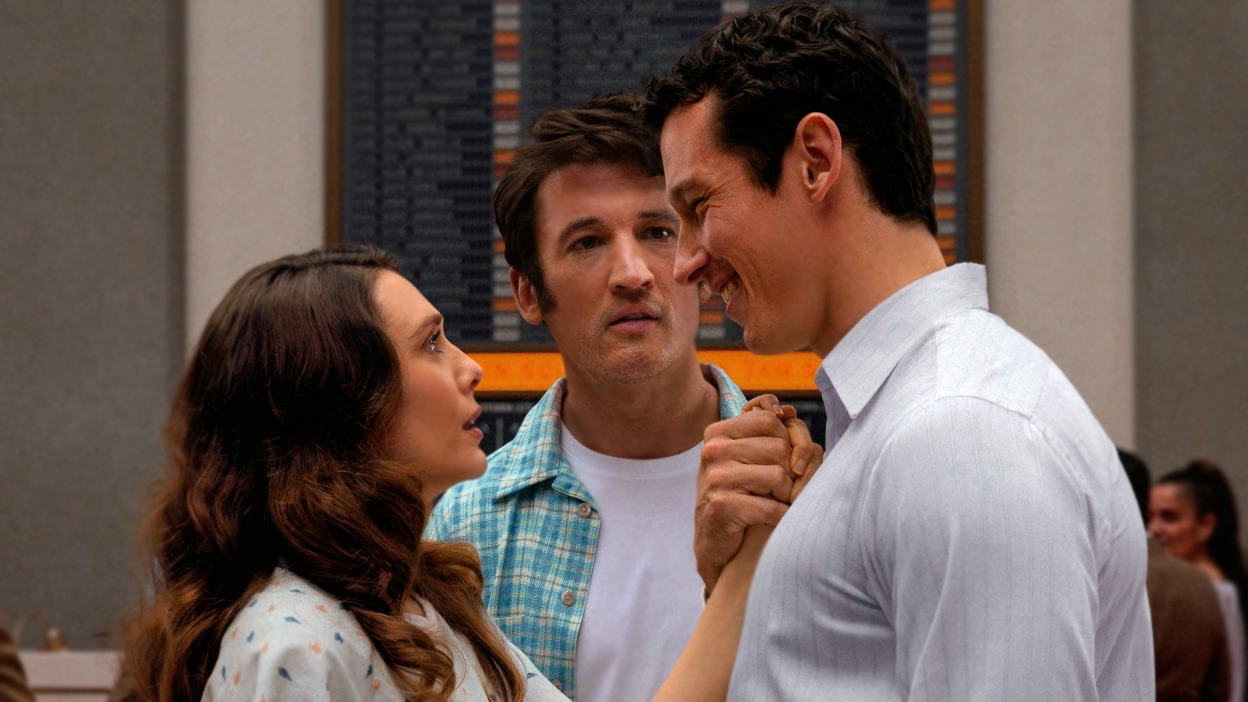
But back to Eternity, where whichever afterlife you choose, there is no going back. Your choice is where you will be forever, for eternity. This becomes the crux of the film as Joan, played by Elizabeth Olsen, is burdened with an unbearable choice. When Joan and her longtime husband, Larry (played by Miles Teller), arrive to the afterlife, they find that Joan’s first husband, whom she was married to for two years in her early twenties before he died in the Korean war, is patiently awaiting her arrival. They realize he’d been waiting 67 years for her so they could go on into the eternity of their choice together. Obviously, this poses a difficulty, since she has now arrived in the afterlife way station with her husband of 65 years. She’s done the gritty day-to-day with this man, created life in their children who’ve grown up and given them grandchildren now. They share experiences and a bond that can only come from the grind which shapes and molds a marriage.
Joan finds herself confused. It’s quite tempting to experience a love one has never had the chance to explore. In one sense, it was stolen from her. She’d always wondered about what could’ve been. In another sense, she’s not that person anymore. Life has a way of chipping away at our marble-block soul and shaping us into something different over time. As the film unfolds, we see her slowly realize the difference between an idealized romance in her head and the reality of the past 65 years of her time on earth.
These are questions everyone wonders about. Whether Christian or not, religious or not, people play with the idea of the afterlife and what it will be like, or if there even is one. The afterlife depicted in Eternity certainly seems to fit the view in modern America, unfortunately sometimes even in the church. It’s a personalized and self-focused afterlife of perfection. You get to choose your own heaven, as if it were some sort of streaming app.
In many ways, Eternity is a fictionalized version of the question Jesus famously answered when Pharisees posed questions about marriage in the afterlife. Jesus was presented with a hypothetical situation where, according to Mosaic law, a brother takes the wife of his now deceased brother. This brother then also passes away, and another brother marries the woman. This pattern continues for seven brothers. Then the infamous question: Whose wife will she be in the resurrection? I can only imagine the intensity of the decision if Joan had five additional suitors — somebody call Angel Studios.
Jesus, of course, responds in his characteristic paradigm-shattering way, offering a nonchalant comparison to the life of angels. Suffice it to say, whatever our thoughts or ideas on the afterlife may be, Jesus may have something else in mind.
As a matter of fact, Jesus has an entirely different view of heaven than we do — and not just with regard to marriage, but its location, when one enters it, and what it means for day-to-day life. Typically in American culture, in the church and outside it, heaven is viewed as something in the future. A place awaiting us, a light at the end of the tunnel. It’s not something that impedes or impacts our life besides a little behavior modification here and there to pad your resume and ensure those shiny gates indeed open for you. But Jesus doesn’t speak of it like this. Jesus talks about the kingdom of heaven being here now, a blurring between the future and present. Eternal life isn’t just a ticket to an afterlife adventure full of personalized preferences but is closer to the mysticism and spirituality that Christians might instinctually be resistant toward.
For Jesus, and subsequently for us, the afterlife begins now — “Your kingdom come, your will be done, on earth is it is in heaven” (Mt 6:10). The kingdom of heaven, the eternal life, breaks into the present. Christ is present through the Holy Spirit. We get glimpses of this in life. Singing hymns together as a congregation, in unison with the heavenly choir. Partaking of the body and blood in the bread and cup with fellow believers. Praying for someone in the mire of grief and aching loss. Asking your son to forgive you for telling him Tonieboxes weren’t allowed downstairs for no other reason than you didn’t want your peace disturbed, and sending him upstairs to his room where he couldn’t bother you anymore — no reason for the specificity on that one. We taste heaven now; it presses in on us from all around. For those with eyes to see and ears to hear, Jesus proclaims a present and living heaven active on the earth.
The Christian faith is inextricably tied to an afterlife; it’s undeniable. And that’s fine and dandy. More than that, from all accounts it’s actually glorious and spectacular. However, just going to a happy place when you die is not the best description of what’s on the menu. If we have eyes of faith only for the future, we miss the unseen in the present.
Eternity, while playing with cultural ideas of heaven and soulmates and all the like, taps into something brilliant. A difficult decision before Joan, she lands on staying with her second husband whom she’d built a toilsome life with. And instead of some paradisiacal reality, they choose an afterlife that has been discontinued: a simple life. It’s modern suburbia, where parents go to die. It’s where you yell at your kids for not listening, only to then realize your window is open and your neighborly image is compromised. And through that same window, on occasions a mother can be seen dancing like a silly monkey with her children. Husbands and wives battle it out over small disagreements that point to deeper-rooted issues with communication. The same couple works on these issues, loving each other graciously and striving towards peace. Decisions on what projects need to be done in the backyard are debated while staring at numbers on a bank’s website. Parents are up in the middle of the night with a child squirming with pinworms as they whisper “Lisan al-Gaib!” to each other. (Let the reader understand the specificity.)
Joan has been shaped and molded and knows there’s something unique about a life riddled with reality. When Joan’s first husband pushes back on her decision and uses their love as an argument for her to stay with him, she responds with the new perception revealed to her in the afterlife:
Of course we were [in love]. It was young love. It was love without the burden of a mortgage or a job or kids. The kind of love you feel before knowing loss. Love isn’t one happy moment, it’s a million. It’s bickering in the car, supporting someone when they need it, growing together, looking after each other.
Joan has come to the realization (or rather has received the revelation) that the true afterlife, the kingdom of heaven, isn’t found in the selfish, personalized desires of our heart. It comes upon you when burdened for the sake of another. It’s hidden in those sacrificial moments. Those days the children haven’t behaved or listened quite as well as you’d hoped, and you slide the cookie over to them anyway. Believe it or not, the kingdom presses upon us when our spouse has done it again, whatever your “it” may be, and we love them anyway. When you’re suffering loss and grieve together, comforting one another.
We have hope there’s an afterlife; it’s high up on the list of offerings for the Christian faith. And a precious gift that is. But we aren’t just kids in the backseat asking “Are we there yet?” over and over — though a worthy question at times. There’s a connected strand from the future to our present which brings heaven into this living moment.
In an interview, Olsen said, “I do love how it celebrates the ordinary, this film, even though it is about the afterlife.” Precisely. For the kingdom of heaven is found in the ordinary. This is the crux of the gospel message, the God who became ordinary man and stepped into our ordinary world. Eternal life doesn’t just await us, it impedes into our daily life. It’s hiding in the pockets of our days. When we least expect it, the kingdom of heaven is in our midst.







