




This summer our family was on a flight across the country and our plane hit a stretch of rough turbulence. Almost immediately, everyone became acutely aware of the fact that we were thousands of feet in the air moving at hundreds of miles per hour in a metal box and feeling pretty helpless. Heart rates began to rise, seatbelts were tightened, arm rests were gripped, and feet pressed flat on the floor. All the while everyone was also trying to avoid thinking about the futility of such actions in the event of a real emergency. And the reminder that our seats can be used as “flotation devices” in the event of a water landing – should anyone be conscious at that point – did little to assuage our immediate angst.
But one thing I noticed in the midst of this turbulence was that everyone also became incredibly alert and attentive to the voice that came over the intercom. This voice that had spoken through much of the flight and been ignored was suddenly the most important voice to everyone. Everyone was waiting to hear that little “ping” over the intercom — the voice of the one who had more control over the situation than any of us, an experienced pilot, who had seen and experienced all kinds of storms – who could tell us that we are going be in a rough stretch for a while, but that he’s got us and can see where things will smooth out. A voice that offered us some sense of stability and assurance that the turbulence would pass. Sure enough, he did, and after a rough stretch, we emerged into smoother air for the remainder of the flight and arrived at our ultimate destination.
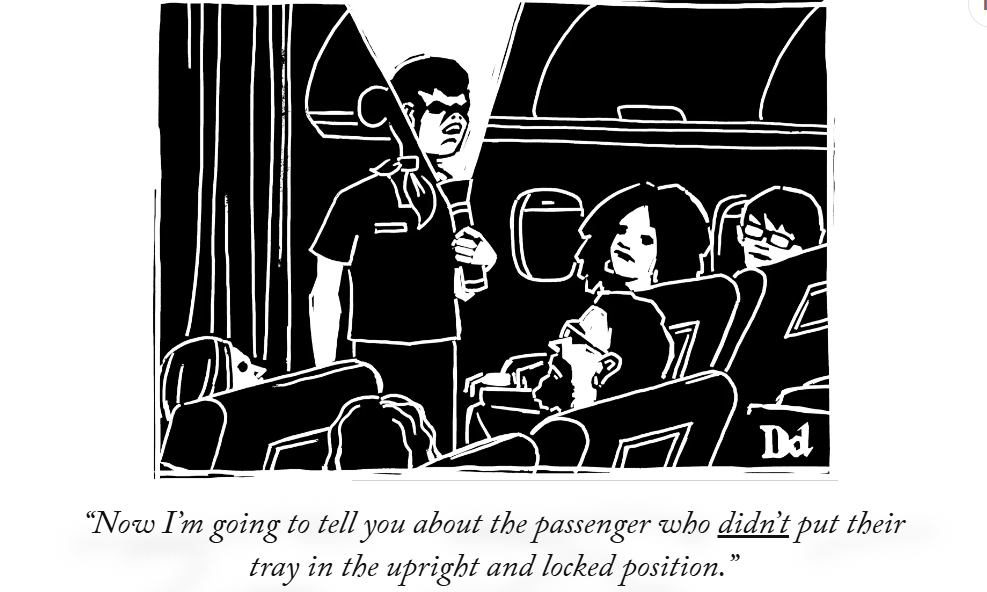
Turbulence isn’t just for flying, of course. So often we are moving through life feeling relatively in control and independent, and then out of nowhere we are acutely reminded of our lack of control. An unexpected diagnosis. A financial hardship we never saw coming. A relational rupture that we can’t fix. Mental health challenges that leave us feeling our helplessness. Amid turbulence, things we thought were sturdy begin to shake and crumble, and we are left feeling disoriented and longing for stability.
And of course, at a societal level, many of the ways people describe the news cycle sound a lot like “turbulence.” There is an acute sense of being caught up in something that is large, yet fragile and volatile and beyond our control. And whatever the corollaries are for tightening our seatbelts, gripping our arm rests, and pressing our feet to the floor – whether one is very engaged or trying to ignore it all – we all find ourselves longing for some sense of stability; looking for some voice to ground us, to guide us, to assure us, to give us hope.
We are certainly not the first people to feel these things or long for stability. The Book of Revelation was written to a small group of Christians experiencing great turbulence – personal and social – in the midst of the large and volatile Roman Empire. In their disorientation and helplessness, the church likely felt all kinds of pressure forsake the way of Jesus, to listen to other voices promising stability, and to adopt the logic and ways of the Empire.
And to them, this strange book was like a “ping” over the intercom of the universe. For, as complex and odd as the content of this book can be, there is one voice that runs consistently throughout it and holds it together. One figure visible across its pages that speaks a word of hope.
In Revelation 1 this figure stands in blazing light, his voice like thunder: “I am the first and the last, the risen one who holds the keys of death and hades.” In Revelation 4–5 this figure is paradoxically like a slain lamb and a roaring lion: the One who conquers through nonviolent, self-giving love, even for his enemies. In Revelation 7 this figure is revealed as one whose story is so spacious that it can be a home for people from every tongue, tribe, nation, and culture. And in Revelation 21 this figure stands at and speaks from the end of history, as the One to whom the rising and falling of every earthly kingdom is like a sentence on the pages of the story he’s writing.
At the center of this story is the voice of King Jesus. And this king speaks words that are trustworthy and true. Which is to say, this king uses his words not to bring chaos and confusion, not to nurture resentment and rage, but to bring life and peace. When this king speaks a promise, it cannot and will not be broken. And the good news is that with King Jesus his words and actions are one. He has perfect integrity.
Amid a cacophony of other voices, we learn that his voice is steady and sure. But not only are his promises certain, we also learn that his purposes are good. Revelation 21 give us a glimpse of the “end” or the content of Jesus’ promises. And if there is one thing being underscored in these rich, poetic readings, it’s that the purposes of our king are very good.
It is tempting to pursue “good ends” through “bad means,” to compromise for the sake of a “good goal.” But with Jesus, the ends are always consistent with the means. This is underscored in the ways he brings about redemption. He offers abundance by becoming poor, belonging by becoming rejected, dignity by bearing our shame. He offers healing by becoming wounded and safety by swallowing up death.
At the most basic level, Revelation underscores that Christians live in a story of hope. One of the core vocations of a Christian is to be a bearer of hope, which is to say God’s presence, in their life and into the world.
In a recent interview, musician and author Nick Cave discussed how one of the greatest battles in our culture and in our souls is between cynicism and hope. He said, “Cynicism is not a neutral position — and although it asks almost nothing of us, it is highly infectious and unbelievably destructive. In my view, it is the most common and easy of evils.” He went on to say, “Hopefulness is not a neutral position either. It is adversarial. It is the warrior emotion that can lay waste to cynicism. It says: the world and its inhabitants have value and are worth defending.”
To be a Christian is to live in a story of hope amid the turbulence of life. But such a hope is not trite. As Winn Collier puts it, “If our hope is that the God of all creation has forever joined himself in the body of Jesus to me, to my children, to my neighbors, to my enemies, to those who are starving, to those who are being bombed, to those whose health is failing. That is a different kind of hope – that does not promise no hardship but promises ultimate rescue and renewal.”
When Jesus offered hope to his followers, he began with sobering words over the intercom: “In this world you will have trouble.” That’s not exactly what we want to hear, but what is beautiful in these words is the recognition that hope is only real hope insofar as it emerges from helplessness. And those words provide the context within which his next words can lift our hearts, “Take heart, for I have overcome the world.” This is resurrection hope.
Each year, my wife and I enjoy getting into the latest streamable dramas and mysteries. And one of her proclivities is to peek ahead to the end of the season or the show to see where things are headed. In her words, she has enough unknowns and stress in her life and knowing where the plot is heading frees her to enjoy the twists and turns. While many might find this anathema, I’ve often joked with her that, perhaps, this is one of the appeals of the Christian faith to her. Jesus offers us the gift of seeing the end of the story and to live “from the end,” freeing us for lives of faith, hope and love amid the twists and turns, and even the turbulence. If Jesus rose from the dead, then there is no evil, no catastrophe, no turbulence mid-flight, that is able ultimately to withstand the power of his resurrection love and healing.








Thank you for composing such heartening words. I am passing this on to my loved ones who are troubled by illness, end of life issues , and the suffering of the world. Yes, we do have trouble and tribulation but Christ has offered courage and a reminder that He has overcome the world. The scripture you use is steadying, hopeful, and true.