




“Safety First!”
Walk by any construction site or school playground and you will likely see a sign that shouts these words at you. The call for safety is so commonplace that you’re likely to take it for granted. The word has worked its way into the fabric of our culture. Rarely a day goes by that you don’t hear an exhortation to be safe, drive safe, or stay safe. To be sure, it is important for there to be an element of self-protection in life. Children should be taught to look both ways before they cross the street, choking hazards should be stored away if a baby is crawling on the floor, and everyone should feel comfortable in their work environments. That said, I would like to prescribe a new motto for daily life: Safety Third.
Go ahead, say it out loud. Practice it. See how it feels coming off of your lips. “Safety Third.” Does it feel uncomfortable? A bit scandalous, even? It may feel strange at first, but this way of thinking may be just what you are looking for to give your life meaning.
The beauty of “Safety Third” is that it can be used in almost every situation. For instance, if your children are being too timid on the jungle gym, you can offer them a bit of encouragement by reminding them that safety is, in fact, third. In other words, because safety is not the most important thing in life, you are free to take risks. On the other hand, let’s say your children are lighting their hair on fire in the bathroom. This would be an appropriate time to remind them, “Guys! Safety Third!” Translation: while safety is not top priority in our house, it is still in The Top Three.
Enter the inevitable counterarguments: What if your kid gets hurt? What if you regret taking a risk? What if you’re putting someone else’s life in danger? These are all good questions and worth considering. But, these days, it’s the parents who are more likely than the kids to cry wolf, most especially when it comes to the real world. From morning until nightfall, they live under constant parental surveillance, watchful eyes scanning the horizon for impending threats. Kids are not so much protected these days as they are monitored — constantly.
A “Safety First” life is one that is principally guided by fear, one where suspicion triumphs over trust and the levers of control are pulled more quickly than they probably should. If you think the worst-case scenario is always the most likely one, then you’ll come to believe that every shadow hides a monster and every fork in the road leads only to disaster. This approach convinces us that life is a test to be passed rather than an adventure to be lived.
I know what you’re thinking. If safety is third on the list, which priorities occupy the Top Two? God? Family? Curiosity? All of these are worthy candidates. That’s why it’s important to maintain a level of flexibility when prioritizing life’s most important elements. Does your spouse feel misunderstood or discouraged? Time to give Family the number one seed. Do you feel deeply insecure about what people think about you? It would probably help to have God at the top spot in this situation. Faced with a difficult decision between two job prospects? Place Adventure at Numero Uno! All the while, safety — something that is always important, but never most important — remains comfortably in third place.
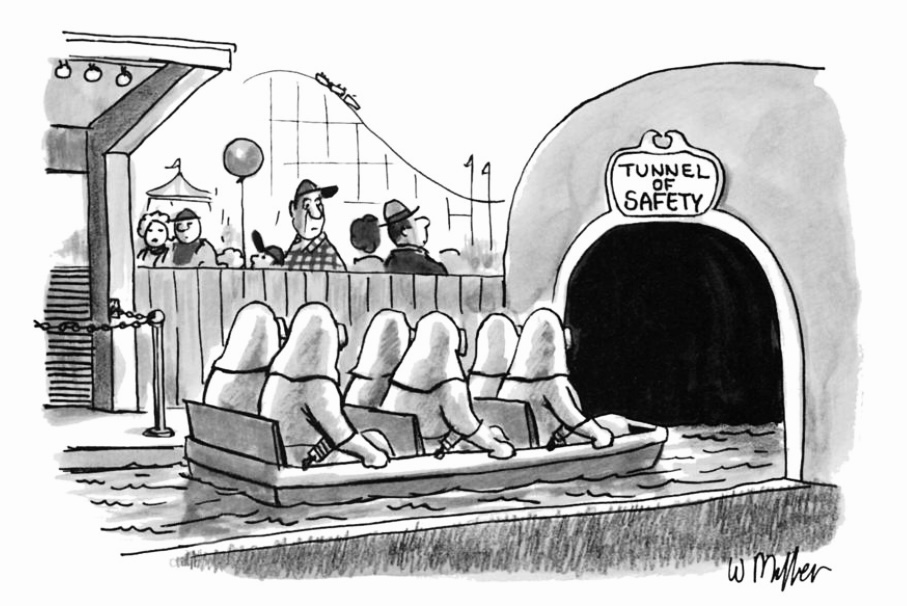
The ultimate question is this: what exactly is the purpose of life? Is it the pursuit of happiness? To find love? To make the world a better place? While these things are important, I think there is a clearer definition. The purpose of life is most clearly defined by the risk of voluntary self-sacrifice. How we see God, ourselves, and each other can be best understood by this one concept. Anyone interested in understanding his ultimate purpose would do well to see life through this lens. One could argue that voluntary self-sacrifice is simply a way to describe love, but it is likely the most accurate definition of what love actually is because it is centered around the life of Jesus.
The meaning of life is ultimately defined by Jesus on the cross, which, coincidentally, happens to be the least safe thing out there. And the disciples? Burned, skinned alive, and beheaded, to name a few, each of them willingly choosing a life of suffering over security. By the grace of God, these men did not live according to Safety First. Clearly, there were more important things at stake such as grace, salvation, hope, and love. These things are worth more than life itself, let alone safety.
A life lived on a Safety First platform may include less heartbreak and fewer broken bones, but it will most likely be far more boring than the alternative. In order for children to have fun and meaningful childhoods, they must accept that the best life has to offer involves risk and even pain. As adults, we can maintain at least some element of self-protection and be thoughtful about the risks we take, but we, too, are selling ourselves short if safety is our chief goal in life. After all, there is nothing safe about love.
So, the next time you pass a sign that says, “Safety First!” consider taking it down a couple of notches on the list of priorities. Say it with me: Safety Third.








“The purpose of life is most clearly defined by the risk of voluntary self-sacrifice”- that is a great line!
I would go a little further on your last recommendation: next time you see a sign that says, “Safety First!” vandalize it. Take a magic marker and cross out first and write third. What’s the worst that could happen?
Love this, Sam!
A ship is safe in the harbor but that’s not what ships are made for. (Can’t remember the writer)