




It’s summer vacation season, and while most of you are probably looking forward to some much-needed R&R on a beach somewhere, some of you may also be interested in a more faith-related kind of excursion. With that in mind, we thought we would share some of our favorite (or bucket list) faith-related travel spots. As always, feel free to add your own in the comments.
Bear Butte, South Dakota: I grew up in the Black Hills of South Dakota, whose Black Elk Peak is the highest point between the Rocky Mountains and the Swiss Alps. The Black Hills were sacred land to the native prairie peoples and had been guaranteed to them by a treaty that was reneged upon after the gold rush of 1876. The holiest place for the indigenous tribes was Mato Paha, a volcanic upthrust that rises out of the prairies at the edge of the Hills. Its silhouette is the shape of a sleeping bear, hence its English name: Bear Butte. The Great Spirit is said to have bestowed seven arrows to a young brave there — the ur-history of all the Sioux tribes. When I was a teen, our church youth would get up at 4:30 and hike to the top for an Easter Sunday worship service. There, when morning gilded the skies of the eastern horizon and the words “He is risen!” were announced to a batch of shivering kids, our hearts awakening cried, “Yes! We believe.” – Ken Jones
Calvary-St. George’s Parish, NYC: My first Mockingbird conference was in 2010, fifteen years ago, at the historic home of Mockingbird — the Parish of Calvary-St. George’s in New York City. I’ve since attended something like eleven of the subsequent fifteen gatherings. The parish has a remarkable connection to the founding of AA, an unending font of spiritual wisdom for yours truly. One of the previous rectors of the church helped me propose to my then-girlfriend by letting us stay in the rectory for a long weekend (she said yes thirteen years ago!). The conferences have been the spinach to the Popeye of my ministry, occasions to grow not only in my vocation and person, but also in my marriage and my wider ministry connections. Few other places on earth hold such a near and dear treasure trove of unmitigated blessed memories. – Bryan Jarrell
Cathedrals in Mexico: When I studied for a semester in Mexico, I did quite a bit of traveling around. I walked into countless old cathedrals, and although they all had their unique features, the experience was similar each time: the smell of incense, dust, and age mingled together; a cool and quiet air on my face giving reprieve from the sun and noise outside; the statues, paintings, and stained glass hiding in every nook and cranny … and the crucifix, front and center. And what impressed me most was the open door that allowed any wanderer to come in and kneel and take a moment to think about what Jesus has done for us. – Juliette Alvey

Delphi, Greece: We worship a God whose nature, as the Book of Common Prayer says, is always to have mercy, and I’m drawn to places Christian or pagan where mercy and favor have traditionally been sought. In ancient Greece, where unearned grace was as yet unknown, I was thrilled to visit the ruins of Delphi, a 126-acre site sprawled on the side of Mt. Parnassus not far from Corinth, where everyone from the common man to Socrates and mythic Greek heroes would journey to beg instruction from the prophetess known as the Pythia. The location as well of a theater, an athletic stadium, a shrine to the goddess Athena, and Athenian treasury of arms, Delphi was integral to pre-Christian Greek religious and civic life. – Ken Wilson
The Dingle Way, County Kerry, Ireland: A few years back, a friend and I completed a weeklong hike of the Dingle Way, a 101-mile-long circular trail on the westernmost peninsula of Ireland, including the Kerry Camino, which contains multiple sites with a rich heritage of early Christian pilgrimage. However, it wasn’t any of these sites that felt spiritually significant to us, but rather it was the enormous bog we traveled through in the foothills of Mount Brandon on the last day of our hike. The bog was seemingly endless, and fog lay low over the landscape, obscuring much of what lay ahead. And then, suddenly, we discovered we were not alone; up ahead, a single-file line of sheep was walking the same path that we were on, winding their way through the terrain with an unhurried attitude. As I checked our hiking directions against the distance on my GPS watch, I realized the sheep were leading us on the very last mile of our journey on the Dingle Way. The words of Psalm 23 echoed through my mind as we were guided through the bog to our final destination: “He guides me along the right paths for his name’s sake. Even though I walk through the darkest valley, I will fear no evil, for you are with me; your rod and your staff, they comfort me.” – Grace Leuenberger
Dr. Bob’s House, Akron, Ohio: There are a lot of places that lay claim to the “birthplace of Alcoholics Anonymous,” including our beloved Calvary Episcopal Church in New York City. But the crown jewel, I’m told, is the house in Akron, Ohio, where co-founder Dr. Bob Smith lived and where the initial AA meetings were held. The house isn’t much to look at, but doubtless that’s in keeping with the greater ethos of recovery. For those of us who consider AA to be the most significant spiritual movement of the twentieth century (in North America at least), this stop feels like a no-brainer. – David Zahl
The Hospital Chapel: This may be the easiest locale to get to on this list. Hospital chapels vary wildly in decor — some are explicitly Christian, some are so vaguely interfaith that they look like conference rooms, some are simple and sparse, some are cluttered with dark woods and thick carpet. All hospital chapels have three things in common: 1.) No one is there by accident. 2.) Every prayer in a hospital chapel is urgent and real. 3.) It is a room where the deepest human cries meet the consolation and presence of God. If you are in a season of doubt, make a pilgrimage to a hospital chapel and ask God to meet you there. If you are strong in your faith, hike to that fluorescent-lit room past the cafeteria and pray for the folks going through hell on the floors above you. – Connor Gwin
Iona, Scotland: The island of Iona is not close to anything. It’s several hours’ journey by ferry, bus, and then boat just to get there from the charming little seaside town of Oban on Scotland’s rugged west coast. In other words, you have to want to get there. But for me and my wife, it was worth it. The island is known as the birthplace of Celtic Christianity in Scotland, the place where St. Columba first established his missionary abbey in the year 563. It was also where the Book of Kells was made. For several hundred years — at least until the notorious Viking raids began — Christianity flourished and spread from this remote island. Today, a few of the original carved eighth-century stone crosses are still standing outside the rebuilt abbey, which doubles as a museum and a church for the ecumenical Iona Community. But perhaps the most lovely thing to do on Iona is just walk around in worshipful leisure, admiring this stunningly beautiful and sparsely populated island, soaking in the bracing Scottish winds and the mythology of saints from centuries past, and musing at what new wonders God may yet bring forth from our own time. – Ben Self
Jerusalem, Israel: The appeal of Jerusalem isn’t quite what the brochures promise. Those looking to walk in the footsteps of Jesus will be dismayed by all the ornate churches. Those who seek an experience of the holy at these sites will likewise be disappointed by the competing claims and thin historical grounds (with a few notable exceptions). Even still, if you can peel back the mythology of it all, there’s so much to learn. Though you might have arrived in the Holy Land expecting a sacred encounter, you instead leave dumbfounded by the scandalous particularity of Christianity, that Jesus was a real person who lived two thousand years ago. – Todd Brewer
Jabal Musa, Sinai Wilderness, Egypt: On my twentieth birthday, the alarm clock jolted us awake at 3 a.m. Twenty-five bleary-eyed college students shuffled into the bus, and just fifteen minutes later, we began to ascend Jabal Musa, “the Mountain of Moses,” the traditional site for Mount Sinai where Moses received the ten commandments. It was a dark and strenuous hike. At the top we huddled together in groups to keep the cold at bay. And then around 6 a.m., a wall of fire and light pushed through the horizon and cut through the wilderness. It was the most aggressive and comforting light I’ve ever seen. The light has come into the world, and the darkness shall not overcome it. – Josh Musser Gritter

John Wesley House, London, England: When I was in high school, my youth group went on a mission trip to Liverpool and made a stop in London. We visited the John Wesley House, which I appreciated because unlike the Tower of London (the other option), it was free. I remember being a bit bored until the guide showed us Wesley’s prayer room. It was the first time I’d ever entered a physical space and felt an overwhelming presence of the Holy Spirit, and I could only be tearful and grateful that I hadn’t opted for the Crown Jewels over this. – Stephanie Phillips
Landscapes of the Sacred: Rather than particular sacred travel sites, I’d recommend theologian Belden Lane’s wonderful book Landscapes of the Sacred. In it, Lane writes about places like The Four Corners in the Southwest and Mount Tahoma (Rainier) in the Northwest. Lane explores what makes some places “sacred places.” It isn’t always self-evident. Places may be visually striking, like Rainier, or somewhat nondescript, like The Four Corners. Most important, those that have come to be known as sacred places are not those we choose, but those which, somehow, seem to choose us. Something may be revealed, made manifest, speak to us — or not. But the initiative lies more with the place itself than with us. Some years ago, I hiked the Wonderland Trail — 100 miles that circumnavigate Mt. Rainier. For most of the time, we never actually saw the mountain. It was hidden in mist and clouds. Then one day it was there, so massive, so ominous, no majestic you couldn’t quite understand how it couldn’t always be visible. A parable of the hidden God who reveals himself in his own way and in his own time. So “sacred landscapes” may not be the ones we have found, but where Something has found us. – Tony Robinson
Lindisfarne, England: My pilgrimage to Lindisfarne was somewhat compulsory as it was on the itinerary of a school trip for my graduate program. I had no idea about the Holy Island except that we would be stuck there overnight due to the tides, and I could very well picture a murder mystery set there. But the Church of St. Mary the Virgin, nestled on the coast next to the ruins of Lindisfarne Priory, ended up being a highlight of my trip. Moved by the historical markers on graves from centuries before, the stories of people who chose to live life by the schedule of the tide as well as the stark beauty of the rocky beaches and windswept dunes, I found the island to be exactly what I was told — a thin place where one could imagine St. Cuthbert and St. Aidan as they shaped the early English Church. – Jane Grizzle
Little Giddings (St. John’s Church), England: As someone who often finds himself betwixt and between, it’s a promising prospect to sit in a chapel where T. S. Eliot once considered this middle and middling way as the precipice of holiness. I’ve often received the height of relief in no-account chapels in the middle of nowhere. I don’t know if I can imagine a better winter afternoon than reading Eliot’s Four Quartets in Little Giddings. And if the powers that be at Mockingbird can’t get me a trip to England, I’m sure the church I worship in week in and week out is ready to offer me a no less transcendent experience. – Ryan Cosgrove
Los Angeles, California: Last summer I was in L.A. for about 48 hours and unfortunately pretty tightly scheduled for the vast majority of it. If I’d had my druthers, I would’ve used a good chunk of it for faith-related tourism. Maybe you don’t think of L.A. as a major Christian pilgrimage destination, but for my interests it’s chock full! I’m hoping next time I make it out that way that I’ll get a chance to visit all of the following: Fr. Greg Boyle’s Homeboy Industries/Cafe, the location of the Azusa Street Revival, Aimee Semple McPherson’s Angelus Temple, and some of the Calvary/Vineyard/Kenn Gulliksen/John Wimber/Jesus People-associated churches started in the early ’70s in the greater L.A. area. And I’d try to get my friend (and a friend of Mbird in general) Nathan Hoff (whose church I did get to see!) to join me. – Joey Goodall
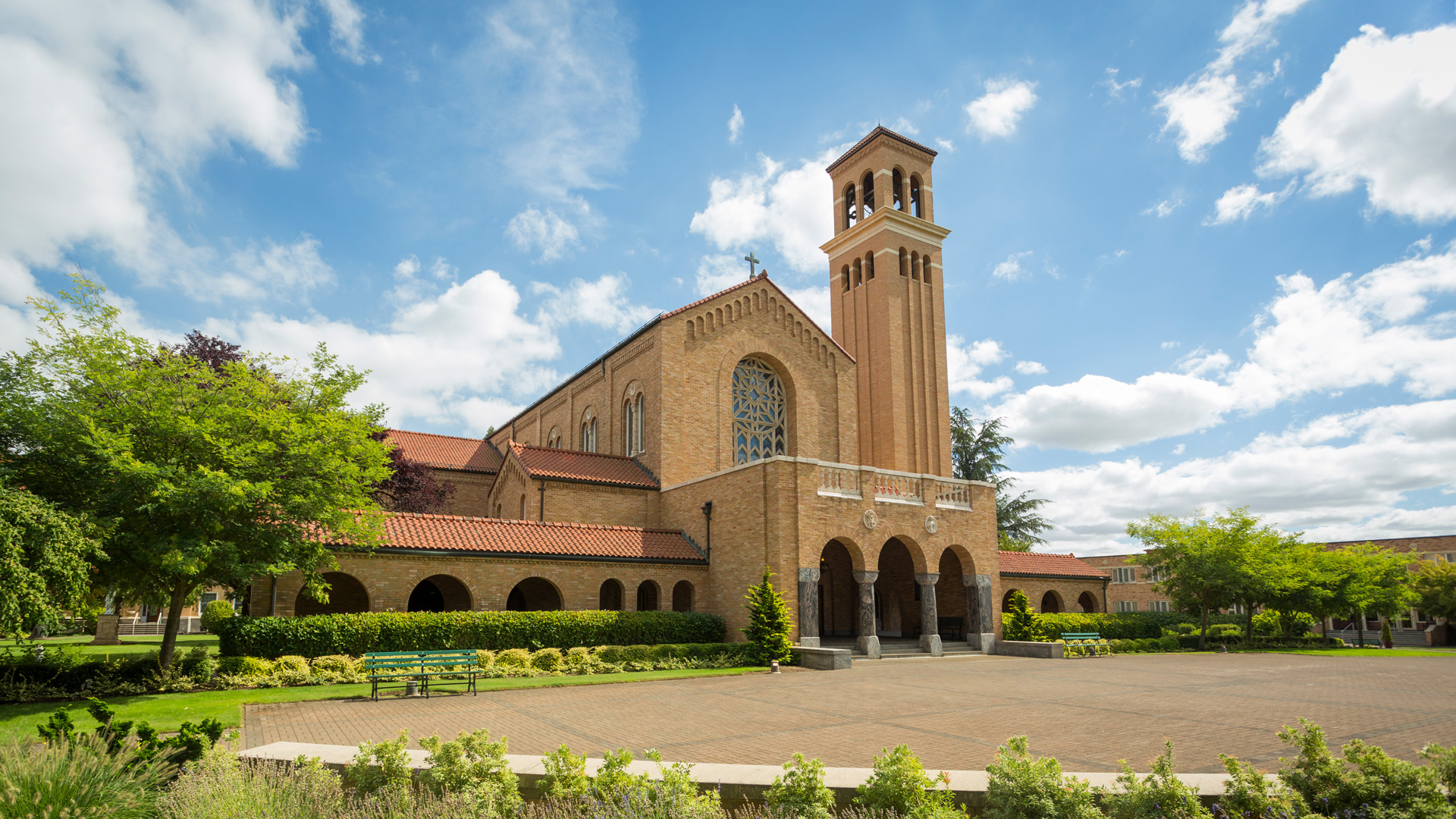
Mount Angel Benedictine Abbey and Seminary, Saint Benedict, Oregon: Set on a hill in a sleepy town an hour outside Portland, Oregon, these monks live and breathe hospitality. In the environment and spirit, there is space and quiet. Uncluttered and simple spaces let our nerves settle. There are small rooms with all one really needs — a window, bed, small desk and chair, a bathroom, and a small crucifix on one of the walls. It’s in these bare and simple spaces I’m reminded of the blizzard of the world we live in. Over the last ten years, the abbey has become a place where my soul comes alive and receives respite. I received the first half of my spiritual direction education here, having been formed and reformed within her hospitable boundaries. I’m a fan of modern architecture, so the abbey’s library is a dream. Designed by a Finnish man by the name of Alvar Aalto, completed in 1970, it is a thing of beauty. It’s a gift to have such a space so close by. – Janell Downing
National Youth Gatherings: Before it was widely known as Hotlanta, I made a pilgrimage of sorts to Atlanta as a high school youth. It wasn’t for the hallowed grounds of Olympic venues or the shrine to Coca-Cola. I was attending a National Youth Gathering. Close to 30,000 youth from around the country gathered in a stadium and convention center for worship, education, service projects, and fun. The sites themselves were thus made holy by what the Spirit was up to there. I was moved to see a world and a God much greater and full of grace in those spaces filled with goofy kids and adults, and I now have the privilege of taking my own son to one in New Orleans this summer. In terms of recommendations for the reader, I’d just say make any excuse you need to get together with lots of Christians ready to express childish and childlike faith! – Ryan Alvey
Patmos, Greece: In January 2004, I took a class called “The Cradle of Early Christianity: A Journey through Greece and Rome.” The class is exactly as it sounds — we traveled through Greece and Italy visiting sites in these two countries that were mentioned in the New Testament. This trip included a 48-hour stay on the island of Patmos, where the book of Revelation was written. I had low expectations for this stop; the island was small, and I had never really been into Revelation. However, as we visited the Cave of the Apocalypse and I encountered the spot where it is said that John of Patmos dictated his vision to a scribe, as we were welcomed with gracious hospitality by the Abbot of the Monastery of Saint John the theologian and the island as a whole, and as we explored the island by foot, Patmos captured my spiritual and biblical imagination in a way that I can’t describe. Themes I encountered on the island, while not new, have echoed throughout my life and ministry: the Christian unity the Greek Orthodox abbot spoke of in broken English as he welcomed us (a group of Catholics with a bonus Lutheran) with chocolate, and the wonder of being connected to God and the history of the church and the Bible when I touched the spot it was said John of Patmos touched. Over twenty years later, as I’ve been renewing my spiritual life, this experience came back to me and has inspired me to read through the Book of Revelation in Greek, verse by verse for myself. I don’t know if I’ll ever get back (I’m not sure I can convince my easily motion-sick husband to board the boat), but it will continue to hold a special place in my heart and faith journey. – Tasha Genck Morton
Philippi, Greece: To an extent, all ruins look the same. What used to be a former epicenter of civilization has been reduced to a pile of rocks and some bare columns. On top of that, many historical sites are speculative since it is hard to confirm exactly where certain events took place. And yet, I felt extremely moved when visiting the jail of Philippi, which some believe is where Paul and Silas were imprisoned in the book of Acts. Was this the exact room in which Paul and Silas were secured in stocks, bloodied and beaten? Maybe, maybe not. And yet, seeing these ruins allowed me to understand this part of Acts with fresh eyes. The story of the jailer’s conversion may have taken place a long time ago, but it did not take place in a galaxy far, far away. Two thousand years ago, an actual man’s life was saved, and his family was baptized in the name of Jesus. That day, his conversion and salvation became as real as the rocks on which I stood. So why visit Philippi? Because it will help remind you that the God of the Bible is not a fictional god, but real. And that he is real, still. – Sam Bush
Sirte, Libya: There is an unmarked spot on a stretch of Mediterranean beach near Sirte, Libya, that I’ve always thought a worthy destination for a pilgrimage. I want to stand there someday because on February 15, 2015, Heaven briefly touched Earth as God, like a mother hen, gathered 21 of our siblings in Christ to his breast. Their deaths weren’t the final word, as evil had hoped, but their spilled martyrs’ blood soaking into the sand spoke only of the One whose blood only brings life. – Josh Retterer
Virginia Retreat Centers: When I need time apart to attend to my introverted side and spend intentional time with God, I spend time at Richmond Hill in Richmond, Virginia — an urban retreat center. Or I go to Mountain Light Retreat in Crozet, Virginia, which overlooks the Blue Ridge Mountains. I experience internal quiet in both settings to hear my own thoughts and prayers and be present to movements of the Holy Spirit instead of the dings of my cell phone. – Marilu Thomas








Aww, I love Ryan’s recollection of the 2003 ELCA National Youth Gathering in “Hotlanta”. I was there too! An unforgettable experience.
I’ve summited Black Elk Peak and find it a sacred and beautiful place (regardless of its orological prominence…aren’t the Pyrenees between there & the Alps?) I find all the mountaintops I’ve summited to have that sense of sacredness and closeness to the heavens. There’s something significant, too, about the fact that they’re not made for lingering. You can reach a mountaintop, but it’s generally not suitable for human habitation. We dwell in the valleys below, sheltered by the trees and protected from winds and storms, whereas the summits are just for visiting – if we can reach them at all! There’s something there to unpack, I’m sure.
Calvary/St. George’s tops my list, not least because it’s the holy ground where I got hitched.
CROZET and the Blue Ridge Piedmont: Four Star: PRIMA. The blue and the green are a good prescription for Scared Site travel.