




In the summer of 2020, my friend Melissa bought a CrossFit gym. A vegetarian folk singer, I was no CrossFitter. But I am a devout supporter of the plucky spirit of small businesses in our little city, so I joined her gym to support her through the pandemic.
Early in the journey, I smacked myself in the chin with my own fist as it gripped an out-of-control kettlebell. Once, a medicine ball thrown overhead slipped through my hands on its way down, pounding my face as its laces lashed my left cheek. It was as embarrassing an experience as I could imagine for an adult. I am a coordinated person, but the foreignness of these movements made me want to cry like a schoolkid.
Just as the rhythms felt cemented, Melissa moved on from her gym and I faced a new dilemma — do I join another gym? Am I the kind of person who walks into a room of weightlifting strangers and joins them? I was more confident, perhaps more obsessed, but still nervous. I felt like a high school upperclassman just getting the hang of things only to change schools.
Nervous, overwhelmed by self-consciousness, I did join a new gym. The head coach, Gavin, was a real-life Bart Simpson. Energetic, loud, funny, adorned with spiky blonde hair, he would fly into class barely on time via Onewheel. It was a simple space, smaller, cleaner, lower ceilings, less complicated. This gym featured more of the stereotypical accoutrements than my first gym, like cross tattoos and a large American flag.
This came to the foreground on Maundy Thursday of 2025. After our congregation recessed in silence, the candles were extinguished, the foot washing basins were drained, and we latched the sanctuary doors in silence. I went home in the tranquil coolness of a spring night in North Carolina, anticipating Good Friday. With the lament of Maundy Thursday saddling my heart and the quiet of kids in bed, I pondered: can one exercise on Good Friday?
My body did not feel right about exercising. Exercise brings endorphins, accomplishment, self-esteem, all things my body had never associated with Good Friday. On the one hand, it felt deeply irreverent to cycle burpees, slapping a gym floor with my sweaty chest. How could I reflect on the death of Jesus while heaving barbell weights to the soundtrack of hypersexual and redundant dance music? On the other hand, “For freedom Christ set us free … don’t submit again to a yoke of slavery!” … right?
I opened the gym scheduling app hoping I might hear a prophetic whisper like, “I am the Lord your God, you shall not cycle power cleans at the noon class, the hour of my crucifixion.”
That did not happen, and I do not remember the main workout of the day, but there was an accessory workout that captured my attention. Accessory workouts are optional additions at the end of some classes. For Good Friday, the program our gym uses planned a 600-meter barbell carry to embody the carrying of the cross. In other words, we would carry a two-meter-long bar with 95 pounds nestled on our necks and shoulders for a third of a mile. I went to class.
After the main workout, I learned the accessory workout would not be optional for the class. Gavin barked out, “Don’t break down your barbells because EVERYONE is *expletive* doing this. It will be great for Instagram!” This wasn’t the open-ended pluralism I had come to expect. And I wondered what we might be aiming for here. Content for sure. But mystical experience also? Humor? All of the above?
He offered a playful caveat that took the pressure off any forced collective religious experience and called us outside to the street with our barbells. Loaded with 95 pounds, this accessory workout was being reframed by my fellow athletes as a “Hero WOD.”
With our gym’s programming, hero WODs (“workout of the day”) were common. Hero WODs honor fallen soldiers and first responders — like the famous “Murph” on Memorial Day. Within my own heart, a severe legalist had already been judging me for even showing up at the gym on Good Friday. I was tense from trying to hold together the Christian liberty represented in an exercise high and the reverence of Good Friday. I was now confronted with an interpretive question: is Jesus a hero in the CrossFit sense?
My first association with Hero WODs is military. Hero WODs hallow men and women of strength, valor, grit, sometimes violence, and patriotism. To quote Jayber Crow, “Jesus’ military career has never compelled my belief.” He has his own strength, valor, and grit, but his victory comes through relinquishment. At the same time, these heroes are often exemplars of physical suffering for the sacrifice of others. So in a sense, Jesus is the ultimate Hero WOD inspiration. I was swirling in pietistic and doctrinal confusion until we made our way outside to a ten-second countdown.
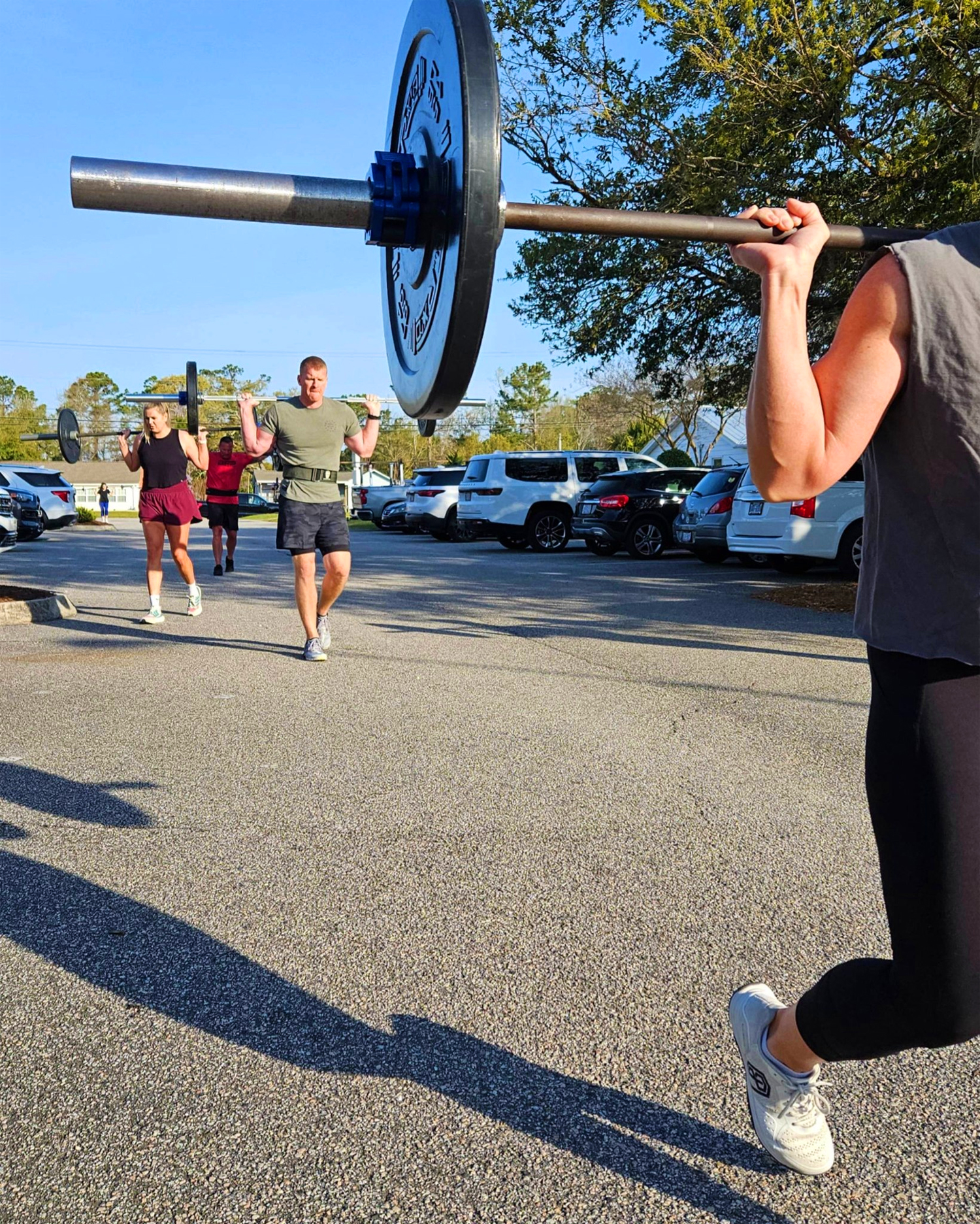 We swung our barbells overhead to rest them on our backs and began our walk to the third stop sign on Hollywood Street. Coach Gavin ran ahead to capture us on iPhone video at the 50-meter mark. We started out fresh, a bit silly, some smiling, perhaps betraying a bit of emotional, spiritual, and certainly physical discomfort.
It was a group of twelve or thirteen carrying wide barbells with large black weight plates through a city neighborhood. One guy carried his barbell with his arms fully extended overhead instead of on his back. With a quiet laugh, I thought to myself, “Does he think he’s better than Jesus?”
Another guy quipped to the group, “If Jesus was real, this must have been really *expletive* hard. I’m impressed.” Of course, the historical Jesus was real, and he certainly did endure something significantly more impressive. The work became quite painful and transcendent after the first 100 meters. The weights were grinding down on the nape of my neck, and my legs began to feel compressed in the most oppressive way.
The street was quiet. No cars, no dog walkers. It was almost eerie since we were in the city. At halfway, 300 meters, I really began to think about Jesus’ suffering in the haunting stillness of this dormant urban neighborhood. The destination for our pilgrimage was a shared sense of accomplishment — fist bumps and an endorphin dump. For Christ, his suffering of the torture and the misery of carrying the cross were not on the way to a reward for himself. At the other end of his travail was death.
At this pivot point, one guy dropped his barbell. I judged him, ironically. I intended to make it the whole way on my own without stopping. As his barbell fell, I thought of Simon of Cyrene picking up the cross for Jesus. When we exited the gym, we were dripping sweat and pumped full of electrolytes. When Jesus set out toward Golgotha, he was dripping blood, pumped full of nothing. We started with every advantage in contrast to the Son of God and his day of agony.
The Via Dolorosa, Christ’s route of suffering through Jerusalem, is something I find easy to imagine given the witness of the Gospels and the proliferation of art portraying his journey to self-giving death. Yet I had fixed my hope on nothing less than finishing under my own power, without stopping, unbroken.
Had I finished the arbitrary goal of 600 meters with 95 pounds, I would have missed the beauty of this exercise and perhaps deluded myself into thinking I was a self-made man. Alas, I would not make it on my own strength because it was not a challenge in tricky weightlifting. It embodied the way of sorrow, and I was given the gift of failure.
I dropped my barbell once, with about 100 meters remaining. It was about that time things became even quieter. Hunched over, my sweat dappled the pavement as I rolled the barbell toward me to pick it back up. We were in front of a church preparing for their Good Friday service, and an older black woman perched on the covered steps inquired, “What are you doing?”
Since the halfway point, no one had been talking. Her question broke through the defeated mood as barbells were falling to the street with grunts of despair. The final stretch was somber. Someone replied, “It’s a workout to mimic carrying the cross.”
She immediately pumped her elbows back, raised her palms to her shoulders, cocked back her head, closed her eyes and belted out, “Oh the wonderful cross, oh the wonderful cross, bids me come and die, and find that I may truly live!”
Her voice was proud, her tone clear, her volume majestic. She was feeling resurrection joy as we were identifying with Jesus’ crucifixion pain. The cross is the end of self-reliance, and while the King of Kings was a helpless man of sorrows, that was not for long.
My body no longer felt confused. And I don’t think it was the endorphins. The tensions I was feeling between reverence and freedom were released. As I put away my equipment, a sense of tranquility came over me because I understood that his mortal flesh was wounded so that my vital body might thrive. “Oh that wonderful cross, bids me come and die, and find that I may truly live.”
That tension I had felt was just one of many that reflected the already-and-not-yet of the human experience. Suffering is contrasted with blessing. Transcendence peeks through in the normalcy of an exercise class. The irony of wanting to celebrate Christ’s strength by using our own willpower. We are free in Christ from the yoke of religious duty, but holy devotion raises questions for daily life.
This is what sets Christian faith apart from anything else in the world — the Incarnation. Christ is both God and man, power and weakness. In him, we are both free and invited to self-denial. We are victorious and yet still unfinished. This is why this particular Good Friday was both bizarre and transcendent. It was both great content for Instagram and the mystical experience that will forever frame every future Good Friday of my earthly life.








The older black woman’s witness is what makes this story. Thanks for sharing.