




About two years ago, my local Goodwill store stopped taking furniture. The sign was posted by the donation drop-off, next to the sign that said the store also no longer accepted tube-based television sets or appliances with freon in them. I asked the Goodwill employee at the drop-off about the new policy and they gave a sensible explanation. For years, people had been donating their dusty, stained, unstylish furniture that didn’t sell, and now they were donating unstable, water damaged, particle board furniture along with it. Nobody bought this stuff, and so it ended up in the dumpster, a dumpster that Goodwill paid to have serviced. By sticking to clothes, small appliances, books, and housewares, the store would save lots of money on garbage utility costs.
I am glad I didn’t learn this by pulling up in a truck with an old sofa in the back.
For years, I have appreciated and taken advantage of second hand stores run by Goodwill, the Salvation Army, and St. Vincent dePaul. These outlets, especially their furniture offerings, got me through college, seminary, and my early years of adulthood. Most Americans, or at least most Americans I know, love their local thrift stores. Millennials in particular made thrift shopping stylish, a fun hobby that revealed treasures like discount records, vintage clothing, and furniture that could be restored, flipped, and even sold. Even those who don’t shop at thrift stores recognize the value they play in society by reducing waste, offering discount clothing to the needy, funding social missions, and providing jobs and job training.
Nowadays, there is a good deal of moral and cultural pressure to own less “stuff.” Fewer toys for kids, fewer knick-knacks for house decoration, fewer bags of old clothes you swear you’ll pull out again after you lose some weight. Fewer books, records, DVDs. Fewer kitchen tools and mismatched socks you keep around to see if the partner ever shows up. Minimalism is not just trendy, but a form of self-care. It wasn’t that long ago that organization guru Marie Kondo was helping all of us to declutter by identifying the items in our lives that “sparked joy” and ditching the rest. There are the righteous minimalists and unrighteous hoarders.
In light of this new ethical imperative, second hand shops conveniently provided a service beyond decluttering. Donating our “stuff” added a moral patina to our own self-image. Not only are we following the cultural mandate to “downsize,” but we are doing so in the name of charity and environmentalism. If “one man’s trash is another man’s treasure,” thrift shops magically transformed our trash into someone else’s frugal find. By donating, we participate in the “good” in Goodwill, the “salvation” in Salvation Army, the “saint” in St. Vincent dePaul. We’re not filling a landfill, but recycling. Here was a righteous way of atoning for our commercialism, imputing virtue to the vice of consumerist clutter. Lighter and unburdened, we received far more than the charitable donation tax receipt that rarely made its way to the IRS.
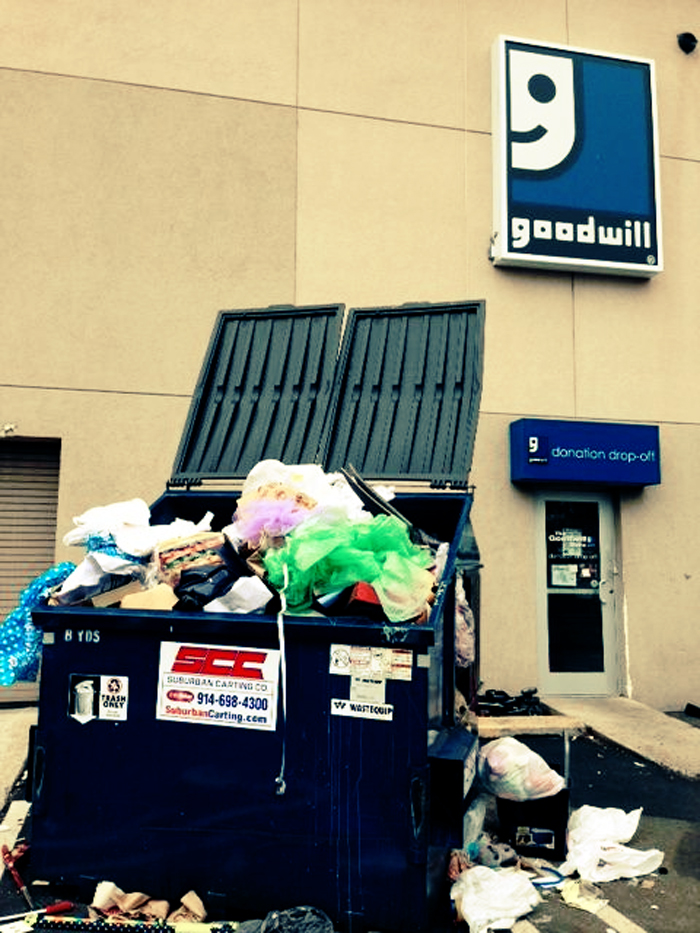
Dropping off things at the thrift store, however, isn’t what it used to be. It started a few years ago when my local thrift stores created a separate section for brand name clothing, each piece individually up-charging them based on the popularity of the brand. Sports fan gear began to show up on separate upcharge racks too. Donations of video game consoles and high end electronics began to show up in locked display cases at the front of the store. No more furniture donations, and most recently, no donations of stuffed toys.
We might blame the times for these changes. Fast fashion has dropped the collective quality of our clothing, devaluing it for resale. Fast furniture offers us flimsy particle board facsimiles of real wood furniture, and it’s so janky that it can’t survive the sweat of a cold glass of water on a hot day. Obsolete technology like cassette tapes and CDs and VHS tapes don’t sell, mainly because modern alternatives are cheaper and work better. Online free sites have changed how people shop for the very things Goodwill sells. In this respect, thrift stores have to change to remain competitive and keep their business afloat.
The actual reality, however, is that most of our donated junk is just that: junk heading straight to a landfill. A handful of our stain-free shirts may make it to the rack for resale, but let’s be honest: Most of the things we donate to thrift stores aren’t worth the time it costs to toss it in the dumpster. Of the items that do make it through the complex sorting process, only a third of them will actually be sold. The trash-to-treasure pipeline is mostly a myth, but it’s psychologically easier to have someone else dispose of our dross.
The mutual exchange of donations for moral validation isn’t as profitable as once was. Thrift stores are reaching the upper limit of their ability to atone for our “stuff” sins — they just can’t take upon themselves the burdens of processing our junk like it used to. Helping the poor will now require more from us than cleaning out our closets. As more of our attempts at donation are declined at the door, perhaps we are facing a deeper reality about ourselves than we dare to admit. If even Goodwill is telling us it can’t take our things, a season of soul-searching through the sins of consumerism, jealousy, and greed may be in order, for the wider world and ourselves.








Very well said. I think a similar sentiment can be aptly expressed about ‘recycling’ of anything made of plastic these days. It was sold to us ’90s kids as one cornerstone of the 3 R’s of conservation: reduce, reuse, recycle. But the enormous glut of cheaply-made plastic stuff has led to a huge crisis now that third-world countries (and China) won’t take our excess plastic from the barges we use to ship it overseas. The truth is, we really can’t recycle much plastic stuff, and what little we can recycle gets downgraded with each processing. Far better, these days, to simply reduce our consumption of everything, especially anything that comes in a plastic container.