




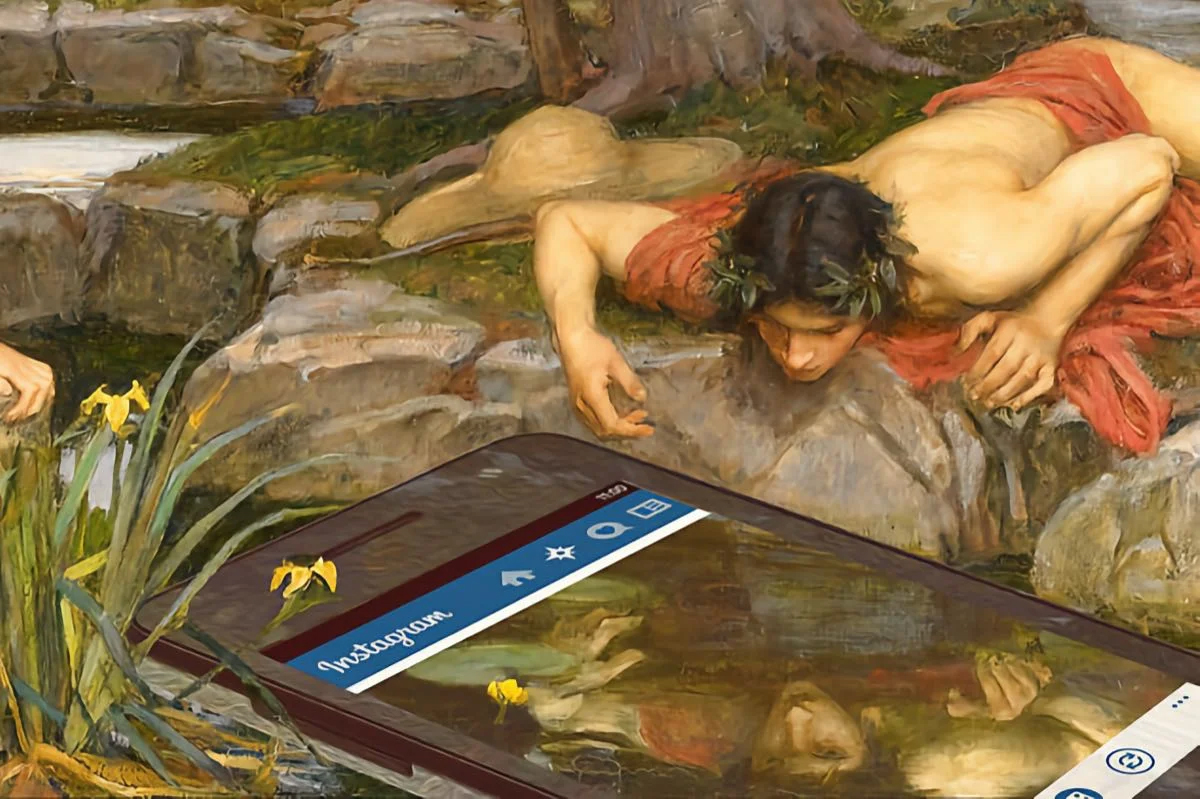
The philosopher Charles Taylor has said that the modern world is one where we all inhabit “the immanent frame.” Which sort of means, “What you see is what you get,” or what you see is all there is. It’s not a world in which people easily imagine a God who speaks or acts. No transcendence. What occurred to me as I listened to a recent interview with the psychiatrist and addiction specialist Anna Lembke is that such a world may be its own special hell.
Recently the NYT did an extended interview with Lembke, who is the author of the 2021 bestseller, Dopamine Nation: Finding Balance In An Age of Indulgence. In it, Lembke argues “that our brains are wired to constantly seek stimulation, and that modern life, with its never-ending stream of content and stuff, makes it nearly impossible to fight that urge.” In a society based on consumption, we suffer not from scarcity but abundance, overabundance. I thought it a terrific book.
So I was interested in listening to the interview, and I wasn’t disappointed. At one point Lembke uses a phrase that grabbed my attention. It was “endemic narcissism.” The interviewer, Lulu Garcia-Navarro, asks Lembke an insightful question, “Are we just playing Whac-a-Mole with our addictions?”, and Lembke responds with surprising insight:
It’s a fair question. And I think on some level we really are, which then begs the question ‘What is it about human nature?’ Or, I would argue, ‘What is it about modern life that makes us so vulnerable to these addiction problems?’ I have some theories. Totally speculative. […]
I think we’re essentially struggling with endemic narcissism, where our culture is demanding that we focus on ourselves so much that what it’s creating is this deep need to escape ourselves. And I think that is what is driving much of our pursuit of intoxicants as a way to just not have to think about ourselves for a blessed, you know, hour or two. […]
It’s not, the whole explanation … the whole point of Dopamine Nation is that we also live in this world of abundance with constant access, and access alone is a risk factor. But although I think access is important, and supply is more important than we have given it credit for, we do have to focus on the demand part of this equation. What is it about our lives now that make us so desperate to essentially be intoxicated in one form or another? And I do think it is this obsessive self-focus. (emphasis added)
It’s a question not only worth asking, but worth repeating: “What is it about our lives now that makes us so desperate to essentially be intoxicated in one form or another?” Does an “obsessive self-focus” owe to our lives in this “immanent frame” culture now? Or is it a reality of our human nature? Or both?
At about the time I listened to this interview, I happened to be taking a grandson who is an eighth grader to an appointment somewhere. As we drove, I asked about school. “What are you doing in English class these days?” He said he was working on a writing assignment. “What about?” I persisted. “We’re supposed to write a personal narrative,” he answered. Inwardly, I groaned. Over the years of talking with my grandkids about schoolwork I have noticed a common theme. A lot of assignments focused on themselves, what they are like, what they like, what’s special about them, what they are interested in, and so on.
On the face of it, of course, that sounds fine, even positive. And yet it seems endlessly repeated in one form or another with adaptations for each grade level. I found myself wondering if this is one indicator of what Lembke calls a culture of “endemic narcissism.” “Write (draw, paint, talk) about yourself,” ask today’s teachers year after year. I expect they are imagining this will result in “good self-esteem.”
Another indicator might be the ubiquity of what I think of as “therapy-talk.” Steady self-analysis with armchair therapy terminology spicing our speech. Say we prefer a tidy desk. “What are you, OCD?” Or a friend is enjoying a burst of energy. “He’s in his manic phase,” mutters his wife. This is not a knock on therapy, which has its place and can be helpful. But I am noting that it has become our go-to language, one that encourages a constant monitoring of our internal states, as well as assigning therapy-talk labels to ourselves and others.
Another part of this, of course, is social media where people are invited and encouraged to daily curate their lives for the public, turning themselves into a brand or product presented for other’s notice and approval. For many, this becomes a profession. They are “influencers,” who monetize their constant self-reporting.
All this to say that Lembke’s observation that our dopamine (the brain’s pleasure hormone and neurotransmitter) addiction, in its various forms, owes not only to the oversupply of stimulation, but to an “obsessive self-focus” from which we seek escape, rings true.
From a theological perspective, a classic definition of “sin” is “the self curved inward, the self curved n upon itself.” One need not condemn this as “selfishness.” It is really more a form of bondage. Moreover, Christians have always spoken of falling in love with God and of a life of faith as, in part, “self-forgetfulness.” In God’s presence, as Charles Wesley wrote in one of his many hymns, we find ourselves “lost in wonder, love and praise.”
That is part of what worship is about, losing ourselves. How many times have I gone to a worship service obsessing over something — a mistake, a grievance, or a conundrum — only to find myself swept up in praise, my self-preoccupation or sundry grievances eclipsed in gratitude and praise?
And of course Jesus famously said, “For those who want to save their own life will lose it, and those who lose their life for my sake and the sake of the gospel, will save it” (Mk 8:35). We find ourselves by losing ourselves. A paradox, but true, though perhaps not a truth easily accessed in a culture trapped by an “endemic narcissism.” We tend to moralize Jesus’ words, as in “don’t be selfish, put other’s first.” But maybe they are more descriptive than exhortative?
So I do wonder if this experience of losing yourself in God’s love and grace, in Christ’s beauty and mercy, is less available today in our post-Christian secular age, and that without quite knowing it, we are feeling that loss, the loss of regular and periodic liberation from “obsessive self-focus” that many have found, and some still find, in congregational worship? After all, the word “ecstasy,” which means “standing outside oneself” (and before it was a drug), was by and large something people found in and through religion experience.
Worship and a life of faith are one route to self-forgetfulness. Others experience it in encounters in nature or by being “in the zone” when caught up in a sport. We can lose ourselves as well in meaningful, engaging work. Yet work seems also to be one of those things that gets distorted, for many, into an addiction, less about forgetting ourselves than a feverish race to gain attention, approval, status, and to get ahead. In fact, Sin being the insidious power that it is, perhaps any path to self-forgetfulness, including “worship,” can be distorted into another way to elevate ourselves and our egos.
The arts are another route to losing yourself in the best sort of way. In the presence of great art and beauty, we are transported out of ourselves. We forget ourselves in the presence of an amazing painting, sculpture, stirring music, or a work of architectural beauty. One of the reasons I enjoy painting is that at least sometimes I lose myself while painting.
Is Lembke right in her hunch? Do we live in a culture of “endemic narcissism?” One that not only encourages but insists on a relentless self-focus, but which results not so much in a healthy self-awareness, but in an imprisonment in the cage of ourselves? As a Christian who is acquainted with sin and prone to turn in upon himself, I suspect that it is a both/and. Human nature, yes, but now on the particular steroids of a twenty-first-century culture of consumption and the trap of the immanent frame. McDonald’s reminds us often, “You deserve a break today.” But maybe the break we deserve, or need, is the break from ourselves.








Love this – thank you for writing! I agree that art is a helpful antidote to this narcissism. I often lose myself in records and films, consumed by the story of another. It’s no wonder the church has such a rich history of commissioning and supporting the arts. Maybe we need to get back to that?
Great article thank you! I’ve nicknamed Anna Lembke “St. Anna”. Gained so much understanding from her. We tend to look at things as black and white culturally. I think knowing yourself can be a doorway to knowing God more deeply, and material like Anna’s helped tremendously; and yes we can’t stay only there. I think it’s both. Read David Benner’s book “The Gift of Being Yourself: The Sacred Call to Self-Discovery”. Very illuminating. And congregational worship is indispensable I couldn’t agree more. The communion with God and others is amazing. Need it all to get to awe.