




Let me ask you something: Are you a responsible person? Do you always get to work on time? Do you try to stay up-to-date on current events? Have you made sure all of your pets are neutered?
So far, so good?
Just a few more questions. Have you ever spent money on an expensive bottle of wine when you could have spent that money feeding a family of four in Bangladesh for a week? Have you ever kept a secret from your spouse because you didn’t want them to get angry? Have you ever texted while driving?
That’s too bad. I’m sorry to hear that.
Responsibility can be a tricky thing to pin down. We all want to be considered responsible individuals, but it is often hard to define what a person is responsible for. Are we responsible for the state of the world? Are we ultimately responsible for the wrongs our children make? Are we responsible for the wrongs we have made unknowingly?
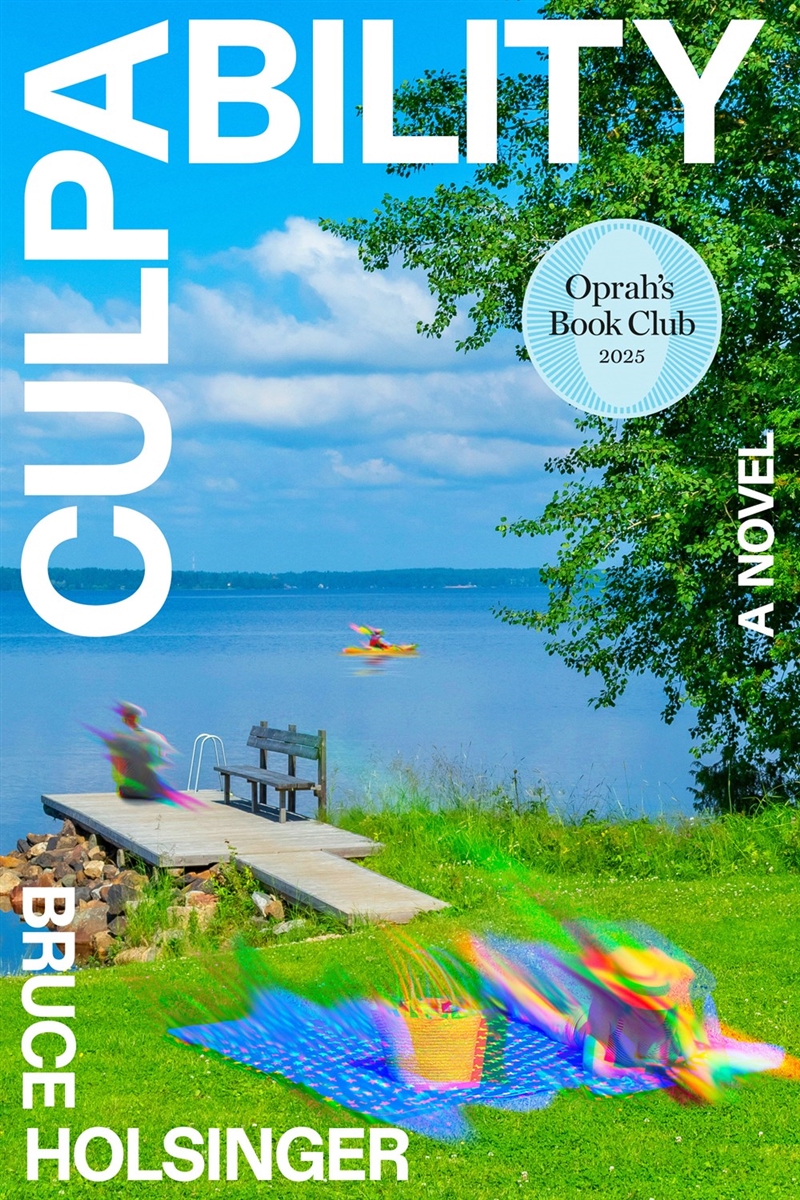
These questions are skillfully addressed in what was widely called the book of the summer, Culpability by Bruce Holsinger. The novel revolves around the Cassidy-Shaw family after their autonomous minivan crashes on the highway, killing two people. As a police investigation unfolds, each member of the family comes to terms with how they may have been responsible for the crash. Who exactly is to blame? The seventeen-year-old at the wheel? The distracted father next to him, emailing on his laptop? The younger siblings in the backseat being distracting? Or the autonomous vehicle’s algorithm that failed to do what it was designed to keep people safe? When it comes to responsibility, everyone is culpable.
 Lorelei Shaw, the mother of the family, is a rule follower. As a brilliant and neurotic AI ethicist, she is hyper-driven to do the right thing every time. While this trait is helpful in her job, it works out painfully in her marriage. After her husband Noah has let one of their kids off the hook without telling her, she calls him out. “You’re afraid of your own responsibility, Noah,” she says. “You’re afraid of my anger when I find out that you’ve evaded it. You’re afraid of anything that makes you look like less than a perfect husband and father. And it makes you sneaky as hell.” The accusation is enough to make any nonfictional husband feel a bit chastened.
In her research work, Lorelei argues that when people do something wrong, they usually experience remorse, even when the wrong goes undetected. For Christians and non-Christians alike, the law is written on our hearts. Even when AI promises to do the hard work of living for us, we have to take responsibility for its own mistakes. We may try to blame faulty wiring, but follow the source and the culpability leads back to us. When an autonomous vehicle is involved in the death of two people, the guilt has to go somewhere.
But what happens when nobody accepts the blame? As humans, we are so well trained in the art of self-defense that excusing ourselves is second nature. We only have an anger problem because our father had an anger problem. So is our anger problem our father’s fault? Over the years, I’ve heard multiple therapists say “Don’t blame the parents, blame the grandparents.” While the idea allows one to feel more compassion toward their own parents, how long until all the world’s blame gets passed back to the original culprits? Are Adam and Even responsible for everything? When we pass the guilt down the line like a hot potato, where exactly does it end up? Like the line “Grief is love with nowhere to go,” fear and shame are guilt with nowhere to go.
I wish there were an easy answer. We can blame ourselves all we like, of course, but even self-criticism quickly turns into a defense mechanism. As Oscar Wilde once said, “There is luxury in self-reproach. When we blame ourselves, we feel no one else has a right to blame us.” In other words, no one can point a finger as long as we beat them to the punch. We are so hardwired to placate judgment that we will throw ourselves under the bus before being thrown by someone else. Time and again, as the bus keeps rolling, we pick ourselves back up and are shocked that the guilt still remains.
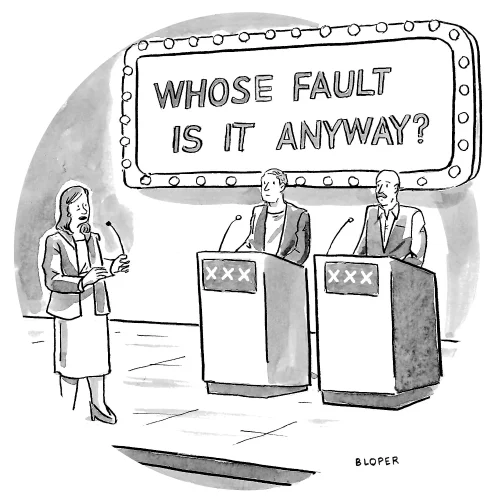
In the end, someone needs to take the blame. With all of AI’s promise to give us a toil-free life, machines are useless when it comes to dealing with fear and shame. Those are two things that cannot be offloaded or outsourced. In a research paper, Lorelei bemoans the limits of the almighty algorithm. For all it can do for us, it cannot be human. “It may think for us, it may work for us, it may organize our lives for us,” she writes. “But the algorithm will never bleed for us. The algorithm will never suffer for us. The algorithm will never mourn for us.” Her implication, of course, is that we need someone who will.
One reason we have turned to AI is because of a nagging truth that we need something superhuman to solve human problems. After all, the guilt has to go somewhere. Friedrich Nietzsche once said, “To take upon oneself not punishment, but guilt — that alone would be godlike.” If only someone had told Dr. Nietzsche about the cross. For us Christians, fear and shame have finally found a home. They have been eternally outsourced. As far as the east is from the west, he has removed our transgressions from us. Our transgressions did not get passed down the line but eliminated altogether. And where exactly did they go? “He himself bore our sins in his body on the cross,” as Peter says. Jesus, the one person who was not responsible for the sins of the world, took our responsibility on his shoulders. While we were the culprits, Jesus accepted culpability.
So who’s responsible for our children being mean to the neighbor’s dog? Who’s accountable for our texting and driving? Who’s answerable for our broken lives? Unfortunately, we are. Thankfully, Jesus takes the blame.





A family is an algorithm, says the fictitious AI ethicist in this book. That reality may be more daunting than all the threats posed by AI. But for Jesus – who exchanged His life for our algorithm.