




I recently had the opportunity to read Karen Stiller’s Holiness Here: Searching for God in the Ordinary Events of Everyday Life and found myself breezing through the pages, noting its many instances of especially eloquent prose. Stiller is a beautiful writer, and I appreciated many of her theological observations. I picked up Stiller’s book after having just finished Kobe Campbell’s wonderful Why Am I Like This? How to Break Cycles, Heal Trauma, and Restore Your Faith. Thus began what often happens when two books are read in close succession: a chance, however unintentional, to compare and contrast them.
Both books were strengthened by personal stories from their authors, moments of vulnerability that laid a groundwork for the reader to trust them. In Campbell’s case, such trust is monumental to her premise, since she’s a therapist and is writing about healing from trauma. Strikingly, though, her book didn’t read like a “how to” manual (even though it’s right there in the title) — rather, it felt like an invitation into a healing process.
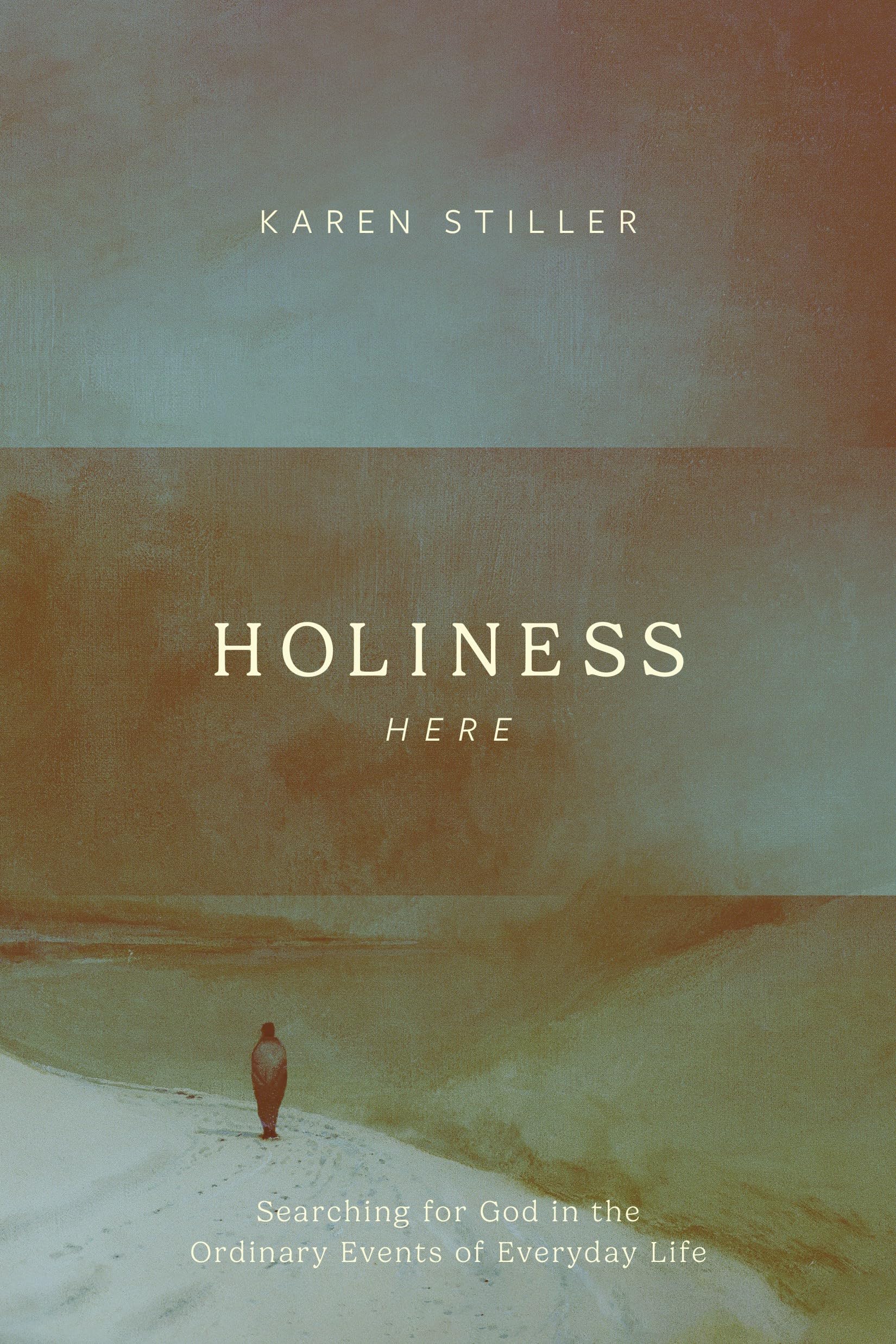
Stiller’s Holiness Here intends to be a similar invitation, and it frequently felt that way — the very word invitation is common among its pages. But sometimes the invitation verges more into a prescriptive “how to” manual, with words like trying, work, and practice often popping up. I have a sensitivity to such language after a couple of decades of my early life were spent using 2 Timothy 4:7 as a personal challenge and figurative bumper sticker, and as an adult I grew exhausted and not a little resentful of any description of the Gospel that veers into prize-fighter, self-motivation territory. Stiller’s book is definitely not that; her winsomeness is evident on each page, and she does more than pay lip service to grace. But after reading both books, though, I found myself asking whether holiness and healing might just be the same thing.
Stiller, perhaps by design, doesn’t specifically define holiness. The closest she comes to spelling it out is likening it to change, consecration, and repentance; she also writes:
Consider Peter, the disciple who let Jesus down in a huge, shattering way, and was then rebuilt and relaunched. His story reminds us that holiness is being repaired and then putting ourselves out there again with real, annoying people and frustrating circumstances. Our lives are to be holy in a useful way, and useful in a holy way. Holy is. Holy does.
This holiness isn’t exclusively a status one has, but more a way of being, a dual focus on both the passivity (“being repaired”) and activity (“putting ourselves”; “Holy does”) of faith. In another passage that uses a gardening metaphor, she bestows upon Jesus the title of gardener after assigning all the duties of the enterprise to us:
We water and tend, prune and mind, nurture and coax, heeding the clear instructions of Jesus, the gentle (but still fairly straightforward in his directions) gardener of our souls.
Helpfully, there is an engagement within faith on our part that must be acknowledged. Some liken it to Jacob wrestling with God, or use a word like grappling (one of my favorites, and Stiller uses it as well). We are, after all, part of the relationship between ourselves and God. We must show up to be present. But at least at this point in my life, holiness seems less a pursuit and more like an observation: any thought of trying for it makes me squeamish, but I can look back at moments in my life and see responses that have changed over time, tendencies that have softened, differences that have been wrought. Wrought not by my own effort, though, but by supernatural effort on my behalf. I just have so little confidence in any ability of my own to wreak anything but havoc — and this, to me, means freedom from “trying.”
Stiller’s best moments in the book occur when it’s written more like a memoir, when she’s relating her own story (and there’s a humdinger of a reveal in the final chapter). But rather than splitting the difference between an active and passive faith, maybe holiness, rather than something to be clocked or “reached” for, is more something to be witnessed, or observed in reverse, its development clearest in hindsight.
As Stiller likewise recounts throughout her thoughtful and engrossing book, I, too, can look back over my life and see instances of growth, places and times when I became more like the God who has held me this whole time. As with any good book, Stiller aims not just for ascent, but an invitation to the reader to ponder with her along the way, even if it leads to different paths. In which case, I’d look at holiness in the present moment as simply living within his love and experiencing more of God. Maybe holiness, then, is simply healing — by the Gardener’s hand — into wholeness. To quote Kobe Campbell:
When we experience the taste of freedom and acceptance that’s present when we fail and we succeed, we find a home with ourselves and God. We experience healing that doesn’t come from being perfect but from loving every version of ourselves that survived heartache.
Holiness and healing, wrapped up in each other — and bringing us, always, home.





I am thankful that I came across your website. Thank you so much for sharing.