




Is the Transfiguration as important as Christmas or Easter? I would not have said so, before I wrote this book. But then, it’s exactly that line of thought that drove me to write this book! Once I got back in the parish and pulpit, a few years ago, I looked forward to my first Transfiguration Sunday. On my second Transfiguration Sunday, I thought, OK, I can do this again. On my third, I thought, I’m running out of things to say. And on my fourth, I concluded: I am completely out of things to say! And that can’t possibly be right. The Transfiguration has got to mean more than I’m seeing. So, I started investigating … and ended up something like Chief Inspector on the Transfiguration case!
I was floored by what I found.
Now I can say with assurance: the Transfiguration is as important as the incarnation at Christmas and the resurrection at Easter.
Seven Ways of Looking at the Transfiguration will be published in the summer of 2024 by Thornbush Press. But you can get early access to the ebook, audiobook, and special edition hardcover right now by backing the Kickstarter campaign! It’s running from now until January 31. And it’s already WILDLY successful, more than quadruple funded in the first 36 hours!
Learn more about the book and the options for getting your own copy here. To get you a bit of a preview of the book, below is an excerpt from the introduction!
They reach the top, and the thing happens. “He was transfigured in front of them.”
The word itself has become luminous. In our Latin-derived English, we only use it of Jesus, and only in this instance. We even bestow upon the noun the distinction of a definite article and a capital letter: the Transfiguration.
But in the simplest sense of the Greek that lies behind it, metemorphōthē, it’s an ordinary word. Meta: beyond. Morphē: form or figure. Combined, placed in the past tense and the passive voice, all it means is “changed.”
All it means? As if it were obvious what change is! How can something be something else? Is it still itself? Is there continuity of identity, or rupture? Does the change reveal what was always there but hidden, or does it create something entirely new? If one form dissolves and another appears, does the reality behind the form perdure, or vanish? What is the relationship between being and becoming?
A simple word, yet in its wake “change” drags along one of the most ancient, most fundamental, least understood, least resolved questions in the entire history of human thought.
The impossible, impenetrable simplicity of the problem is revealed by the chief English use of the noun taken right from the Greek, “metamorphosis,” to describe how a caterpillar becomes a butterfly. The transitional state is the chrysalis. You would assume that the caterpillar inside the chrysalis does something straightforward and sensible, like sprouting wings from its existing body. That is, after all, what it looks like on the other side: a caterpillar with wings.
But in fact, once sealed inside its living tomb, the biological entity that is the caterpillar dissolves. It actually digests itself! It is formless and void, a molecular chaos, or to put it in the vernacular, goo. The tiniest fraction of cells survives the process, reassembling the goo into a butterfly. And so the resulting creature is and isn’t itself; it remains the same and becomes something different; its lifespan is both continuous and radically severed.
So to assert that Jesus was “changed,” “metamorphosed,” “transfigured” in front of them says entirely too little. Or entirely too much!
[…]
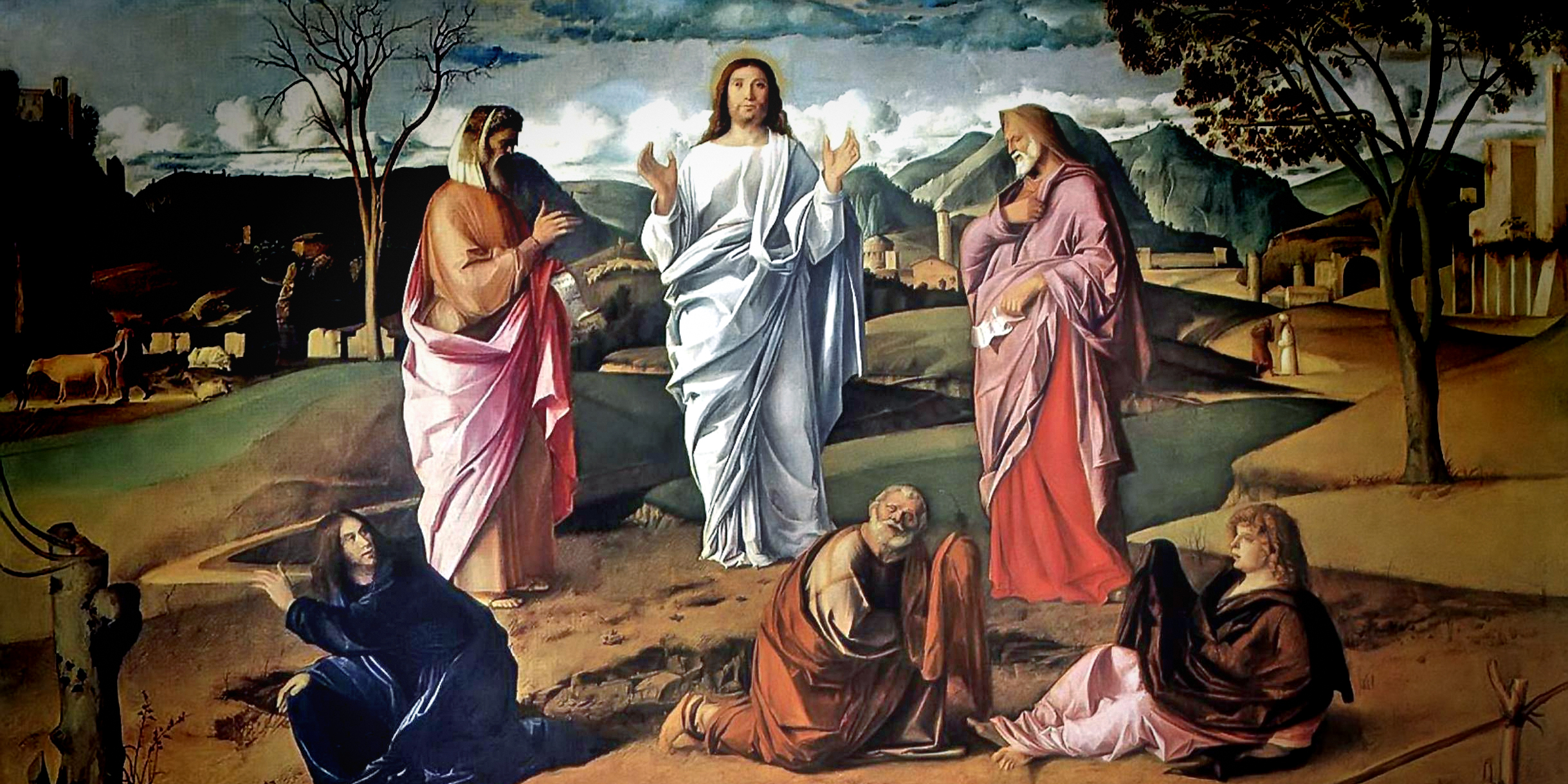
John of Patmos sees “one like a son of man, clothed with a long robe and with a golden sash around his chest. The hairs of his head were white, like white wool, like snow. His eyes were like a flame of fire, his feet were like burnished bronze, refined in a furnace, and his voice was like the roar of many waters. In his right hand he held seven stars, from his mouth came a sharp two-edged sword, and his face was like the sun shining in full strength” (1:13–16). To apply the term that Revelation does not, this Jesus is transfigured.
And this in turn points us toward a mystery that will require the rest of the book to solve.
In the accounts of his Resurrection, Jesus is absolutely, certainly, definitely not the figure robed in white or dazzling like lightning. At precisely the moment you’d most expect him to be set apart by his appearance, he isn’t. The risen Jesus is in fact so unremarkable that Mary Magdalene doesn’t recognize him at first, nor his companions on the road to Emmaus, nor his disciples on the boat squinting at the seashore.
More strangely still, the whiteness, lightness, and brightness are transferred to others—unnamed messengers at best. Mark reports how the women, upon entering the tomb, “saw a young man sitting on the right side, dressed in a white robe, and they were alarmed” (16:5). His robe is not whiter than a bleacher could manage, but distinctly white all the same.
Matthew employs images he didn’t use for the Transfiguration but that draw on the same prophetic sources: “And behold, there was a great earthquake, for an angel of the Lord descended from heaven and came and rolled back the stone and sat on it. His appearance was like lightning [astrapē], and his clothing white as snow” (Matthew 28:2–3). The angel, not Jesus.
Luke puts a similar figure at the Resurrection—“While they were perplexed about this, behold, two men stood by them in dazzling [ἀστραπτούσῃ] apparel” (24:4)—and also at the Ascension—“And while they were gazing into heaven as he went, behold, two men stood by them in white robes” (Acts 1:10).
The unnamed messengers bear some resemblance to the transfigured Jesus, but not at all to the risen Jesus.
More to the point, the transfigured Jesus bears almost no resemblance to the risen Jesus!
The Evangelists do not intend you to doubt that the Jesus of the Transfiguration and the Jesus of the Resurrection are the same Jesus. Most certainly, he is one and the same Jesus.
What they want you to grasp, rather, is that the Transfiguration and the Resurrection are telling you two distinct things about the same Jesus. They are not to be interchanged or collapsed. To lose either is to lose something crucial about Jesus.
So if it’s not a preview of the Resurrection, then what is the Transfiguration?
What can it mean for one and the same Jesus, eternal and everlasting, to change?
To learn more about the book and the options for getting your own copy click here.








Dear Sarah, Thanks for sharing! I am preaching on the Transfiguration as a chaplain (and artist and author) at a retirement facility this Feb. 11 and this will be helpful! I am enjoying your “Queen of the Sciences” podcasts with my husband, Mark Bjelland, who is a Calvin University professor of Geography and Environmental Sciences. Blessings to you as you lift up the Lord. Barbara Sartorius Bjelland