




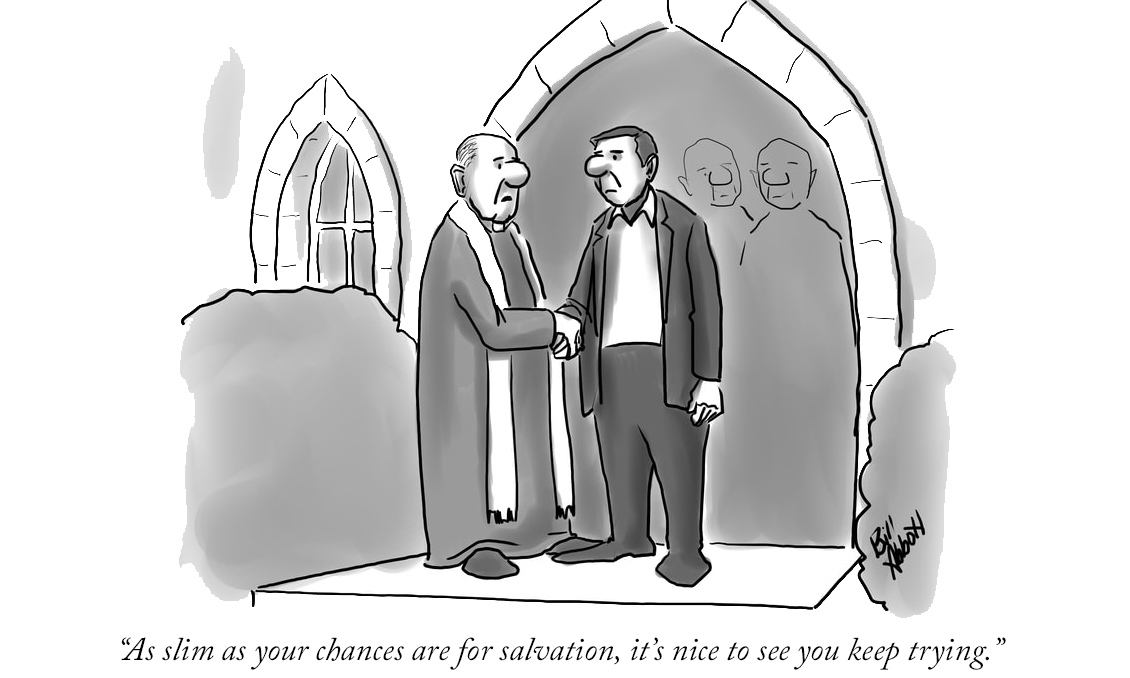
Last year I was on a trip to a major city. I saw there was a liquor store near the hotel I was staying at, so I took a walk over there. On my walk back, I decided to walk around for a bit in the neighborhood I was staying in, sipping bourbon as I went. As I was walking, I saw an old church ahead of me. I got closer and saw that it was a historic mainline church, and they had a big banner out front that said “All are welcome.” On the banner there were several flags (not a Christian flag nor American) that represented several ideologies. Now, I really don’t respect any flag. I’m not a flag person. However, I thought it is nice for a church to be so welcoming to such specific types of sinners.
As I turned the corner and walked down the other end of the street, I saw another sign. This one was much smaller, typed out on printer paper. It was the fine print to the “All are welcome” sign. On it read: “Thank you for visiting. For the safety of our visitors the following items/actions are prohibited from church grounds: No alcohol, No drugs, No littering. Violators will be trespassed from the property.”
Based on the items I had on me at the time, if I stepped on their grounds, I would be trespassing. Nothing wrong with that. One thing I do respect is property laws. Who wants to go to church with people carrying booze and drugs and (God forbid) dropping litter?
The banner, “All are welcome here” is actually saying “All sinners are welcome here, but some sinners are more welcome than others.”
Religion is known for its prohibitions. It excels at using them to mark who is in and who is out. In Jesus’ day, the Pharisees were some of the best at this game (modern Christianity can make the Pharisees look like amateurs). They were experts at clearly defining the difference between upright, faithful people and those who shouldn’t step inside the gates.
One of the tactics used by the Pharisees to keep the Jesus movement from growing was to threaten expulsion from religious gatherings and services to any of those who associated with Jesus (Jn 9:22). No doubt a painful experience. Ironically, this expulsion is in fact the best thing that could happen to a person. Jesus looked at his disciples one day and told them that when this happened, it was a cause for a celebration; it’s time to dance (Lk 6:22–23). This is liberation! It’s in that moment that Jesus will find you (Jn 9:35). But, these types of threats worked. It made people afraid. You don’t want to be the one that’s banned and have an entire community turn against you. To be an outsider is to be marked beyond the bounds of what is decent and holy.
Today, Christianity is not always so different. It too can entrap a person in an endless back-and-forth cycle of sin and absolution. It creates a continuous need that must always be met, a continuous righteousness one must maintain to keep your spot in the waiting line to heaven. It’s a religious hamster wheel.
Hebrews 10 says participating in the sacrifices offered year by year couldn’t make a person righteous (10:1). And yet it kept going. People kept participating. The continuous back and forth didn’t improve anyone but made things worse. Each time they went, they lost more sight. They thought they were drawing near to God, but they were drifting further into a system that reinforced blindness. If the sacrifices had worked, the Bible says, people would have stopped coming. The endless routine would have ended (10:2).
Why didn’t it work? Why did they keep coming back? The writer of Hebrews gives us a few reasons.
First, it didn’t touch the conscience (10:2b). If the sacrifices had been effective, people would have had no more consciousness of sin. Some translations say their guilt would have been gone. It would be useless to go back and hear a message of guilt and condemnation again if you are, in fact, righteous. Religious systems are designed to keep the guilt game going or it all falls apart.
Second, it did nothing except remind (accuse) them of something that God has no memory of (10:3). The sacrifices caused them to remember their sins. It reinforced guilt, and people kept coming back to hear it. The system kept them in permanent spiritual limbo. Always just out of reach of the promise. Before Jesus heals the blind man in John 9, his disciples ask him who sinned, this man or his parents that he was born blind. Jesus says neither sinned. The Pharisees say later to the healed blind man, “Thou was altogether born in sins, and doest thou teach us? And they cast him out” (Jn 9:34). Jesus doesn’t call the man a sinner, but the Pharisees do. Sin is often weaponized and used as a method of control and manipulation, but when Jesus sets you free, you are free indeed.
Third, the ritual continued for economic reasons: guilt is big business. The system survives on it. Nice buildings need to be maintained, and there are priests on the payroll. If the sacrifices had actually worked, the religion shop would close. Groups profit, along with personal egos, by continually bringing people into remembrance of their sins and their ongoing need for expiation. But, “we draw near to God having our hearts sprinkled from an evil conscience” (Heb 10:22).
A relationship with God is not an endless back-and-forth of sin, absolution, and forgiveness. Cycles like this shape your posture toward God. You can’t come boldly. You might not come at all. Instead of relating to God personally, you let someone do it for you. Instead of hearing God for yourself, you’ll hand that privilege off to another.
Jesus stops the religious hamster wheel. For all of us who are sick of the guilt game that religion shoves down our throats, we can look to Jesus, the author and finisher. God doesn’t see a spot on you. You have been reconciled to God and have access to him. You have been made righteous; there is no smaller addendum on the sign of his grace.








Love this. Thanks Melvin.