




I’ve come to feel rather ambivalent about the way people often draw a sharp distinction between the words “shallow” and “deep.” The safe shallows aren’t always “shallow” in the conventional sense of being superficial, and the mysterious depths aren’t always places rich with opportunity for growth and transformation. Many wonderful and scary things are floating outside our safe circles, and I think we need to pay attention to them. Some are gifts calling us into new, deeper worlds of discovery and healing. Others are sneaker waves aiming to drag us out into dangerous waters.
I confess, I often find it hard to tell the difference between the two.
That struggle to distinguish the shallow from the deep is one of the primary themes in my new book, And the Sea Was No More: Reading the Bible in the Deep.
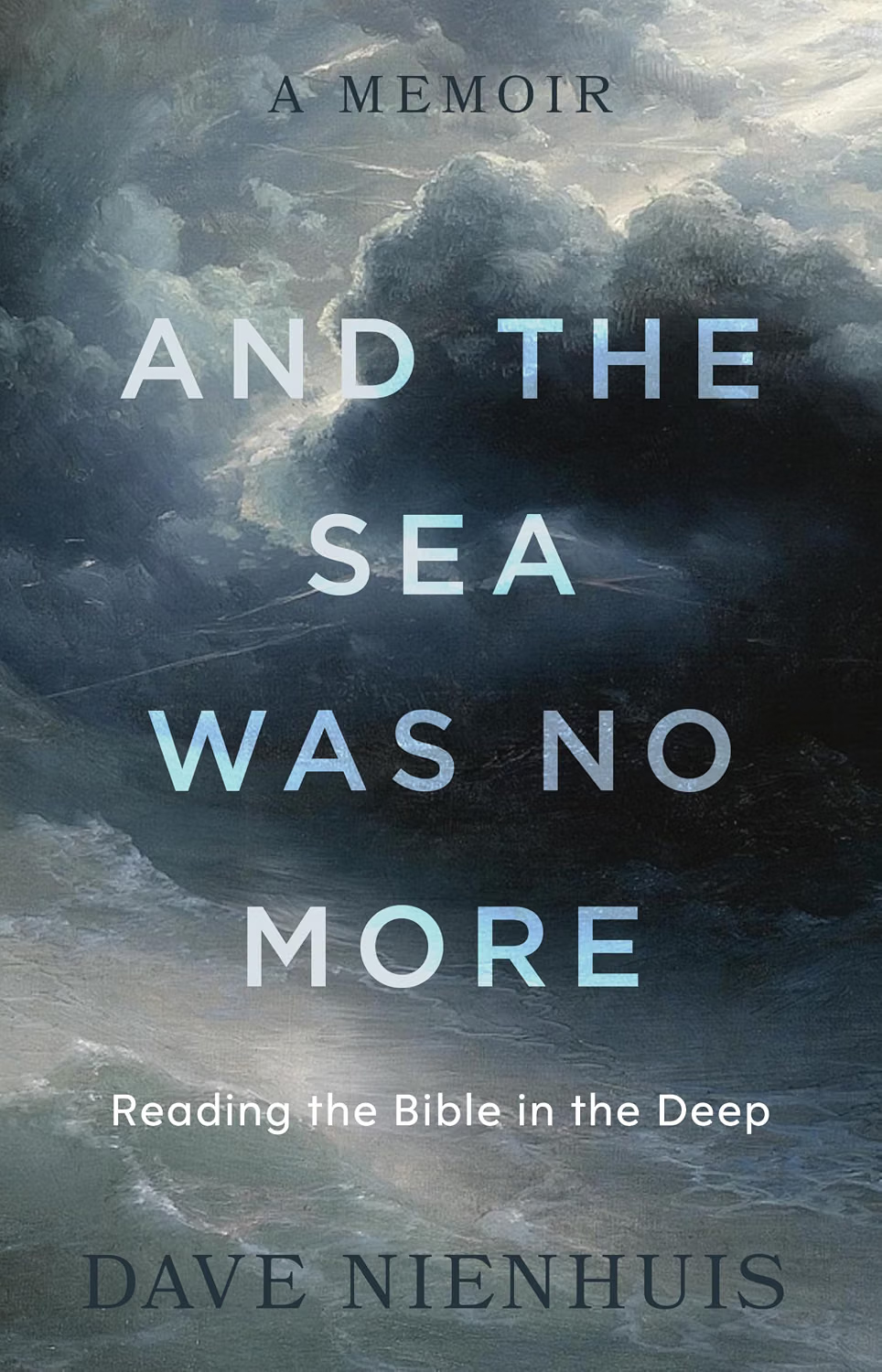 The book is rooted in the depiction of God’s creation of the world in Genesis chapter one. When God begins the work of creation, we’re told “the earth was a formless void, and darkness covered the face of the deep” (1:2). God goes on from there to speak light and life into existence, calling everything that is made “good.”
But what about the darkness and the deep? Neither are called good, but they’re also not destroyed. God allows them to persist in the world.
The darkness is restrained by the Light (1:4) — a Light it will never be able to overcome (Jn 1:5) — and the watery Deep is restrained by a Dome that holds it back so that life can flourish under its protective shield (Gen 1:6–7). But both the darkness and the deep are allowed to linger in our world. God restrains them, but also, for some reason, sustains them.
And as the story goes on, we see that sometimes God allows the chaos water to rush in on us.
This theme of threatening water will be used repeatedly in the Bible to describe the experience of being catastrophically overwhelmed. It functions as a flexible image for the things in life that sink us, whether it’s an illness, or a natural disaster, or depression, or a marauding army, or death itself. From Noah to the Exodus, from the Psalms to Jonah, to the life of Jesus and on through to the book of Revelation, the chaos water will make its presence known. And then, at the very end of the Bible, John will share a glimpse of a new creation where “the sea was no more,” and as a result, “death will be no more; mourning and crying and pain will be no more, for the first things [that is, the world surrounded by the chaos waters of the deep] have passed away” (Rev 21:1–2, 4).
***
Truth be told, the revelation of the scriptural Deep saved my faith.
About twenty years ago, life pressures built up around me to such an extent that I began experiencing overwhelming panic attacks in response to horrific intrusive thoughts. I kept the panic at bay as long as I could, but eventually, I lost my mind.
At the time, the only mental health tool I had in my spiritual toolbox was the practice of contemplative, centering prayer. But when I lost my capacity for mental focus, I lost my capacity to pray, to hear God in scripture, to worship with an open heart, and to share myself openly with others. And when all that happened, I began to lose my capacity to trust in God’s providential goodness. Everywhere I looked, all I could see was a dangerous world where chaos appeared free to rush and run with no one able to restrain it.
I’d learned from great teachers of the Christian life that God sometimes allows us to experience periods of dryness and doubt in order to strengthen our faith, so that’s how I interpreted my experience early on: it was a spiritual battle, and I needed to be courageous and bear up under the weight of it all until the period of training was over.
But my condition only grew worse.
Then, one day, after years of mental, physical, and spiritual suffering, I realized that there might be a difference between the darkness and the Deep.
Here’s how I describe it in the book:
The darkness is characterized by a painful sense of God’s absence and a corresponding lack of the spiritual consolations we’d grown used to — the pleasure of singing, the yearning to pray, the experience of God speaking to us through Scripture. This darkness results in a loss of hope, but with it, the possibility of growth in faith: We learn to love and follow God for who God is, not for what God gives us. Because of this, the darkness of God may be conceived of as a purifying and potentially generative place. We discover that we can learn to walk in the dark, and the blindness we experience sometimes results in a new kind of sight.
The Deep is different. Where the dark is experienced as privation, the Deep is an experience of intolerable excess. Rather than leave us in an empty, desolate place, it’s a tsunami that floods us into a panicked maelstrom. The darkness is a dry desert; the Deep is a raging sea. The darkness is characterized by silence; the Deep, by screaming. They are best friends and often walk hand in hand: There they are, right in the first sentence of the Bible: Darkness covered the face of the Deep (Gen. 1:2). But where the darkness is a potentially teachable place, your only hope in the Deep is that you make it through to the other side. God sometimes partners with the darkness, but God works to restrain the Deep. God allowed it to do its very worst to the world once, long ago in the days of Noah, and vowed to never let that happen again.
The persistence of the watery Deep has become a scriptural way for me to speak about the experience of being catastrophically overwhelmed, whether by meaninglessness, or intrusive thoughts, or pain, or grief. Scripture helped me to realize there’s no failure or faithlessness in speaking truthfully about such things. Being overwhelmed, even fatally so, is simply a built-in part of being a breakable creature in the world that God has made. No further explanation is necessary. In fact, no explanation could be given that we’d be able to receive.
There’s so much more to say, of course, but here’s what I want you to hear today: don’t feel compelled to think of your mental struggles as spiritually meaningful or beneficial. Don’t automatically assume they’re something God has given you to endure in order to make you stronger or more faithful.
When you’re drowning, the only thing to do is to scream out for help. And sadly, there are ways of being Christian in this world that will keep you from doing that very thing.
Excerpted from And the Sea Was No More: Reading the Bible in the Deep by Dave Nienhuis ©2026 (Wm. B. Eerdmans Publishing Co.). Reprinted with permission from the publisher.








I love the honesty of this piece, the thoughtfulness, and ultimately the hopefulness. John of the Cross, writing of the dark night of the soul centuries ago, would say Amen, too.
Dr. Neinhuis! Im almost done with your book and it has been a profound gift to me in ministry! My margins are full of !!! and hearts. Your distinction between the dark and the deep is so needed for the American church which often struggles to find words or space for both. I can’t wait to share your book with parishioners and colleagues alike. Thank you for this gift!
Dave, thanks so much for this; the distinction between darkness and deep is so helpful. There are times of “overwhelming” by a raging sea in most/ all our lives. And I wonder if now our shared life, whether as church, nation or world is besieged by multiple overwhelmings? It is as if we’ve been staggered by one wave, barely gotten to our knees and another huge wave smacks us. The latest being AI but really tech which has now a life of its own, that on top of climate change, on top of assault on most every norm that once provided a guardrail and guide. While a part of me wants us all to rise up and do better there is also a part of me that is amazed at how well, given all this, many people manage to be doing. How long we can sustain even that I don’t know.
I could not order this book fast enough. I want to read words that I feel as though I could have written. Thank you!
Thanks for the kind words, friends.