




By one count, the Bible contains 1,967 distinct named characters and another 1,000+ place names, so you’d be forgiven for forgetting or overlooking at least a few of them. Not to worry. We here at Mockingbird are great fans of underdogs and unsung sinner-saints, so we’re highlighting just a few of our favorite underappreciated biblical characters here for your edification. Feel free to include your own in the comments.
Lot’s Wife (Genesis 19)
She comes to me sometimes
in my dreams, or while I’m wandering through my city
some people say is so wicked, why don’t you leave it.
It would take everything within me to not look back.
Burning houses enclosing the people I love,
gardens ripe, now turning to ash.
Oaks and Maple, bricks and stone,
places of belonging,
gone.
I wonder if Lot’s wife felt like she was righteous enough to leave.
I know, this was before the time of Grace.
Mercy brought them out, and justice reigned down on that town as soon as the sun was peeking over the mountains, and they could only feel the heat of God’s justice.
That’s when she looked back. Tear stained cheeks,
salt already falling from her eyes,
becoming the salt of the earth
before the time of grace. – Janell Downing
The Angels: I rarely think about them in the Bible or in life, but when I do, they offer incredible comfort. As David Yeago puts it, “God the Creator in his infinite goodness has no need to proceed like a sober and economical post-Enlightenment bourgeois, creating cautiously so as to avoid going over budget. … In all their might and glory, [angels] are … flourishes of God’s love, extravagances of beauty and power flung out [to declare the glory of our] prodigal Creator.” As Jacob learns at Jabbok in Genesis 28, the angels reveal to us that no matter how dark things are, no matter how far we are from home, “Surely the Lord is in this place, and I did not know it.” We are held in the mysterious, bountiful care of God. – Joel Steiner
Tamar (Genesis 38): The extended Joseph story (Genesis 37, 39–50) is interrupted with the drama of the widow Tamar and her father-in-law, Judah. Commentators are hard-pressed to find any connecting link between the Tamar/Judah and larger Joseph narrative. Here’s one possibility: The biblical family is sort of a mess. Judah fails in his duty to his widowed daughter-in-law, refusing his son Shelah to be her husband as required by law. Tamar takes matters into her hands. Posing as a prostitute, she is hired by an unwitting Judah. When told that Tamar has “played the harlot” and is now pregnant, Judah demands her execution. But Tamar has a few items up her sleeve, all of them identifying Judah as the one who solicited her favors and made her pregnant. Exposed, Judah fesses up, saying, “She is more in the right than I.” Soon Mary will sing of the mighty cast down and the poor raised up. It’s not a new theme. It is as old as the powerless widow Tamar and the powerful patriarch Judah. – Tony Robinson
Shiphrah and Puah (Exodus 1): Around February 24, 2022, Shiphrah and Puah of Exodus 1:15–22 became two of my favorite Bible characters. I was in the midst of recording a video series for my church, which was going through the Old Testament verse by verse with commentary, when Russia began its invasion of Ukraine. As I watched this world’s tyranny rage, I was reminded that the Pharaoh in Exodus is purposefully NOT named while two midwives in the story are, Shiphrah and Puah. They fear God and stand up to tyranny by faithfully doing their job, helping bring life into the world and outwit the Pharoah. As we continue to watch the oppression of people by tyrants, we remember that God too knows us by name and that living out our callings faithfully and fearing God put us on the front lines of bringing the gospel of life into the world. – Tasha Genck Morton
Phineas (Numbers 25): The story of Phineas and his spear is as graphic as it is teeming with significance. A plague is unleashed on Israel for having “yoked themselves” to the god Baal. To be clear, “yoke” here serves as an innuendo for ritualized sex. When a couple brazenly begins “yoking” in front of everyone — and on the Ark of the Covenant no less — Phineas simultaneously kills both with his spear. The Christological allegories of the whole scene almost write themselves. But I’m more interested in the aftermath. For this act of zealous atonement, the plague stops, God makes an eternal covenant with Phineas, and Phineas manages to survive the slaughter of the wilderness generation. Psalm 106 then records that this quick-thinking Phineas was “reckoned as righteous.” Abraham and Phineas, two people whose entire lives are considered righteous by a single moment. How extraordinary. – Todd Brewer
Rahab (Joshua 2): Joshua 2 begins with a spy mission. Despite the assurances of the Lord that he will provide for the Israelites, Joshua sends two spies into the Promised Land to check things out. Who among us hasn’t wanted to do everything we could to ensure things worked out the way we believe they will? The spies, of course, would be captured but for the faith of a woman named Rahab. Most people want to emphasize her occupation as a prostitute: Look, God can use even fallen people. But I see the point of Rahab’s story as much larger. She shows greater faith in God than the Israelites. She not only trusts that God is going to give them the land, she also takes a great risk in ensuring the safety of these spies. She trusts that God will deliver not only his children but her as well. We always want to hedge our bets, but Rahab is the one called by God to save his people. I love when God uses the least expected person to do his work. – Jane Grizzle
 King Eglon (Judges 3): In the dark hallways of the Old Testament stands the book of Judges, and within it, many of the more bizarre and, at times, deeply distressing stories of what the world looks like when “everyone does what is right in their own eyes.” In the third chapter, we meet a fat king whose shameful, latrine-tinged death releases Israel from bondage, making him remembered for centuries in ridicule. Ehud, the judge who kills King Eglon, can be easily connected to Christ without much effort: He walks into the mess Israel made, topples the tyrant they empowered, and hands them a left-handed (unexpected) victory they didn’t lift a finger to earn — a preview of the grace that meets us in our self-inflicted prisons.
But what about King Eglon? At the end of Luke’s gospel, we’re given a short lesson in how Jesus reads the Old Testament. I imagine Jesus flipping to Judges 3 on his walk to Emmaus and pausing to reveal how the darkest parts of the story point to him, perhaps even the worst characters. Like Eglon, Jesus died without honor. While he hung on a Roman cross, he was mocked, ridiculed, and remembered in shame. The first image we have of Jesus is believed to be a cave drawing of a donkey being crucified with the caption: “Alexamenos worships [his] god.” Perhaps the villain’s shame stays in the story so we see the Savior who takes the villain’s place — the One who became sin to save sinners. This is the best news: it means the most humiliating, dark, and twisted parts of your story have been claimed by the God who died in shame for you. – Davis Johnson
Shamgar (Judges 3, 5): Do you know the story of Shamgar? In truth, me neither. According to Judges 3:31, he “struck down six hundred Philistines with an oxgoad. He too saved Israel.” I had a professor in college who pointed out that he was no less or greater than the other judges, and God did saving work through him. Underappreciated? More like unknown, and yet … Shamgar is a helpful reminder to me that I’m free to “preach the gospel, die, and be forgotten.” – Ryan Alvey
Rizpah (2 Samuel 3, 21): This forgotten mother of Israel proves that the silence of women can be the most potent rebuke imaginable. Late in the David epic, when the shiny king has no reason to fear or doubt, he indulges in a bout of tactical murder of Saul’s remaining descendants — supposedly to cope with a famine, supposedly due to Saul’s maltreatment of the Gibeonites (otherwise unattested). David all too eagerly agrees with the Gibeonite plan. It is the biblical equivalent of the second twist ending of a thriller, calling into question who in fact has been the good guy and the bad guy all along. In further ugliness, Saul’s heirs are subjected to a form of death whose Hebrew meaning is not altogether clear — but might not be that far off from impaling or even crucifixion. Yet the famine doesn’t end! Why not? What opens the heavens is Rizpah, the late Saul’s concubine and mother to some of the sons, keeping silent vigil over their exposed bodies so birds and beasts can’t devour them. It’s only when David learns of this and sees to the proper burial of his rival’s children in the tomb of their forefathers that “God responded to the plea for the land.” David doesn’t say so outright, but I hear behind his action Judah’s judgment on Tamar: “She is more righteous than I.” – Sarah Wilson
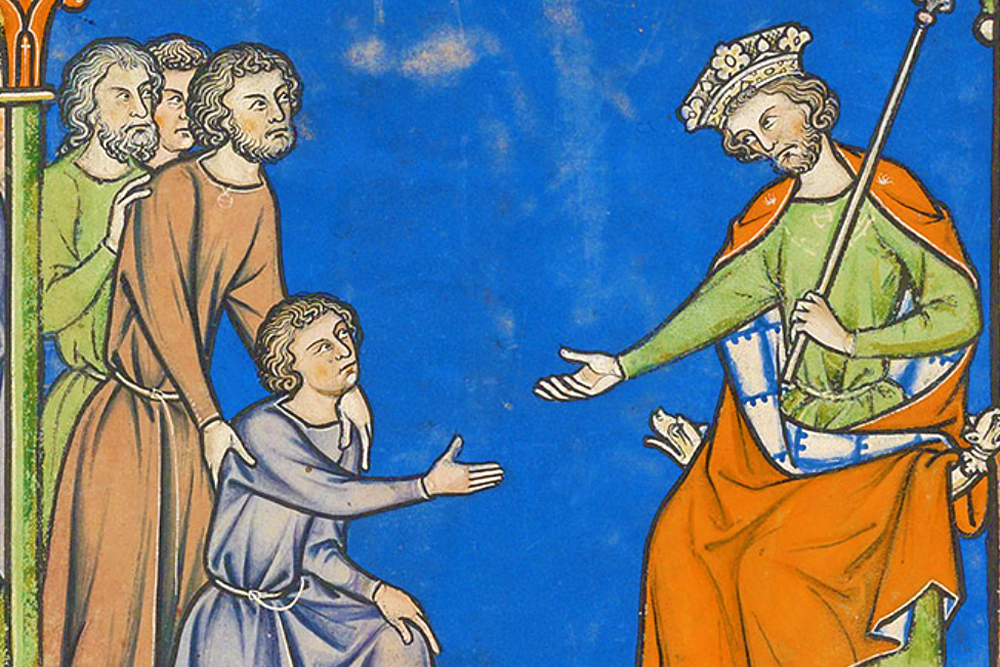
Mephibosheth (2 Samuel 9): I have Tim Keller to thank for bringing Mephibosheth to my attention via a sermon on 2 Samuel that I heard him deliver in my twenties. After David becomes king of Israel, he seeks out any surviving relations of his late friend Jonathan so that he might show them kindness. Jonathan’s sole living heir is his son Mephibosheth who, it turns out, is “crippled in both feet” (i.e., not exactly regal material). Mephibosheth seems to have internalized his disabilities, referring to himself in front of David as “a dead dog” (2 Samuel 9:8). We read as David restores to him all of his family land and issues the command that Mephibosheth is to dine at the king’s table at every meal henceforth, just like a son would. It’s a beautiful and relatively unsung moment of grace in the Old Testament, of an unworthy person receiving love and favor on account of something that someone else has done. – David Zahl
Nathan the Prophet (2 Samuel 12): After David’s descent into adulterous madness and after he kills the husband of the woman he took for himself, Nathan tells him a story. It’s a simple tale about a rich man who steals a poor man’s sheep, after which David burns with anger and demands the rich man be found and killed for his sin. But it’s what happens next that serves as one of the more underappreciated moments in Old Testament lore: Nathan’s famous, mirror-spinning statement of “You are the man!” It’s like watching a movie and realizing we’re a lot more like the bad guy than the good guy, and it serves as a hermeneutical guide for us, the readers, to see a glimpse of ourselves in the unmentionable parts of scripture rather than the heroic and clean parts. But it all leads us to one of the more important questions of life: If we’re already on the wrong side of the story, who will meet there to save us and cover our sins? The answer is in a slight rewording of the prophet’s declaration, but applied to one of David’s distant sons, one who would stand before the angry mob and of whom Pilate would say “Behold, the man!” right before he was dragged away to be crucified. The one who would become the bad guy in our place and die so we could live. – Chris Wachter
Jonadab (2 Samuel 13 / Jeremiah 35) built a legacy that lasted. Somehow he was inspirational enough to lead his descendants into a sober and nomadic life. So much so that generations later, in Jeremiah 35, God uses them as an example of faithfulness to men as opposed to Israel’s unfaithfulness to God. We celebrate legacies like these that last generations. There are still orders and communities carrying Jonadab’s legacy today. Thank God for leaders like Jonadab, and praise God for his faithfulness amidst our unfaithfulness. – Blake Nail
Obadiah (1 Kings 18) is palace admin for King Ahab, but he’s secretly hiding Yahweh’s prophets at the same time. He’s the quintessential example of a guy trying to do the right thing while, preferably, keeping his head attached to his shoulders. One day Elijah appears and tells Obadiah to summon his boss. Obadiah, nonplussed, assumes that the Spirit will teleport Elijah away in the meantime (these things do happen) and that Ahab will have him executed. Elijah does not promise otherwise; sometimes it’s hard to get respect. – David Clay
King Nebuchadnezzar (Daniel): “Now I, _________ , praise and exalt and glorify the King of Heaven, because everything he does is right and all his ways are just. And those who walk in pride he is able to humble.” Who, would you guess, said these words? King David? Samuel? Elijah? NO! These are words from the mouth of King Nebuchadnezzar in Daniel 4:37. You know, the one who threw Shadrach, Meshach, and Abednego into the fiery furnace? He was definitely impressed by the way their God rescued them … but it wasn’t until he was driven away from people, ate grass like the cattle, and had his body drenched by dew that he personally encountered the unmatched power of God. His downfall humbled him, but it was restoration that led him to praise. We tend to remember King Nebuchadnezzar as an egotistical, power-hungry, and ruthless man when really his last recorded words in the Bible show him to be a humbled worshiper of the one true God. – Juliette Alvey
Ship, Fish, Bush, Worm, and Many Cattle (Jonah): The book of Jonah is a cartoon, alive with action, or perhaps a Muppet extravaganza. The unwilling prophet is borne along by a full cast of nonhuman agents, each with divinely set purpose. The Ship isn’t merely threatened by the storm — it thinks about breaking up and bears Jonah into the Fish’s gastric care; the Bush is appointed to deliver Jonah from his evil, and he rejoices in it; the Worm fulfills its task to relieve the Bush of worldly duties. Each of these acts on divine impulse; how could we imagine them rightly except as bearing faces? Lest we forget, Jonah’s task is not for his own sake but for the salvation of more than 120,000 Ninevites and, wrapped in sackcloth and crying out to God just the same, Many Cattle. – Adam Morton
Habakkuk is a minor prophet whose lament covers only three chapters, but his words become the cornerstone of Paul’s doctrine: “The righteous shall live by his faith” (Habakkuk 2:4). As his name states, Habakkuk “wrestles” and then “embraces” God, taking us on a journey from despair to delight. H/t to Josh Garrett in Macon, who preached that Habakkuk won’t look away from the problem and won’t let go of God. And did I mention the whole thing’s a liturgical song? “Though the fig tree shall not blossom … yet I will rejoice in the LORD, I will joy in the God of my salvation” (3:17–18). – Derrill McDavid
Jesus: We never appreciate him enough. – Will McDavid
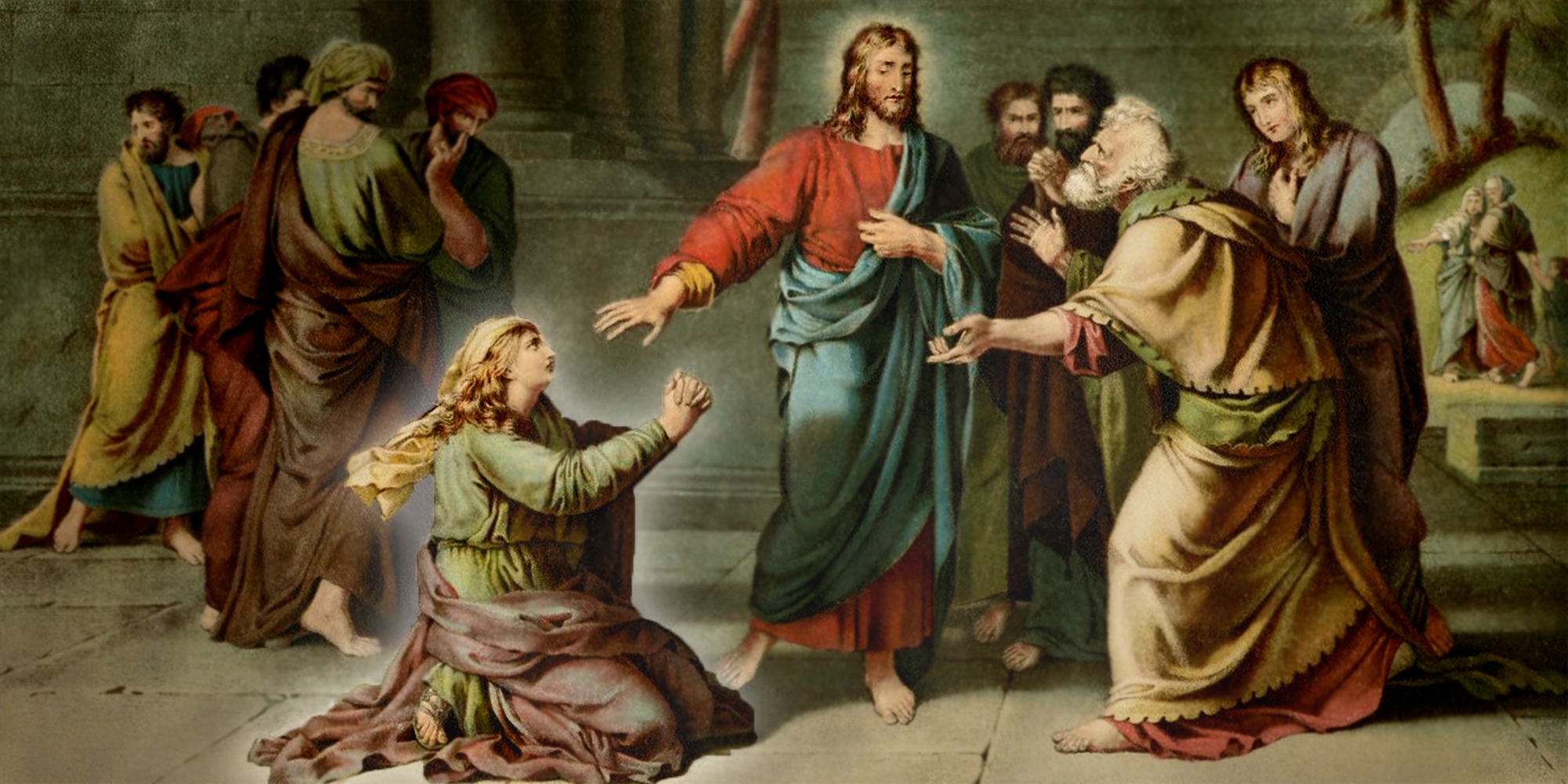
The Syrophoenician Woman (Matthew 15): I love the story of the Syrophoenician woman, who in today’s parlance really slayed in her interaction with Jesus. At this point in the Gospels, Jesus had crossed from Jewish into Gentile territory, signifying his mission’s extension beyond Israel. There, he encountered a desperate woman motivated by her child’s demon possession to cry out to Jesus. As not only a woman but a Gentile and a Canaanite (ancient enemies of Israel in the Old Testament), her outburst is especially unusual (and possibly dangerous — which makes me love even more that she did it and highlights her lack of other options). At first, Jesus doesn’t even acknowledge her — ouch — necessitating her further pleas over the disciples’ objections. Finally, Jesus tells her he wasn’t sent to her kind of people, to which she responds with more pleas. Then they share an odd exchange that I’ve seen used to validate everything from a lack of empathy to full-on racism. However, I’d like to defer to Tim Keller’s interpretation, which I heard years ago. He surmised that this exchange is actually a form of banter that reveals Jesus’ regard for this woman and his estimation of both her character and intelligence. Jesus is being playful here and giving her an opportunity to prove her faith. He’s also using this situation to reveal the broadness of his mission — a mission that, thankfully, includes us. – Stephanie Phillips
The Samaritan Leper (Luke 17) was the only one in a group of ten lepers Jesus healed who returned to thank him. We don’t really know anything about this man except how demonstrative he was, throwing himself at Jesus’ feet, thanking him and praising God in a loud voice for deliverance from the discomfort and unsightliness of the disease itself, the stigma and self-hatred ensuing from the divine disfavor it was said to signify, and the ostracism that invariably followed. But what happened after he returned and made a holy scene? Maybe he followed Jesus and his disciples as they made their way to Jerusalem, operatically thanking the “miracle man” three times a day until Jesus got so tired of the cheap drama he asked him, in an exquisite combo of perfect understanding and righteous irritation we’ll get to see in heaven on some Home Movie Redemption Night, to cut it out. Or maybe, emotion spent, the man sobered up and went quietly home, repented of his sins, resumed his old job, and doubled his temple tithe. Perhaps his mother, previously a seen-it-all cynic, baked bread for the village poor and the Judean leper colony to the end of her days. There are deep and shallow, spiritual and superficial ways to respond to a miracle that takes a life harrowing and hopeless and gives it back to you, fresh and ready to be lived out as you choose. What would I have done? Given all that God has given me and all he’s promised, what can I do now? – Ken Wilson
Nicodemus (John 3, 7, 19): It’s because of this guy we get some of the most meaningful pieces of scripture and summary of Jesus’ ministry, John 3:16–17. That alone should warrant his inclusion in this list, but there’s more. Nicodemus shows us that discipleship isn’t always a Saul to Paul sudden thing; for some, it takes time. Nicodemus first shows up at Jesus’ door under the cover of night because he’s embarrassed his Pharisee friends might see (3:1). That conversation must have stirred something in him because his next appearance is to offer a subtle defense of Jesus in front of his friends who wanted to curse Jesus (7:50). His last appearance shows him caring for Jesus’ dead body after it’s taken off the cross, anointing, wrapping, and placing it in the tomb. Quite the transformation. – Will Ryan
“Doubting” Thomas (John 20): Invited by Jesus to place his hand in the resurrected Lord’s side in John 20:26, Thomas’ doubts have been recorded for eternity, leading to the descriptor “Doubting Thomas.” What a crappy nickname! Note though, Christ’s rebuke was not recorded — because there wasn’t one, just a gentle “believe.” We forget that just a bit earlier in John 11, Thomas was willing to die with Jesus after Lazarus’s death; his bravado and love, at least, were undimmed by whatever proof he later desired. I’ve witnessed parents drive children from the faith when their children’s questions were deemed doubts. Christ’s response to our doubts, as it was to Thomas, is invitation. – Josh Retterer
The Young Men Who Buried Stephen (Acts 8): The preaching of the gospel in the Book of Acts was an all-out collision with reality. So charged are Jesus’ death and resurrection that it takes only seven chapters for the early church to have its first martyr, Stephen. In a scene that only fits The Sopranos, the blood-bent crowd stones Stephen, and the witnesses to the execution lay their coats at Saul’s (soon-to-be the Apostle Paul) murderous feet. As the persecution intensifies and the fledgling Jesus movement is scattered and frenzied, we’re told that “godly young men buried Stephen and mourned for him” (Acts 8:2). It’s the first Christian funeral. Amidst all the chaos and death, these unnamed young men lay Stephen to rest and pause to place their sorrow at God’s feet. And in so doing, they remind us of our sacred calling, to call death what it is, and to accompany the dead into God’s everlasting arms. – Josh Gritter
Simon the Sorcerer (Acts 8): There’s a wonderful story in Acts that speaks to how God handles our tiny little egos. In the Book of Acts, a man named Simon had achieved minor fame by practicing sorcery and astounding the people of Samaria. Chapter 8 says, “He claimed to be someone great, and all the people, from the least to the greatest, heeded his words and said, ‘This man is the divine power called the Great Power.’” But then, Philip comes along proclaiming the gospel of the kingdom of God in the name of Jesus Christ. Apparently, it didn’t take long for Simon to realize that his gig was up; that he simply couldn’t compete with the power of what Philip was preaching. It says Simon believed and was baptized. He then continued to follow Philip closely, “astounded by the great signs and miracles he observed.” Here, we find that the gospel is not what “separates the men from the boys,” but what separates the power of man from the power of God. – Sam Bush
Ananias (Acts 9): You know who I have absolutely unequivocally no interest in doing ministry with? Men who use violence. Nothing is quite as challenging to me as a pastor. As a women studies minor in undergrad, I looked at the landscape of issues uniquely facing women and grasped that no one person could solve all of them. I decided to make women’s safety my focus. When the Holy Spirit sends Ananias to Saul, Ananias was likely in hiding from Saul’s murderous threats. And yet, in obedience to the only one who can actually solve all of the issues uniquely facing us all, Ananias goes to Saul and calls him not one of the many expletives I might reach for but instead calls him brother. Brother! If not for Ananias’ obedience to God’s grace, we would not have the words of the Apostle Paul saying, “Nothing can separate us from the love of God in Christ Jesus, our Lord.” Thanks be to God for those Christians who offer the grace of the gospel to those who use violence. – Lara Musser Gritter
 Mark (Acts 13, 15 / 2 Timothy 4): In Acts 13, when Paul and Barnabas set off from Antioch on Paul’s first missionary journey, Barnabas selects his young cousin Mark to tag along. Their mission begins on pagan-dominated Cyprus, where, according to tradition, Paul receives his first lashing. After they leave Cyprus, Mark mysteriously bolts their company. Was he homesick, exhausted, or just scared? It’s easy to see why he might bail. But Paul is not having it. In Acts 15, Paul is unwilling to forgive Mark for having “deserted them,” and he and Barnabas ultimately separate over the matter. Yet in 2 Timothy, in spite of everything, we find that Paul has changed his tune and is now sending for Mark, one who has been “useful in my ministry.” Apparently, with time, Paul came to see his error in prematurely judging Mark, the same longtime collaborator of Barnabas and Peter who, according to tradition, eventually authored the first Gospel and is credited as the founder of the Coptic Church in Alexandria, Egypt, where they even believe — despite Mark’s early squeamishness — that he died a martyr. It’s all a warm reminder not to give up on people, and that even if we do, God never does. – Benjamin Self
Phoebe (Romans 16): Karl Barth, Martin Luther, St. Augustine of Hippo. These theological greats were famously shaped by reading Paul’s Epistle to the Romans and so shaped the church. But we ought to list one more name when remembering Romans’ great readers: Phoebe. She not only carried the epistle to the Romans but also likely read and interpreted it for the early Roman church. Without her preaching, Augustine, Luther, and Barth might not have had a letter to the Roman church to read. – Lara Musser Gritter
Epaphras (Colossians 4): I would love for someone to refer to me with the words Paul applied to Epaphras, the guy who planted the church in Colossae: “beloved fellow servant,” “faithful minister,” and “servant of Christ Jesus.” But my favorite designation comes in Colossians 4:12, where Epaphras is identified as “always wrestling in prayer for you.” I picture not a John Cena type but more a Division II college wrestler with huge forearms and cauliflower ears constantly going to the mat on behalf of God’s people and the gospel. – Larry Parsley








You missed Epaphroditus, whom Paul calls “my brother and fellow-worker and fellow-soldier, and your messenger and minister to my need … So receive him in the Lord with all joy, and honor such men …” (Philippians 2: 25, 29 ESV).
He is the quintessential model for our lives: brother, worker, soldier, messenger, and minister.
These are all so good! I kinda wish there was a mini video series about each one! Love love love!
The Ethiopian Eunuch (Acts 8) – Gentile and Sexual Minority guided and baptized by Philip. A beacon of faith for marginalized communities and outsiders everywhere. Myself included.
What about Mahershalahashbaz from Isaiah? “Quick to the plunder, swift to the spoil”.