




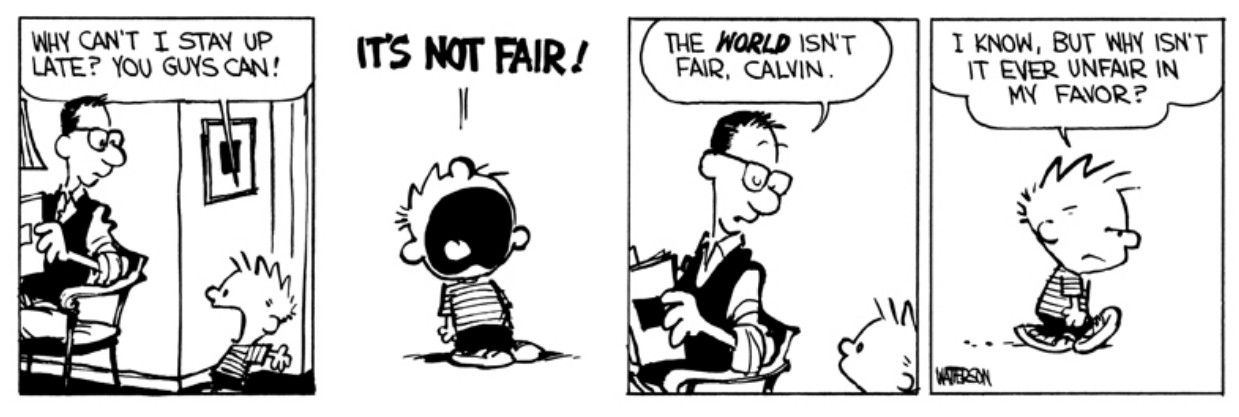
We all want fair. If we’ve been a long-time customer for a cell phone service, we expect better perks than someone new. It’s only fair. We want a salary that is fair for the work we do. We want referees to be impartial to both teams. We get furious when someone breaks in a line we’ve been standing in for a while. And heaven knows we want our parents to be fair on Christmas morning!
In a recent episode of New Amsterdam, the hospital therapist (Dr. Iggy Frome) was tasked with mediating between a father and son. The show presented a classic case of “the father is wrong and the son is right” scenario, the conspiracy theorist father vs. the traumatized son. Viewers were pulling for the son. Viewers were waiting for Dr. Frome to help the son put his father in his place, but that’s not what happened. To the initial shock of the son, Dr. Frome urged him to look past his father’s ignorance for the sake of relationship. Everything within me screamed, “That’s not fair!” when I watched it unfold. But Dr. Frome was right. The relationship was much more important than fairness. It wasn’t fair. Grace never is.
As a matter of fact, if you want fair, you won’t like Jesus.
Have you ever thought about how unfair Jesus’s words were to the woman caught in adultery in John 8?
“Neither do I condemn you,” said Jesus. “Go, and from now on do not sin anymore.” (Jn 8:11)
How you interpret Jesus’s words to this guilty-of-adultery-yet-not-condemned woman reveals much about your understanding of grace. These words have been so controversial, some of the earliest scribes of Christianity thought better of it and decided to omit them altogether.
What do you think He means when He says, “Go, and from now on do not sin anymore”? Is is bothersome that He doesn’t say more? Should it be assumed He is telling her to get her act together, or else? Perhaps Jesus’s answer might change if he encountered the same circumstances with her a week later. Would his refusal to condemn her run out? Think about it. If she found herself again at his feet, humiliated for the second time, would he then pick up a rock with everyone else? Does His “neither do I condemn you” declaration have a limit?
Is forgiveness only given once? Is the death of Jesus for our sins for all time, or just the first time?
Fairness might demand more from this woman. Shouldn’t He say something like ..
-
“Neither do I condemn you — now go be thankful for the rest of your life.” Or,
-
“Neither do I condemn you — now go and never forget how close you came to being stoned today.” Or,
-
“Neither do I condemn you — now go to the temple, offer up the appropriate sacrifice, and apologize to the Pharisees who were just here. You embarrassed them pretty badly today.”? Or,
- “Neither do I condemn you — now go join a church, get in a small group, surround yourself with the right kind of people, and have weekly check-ins with an accountability partner”
It bothers me, I must admit, that Jesus only says, “Neither do I condemn you. Go, and from now on do not sin anymore.” Is that it? What about the offended parties? What if they were standing there? Would what Jesus said to her suffice for you if it was your spouse who cheated? It’s not fair.
No. No it’s not. Grace never is.
If you are looking for fair, you will not enjoy being around Jesus. If you need fair, Jesus will always make you uncomfortable. Always.
Jesus “only” said what He said to her because He knows what we all, deep down, know and long for. When we are given a conditional list that is insisted on, we resist. It never works. However, when we believe we will be loved regardless of our actions — we are free to be. When Jesus said, “Go and from now on do not sin anymore,” He wasn’t saying, “You better stop it now because if you don’t, I will condemn you.” No. He was saying, “Neither do I condemn you. I never will. I will be condemned – once and for all – in your place. Leave your life of sin because it is killing you. Leave your life of sin because it is destroying you and those you love. I will never condemn.”
Jesus invites her into a forever and safe and loving and unconditional relationship with Him that gives her freedom and space to work out — with him — her transformation. Jesus promises to us — just as he did this woman that He will not condemn now, or ever. His words to her were not to “go fix herself” so she might earn more love next week. His words to her were words of safety and security that she would be loved forever. His words were a beautiful and grace-filled invitation to live life from a position of being confident of forever love.
If that bothers you, you’re starting to get it. If it makes you uncomfortable, welcome to life with Jesus. If you feel it’s unfair, you’re correct. It’s not.
It’s grace.