There is an internet conspiracy theory that Jesus Christ is merely a Jewish reimagining of Julius Caesar.
The idea goes like this: no Jesus Christ ever existed, but the Romans were so enthusiastic about their own JC, that the Jewish people invented a proxy hero. Jesus Christ is an inverted version of the great dictator for life, a folk hero for Jews that took on their values instead of Roman values. It’s a tremendous farce of a conspiracy theory which refuses to acknowledge how Jesus challenged both traditional Roman and Jewish thought, and zero historical evidence.
The thing is, the conspiracy theory does highlight a number of overlaps between the life of Julius Caesar and the life of Jesus Christ that are worth consideration. The two had a lot in common. They were both adored by the masses, though the elites viewed them as political rivals. They both upset the traditional balance of power. Both men were murdered without justice — Jesus was crucified out of peer pressure by the mobs and a weak willed governor, Caesar was stabbed to death by a coup of 60 other Roman Senators. Both were deified after their deaths, with Julius Caesar elevated to his divine status by his nephew and heir, Octavian, aka Caesar Augustus.
There even seems to be some overlap in their respective biographies. In Plutarch’s biography of Julius Caesar, written in the same era the canonical gospels (and probably a little behind them), the story is recounted of Caesar making a daring ploy. His army was divided, with the enemy in between them, and he was desperate to meet with the other half of his troops as he could. So he dressed up as a slave and hired a twelve-oared ferry boat to take him out to sea, around the enemy’s troops, and land with his troops on the other side. Before he got to the sea, a storm broke out, and the oarsmen couldn’t overpower the storm. The captain tells them to turn back, but Caesar makes a brave move:
Caesar, perceiving this, disclosed himself, took the master of the boat by the hand, who was terrified at sight of him, and said: ‘Come, good man, be bold and fear naught; thou carryest Caesar and Caesar’s fortune in thy boat.’ The sailors forgot the storm, and laying to their oars, tried with all alacrity to force their way down the river. But since it was impossible, after taking much water and running great hazard at the mouth of the river, Caesar very reluctantly suffered the captain to put about.
It’s not hard to see overlaps between this story and Jesus’s 12 disciples caught in a Galilee storm with their powerful leader resting below decks.
Similar, but different. That’s the best way to see the overlap between the two. And yet, curiously, one remains worshiped as the son of God, is praised by his followers, and continues to chart the path of global destiny. The other, curiously enough, is mostly remembered in cheap pizzas, high-end salads, casinos, and a well regarded Shakespeare play. (Though, according to last year’s great meme, men do think about the Roman Empire more often than we expect!).
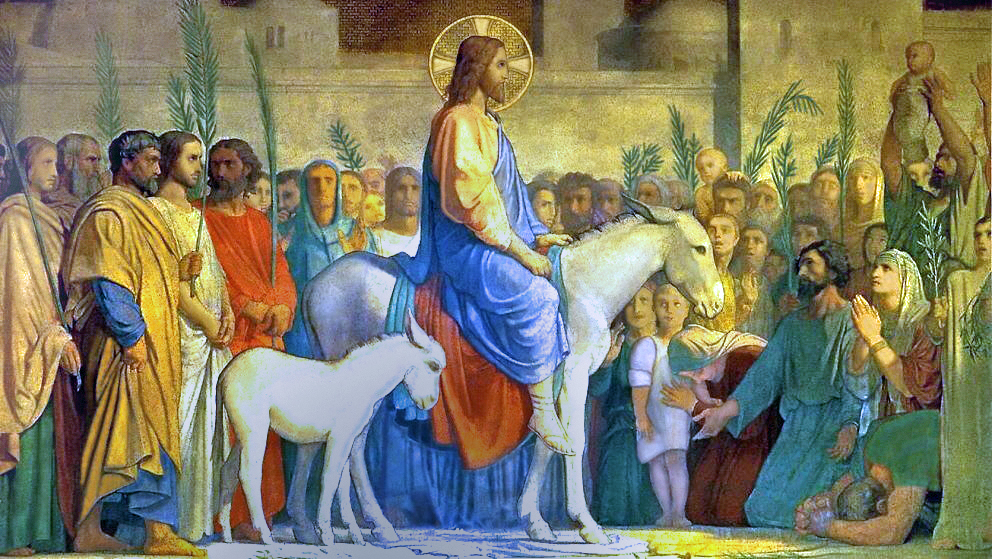
The reason for their divergent legacy can be seen clearly on Palm Sunday, a day Christians remember Jesus’s “triumphal entry” into the city of Jerusalem. The word “triumph” there is richer and deeper than we might expect. A triumph is, historically, a symbolic Roman procession where a general or figurehead is honored and exalted for a monumental victory. We would do well, then, to compare Jesus’ “triumphal” moment with the triumphs that Julius Caesar collected in his lifetime.
For decades, Julius Caesar was the general who conquered in Rome’s name. He is most famous for conquering all of modern day France and even threatening the British Isle. But he also had ambition, intensely loyal troops, and (most importantly) popular support. When he returned to Rome after conquering France, he brought his army with him, sparking a major civil war. Emerging victorious, Julius decided to throw himself not one, not two, not three, but 5 triumph parades, each one featuring displays of glory over the regions he conquered.
To start each triumph parade, thousands of prisoner soldiers, now slaves, were marched in humiliation in front of jeering crowds. Enemy generals and kings, also captured, were marched in humiliation with them. Then, the spoils of war were presented — chests and carts filled with gold and jewels, statues, artworks, religious idols, all the weapons and armor of the captive soldiers. Any horses or animals that were taken as spoils were marched, as well as exotic animals, like giraffes. After this, large floats depicting key moments of the campaign were carried through, perhaps models featuring key battles were quickly assembled to help explain the story of the victory to the crowds. Next, the senators of Rome itself, the governing body of the city, would march through in formal attire, showing their gratitude to the general. Then, of course, came Caesar himself, resplendent, dressed in purple and gold, pulled by a four horse chariot. He is followed by his troops, marching in white robes, who all sing songs to honor Caesar and their triumphs. Many songs were quite bawdy, with chants like “men, keep your wives close, the bald adulterer is back and triumphant!.”
The procession would work its way through the city for everyone to see. It would eventually stop at the temple to Jupiter, where two blemish free white oxen were sacrificed in thanksgiving for victory, and an offering given to the temple. The triumph would be followed by feasting and revelry. The spoils of victory would then be dispersed to soldiers, supportive senators, and the Roman treasury.
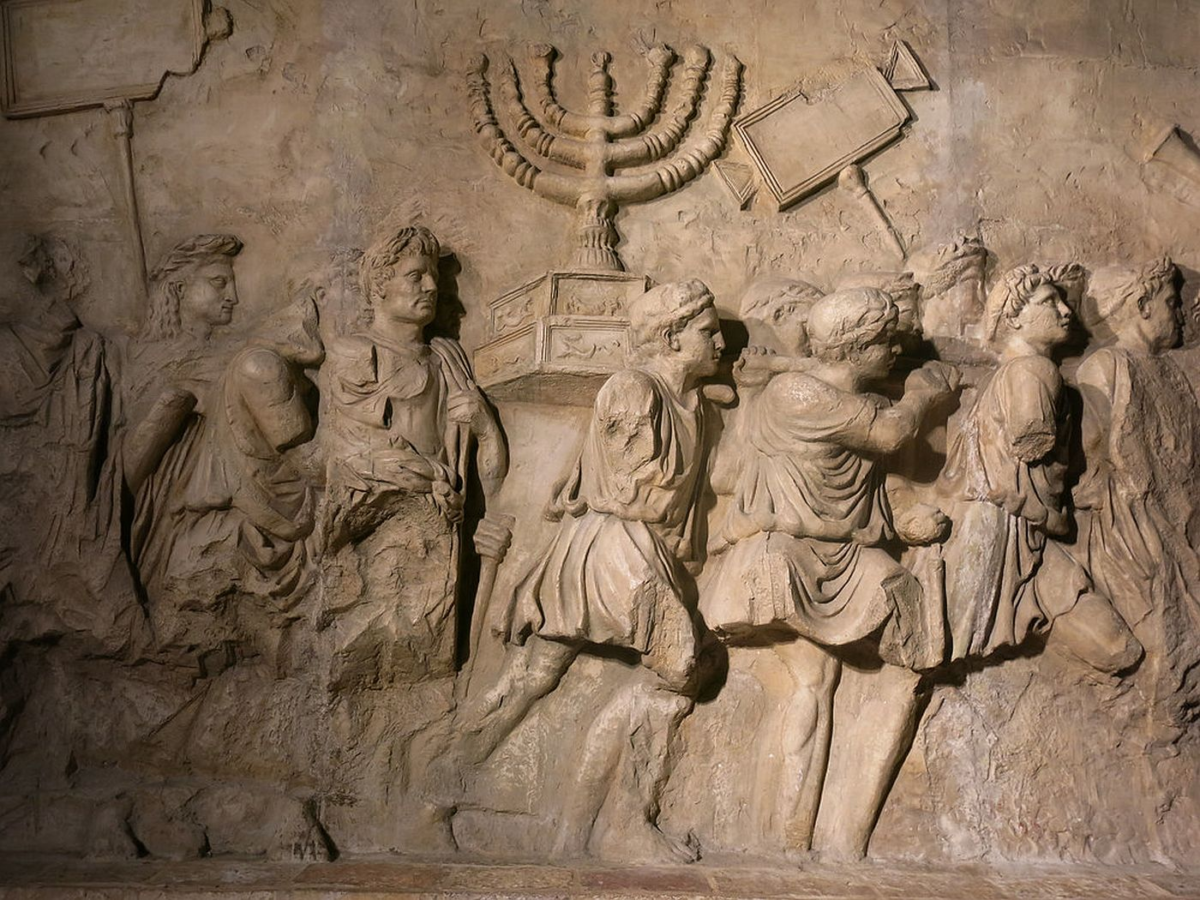
The Spoils of the Jewish War (66-70 A.D.)
To put these spectacles into perspective for you: when Julius Caesar was in the middle of his triumph parade celebrating his defeat of France, his chariot axle broke, and it almost threw him off the side. After collecting himself, he finished the parade on foot, which slowed things down a bit. As the sun was setting, Caesar lights a torch, and begins to climb up the steps to the temple to make his sacrifice. And in doing so, he is flanked by 40 war elephants, 20 on each side, each one supposedly holding a lantern for him with its trunk, to help light the way for him.
On the one hand, it puts Palm Sunday to shame. Where’s the spectacle? Where’s the pomp and glory? On the other hand, Palm Sunday’s triumphal entry does reflect a different set of virtues. One might even say those values and virtues on Palm Sunday are eternal in scope, which is why the J.C. with the lesser spectacle is the one who is worshiped today.
Notice, for example, how the only planning involved has to do with finding the pack animal Jesus will ride. It took a massive logistical effort to sustain a triumph parade in Rome, but all Jesus needed was a donkey.
Notice, too, how the procession develops spontaneously and organically. Jesus’s reputation precedes him, and not only do fellow pilgrims join him as they travel to Jerusalem for the Passover, but city dwellers also leave the city to join the fun.
Notice how, instead of chants of triumph or bawdy jokes, the crowds chant “Hosanna,” which means “save us,” and they call Jesus blessed and cheer on the restoration of the Davidic monarchy. This is a triumph of faith — we know what he will do for us, so we shall worship him now in trust that God’s promises will be fulfilled.
Notice how Jesus picks for his steed the righteous, humble, diplomatic, non-violent donkey to be his mount instead of a war horse or a four horse chariot.
Notice how there are no spoils of war — unless we include the walking lame, the singing mute, the bright-eyed blind, and the dancing deaf. Notice that there are no slaves in his train. Notice the palm fronds instead of the gaudy purple and gold ornaments. Notice that the Senators march compliantly in line during Caesar’s triumph, but the Pharisees and Sadducees are not only absent during Jesus’s entry, but they try to get it shut down.
Notice how Caesar offers sacrifices in his temple, but Jesus cleanses his.
The two men exemplify two different sets of virtues. The worldly virtues of Julius Caesar are power and might and honor and glory. There is wealth and pomp and fame and prestige and renown to be had for all his victories over foreign militaries and domestic rivals. But the spectacle is ultimately self-serving, isn’t it? Sure, it’s for the glory of Rome and the greatness of her society, but c’mon. Julius Caesar is an ambitious man. And the truth is, he does become a symbol of all that is great about Roman might and power.
Jesus’s triumphal entry exemplifies the opposite. It is humble, somewhat unplanned and spontaneous, authentic. Four horses and a chariot? No way — one donkey (maybe two). Palm fronds. Cloaks on the ground. Leave the elephants to Caesar. Leave the bulls to Jupiter. And when we’re done, someone be sure to return the donkey we borrowed.
Despite the size of both triumphs, both of them end poorly, or at least things end badly for the men at the center of them. Julius Caesar is eventually assassinated because his grasping for victory and glory make the powers-that-be afraid he would topple their senatorial authority and civic traditions. Jesus Christ is eventually assassinated because his grassroots movement to reform Judaism made the powers-that-be very angry that he would topple their authority and their civic traditions. Many similarities between the two men, with, again, two diverging legacies.
One of the earliest texts we have in early Christianity ends with the declaration that Jesus is Lord (Phil 2:6-11) A friend of mine pointed out to me that we tend to think that phrase “Jesus is Lord” is good news because Jesus arrives on the scene to fill a void. We previously had no Lord, we were wandering in darkness, lost in our way, but then Jesus comes along to be that thing we need. A Lord that finally gives our lives meaning and direction.
This is a half-truth at best. The testimony of the Bible is that we all have lords, and the question is which one are we following. We were slaves to sin and death — they were our lords. Or perhaps, as the Bibls says elsewhere, our Lord is our stomach, the appetites and desires that drive our actions. Perhaps Caesar truly was the Lord of many in the ancient world. In the ancient world, you were never an unaffiliated soul or a free agent — you were, as Dylan famously sang, serving somebody. Even the wealthy and the powerful and the kings and emperors were seen as servants of Gods. Julius Caesar, in his early political career, was appointed to be a priest of Jupiter, and eventually became the pontifex maximus, the high priest of Jupiter, before his work as a general. Even Jesus Christ himself chose total obedience to the God of Israel, his heavenly father.
So when we say that Jesus Christ is Lord, this is good news not insomuch that we have a Lord, but that the Lord we have is Jesus. Our Lord is merciful, and good, and kind, and righteous. Our Lord is not self-obsessed, but lays down his life for his people (and then takes it back up again!).
A week after his triumphant processions, Jesus would display a greatness and power that far exceed anything Julius Caesar could imagine: a power transcends the power of sin and death and hell itself. Who cares about conquering Gaul when someone has conquered the grave? Who cares about the defeat of a political rival when Satan himself has been cast down in defeat? Who cares about the spoils of war when the gifts of God are abundant mercy and forgiveness and grace? Jesus and Julius may have both marched in victorious parades, but there’s only one procession that continues on into eternity.