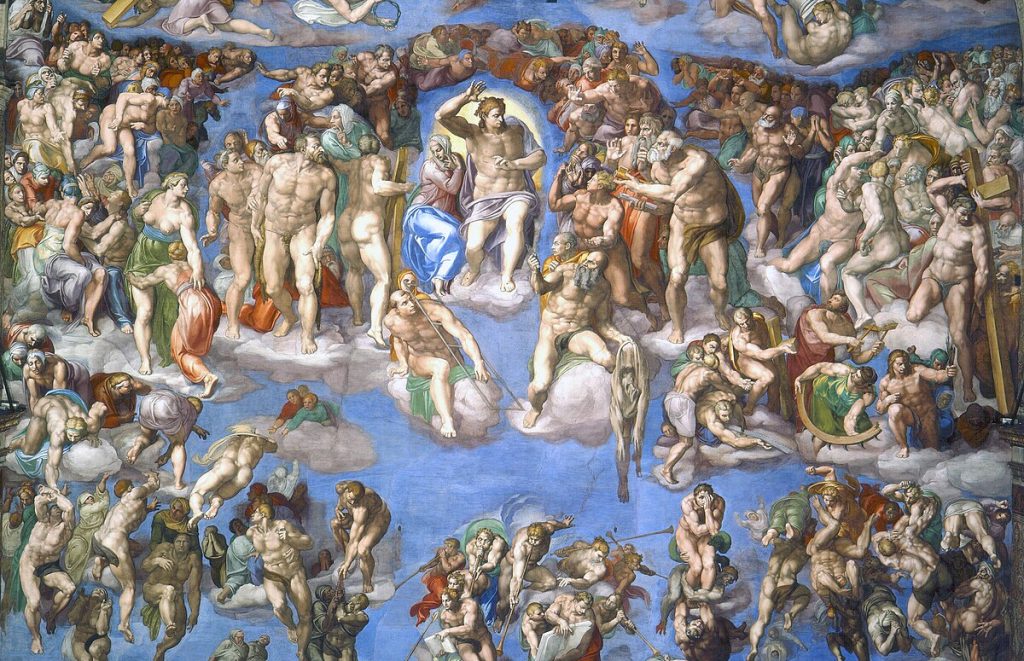
All doom paintings, including Michelangelo’s The Last Judgment, follow a pattern. Within wet plaster walls or onto wooden polyptychs, painters imagined scenes of Christ’s second coming, the day of judgment, heaven, and hell, often employing gruesome imagery to evoke fear and introspection in viewers. The point was to remind viewers of the soul’s fragility. The Catholic Church commissioned the majority of doom paintings across Europe, which were painted into enormous stretches of wall. They decorated altars and archways and cathedral ceilings. Worshipers would encounter these images walking into or out of the building while daydreaming in the pews and while exiting and entering the confessional. In other words, every direction you looked, you’d see theology represented visually within the structure of the church building itself, communicating the story of Jesus and the Scriptures to an illiterate congregation. Yet their most immediate purpose was to evoke repentance in the laity: doom paintings offered “a constant spectacle of the ordeal through which they would have to pass in order to reach the presence of God,” according to art historian Jane Ashby.
The Protestant Reformers were appalled at these scenes, in part because they decided that Catholic reverence for iconography equated to idolatry. So, from the time of the Reformation onward, these frescoes were literally washed away using “a veil of wholesome Protestant lime-and-water.” So began a tradition of iconoclasm that persists to this day.
The Last Judgment may be the most famous example of medieval doom painting. At the top of the knave, between ceiling and wall, a viewer can see the Father God’s sandaled feet. Christ floats in the center, a dispassionate Italian male who presides over a chaotic end-time sorting on the ground below. Near the bottom of the wall, humans rise out of graves to be sent to heaven (into the sky) or hell (the bottom right).
Even if they rise, however, nothing guarantees that the barrel-chested Savior will notice them. In fact, the serene Christ does not seem capable of relating to the plebeians at his feet, let alone counting the hairs on the heads of each follower. This Christ seems indifferent to the followers and the doomed alike. Even those who hover within reach seem to balk at the figure of their Lord. And no one hovers close enough to test the resurrection miracle, as Thomas once did by prodding Christ’s scars with his fingers. Instead, access to the divine Son is limited. Christ’s mother, Mary, claims a spot on the same cloud, while the martyred claim the next closest clouds, such as Bartholomew, who lounges in heaven with a restored body even as he holds in his hands the suit of skin that his torturers flayed from his body, according to legend. (Supposedly, this suit bears the face of Michelangelo.) Next in the hierarchy are the major Old Testament prophets, the apostles, and the Greek female oracles (sibyls). Viewing this scene, you would not be amiss in wondering whether there is room enough for the rest of us within proximity of our Savior.
Meanwhile, damnation sits at eye level. Though the left bottom corner of the fresco features the ascent of the holy to heaven, the right bottom corner depicts the opposite. Demonic figures drag the unlucky toward flames, pythons, and torment at the edge of the wall, with Charon, from Greek mythology, ferrying the damned to hell. Whether Michelangelo’s viewers pictured themselves as headed up or down, no one can view the painting without reckoning with their own feelings of dread and disgust about not getting into heaven. This is horror Christianity. Humanity finds itself trapped in a two-dimensional frame, bound to the failure of the first humans, a target on our backs. We cannot escape; we are dogged until our dying days.
And who chases us down? According to the mythology of the doom painting, our antagonist is not demonic, but the abusive Father of Wrath, the one seated on a throne that barely skims our realm. In The Last Judgment, viewers can behold only the Father’s sandaled feet at the top of the wall, while the artist has painted the rest of God’s body and seat into the ceiling. We cannot approach this deity who rules at unreachable altitudes. Nor can we understand the logic of God’s anger, anger that has climaxed in brimstone and eternal torment. Meanwhile, our stoic big brother Jesus appears at the center of the painting, unmoved by our fate and untouchable even by those who followed in his footsteps during his lifetime.
When we refer to the Old Testament God, this is the popular image we conjure. The abusive Father of Wrath is the worst possible version of divinity that humankind could think up. When barely religious Americans open the pages of the First Testament, they interpret the most foreign, confusing, appalling, and embarrassing stories in our Scriptures through this frame: God as vindictive, all-powerful, and disdainful of creation — especially disdainful of humanity with our tears, blood, sweat, and dramas. This is the God who obliterates Sodom and Gomorrah in ash and flame, the God who slaughters the firstborn Egyptians in Exodus, and the God of Noah, who dooms humans, animals, and plants to extinction by drowning. This is the God who executes God’s own son at Calvary.
It may surprise you to hear that though I was an exceptionally devout evangelical teenager, I rarely considered hell to be a real place. The most extreme members of my sect droned on about hell, usually at protests of one kind or another. But I believed hell was irrelevant to me. Someone else was going to hell; hell did not apply to believers, so, why should I dwell on it? Sure, I sometimes worried about friends who might not make it to heaven, but while living in the suburbs in twenty-first-century America, I found I could easily ignore the justice and judgment of God. Call it a delusion of the young, privileged, and healthy: I never had to consider hell because I was going to live forever.
I recognize now that I overlooked the parts of the Bible or God that made me uncomfortable. I did not want to remember my body’s frailty. However, becoming a mother — witnessing the frailty of my children’s bodies — cured me of these delusions. And I can no longer ignore those at the bottom of the frame, the objects of God’s wrath. For example, how can I make sense of God’s command to commit genocide or to colonize the lands of the Canaanites?
I understand why God has been painted as the abusive parent who — never having set the rules to begin with — barks up the stairs, “How many times have I told you to put the bowls on the top rack of the dishwasher?” before retaliating by setting the teenager’s car on fire. Yet reading further in Genesis means we must face the horror of God. Telling the truth about God — and the book and people that represent God — means that we must come face-to-face with the aspect of God that makes no sense to most of us, the aspects of God that may in fact be cruel. Genesis is full of these stories.
Rather than skim over the top, I suggest that thoughtful literary engagement may provide understanding. We must unwind lies from truth, repenting of the harms of the past and present. Only then can we understand and embody the truth of God as expressed within the Bible. The God who, we Christians believe, bore the weight upon Their own back, rather than leaving us alone to face the atrocity of our own choices. The God who does not stay distant, but rather descends to the bottom of the frame. Only in our honesty do we find that God, seated beside us in the dirt.
This essay is adapted from Liz Charlotte Grant’s book Knock at the Sky: Seeking God in Genesis After Losing Faith in the Bible, forthcoming in January 2025 from Eerdmans.