




I really enjoy playing chess. It’s a hobby. I’m very average at it. I remember watching Searching For Bobby Fischer as a kid, before I even knew how to play chess, and being really moved by it. The film could’ve been titled Searching For the Undiscovered Genius in Ourselves — or at Least a Close Family Member So That We Can Feel Superior to Our Neighbors. But if that had been all the movie was, I wouldn’t be writing about it now. Instead, for me, the movie is about the beauty of grace and the destructive force of judgement.
Searching for Bobby Fischer is admittedly a deep cut. So a little refresher: Based on a true story, a 7 year old New Yorker, Josh Waitzkin, is discovered to be a chess prodigy. Josh’s parents are played by the wonderful actors Joe Mantegna and Joan Allen. Dad (Fred) is a sportswriter who loves playing catch with Josh. Fred prefers this kind of activity actually. However, Mom (Bonnie) knows that Josh gravitates more toward the inner life.
In the first “And we’re off!” dramatic moment of the film, Josh loses on purpose and asks “Can we go [outside] now?” because he believes that will make his dad happy. Also: Josh already knows he’s able to chess thump his pop but doesn’t want to beat him. (In my own childhood, I beat my dad, at checkers, exactly once. And I had to retreat to the bathroom to think about whether or not I wanted to do that. I did and our relationship survived; he dominated me every time afterwards.)
Josh leaves the room. Fred lightheartedly tells Bonnie that he “knows he should’ve let him win.” Mom quickly unpacks the reality of the situation. Stunned, Dad summons his son and, I’m paraphrasing here, says “Play me. For real.” Another way to hear this is “Son, be yourself.” Josh takes a breath, then clears the phone books off the chair that he was sitting on. You can almost hear Dad gulp. Josh beats him not once, but twice. This isn’t a flash of competition so much as father and son seeing each other clearly for the first time. His parents do their best, amidst their humanity, to meet Josh where he’s at. They willingly throw themselves into their son’s world. Driving him to tournaments, supporting and encouraging him as his ability continues to reveal itself. And he flourishes.
It’s only when a taskmaster enters that he becomes wounded and less effective in his gift. They find a “proper” chess tutor played by the eminent Ben Kingsley. Gentle he is not. He tells Josh that he can earn points by meeting certain goals. Every time Josh does so, he gets a precious certificate. But even this is a ruse. When Josh stops being able to meet the goals (or doesn’t want to), his teacher has the mirror opposite display of the phone books. With great flourish, he throws all of the fake and photo copied certificates on to the floor. The futility of the expectation becomes evident to both as Kingsley reveals who he is: if Josh is a genius, then who’s his teacher???
The movie also sometimes depicts a swirling mess of adults trying to claim missed glory through the talents of a child (sound familiar?). At one point in a tournament, the parents get so rowdy that a proctor literally has to lock them in the basement until play is over. The kids erupt in applause. It’s poignant and hilarious.
As is usually the case, parents and tutors aren’t the only problem. In a critical scene, gentle soul that he is, Josh extends his hand in reconciliation to an opponent and is met with a cold stare. Josh is about to defeat the mini-bête noire of the film — his evil twin on the competition circuit. Josh wants to do the kind thing and offers a draw. But the kid sneers at him and rejects his offer. Why? Well, sometimes we don’t want to be forgiven and met where we are. We want to stay in our darkness because it’s the rhythm we know best. Healing doesn’t always feel safe, especially when it touches a third rail in our psyche: greed, ambition, or vulnerability. Perhaps more interestingly, our healing can also tweak and tilt others. “If they’re ‘getting better’ by not doing what I’m doing, then what does that mean for me and my beliefs?! Attack!” The extrapolations are endless. Sometimes I’m a Fred. Sometimes I’m a Bonnie. And very occasionally, I’m a Josh. My subconscious is always Ben Kingsley.
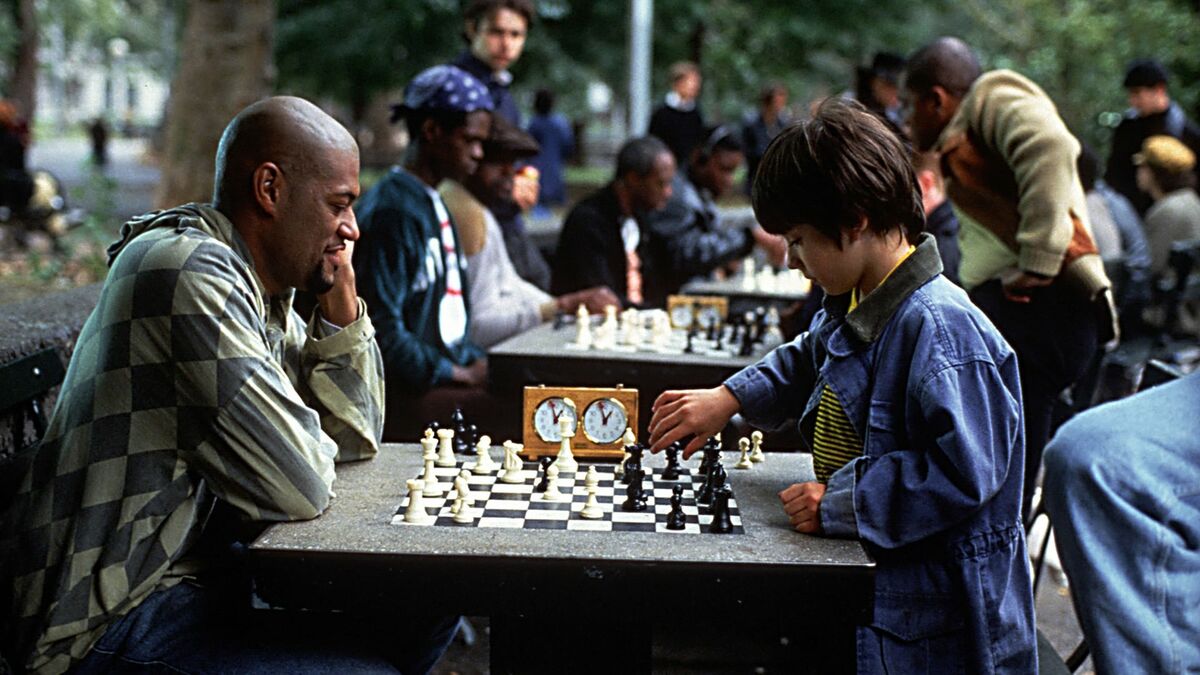
Finally, Josh puts it all together and you can see the harmony restored in his soul. He has come to his own realization, on his own time, that it’s not about achievement (vs. Dad or peer) nor about identity — that these things do not bring about what they promise. And (spoiler alert) he actually does win, in every sense of the word. In one of the final images of the film, we see him take a slightly younger chess player under his wing. “[Morgan], you’re a much stronger player than I was at your age.” Josh is being his true(r) self, acknowledging his own gift by helping cultivate another’s. And that’s what I mean. When we accept the fact that we’re all doing the best we can, however rare that is, we’re less likely to lay on the horn in traffic, less likely to snap at a partner, less likely to see that spark of resentment turn into a wildfire of hatred.
Is this fantasy optimism? Like Brad Pitt in Moneyball? “It’s not that hard to play first base, Scott. Tell ’em Wash.” Well, try it. It’s impossible on our own (Wash: “It’s incredibly hard”). Try not to passively aggressive leave the toilet seat up or down. Or try waving at the neighbor who has inexplicably ignored you since the day you moved in 3 years ago. Nothing diminishes me faster than someone saying “This is great! Everything is great!” when that is not the case.
Grace is rooted in reality. Grace says “Yes this is sometimes a brutal experience, this human thing.” Grace requires, to borrow some 12 Step language, a power greater than ourselves.
True grace does indeed beget true grace. True love does indeed beget true love. That’s where my hope lies. On the good days and the bad.
Wanna play chess?





Bravo! Well written, Nate. Bring your chessboard, and I’ll show you what average chess playing really looks like.
I love this, N. (the movie too). Dripping with wisdom.