




1. Just a spoonful of sugar helps the vegetables go down. So says Ashlie Stevens in Salon recently, who advocates that more adults should eat like children by hiding their vegetables in other foods. Brownies with zucchini baked in, broccoli covered in cheese, or carrots dipped in ranch. It doesn’t matter how you eat those vitamin-rich ingredients, only that you eat them. But within this small culinary modification, Stevens hides some truly radical ideas about our relationship to food, legalism vs. liberty, and the nature of adulthood itself:
Adulthood is supposed to mean meeting the vegetable on its own terms — and, preferably, enjoying it. You’re not merely supposed to eat the broccoli. You’re supposed to have matured into the kind of person who wants the broccoli.
I know this because I can make feeding myself unnecessarily complicated if I let myself. I am a food editor; I know how to make vegetables taste good. I also know how quickly “eat some vegetables” can become “eat vegetables correctly.”
What is this best way to eat a vegetable? Straight from your home garden, preferably raw, maybe with spritz of lemon juice and “enough dirt still clinging to them to imply virtue.” Just as God intended. Back to Stevens:
What you eat is, once again, evidence of what kind of person you are.
Which is perhaps why I was so susceptible to a piece of nutritional wisdom I first encountered in the lauded medical halls of Pinterest. It appeared on a peach-colored background in undulating cream script: Eat what you want, add what you need. […]
A couple years before Pinterest delivered this revelation to me, chef Roy Choi gave me another version of the same permission — only a little less polite. “Disrespect the s**t out of vegetables,” he told me in an interview.
His point was that we have made vegetables too precious. We talk about “letting the ingredient shine,” as though the carrot is competing for a prestigious academic scholarship. Choi’s advice was to go the other direction: blister them, puree them, drown them in vinegar or chili, add something sweet, blend them into sauces, make them taste like the foods you already crave.
Stop treating vegetables like museum objects and start treating them like ingredients.
What I remember most, though, is that beneath all the swagger, Choi’s argument was really about self-compassion. Later in that same conversation, he described the larger project — his cookbook, “The Choi of Cooking” — as learning to have “the courage to be kind to yourself.”
I was drawn to this article for a few reasons. I am an adult who prefers to eats vegetables when they are in a salad or covered in salt and butter. This, I think, just makes me a human. But the article also illustrates how many of the rules for being an adult confuse pragmatics for sanctity (see also: rules for being a Christian). In that way, Stevens’ and Choi’s “disrespect the s**t out of your vegetables” feels less like another rule and more like the freedom of playfulness that transforms the mundane into the magic of fun.
2. After reading the above and trying out your first course of garlic and bacon green beans, you might be tempted to think the secret to lifelong happiness is to imbue each day with an overflowing sense of whimsy. And you wouldn’t necessarily be wrong. But in attempting to make every aspect of life feel magical, Mitch Therieau wonders whether a dash of whimsy has become less whimsical:
Isn’t life today a bit too mechanical? Aren’t we treating ourselves too much like machines? One moment, we’re eating some kind of goop to optimize our nutritional stack; the next, we’re having a computer write emails for us while we vacantly scroll our feed, letting an algorithm remote-control our attention. “Everyone is a little burnt out,” observes a pink graphic on Instagram adorned with little stars and charms, using one of the master “body as machine” metaphors of our time. “Maybe the answer is whimsy.”
If whimsy is really the answer to our ills, it’s understandable that people would want more and more of it. […]
Whimsymaxxers talk about bringing out the magic in the everyday, but increasingly that magic is seen as something to be measured and harnessed. It is no surprise, then, that whimsy slots so comfortably into the jargon of our wellness-saturated culture. One social media guru breaks whimsy down into a series of salutary “microhabits”; another speaks of whimsy as a means of maximizing the return on investment of one’s “inner child.” Whimsymaxxing is presented as part of a “low-cortisol morning” routine. A medical spa shows off a bedazzled box of Botox vials.
Whimsy here starts to look less like magic and more like the mining device, turning in circles, working on the self, dredging some things up from its depths and shuttling others down from the surface. Buy yourself a little treat. Invest in your inner child. Let your impulses drive. “Fun is a medicinal bath,” as Max Horkheimer and Theodor Adorno put it more than 80 years ago. “The pleasure industry never fails to prescribe it.”
To try to optimize whimsy is to subject it to an “if … then” conditionality of law. The whimsymaxxer instrumentalizes whimsy, disfiguring playfulness into its opposite. The law of fun, it turns out, is no fun at all.
3. For the clergy out there, this next article is a parable on the plight of being a pastor’s kid. For everyone else, it’s another example of how to zap the fun out of something that should be enjoyable. While a coach can be a surrogate father figure, being both simultaneously, as Nick Paumgarten discovered, is a kind of toxic alchemy. Like the mixing of law and gospel, being parent and coach spoils both in the process: it turns out that being the coach’s kid is a recipe for hating the sport.
But it wouldn’t be long before I would forget and be tricked into expecting too much. Something came awake in me, an incubus of ambition — a desire for excellence, obviously of a shine that would reflect back on me. The vanity of parenthood took hold.
I hadn’t set out to coach my sons. The earliest impulse was to be on the ice with them. If I was going to go to the rink, I might as well get to skate. I wanted to play with them, not teach them to play, much less to play for me. Still, it was pride, of a kind, that drew me to the bench. … But eventually a dad’s tutelage sets in motion the familiar cycle of expectation and disappointment.
What unfolds is as predictable as it is sad. As the dual roles of father and coach become intertwined, Paumgarten ceases to be either. One vignette he recounts is particularly instructive. When James, his eight-year-old son, is shoved from behind into the boards, he retaliates by hitting the other player in the face with his stick. Paumgarten tries to play it cool, as any coach would, but inside he’s being split in two:
From a certain remove, the mayhem amused me, but I worried, with a dad’s fierce, selfish concern, about James’s well-being — his head, ribs, neck, shoulders — and muttered justifications to myself for the retaliatory stick to the ear. “Kid had it coming,” my inner hockey man said. Yet I also worried about that Rye boy and felt the rustlings of embarrassment, guilt, or even outrage. The refs kicked James out of the game and gave Rye a five-minute power play. They scored twice. It cost us the game. […]
On entering the locker room, I immediately checked in on James to ask about his head and spine and give his shoulder a surreptitious squeeze — what he really needed was a hug — on the car ride home I began to criticize him for losing his cool, for attempting to hurt another player, and also for putting his team down a player and depriving it of his services. “You can’t keep doing this,” I said. “We need you out there.”
I knew it was bad to talk to James about the game, or really to say anything at all besides “Let’s get some pancakes,” but, because I was wound up myself, or because I felt that I needed to impart some kind of lesson, as a father and as a coach, or because there was some childish part of me that needed to spill my own disquiet onto someone else, I persisted. Sometimes I savored the sweetness of driving to and from the rink with one or the other son in back; other times, I felt like little more than a chauffeur. Today, I was a cop, with a perp in back, behind a scrim of parental expectation as impenetrable as bulletproof glass.
Eventually, Paumgarten’s son James would quit hockey and “the yoke of expectation” that it likely brought. He soon picked up basketball:
Basketball! Sacrilege. Out on the hardwood, as an energy guy off the bench, he bounced around with the avidity and glee of a parolee. I took it as a delicious rebuke. Another dad exclaimed, “James is the happiest basketball player on the planet!”
4. I promised myself I wasn’t going to write about AI (yaaawn), so here are some quick hitters of the best of what I found this week. Becca Rothfeld notes the current anti-AI populism is being driven by a new humanism. I think this observation is largely correct, but Ashley Frawley’s “We Must Become Gods” strikes me as more prescient. The New York Times notes the homogenizing tendency of AI, which Noema argues will make human knowledge work more essential (here’s hoping!)
5. I obviously can’t endorse what I haven’t seen yet, but my gosh the reviews of Nathan Fielder’s You Can See Everything are superlative. See this, from the Guardian, which gives it five stars:
Those who were there can confirm: the hype is deserved. You Can See Everything is, somehow, more shocking, twistier, thornier and revealing than billed – a stupefying and gloriously destabilizing hall of psychological mirrors, a thrilling once-in-a-lifetime collision of director and subject.
6. For laughs, Little Old Lady Comedy has the perfect satire of people who study abroad in their “I Can’t Really Explain It, But Things Just Seem Different Since I’ve Been to Mars.” Elsewhere there’s Beaverton’s “Child’s Imaginary Restaurant Acquired, Shuttered by Private Equity,” and my personal favorite that is also 100% true comes from the Onion, “Algorithm Distorting How Important Man Thinks ‘Gummo’ Is To Rest Of World”:
Blaming their friend’s personalized internet feed for his warped perception of the film’s impact, sources confirmed Wednesday that the algorithm presented to local man Todd Bennett had been distorting how important he thinks Gummo is to the rest of the world. “No matter which social media site he’s on, he’s being pushed Gummo content left and right, all the time,” said roommate Jordan Mintz, explaining that between the long Reddit threads arguing about the symbolism of Tummler killing stray cats and the TikTok tutorials for Bunny Boy cosplay, Bennett appeared to “live in his own little bubble” where the experimental indie film from 1997 was widely considered one of the cultural touchstones of the last century. “He’s stuck in this echo chamber of Gummo GIFs, Gummo fan fiction, and speculation about whether Harmony Korine will ever make a Gummo sequel. No matter what we try to tell him, he’s convinced that people come home from work and casually put on this chaotic series of conceptual vignettes to unwind. He just keeps being pulled deeper and deeper into a false reality where everybody understands the reference of a boy eating spaghetti in a dirty bathtub filled with murky water, when that’s definitely not the case for the majority of the population. It’s sad, really.” Mintz added that he worried Bennett’s algorithm made no mention of what’s actually important to people, like the 1992 live-action/animated fantasy Cool World.
And for the Presbyterians out there, this new monograph from Penguin Books will change your life.
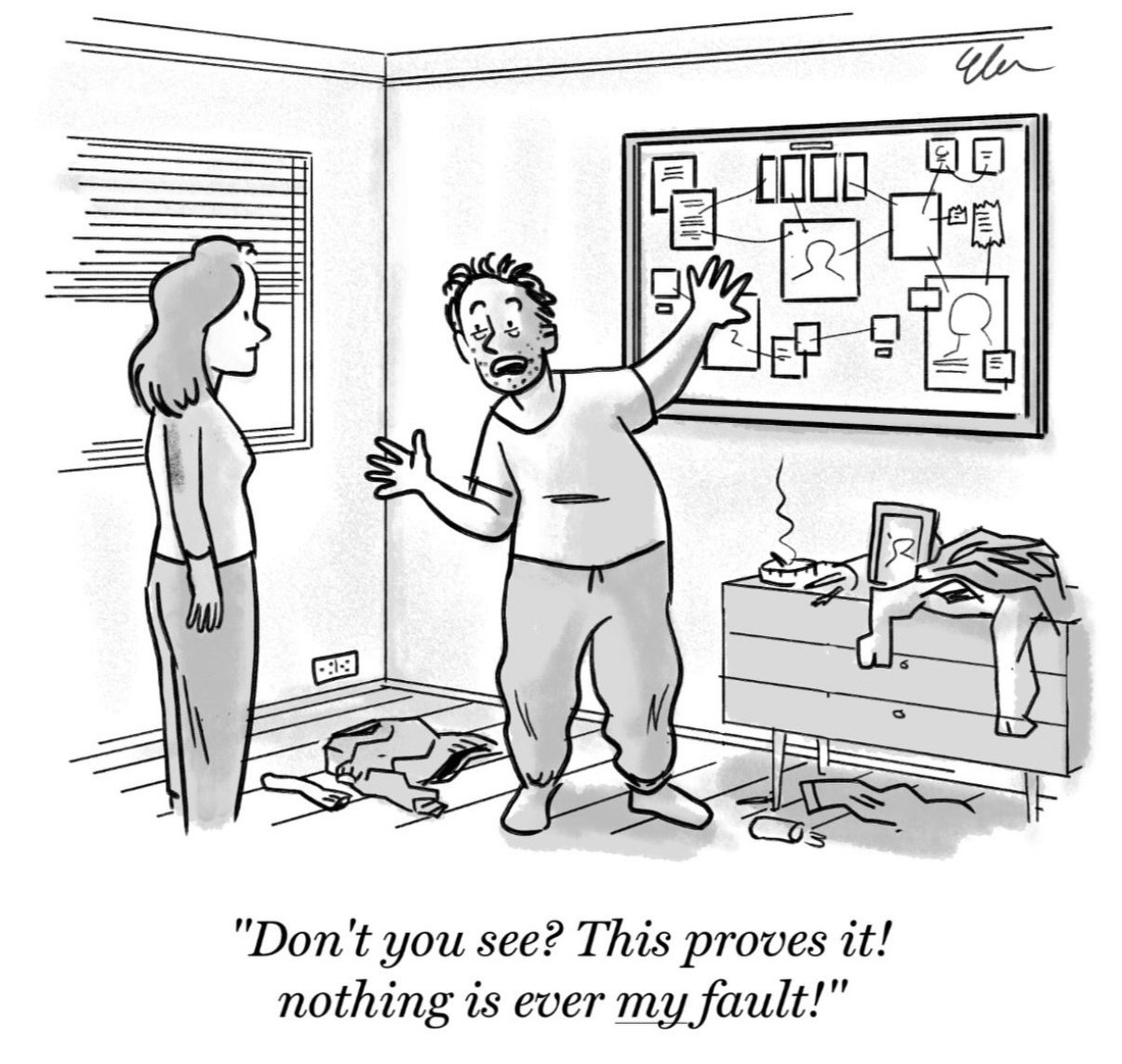
7. The above cartoon is actually the perfect segue … Next up, we turn to a familiar voice sounding in an unexpectedly devotional key. Writing from the Lamp magazine in their special examination of the seven deadly sins, Freddie deBoer offers his thoughts on the sin of pride. I’d quote more if I weren’t constrained by length/copyright, but here is a small sampling that should convince you to read the whole thing.
What separates pride-as-vice from pride-as-virtue is not entirely obvious, and the people who are most guilty of the former tend to be exactly the ones who are most certain they’re practicing the latter. This is pride’s most insidious trick: unlike envy, which makes its victim feel bad, or sloth, which inspires some degree of self-hatred, pride often feels like clarity. Pride presents itself as a correct and lucid appraisal of your own worth; it feels like knowing who you are. It feels like standing up for yourself. It takes extraordinary self-awareness to recognize it for what it actually is. And if I wanted to make it harder for people to recognize and embody that self-awareness, I would come up with something like modern self-help culture.
What pride actually is, in its full theological and psychological sense, is a systematic distortion of reality, a chronic overestimation of one’s own value and what one deserves thanks to that value. The proud don’t just feel good about themselves; they feel good in a way that cannot be revised by evidence, in a way that is essentially insulated from the kinds of information that the world is constantly, if imperfectly, offering. The proud sometimes know they’re talented. They know they deserve what they have and probably more besides. But when the evidence suggests otherwise, they discount that evidence. They blame external factors; they blame the people delivering the news; they shoot the messenger. They do everything except the one thing pride cannot permit: they do not revise their self-assessments downward. Pride may be a condition of self-love, but before that it’s a condition of self-fixity, a snapshot the proud have decided to treat as an unchangeable document. […]
Can you resist pride? With more difficulty than your therapist is likely to tell you, sure, because pride has this weird recursive quality: any self-inquiry into your own pride runs through the very cognitive system that pride corrupts. Forgive me for engaging in crude folk postmodernism, but there is no Archimedean point outside your own perspective from which to objectively assess your perspective. The proud are exactly as unable to recognize their pride as they are unable to see anything else about themselves clearly; that inability — that helplessness — is just … what pride is. The standard advice is to seek feedback from trusted others, to cultivate intellectual humility, to practice saying “I was wrong” about small things so you can do it about big ones. All good counsel, and all, predictably, resisted most fiercely by the people who need it most. Pride makes feedback feel like an attack, humility feel like self-erasure, and the straightforward acknowledgment of error feel like a confession of total inadequacy.
DeBoer concludes by pivoting to pride’s cure, which resides not in rebalancing the scales of self-worth but by having an altogether non-contingent identity.
What helps, I think, is not trying to eliminate pride but trying to make it less central to your self-conception. … The cure is not to think worse of yourself, or to go in the other direction and wallow in self-criticism, which is frequently just pride’s photographic negative. The treatment is to make your sense of yourself more dynamic, more process-oriented, less contingent on any particular fixed assessment of your worth.
Strays:
- Calling all Gerhard Forde fans! Lutheran Quarterly has just released a previously unpublished paper by him entitled “The Concept of Justification”!
- “One Reason People Are Spending So Much Time Alone”
- “Why Are So Many Adults Cutting Off Their Parents?”




