




1. Starting off this week is a heavy hitter that didn’t hit our inbox until 8 a.m. this morning(!). At 43, Freddie deBoer is at the stage of life where his peers are reaching the highest peaks of the corporate mountain range. As with any stage of life, the desire to be successful reigns supreme. What varies, however, is what different generations of people consider to be successful and whether or not one wants to appear as such. What begins as a plea to people who know they are impressive to just be impressive ends with his trademark astute observations on human behavior:
It’s fine to feel conflicted about one’s own flourishing; it’s healthy to both want to do better financially and professionally and to also understand that the systems of financial and professional reward are fundamentally broken and unfair…
What gets to me is the way that certain people clearly see appearing not to try as a way to try, who need to aspire to never appear to be aspiring. They never stop trying, but part of their trying is making sure no one thinks they try. They work relentlessly, but they want you to think they’ve never sweated a day in their life. They, like, got into a great school, but they don’t take that stuff too seriously? I mean, yes, they got that promotion. Yes, they live in that brownstone. Yes, Dakota and Maddisson go to a $75,000/year preschool. Yes, they bought in, hook line and sinker, when they were in elementary school, and have spent the vast bulk of their lives never not striving, never slowing down, never allowing themselves to let a few things go. Yes, they always said yes to everyone with authority or connections or a gradebook. But they don’t take it too seriously! Haha! They may have climbed over a ton of bodies to get to the top, but they don’t, like, think it’s a big deal or whatever.
What could we call this false humility? Weaponized self-deprecation:
It’s a type of weaponized self-deprecation that ultimately does the exact opposite of deprecating the self. All of it is done in the service of being not just successful, but also with it, cool, laid back, sensible, with a good head on one’s shoulders. In other words, it’s a deeply perverse exercise because it’s the habit of denying the importance of success or one’s interest in achieving it as just another way to achieve success. It’s continuing the grind by pretending to reject the grind, advancing in meritocracy by denying the legitimacy of meritocracy, striving by insisting that you’re not into that whole striving thing. The point is to end up looking not just rich and stylish and successful and Instagrammable but also wise and approachable. To have it all while pretending to be the kind of person who would never try to have it all. […]
Past a certain level of accomplishment, the affect of being unimpressed with one’s self, of not taking one’s own success seriously, becomes worse than arrogance, righteousness, self-promotion, or bragging.
Weaponized self-deprecation seems like a natural response to our current cultural ecosystem, where envy (to call a spade a spade) leads directly to indignation. Better to give the appearance of humility than to become the target of malice. Because no matter how successful you are or aren’t, aren’t we all just trying to avoid judgment and find love?
2. Next up is Gretchen Ronnevik for Christianity Today on parents’ fears of emptying the nest. The worry? That their children, although raised in the church, will lose their faith once they go off to college. This fear is not without validity, as surveys find Gen Z men to be more affiliated with religious institutions than their female counterparts. The solution then would be to encourage young adults to “defend their faith” and raise them to become apologists who are ready to argue their religion complete with note cards, a PowerPoint slide (or two), and an APA formatted bibliography (right?). Ronnevik, however, offers an antidote to our fears — hope:
Peter teaches that Christians don’t need to be afraid, nor do we need to go looking for arguments. On the contrary, he envisions other people noticing our hope and asking us about it, then us giving an explanation in gentleness and reverence. The best apologia to teach young Christians, in other words, is to give them a solid hope in Christ the Lord.
To do this, we must first address our own fears and lack of hope. After launching two of our six kids into adulthood, I’ve been astounded at the things other adult Christians have said to my children as they left our house to pursue the vocations God had prepared for them. There’s a consistent theme of fear and discouragement: If you go to that college or move to this place or aren’t super careful, you’ll lose your faith.
These statements come from a place of genuine and justified concern. Many young Christians go to college and never return to church. We’ve all heard of a young person who’s moved out of the house, begun dating an unbeliever, and rejected their faith to live a different life. We know the data. We know the stories. And we are filled with fear. So we impress that fear on our children, urging them to draw their apologetic swords.
But however good the intent, these warnings communicated something more to my kids: Have fear, not hope. Your faith is delicate. It’s fragile. It’s glass. At any moment, it could shatter forever.
It’s no secret that a large amount of parents are overwhelmed by the pressure to keep their children from harm and on the right path. But it’s also no secret that we have little to no control over what young adults choose to believe in once they leave the nest. The best we can do is love them and welcome them back home whether or not they are regularly attending church.
3. Over at the Hedgehog Review, Aaron Brown wrote about the experiences of grief that seem to be the key driver of many stories, including hero’s journeys, tragedies, and poetry:
Consider that at the emotional center of many stories, characters are often faced with a particular loss or trial. We might propose an alternative structure that is more attentive to the affective dimensions of narrative: In the middle of their journey, few heroes seem conscious of the great story they are a part of, but they are certainly aware of their immediate lack of home or a person they have lost or a peace that once existed but has been disrupted. Considered in these terms, the hero’s journey is fueled by a desire to overcome — or rebuild in the aftermath of — an experience of grief. […]
And yet for as much as grief is a vocabulary, grief is also the loss of language and of prayer. Consider Dzukogi’s poem, “The House Held by Chaos”:
It is unsayable what echoes inside of him,
like some word that has already been said.
There is no space in his voice for anything
other than sorrow. It clings like a shadow,
something he cannot step out of,
a house, a masjid. It temples in his heart.I knew when I first read the collection that I needed to write about it, but I also found in its devastating poems that my own language was silenced by the all-consuming power of its grief-infected lines. Like the empty halls of a mausoleum, these poems are full of the shadows that recall a once present light. The vocabulary of grief is never complete: It continues to return to a central moment of loss in search of a kind of mythmaking. As Dzukogi puts it in another poem, “Baha is not dead—/she is walking her way into myth.”
Neither Cording’s book nor Dzukogi’s astonishes with over-the-top feats of language or form. Their strength is in their minimalism, their “direct-ness”—what it means for a speaker to come face to face with death at the breakfast table, to brush against death with every breath. These are poems in which no memory and no waking moment can fall outside the reaches of a lost loved one, who seems as present now as when living.
That last sentence — that “no waking moment can fall outside the reaches of a lost loved one, who seems as present now as when living” reminded me of Lore Ferguson Wilbert’s poignant essay about fallen trees, old growth, and grief in the Home Issue. According to scientists from the H.J. Andrews Experimental Forest in Oregon, fallen logs themselves are critical to the living ecosystem because they create “a nutrient-rich environment for wildlife and plants to find a home again.”
Lore Ferguson Wilbert, kayaking on an Adirondack river, came to a stop at a fallen log:
A two-inch balsam fir is just beginning to sprout from the carpet of spongy moss covering the nursemaid, in addition to orange jewelweed, a baby white pine, and another coniferous tree I don’t know the name of yet. Fiddleheads are sprouting around the log, ready to provide a protective canopy for the perfect ecosystem below. Fungi cling to the sides of the fallen tree like nurses in neonatal intensive care units hovering around the babies, answering to their beck and call. The log is lush and spring green, wet to the touch, and beautiful in the eyes of this beholder. […]
What is being rooted and grown and cared for now is nourished by what has come before, its nutrients feeding, providing for, and sheltering what is coming now. This is how grief changes us, reorders us at a cellular level, making us and everything around us into something entirely new, never before see or experienced.
4. There’s a reason we keep rewatching the same tv series and movies over and over again, why (despite knowing the ending to the Return of the King) we long to go back to the beginning of the eight-hour trilogy. According to psychologist Anjum Naweed for the Conversation the reason is nostalgia, but rather than bemoaning it as being “stuck in the past,” he sees it is as something healthy, perhaps even hopeful.
Although one-sided, the relationships we form with characters in our favourite TV shows can feel very real. They can increase a sense of belonging, reduce loneliness – and keep pulling us back in.
When we rewatch, we feel sadness, wistful joy and longing, all at the same time. We call the sum of these contradictions nostalgia.
Originally coined in the 17th century to describe Swiss soldiers impaired by homesickness, psychologists now understand nostalgic reflection as a shield against anxiety and threat, promoting a sense of wellbeing.
We all rely on fiction to transport us from our own lives and realities. Nostalgia viewing extends the experience, taking us somewhere we already know and love. […]
The neuroscience of nostalgic experiences is clear. Nostalgia arises when current sensory data – like what you watch on TV – matches past emotions and experiences.
It triggers a release of dopamine, a reward-system neurotransmitter involved in emotion and motivation. Encountering nostalgia is like autoloading and hitting play on past positive experiences, elevating desire and regulating mood.
So, nostalgia draws on experiences encoded in memory. The TV shows we choose to rewatch reflect our values, our tastes, and the phases of life we have gone through.
Although few who are stuck in a nostalgia doom loop will tell you that it solves their problems, comfort TV shows and movies can still be a necessary balm for the weary. In the uncertainty of life it’s nice to know how the story (albeit fictional) ends. Anyone up for a Lord of the Rings marathon? Extended editions, of course.
5. For kicks and giggles this week, there’s Reductress’ “‘Comparison Is the Thief of Joy,’ Says Woman Who Apparently Has Never Compared Herself to a Huge Loser“:
“We were just talking about a mutual friend who kind of has everything that we want,” Coral’s friend, Maggie, told reporters. “And, sure, we were venturing into dangerously wicked and covetous territory, but we were just getting started! Everyone knows that after you despair over someone else having the life of your dreams, you slowly and systematically work your way through every miserable f*** you know of and extensively outline how you’re better than in every conceivable way.” […]
“I don’t know why Coral would try to take that from us,” Coral’s friend Frankie added. “Oh my god, is Coral the real thief of joy?”
The grass is always greener with the Hard Times’ “Millennial Reaches End of Zillow, Begins Scrolling Out-of-Network Doctors.”
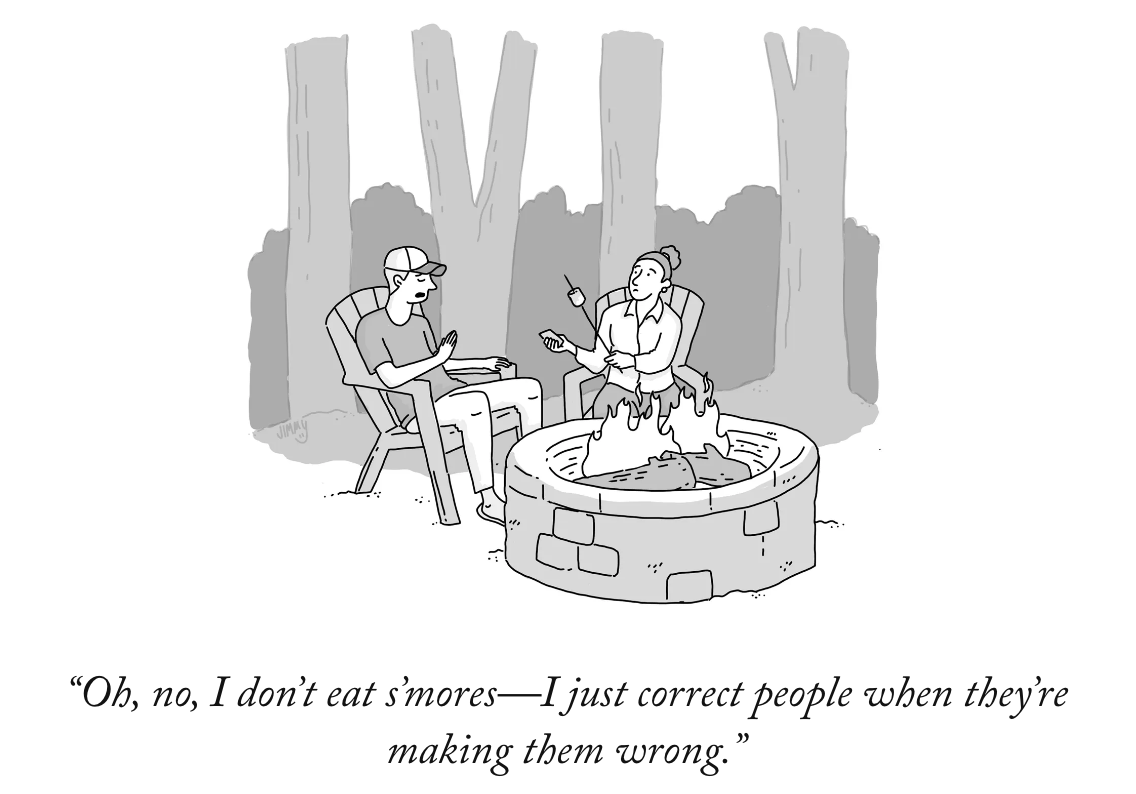
And last but not least, a cartoon from the New Yorker just in time for bonfire season:
6. We’re big fans of John M. G. Barclay here at Mbird (as evidenced by this series we did in anticipation of his 2020 book Paul and the Power of Grace), so any time he writes something we tend to take note. A biblical scholar and historian, Barclay’s writings on Paul have been very influential. His latest for Plough is no different, as he analyzes how Paul’s letters broach the paradox of freedom through love. For Paul, freedom is not defined by individual autonomy but by a love greater than ourselves. How are we to understand what Paul means when he says “through love become slaves to one another”? Barclay may have the answer:
Paul propounds the paradox of freedom and slavery at the human level because the “slavery” he has in mind is, as we have seen, the mutual slavery of love: “Do not use your freedom as an opportunity for self-indulgence, but through love become slaves to one another.” He understands (and we too often forget) that humans are constituted by relationships, not by self-definition, and his vision for human flourishing is not that of isolated individuals who chart their own paths through life with as few commitments as possible, but the self-in-relation, the people who reach their human potential through life with others, in the mutual self-giving of love. All of Paul’s letters drive toward the formation of cross-cultural and cross-status communities whose members work out together how best to practice their commitment to Christ. As he makes clear in his famous image of the body of Christ, all the members have something to contribute to others and something that they need from others; no one is self-sufficient and capable of flourishing alone (1 Cor. 12:12–26). What holds this community together is what Paul calls koinōnia (solidarity or partnership) – solidarity with Christ (experienced in the Lord’s Supper) and partnership with one another. And the glue in that solidarity is love – love received from Christ, who gave himself “for me” (Gal. 2:19–20) and “for you” (1 Cor. 11:24), and love shared with one another (1 Cor. 13). […]
In any case, it is clear that freedom for Paul meant more than something “spiritual” or “inner,” as many modern forms of Christianity make out. Freedom is about the God-given release from all that inhibits and undermines our human potential as creatures of God, and thus from the multiple layers of constraint under which we operate, from coercive control to cultural prejudice, from obsessive behavior to death itself, and all the various forms of unfreedom in between. “For freedom Christ has set us free” at every level of our being. But ironically (or so it might seem to the modern mind), our freedom is acquired and enjoyed not through self-determination, but through our alignment to the liberating power of another, Christ, and through our immersion in the self-sharing practices of love that bind us to one another in commitment and community. Our freedom to love is the way we resonate with the transcendent love that comes to meet us in Christ. That divine love calls us to sing the melody of reciprocal, committed, self-giving love, a melody that foretells the ultimate liberation of the universe. Because of that deep resonance with eternal truth, this song of freedom-in-love turns out to be greater than any of the other songs of liberation passed down through history. It is sung, incompletely but powerfully, in countless lives throughout the world today. “Do you hear the people sing?” (Les Misérables).
Strays:








I love the comment:
“And yet for as much as grief is a vocabulary, grief is also the loss of language and of prayer.”
so true…thankful for friends who can name and give words to the grieving.