




1. Is this the week the internet broke? Scrolling print and social media, unable to know with any certainty whether the tragedies being reported were real, fake, or embellished was dizzying, to say nothing of the extremity of the discourse itself. It can be difficult to wrap our minds to fathom evil in the best of circumstances, even more so when an actual war is used as a proxy for our silly culture wars.
Reading the endless articles, hot takes, and counter hot takes this week, I couldn’t help but recall the recent book excerpt from Yascha Mounk on “The Insidious Lie That We Can’t Understand Each Other.” If this week is anything to go on, Mounk’s thesis seems shaky at best — there is a lot of misunderstanding going around. But I think the reverse is true. Mounk critiques what is called “standpoint theory,” or the idea that one’s experiences shape their worldview in such a way that others who don’t have those same experiences can’t sufficiently understand. Mounk recognizes the explanatory power of standpoint theory, yet ultimately believes it to be a Trojan Horse that undermines reason, truth, and empathy. According to standpoint theory, an “ally” must defer to those who possess a truth they cannot actually apprehend, or as Mounk says,
When members of other groups call on you to be their ally, you should, according to standpoint theory, say something along the following lines: “I don’t understand your experiences and I am in no position to evaluate your demands. But since I recognize that you are more oppressed than me, I will endeavor to be a good ally and support what you ask for.”
It’s not difficult to see how such a philosophy would fracture when it comes to assessing an actual war, which lead to debates over which group is more oppressed (and thus more righteous in their cause). And having identified such a group, one must support it regardless of whatever crimes it commits. But even more problematically, the ability of an ally to make such a calculation is already tinged by a #lowanthropology. Mounk again:
Most people simply won’t be willing to delegate their judgment about what actions or policies they should support to a representative of a different group. They are especially unlikely to do so when they can’t understand the reasons for the demand or disagree with it based on their own moral or religious views. For the most part, admonitions to defer to the views of the oppressed are likely to go ignored.
There may be a few exceptions. A small number of people who are deeply immersed in the identity synthesis might insist that they really do defer to members of other groups. But they will still face the problem of having to determine whom they consider a “true” black or brown or Muslim or queer voice — and will almost certainly anoint spokespeople whose political prescriptions happen to dovetail with their own. In practice, demands to defer to an oppressed group succeed, at most, in encouraging activists to point at someone with whom they already agree and pretend that this ends the argument.
Or in many cases, point to someone else with whom they vigorous disagree and cite their privilege as a reason they shouldn’t have a voice. All of which can lead, I think, to precisely the kind of dehumanization used to justify wars, whether literal or cultural.
Early and medieval Church history told through Star Wars GIFs. A thread. pic.twitter.com/BnzuQZctTr
— Amy Mantravadi (@AmyMantravadi) October 10, 2023
2. Switching gears entirely to a far lower-stakes discussion, this next article by Adam Mastroianni on flossing (teeth, not dancing) will cause you to question everything you know. Kidding … sort of. It turns out that the wisdom to regularly floss your teeth is largely unfounded by any research: “Flossing ‘may’ reduce gingivitis, the meta-analysis found, but the effects were uncertain and barely significant statistically.” Not exactly an earth-shaking revelation, but it does raise for Mastroianni the question of what else might not stand up to scrutiny.
I thought I was born into the age of science and reason. But what my trip down the flossing rabbit hole taught me is that this is nowhere nearly as true as I hoped it to be. It wouldn’t matter much if it was just dentistry, which has long been the Wild West of medicine. But the more I learn about science, the more I discover basic mysteries that I assumed were solved long ago. Perhaps we’ve exited the Dark Ages, but our own age still seems rather dim.
How do you make sense of a world where the scientific sands are always shifting and where so much remains unknown?
Of course, one could travel further down the freefall of this existential crisis and into the world of conspiracy theories. Either that, or perhaps have some empathy for those who do — and a smidge of doubt the next time a TikTok influencer is shilling some revolutionary self-care product. But Mastroianni is himself a scientist, for whom uncertainty is not a cause for disillusionment, but the opposite:
What sustains me now is neither certainty nor hopelessness, but a determined, humble optimism. The right answers are often simply unknown, and I might die without getting to know the truth. And yet the truth will be known one day. Just as we solved many of the mysteries that befuddled our ancestors, our descendants will solve many of the mysteries that befuddle us. Our ignorance is profound, forgivable and temporary. There are only two true errors: One is believing that we have no errors left to make, and the other is believing that those errors are permanent and irreversible.
There is also something freeing to the idea that even scientific knowledge can be more provisional than irrefutable. Mastroianni’s humble optimism might be a synonym for a curiosity that withholds judgment (thanks Ted Lasso).
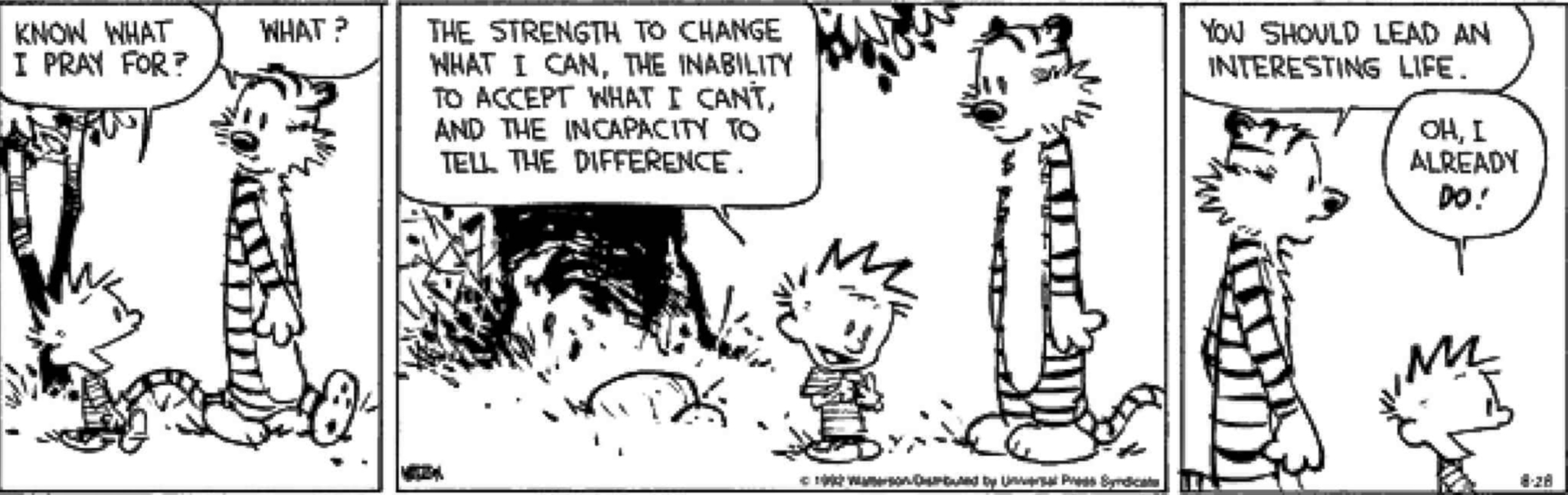
3. Calling all Calvin and Hobbes fans! Bill Watterson has just dropped a gift of a fable on … secularization? The Mysteries is superb and nearly worth the thirty year wait.
4. Sticking with the health theme for a bit, in the Atlantic this week Megan Garber takes a look at our fraught sleeping habits and how assessments of them have less to do with bodily necessity than they do with social values and judgments.
American culture, after all, tends to treat sleep less as a matter of morality than as an outlet for haphazard moralism. Getting a lot of sleep is virtuous (wellness, leisure) and also objectionable (self-indulgence, indolence). Getting very little? This may be personally admirable (industriousness, sacrifice, dedication to de-escalating a war) or socially irresponsible (drowsy driving). TikTokers regularly share the morning routines they’ve developed as a means to getting a jump on the day; these typically involve some blend of exercise (willpower), yoga (spirituality), and waking at 4 or 5 a.m. — treating the early hours as a time to grind when many people are (laziness) still in bed. Other influencers have won likes and views for the tips they’ve offered under the assumption that getting sleep is a principled act of self-care: CBD, mouth tape, the tart-cherry-juice drink that has been branded the “sleepy girl mocktail.”
Everyone will have reason, at one point or another, to encourage sleep or fight it: The culture that gave rise to Starbucks is also the one that created Tylenol PM. But the contradictory messages, on the internet as in the world at large, reflect more than the varying demands for sleep. They do broadly what the marketers of luxe sleep are now doing specifically: They treat sleep as one more means of social division. Americans are so accustomed to regarding rest as a call to judgment — as evidence of worthiness, or evidence of failure — that we deliver the verdicts even though we can’t quite decide what we’re judging one another for.
The approach is classically American: the Protestant ethic, applied to the work of slumber. Now, though, all of that messaging comes with merch.
Garber’s linking of sleep moralizing and social division is illuminating. Though some may be inclined to equate the excess of sleep with the vice of sloth (spoiler: that isn’t really a thing), sleep is yet another example of where moral values and social values become conflated with one another. Or better, we bless our social values of productivity, self-optimization, and Type-A wherewithal with a moral justification. In that way, our made up rules about sleep are no different from a prosperity gospel that believes rich people are more blessed by God.
5. On the subject of curiosity (and standpoint theory), in Liberties journal Leon Weiseltier has a fascinating dive into the question of how people change their minds and its significance for public discourse. In an article titled, “The Rise of Narrative and The Fall of Persuasion,” Weiseltier begins with the observation that a debate over truth is rarely persuasive. Show people the truth and they might yawn or look away. Tell them a story — however true or untrue it might be — and one’s audience will be captivated. Stories may be compelling, but they are an imperfect instrument. (As a good for instance on this, one simply need to observe the dustup over comedian Hasan Minhaj’s embellishment of the facts in order to tell the “emotional truth“).
The aesthetic and emotional satisfactions of narrativity should not delude us into accepting its techniques as the most useful or illuminating method for the exposition and the resolution of the problems that we face … There are realms, in other words, in which stories are not enough, in which they demand too little. There are questions that cannot be answered by a narrator, reliable or otherwise.
Weiseltier notes that “Rhetorically and methodologically, the antithesis of narrative is argument,” a contrast one can find nearly everywhere. Many debates are often framed in terms of heartless truth purveyors vs. personal testimony (standpoint theory, again). Or in the church world, the opposition between propositional dogma and narrative theology. Even still, the rhetorical power of narrative is necessary since,
The process of persuasion does not usually work, alas, in a rational manner, as I have just described it. The unconvinced mind is not a vacant mind; it is already stocked with opinions which it asserts firmly even though it may not have justifications for them. The reasons for an opinion generally do not precede it. Contrary to rational procedure, they follow it.
Instead, if persuasion is to preserve any salience today, truth must be less of a treasured possession and more of an adventure.
As long as there is life, there is surprise. The quest for inductive knowledge, for learning from the phenomenal world, is never over, because conditions change and there are new things under the sun; and rational discussion is never over, because in such a discussion a rigorous and well-wrought intervention is forever welcome. (That is why we still debate with Aristotle but not with Ptolemy.) In the sealed world of perfect certainty there are always the escape hatches of empiricism and reason, however small or hard to locate they are.
At the risk of a both-sideism, maybe narrative and argument need each other to survive? Unbounded subjectivism leads to nihilism and even the best of arguments will still fail to move the heart. But rather than theologically punting to C.S. Lewis’ famous “true myth” of Christianity (which hasn’t aged as well as people assume), the better place to build an epistemology is the Apostle Paul’s statement: “I have been crucified with Christ. It is no longer I who live, but Christ who lives in me. The life I now live in the flesh I live by faith in the Son of God, who loved me and gave himself for me” (Gal 2:20). Which is to say that truth must always be self-involving, never remaining aloof. Decisive, universal, objective even, and yet affectively salient.
6. In humor, last week’s “I Am Still Scrolling and Would Like Very Much to Stop Feeling Things” is a little too precient for this week. And Reductress has some fun with “Woman Can’t Shake Feeling That She’s Squandering Her Twenties Wrong,” which hits the same self-optimization notes as Slackjaw’s “You Must Have a Hobby.”
But my favorite was easily NewsThump’s “Your Brain Waiting Until 2:30 Tomorrow Morning to Remind You of That Stupid Thing You Did“:
The spongy grey lump which sits between your ears is planning a real ‘greatest hits’ retrospective which will include every dumb thing you’ve ever said, that time you got it completely wrong with the person you really fancied and doomed yourself to a life of regret and loneliness, every stupid fashion choice you’ve ever made and how people are only your friends because they pity you.
It expects this will be complete by about 6:30am, by which time you’ll have to get up and go to work and pretend you’re just fine.
When asked, your brain said it intends to do this randomly at intervals for the rest of your life.
7. Closing out this week is yet another splendid sermon from 1517’s Gerhard Forde archives. This one, preached all the way back in 1962, hasn’t aged a bit.
Bertrand Russell, in an essay entitled “Why I am not a Christian’’ states that one of his reasons for rejecting Christianity is that religion is, after all, based on fear. “Religion,” he says, “is based primarily and mainly upon fear. It is partly the terror of the unknown, and partly … the wish to feel that you have a kind of elder brother who will stand by you in all your troubles and disputes. Fear is the basis of the whole thing – fear of the mysterious, fear of defeat, fear of death.” […]
I wonder if we can’t say that it may well be true that religion is based on fear — I don’t know whether this is so or not. That is a question we can leave for the anthropologists and psychologists to argue about. But this has little or nothing to do with the gospel of Jesus Christ. Granted we all have our fears: fear of the mysterious, fear of defeat, fear of death. And there is enough truth in what Mr. Russell says to give us cause to stop and think. But God in Christ calls us to a different kind of life — he calls us out of fear to a life which is beyond even the questions of life in which the entire issue is forgotten.
Christ did not come to hold us in a state of perpetual fear so that we will feel the need of him only to the degree to which we are afraid. He came to set us free from all that — to set us free even from the burden of religion. He came so that we could walk in joy and peace, and enter into life in all its fullness. The angel who announced his birth said, “Fear not, for behold I bring you glad tidings of great joy, for unto you is born this day a savior” — not a new doctor of religion, but a Savior. Fear is transcended and peace and joy are restored to us. This is what God has done for us in Christ. It is a great gift, and to him belong all honor and praise and glory.
Strays:
- The recent Mbird Midwest recordings are out!
- A must-read for nerd types, theologian Lewis Ayres wrote against anthropomorphizing the Trinitarian relations between the persons of the Godhead. God is a communion, but not one we’re really meant to emulate.
- Enchantments of the One and Zero Mirror: Is media now considered sacred?
- Why the Internet Isn’t Fun Anymore.
- Outsourcing Our Identities: The Corrosive Effect of Political Tribalism.





Such a great weekender!! Thank you Todd
Are we outgrowing C.S. Lewis?
The aside above that Lewis’s statement about Christianity as “true myth” has not aged well forces the question whether the default popular theologian of our lifetime is no longer as applicable to contemporary life.
My wife and I reread through a few of Lewis’s works over the past year or so, and more than anything else, our impression is that while he was the perfect voice for the 1950s, we are now almost three-quarters of a century removed from that era, and the existential travails of people today don’t seem like the same ones Lewis addresses for his contemporaries. This was a disconnect we repeatedly encountered.
It’s not that Lewis doesn’t address the basic truths. It’s that the basic truths have been remixed over the years in more intractable combinations that are harder to untangle.
The question then becomes, Who is the “new Lewis” that Christians will be quoting for the next 75 years?