




1. After the midterms this week, everyone is talking about politics, but I’d rather zero in on topics far closer to home. So let’s check in on Ilia Malinin, aka the figure staking Quad God, who had the most disappointing Winter Olympics in recent memory. How do you recover after such a spectacular (and public) failure? As Marcus Thompson II tells it in the Athletic, Malinin has “reveled in the freedom of performing without the scrutiny of judges and the nuance of scores” while skating in the Stars on Ice tour:
An Olympic disappointment of such magnitude — especially for a prodigy whose identity has become synonymous with doing the impossible — could have fueled four years of relentless training. An obsession with redemption. A desperate need to prove himself all over again.
Instead, Malinin found something unexpected in his failure: The chance to rediscover the joy in a sport that demands so much of him. The freedom from anticipating devastation, because he’s felt it and survived it. Even the world’s most extraordinary athletes experience ordinary shortcomings.
If Malinin’s life were a movie, he’d have spent the months and years after the Olympics training with Apollo Creed in a grimy gym while spouting off the usual cliches: “No pain, no gain,” “Pain is weakness leaving the body,” etc. Instead, he decided to have fun again beyond the assessments and judgments of points and trophies. There are lessons one can only learn through grief and cataclysmic failure. As Simone Weil once wrote, “One needs to have exhausted one’s will in seeking the appearance of the good in this world and to have desired in vain for a long time, before one can come back to oneself and remember one’s Father.”
But even more surprisingly, Malinin looks back on his Olympic failures themselves with some real #lowanthropology insights.
Perhaps most revealing is his belief that losing men’s figure skating gold in Italy nine months ago gave him something winning couldn’t. The man who made a name for himself doing the impossible discovered the power of being relatable. His vulnerability connected with people in ways his dominance never had. […]
“I think I’ve definitely touched people more than I would have if I won the Olympics,” said Malinin, who was honored in September at American University with the Icons of DC Award for his contributions to the community. “I think people would have seen me the same as I was if everything went, you know, perfect-world scenario. But being the way it went and seeing the amount of support, the amount of love I’ve gotten. … They told me that it was something that made me human and (something) people could relate to.”
2. Sticking with the grace-in-sports theme, we turn to baseball and Rhenda Strub. Strub made headlines earlier this year for inviting total strangers on Facebook to watch the games with her. Much to her surprise, hundreds of people responded (all willing pay the $71 for the ticket). It turns out that Strub had bought the season tickets as a way to order her days after her 27-year-old son died of muscular dystrophy. What ensued was an impromptu grief support group:
“I just needed something to snap me out of the fog of grief I was in,” Ms. Strub said. “I don’t ever expect to be over his death. I don’t expect to ever recover. But I have been able to find joy again.”
Others found joy through her.
One woman who has a disabled child came from Australia to meet Ms. Strub at the ballpark. Steve Hayburn, a probation officer from Ketchikan, Alaska, flew to Seattle in September after the death of his father and the dissolution of a long relationship. “When I saw her story, I knew I had to connect with her,” Mr. Hayburn, 55, said. “She kind of reminded me of my mom.” They met up at the stadium for the second to last game of the season, on a Saturday night. Ms. Strub walked in with her cane, her hat on sideways, a pink chain around her neck holding her cellphone. “She kind of reminded me of a gangster, the way she was walking,” he said.
They watched the Mariners play the Los Angeles Angels and shared a tub of popcorn. “It was like I was spending time with my mom all over again,” he said. Mr. Hayburn, who grew up in Ohio and rooted for the Cincinnati Reds, added, “It helped me deal with my trauma I’ve been through this year.”
Another new friend, Sheila Cook, lost her wife, Michelle, a few years ago, also to muscular dystrophy. Ms. Cook was shattered by the loss and felt angry and confused about why doctors told her Michelle was ineligible for a heart transplant.
Then she met Ms. Strub, who explained the disease in a way that finally made sense to her. (Ms. Strub also has three grandsons who have been diagnosed with the disease, having passed it down through her daughters with a mutation on one of her X chromosomes, she said.) “We were just weeping and crying all the way to the ballpark,” said Ms. Cook, 74, who has a dog named after Ken Griffey Jr. “It was a wonderful gift. I truly believe it was a gift from God, that Rhenda was a gift from God.”
3. This next article is a catenae of grace-in-practice stories found in an excerpt from Meghan O’Gieblyn’s new book Will and Attention. It’s one thing to receive the kindness of strangers when you need it. It’s another thing entirely to receive random acts of kindness when you are at your lowest of lows.
There was so much to be grateful for during those months. I had forgotten about this, how any period of dissolution brings you into such close proximity to the gratuitous abundance of human kindness. I had experienced it throughout my 20s: the cab driver who picked me up when I was passed out on a curb, drove me to the address on my license, carried me up the stairs to my apartment and laid me on the couch, where he left me unharmed. The pharmacist who could have reported me for trying to fill an expired script (the date changed by one number), and who instead saw that I was shaking with withdrawal and told me to meet her outside, where she slipped me two pills and the number of a local detox center. The woman who stopped at my table in the rehab cafeteria, where I was sitting alone, sobbing, and told me it would get better, her voice so full of calm authority that I assumed she was a doctor or a therapist, or perhaps an angel, and whom I discovered later was a patient who’d been admitted only three days before me.
The dangers this time around were not as extreme, but I was still frequently the recipient of baffling acts of compassion. The woman at the airport bar who paid my tab when I realized I was about to miss my flight. The flight attendant who brought me aspirin when I was vomiting in the airplane toilet. The librarian who was so entirely forgiving when I cancelled the virtual panel she had organized on the morning it was supposed to take place, and who may or may not have bought my line about a stomach virus.
These were not heroic acts, but the kindness was so entirely undeserved – in fact, the opposite of what I deserved – that it felt like grace in its most intense form, the grace of the reformers, unmerited favor “given to the most undeserving and unworthy”, as Luther said. We should all pity those perpetually capable, functioning adults who have never experienced this grace, which is among the rare miracles of this life.
These are the kind of stories that (to me) cumulatively count as proof of the existence of God. O’Gieblyn is right that these all aren’t particularly heroic acts, but what’s striking to me about them is the sheer happenstance of them. I’m about 2/3 of the way through Will and Attention, and it’s probably going to be my favorite book of the year.
4. A quick-hitting social science study for you this week looks at ingroup and outgroup prosociality, or whether love of one’s neighbor necessarily excludes love of one’s stranger. The answer, it seems, is no:
A common premise in the social and behavioral sciences is that ingroup love goes together with outgroup hate. […] Across six datasets that span multiple domains of prosociality and group distinctions with 743,402 individuals in up to 121 societies, we find strong evidence for a positive relationship between ingroup and outgroup prosociality. Regardless of which prosocial domain, group distinction, or society is tested, the positive relationship appears. Thus, when people are not made to choose between the ingroup and outgroup, ingroup love and outgroup hate no longer go together. Rather, ingroup love goes together with outgroup love.
To give this an Augustinian twist: While there is an ordering of affections (ordo amoris), these needn’t exist in competition with one another. If anything, they are all positively correlated with each another: Love of God coincides with love of neighbor and love of the stranger.
5. Ok, it’s time for a bit of quasi-politics. Much was made this week of the apparent rise of the religious left and the decline of the religious right. For my part, I find the longer historical view of the matter to be more interesting, one reflected in Justin Germain’s recent “The Atheist Case for Christ.” Germain is repeating here much of the argument historian Tom Holland has made before, but it’s worth revisiting.
Before Jesus said “love your enemies,” the Greeks said, “do good for your friends and harm your enemies.” In the pagan world, Achilles was the moral exemplar. Plato challenged this ideal, and in some ways, Socrates was a type of proto-Jesus. But it wasn’t Platonism that ended infanticide and gladiatorial combat in the ancient world. And there was a reason those practices were so common in the first place. The values of Achilles were strength, power, resilience, and dominance. Yes, Achilles could be merciful too. But that’s not how we remember him. His mercy came only when his power was ascendant, once he had taken his vengeance and Hector lay dead before him. As Friedrich Nietzsche lamented, it was Christianity that made mercy, humility, forgiveness, justice for the weak, the ascendant virtues. Christianity unionized the minnows against the pike. Who would you rather have as a neighbor, a disciple of Achilles, or a disciple of Christ?
What of prayer? No God is necessary for prayer to change you. The Lord’s prayer teaches gratitude, dependence, a willingness to forgive others and to acknowledge one’s own flaws. It asks for moral courage and discipline. Consider what kind of individual you get if someone prays for those things, meditates on them, seeks avenues in their life to practice them. What kind of civilization do you get when people, corporately, recite that prayer generation after generation for two thousand years? A civilization that even atheists would want to live in.
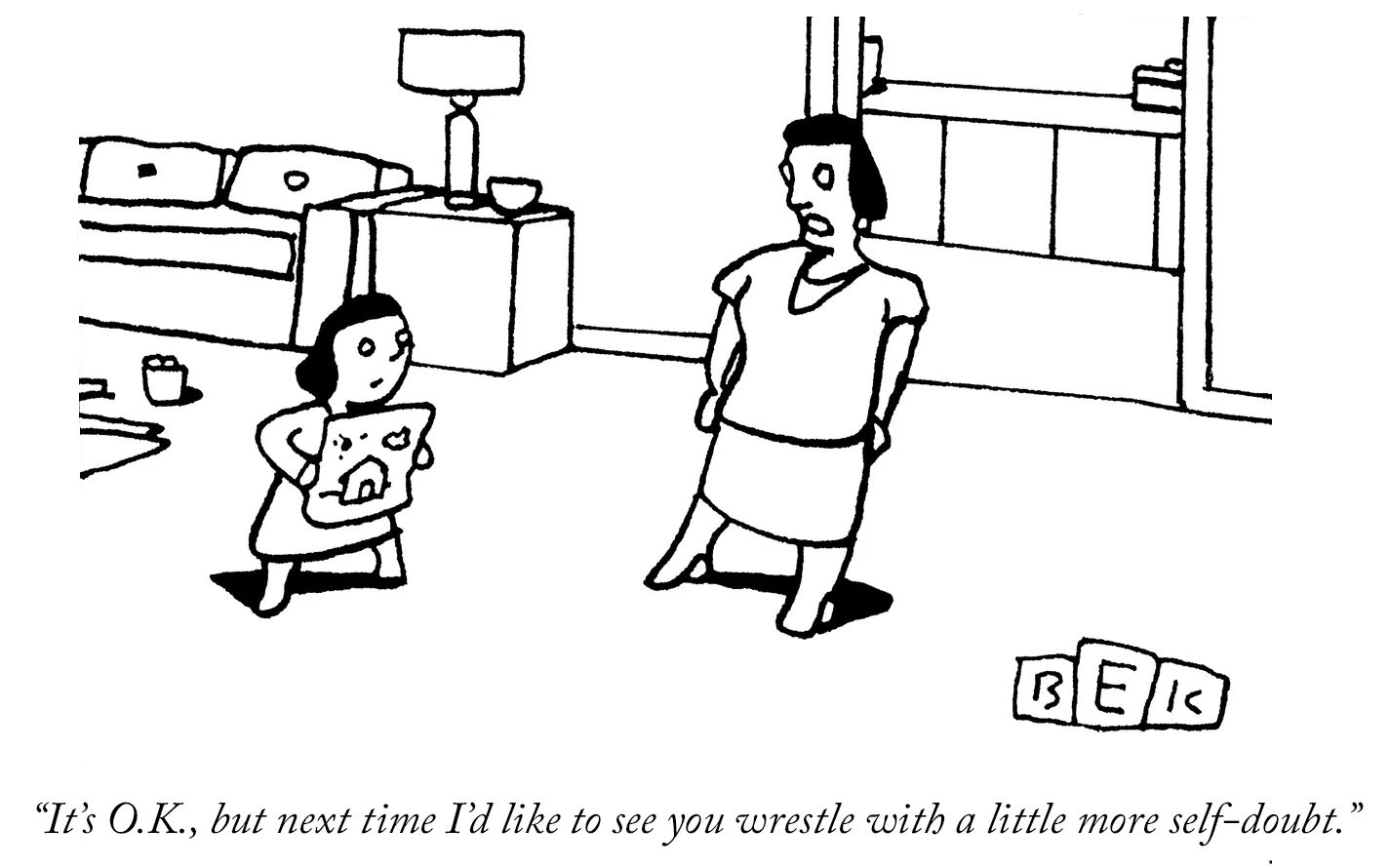
6. On the subject of addiction and willpower, Mitch Therieau’s “On Tilt” in the New York Times features a surprisingly astute analysis of not only pinball but also doom scrolling and exercise culture. To be “on tilt,” Therieau writes, “is to be bent or askew from your normal state, but it is also to tilt toward something, to be drawn further into the game.”
Today this quixotic pull emanates most strongly from the devices in our pockets. The whole digital world seems tilt-inducing by design. Pick up your phone, and you risk becoming stuck in a doomscroll spiral or sinking into the morass of so-called rage-bait content on Elon Musk’s X. You might end up arguing with a robot. You might also, depending on your taste, get locked into a bidding war on a livestream shopping app and need to hop over to a cash-advance app to replenish your funds, before blowing them all again. (Naturally, the two apps in question are named Tilt.) Maybe “tilt” isn’t a deviation from the norm anymore; maybe it is something like our default state, the hedonic cul-de-sac we’re all circling.
The exaggerated anger that dominated the internet of the 2010s — rage comics, rant videos — was often a social anger, a burlesque overreaction meant to highlight a set of “relatable” common experiences. But tilt is an asocial anger: It blocks out the world and encloses the self in a poisonous bubble. This, maybe, is what Browne meant when he described tilt as a “dissociative state” in which players float outside themselves, as if in a trance. It’s maybe also what the novelist Haruki Murakami meant when he wrote about pinball. “The goal of pinball is self-transformation, not self-expression,” he wrote. “It involves not the expansion of the ego but its diminution. Not analysis but all-embracing acceptance.” Anything else will lead to tilt. “It makes you think the whole aim of the game is to achieve a form of eternity.”
We’re used to hearing about positive dissociative states, in which we lose ourselves in fulfilling work or exercise. “Tilt” shows us a darker version of dissociation, the negative image of a concept like “flow” or “the zone.” Its vision of eternity isn’t the timeless flow of creative energy but the endless loop of failure, one you enter by tilting over the edge.
I’m particularly interested in the idea that there is a similarity between what we might socially deem to be healthy, benign, and unhealthy trancelike activities. The pinball player who is on tilt is only nominally different from the pinball player who is in the zone. The razor-thin distinction between the two reveals the danger of any self-effacing, eternal, timelessness. Can any moment ever truly be trusted to “lose yourself” in it? Perhaps not in this lifetime.
7. In humor this week, from the Halloween leftovers there’s “Uncarved Pumpkin Struggling With Survivor’s Guilt.” Otherwise, Points in Case had “Staff Picks from Your Local Bookstore from Employees Who Definitely Don’t Hate Each Other.”
But my favorite law/gospel humor comes from the Betoota Advocate’s “Milk Spill Promptly Followed By Tears“:
“I really don’t see the necessity of causing such a fuss over something that has already happened!”
Despite repeated attempts to explain that there was no use crying over spilt milk, Teresa reportedly found that the age-old saying carried little weight with someone who had only been alive for 19 months.
“I tried to tell him that while what occurred may not have been the outcome he was hoping for, it would be pointless to feel sad and continue to dwell on it, and instead, he should aim to learn from this experience and avoid making the same mistake in the future,” Teresa continued.
“But he just wouldn’t listen to me!”
More to come.
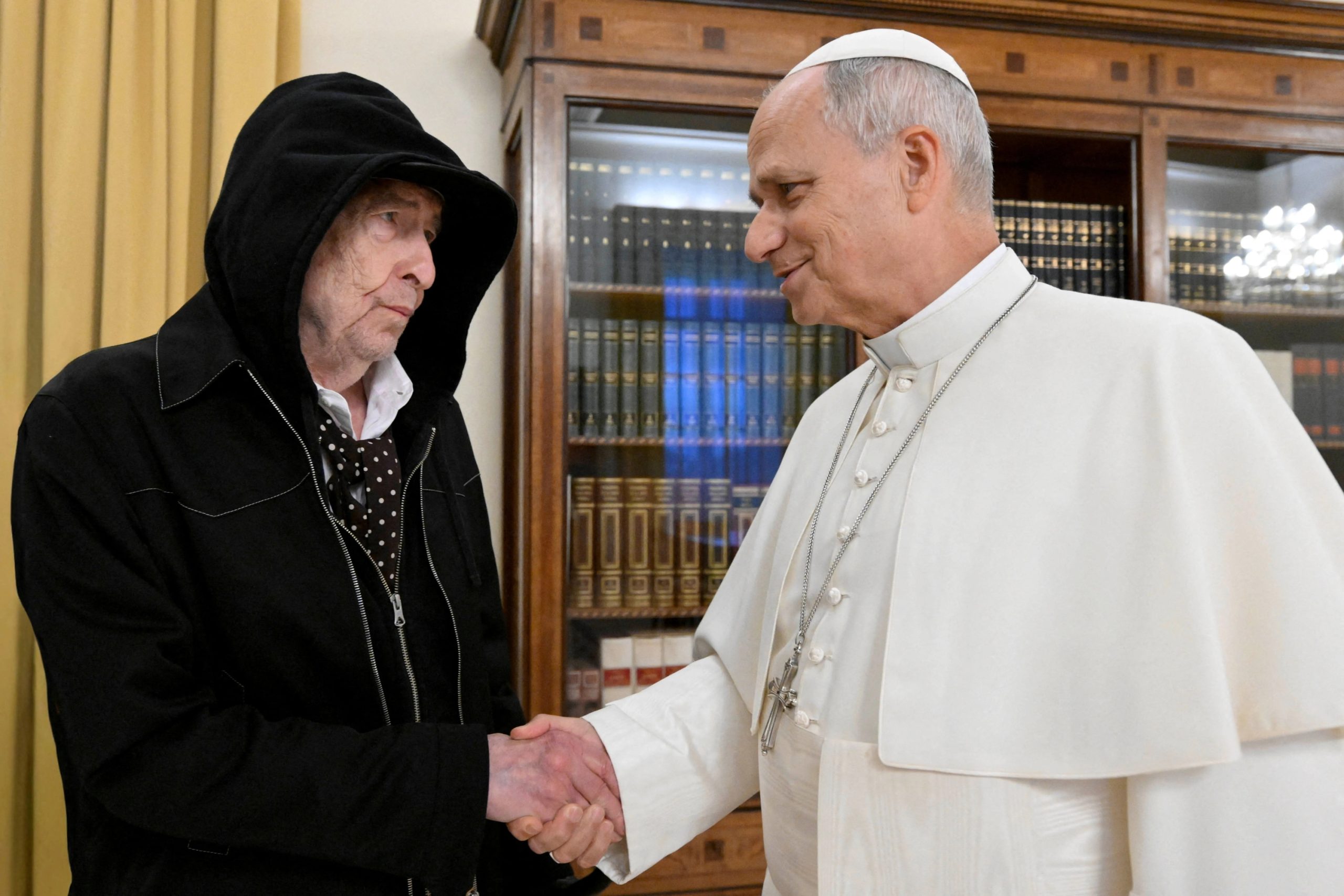
Also, moderately funny, mostly cool, Bob Dylan met this week with Pope Leo (aka Bob Prevost). A full account of the interaction can be found here, and it includes this gem:
Dylan came dressed in black, with a tie, gloves, and the hood up over his head: that’s how he appears in public, onstage on this tour too. It’s his way of being himself right now. I know that for a fact. And in front of the Pope he wanted to feel like himself.
Never change, Bob.
8. To close this week, we turn to an academic deep dive into Martin Luther and the apostle Paul’s motifs of “strength in weakness” entitled “Revelatory, Ontological, or Transformative? On Luther and the Theological Function of Paul’s ‘Strength in Weakness’ (2 Cor. 12:9–10).” Published in the Journal of Theological Studies, B. G. White argues that the paradox of strength in weakness is not simply revelatory (a lens for understanding) or ontological (the pattern of divine action) but transformative [emphasis added]:
Luther envisages the strength in weakness paradox as affecting more than one’s knowledge or their ability to be humble. He imagines a broader transformation that affects the whole of the sufferer’s being. “A heart is needed that has sure and full confidence in God alone and does not forget God when … it feels that it is being deprived of success … according to the statement in 2 Corinthians 12:9: ‘My power is made perfect in weakness.’” Luther even returns to the emotions, imagining Abraham being told “my grace is sufficient for you” and receiving it as “consolation, when his conscience within him was gladdened, made peaceful, and healed.” In other words, the paradox provides “not only knowledge, but comfort as well.”
Whether or not one prefers Luther’s third interpretative trajectory over the others, this reading finds some support in 2 Cor 12:9–10 and offers certain improvements upon the other views. For instance, Luther exploits the passage’s breadth — a noted deficiency of current views — by considering how the paradox impacts one’s knowledge, emotions, and attitude. Luther also offers a helpful view of divine power. Rather than being revealed in weakness, or arriving in response to it, Luther envisages divine power being present in suffering and especially effective there. Luther’s focus on what the paradox achieves for Paul, and for those in Christ, captures an essential “before and after” dynamic within the passage: Paul tried to pray away the thorn in the flesh (v. 7), but after his encounter with the Lord, he boasts in his weaknesses (v. 9). Such observations are consistent with certain themes in Luther’s theology generally, especially the onus that he places on the cross and Christ’s death “for us.” If Christ is now the believer’s “righteousness, holiness and redemption” (1 Cor 1:31), then one should anticipate a wide range of implications for how one lives and relates to the world — as Luther famously says, “the cross puts everything to the test.” One might also see thematic connections between Luther’s interpretation of Paul’s strength in weakness paradox and the apostle’s inner struggle with sin (Rom. 7:13–25) that inspires Luther’s famous anthropological formulation: “simul iustus et peccator.” The paradox of 2 Cor 12:9–10, however, is both broader and more specific than this statement. As I suggest below, it is broader because, rather than focusing on moral failures, it concerns human deprivation generally, including shipwrecks, negative emotions, and bodily illness. But it is more specific because, more than a mere co-existence of two opposed realities, it envisions human deprivation (transformed by divine power) becoming an essential component in the flourishing of the believer, including in their attitude, knowledge, and emotions. Instead of a ‘revelatory’ or ‘ontological’ view, then, Luther’s third interpretative trajectory represents a broader ‘transformative’ paradigm that embraces the various practical dimensions of the paradox, especially the difference it makes in Paul’s presentation of his life to Corinth.
Strays:
- The Lutheran Quarterly is giving away Gerhard Forde books for free.
- “How J.R.R. Tolkien’s Strong Catholic Faith Influenced His Writing”
- Director Whit Stillman (of Mbird fav The Last Days of Disco) is filming a new movie!
- “Mental Health Culture Is Not Healthy”




