




1. Kicking off this week, let’s begin with an analysis published this month on the reddit thread AITA (am I the asshole) that offers more than one insight for modern life. The AITA reddit is where people go to ask perfect strangers to weigh in on personal moral dilemmas, and researchers gathered 369,161 of these queries into a data set that reflects the broader American moral landscape. Some of their findings confirm what we intuitively know: “People tend to disappoint their mothers but be disappointed by their boyfriends.” Many are more surprising, for example:
While descriptions of large-scale conflicts tend to occupy our newspapers and airwaves, our findings suggest that many of the moral questions people face concern the messy, quirky web of responsibilities they have to the people in their lives.
People aren’t seeking advice about politics? Go figure. It turns out that people have more angst over whether you have to invite their sister’s liberal-voting ex-husband to Thanksgiving dinner than who you voted for three weeks prior. (Which should probably be a signal to pastors and researchers to cool it with the armchair politicking, but I’m not holding my breath.) The overwhelming number of questions posed to the internet had to do with personal relationships.
These findings also highlight the degree to which social relationships impact everyday moral experiences. First, we find that the most frequently occurring type of moral dilemma concerns relational obligations. Not only that, we find that the kind of dilemmas people experience vary widely depending on whom they are with.
Which makes perfect sense, really. A DIY morality might be in vogue, but it’s through our interactions with other people that our beliefs and value systems are most tested and fine-tuned. (Just as our beliefs about God bump against who God actually is.)
So are the AITA authors actually assholes? The internet says that 31% of all questioners are not:
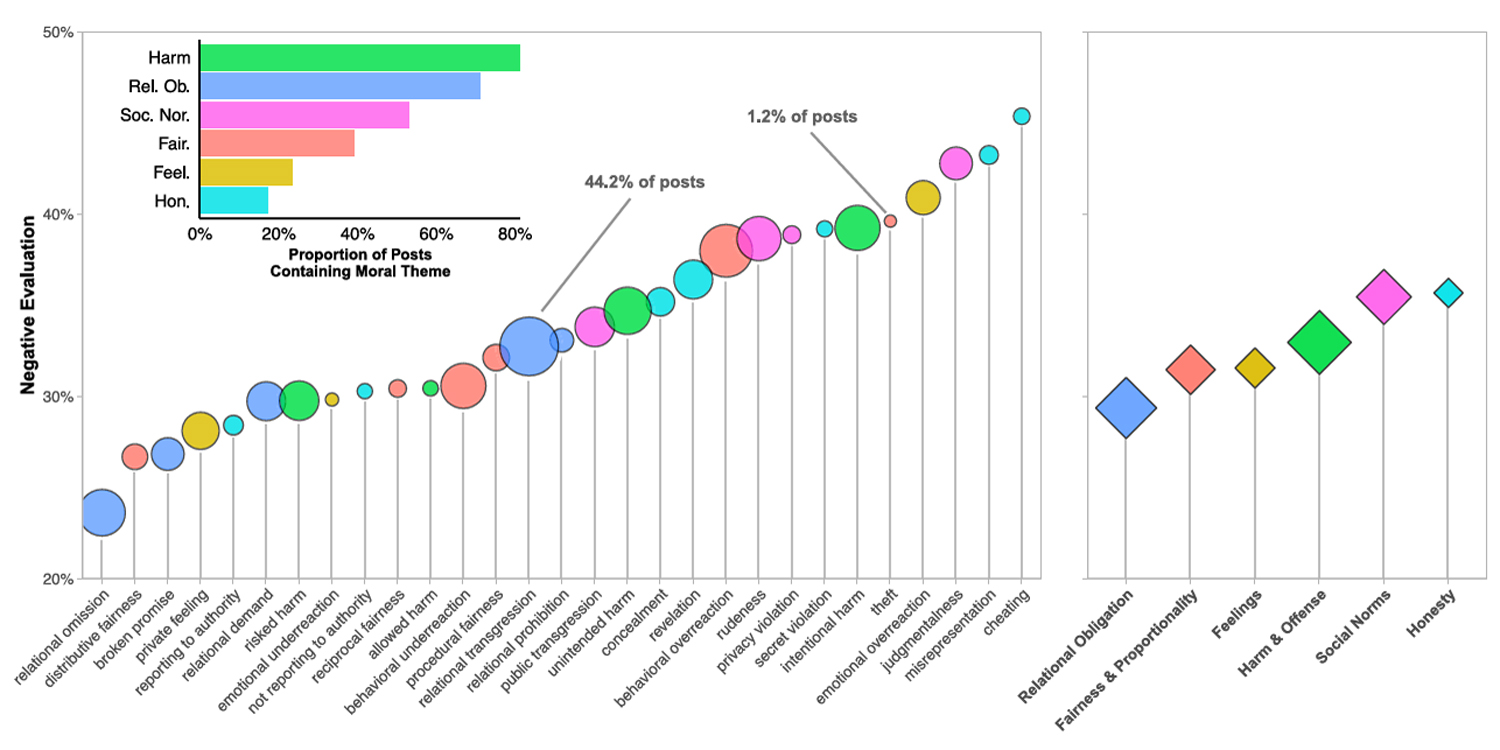 … unless you cheated/lied, intentionally caused harm or were too judgmental. Hold on … judgmentalism comes in at third?!?
Unexpectedly, the third most negatively evaluated dilemma type pertained neither to harm nor honesty, but rather to judgmentalness (defined as passing judgment on someone, M = 42.7 ± 0.44%). This finding, which is consistent with recent work, suggests that the act of imposing a moral evaluation on others can itself be considered morally wrong, perhaps by eliciting perceptions of self-righteousness or hypocrisy.
Oh the irony of the internet judging people for being judgmental, but that’s pretty much true everywhere really. As much as some might say the absence of judgment is what ails our post-modern society, the cry of judgmentalism it’s more aspirational than it absolute. We want from our closest relationships that which we can’t have elsewhere — the freedom to breathe easy without being told we’re doing it wrong.
2. On the subject of judgmentalism, let’s turn to some humor and the Onion’s latest gem, “Experts Recommend Just Putting Up With Everyone Else:
Shrugging their shoulders and tilting their heads to the side, a group of defeated-looking experts from top American universities released a joint report Monday recommending you just put up with everyone else because there’s nothing you can really do about them. “According to our research, the people around you are never going to change, so you might as well adapt and just save yourself the emotional energy,” said the experts in a series of frank and honest remarks, adding that statistically speaking, it was about time to grit your teeth and bear it for the foreseeable future. “While it might seem counterintuitive, if you’re waiting on them to get better, now would be as good a time as any to disabuse yourself of that notion. Rather than waste your time, just accept them for what they are and move on with the rest of your life.” At press time, experts confirmed that, yes, your current situation certainly sucks, but what the hell else are you going to do?
Elsewhere, there’s Slackjaw’s “The Universal Experience Of Feeling Awkward While People Sing You Happy Birthday,” and the Hard Times’ “Wikipedia Once Again Asking for $1 in Exchange For Teaching You Everything You’ve Ever Learned.”
3. Over a decade ago, I took an overnight Greyhound bus trip from NYC to Pittsburgh. Never again. The bus ride itself was fiiiine, but what I didn’t account for in my $30 ticket was the inconvenience of having to deal with other people. The guy next to me snored the whole way. The person across the aisle from me was uncomfortably chatty. Someone behind me was using the outlets to cook a midnight snack with a portable microwave. Hot Pockets. AITA? Maybe, writes Sarah Ball in Plough. Because what she found in her bus terminal travels is something far more enlivening:
Life is other people. Life is realizing we need other people – then working out what to do about it. That was what I felt so mysteriously on the Annapolis bus. It is what made the experience rich with that richness you can’t get any other way. This is what so many of the riders of the Greyhound know, because they are poor. They know we only have each other in the end. Why hide problems when they’re everywhere? Why not, in fact, share them? So the problems become visible. Crack pipes and talk about crack pipes. Jail time and talk about jail time. Talk about trying to quit, and really trying, right now, to quit. And, filling every corner, following every story, generosity, grace, a kind gesture. Once you let your eyes get accustomed to the light it is these things you see rise to the surface like cream. […]
The bus straps you down to time and place. You’ve given up your right to choose who you’ll see and where you’ll go. You are forced to be with these people, in these places; you must endure every bit of it as you must endure every second of your own life, no skipping. What will you do? How will you act?
Some of us can escape more easily than others, it’s true. Some of us have bank accounts, and some of us even have money in them. Some of us have family who will support us no matter what. Some of us have degrees. These things make a difference. Indeed, they make such a difference we forget what this difference means. It is a vile, wicked breach, and it is growing. And yet – we cannot in the end control our lives. Life will always come back around, knocking. Maybe we can learn something from people who know this down to the ground. People who throw away a twenty on two buck lottery tickets. People who know what it means to say “The Lord will bless us!” in the face of a lifetime of apparent misery. People who know we have to help each other.
I get on the bus wanting so many things. I want my mother to live forever. I want that one person to write me back. I want love. My heart stirs madly. I get on the bus, strapped up with all these other crazy people, their own desires sloshing within, sometimes overflowing and spilling out grossly before me, all of us caught in the jaws of fate, knowing it, saying it, living it. Riding with the poor. The poor, the so-easily-bereaved. The poor, that is, us.
If it weren’t obvious from the above, for Ball riding the Greyhound is small a metaphor for life. We’re not the drivers, but passengers gifted with time riding alongside fellow sufferers. The sooner we realize that, the more enjoyable the trip might be.
4. I can confidently say, however, that if I stepped on a Greyhound tomorrow, everyone would be on their phones or laptops. Few would choose boredom for hours on end. Better to listen to a podcast, watch a movie, scroll social media, or try to get some work done. But boredom, writes Christine Rosen, is something to be cherished, both as a reminder of our limits and a wellspring of surprises:
Moments of idleness and daydreaming used to be prized for the unexpected pleasure they brought. As Wordsworth wrote, “For this one day we’ll give to idleness . . . One moment now may give us more than fifty hours of reason.” He advocated straying about “voluptuously” through rural fields, asking “no record of the hours given up to vacant musing.” We might not spend our free time lolling about rural glens, but idleness of this variety is the opposite of the instrumental, practical use that our culture encourages us to make of our time. Technologists like Levchin would have us hire out our voluptuous spare time on TaskRabbit. To borrow an image from Wordsworth’s rural fields, we should embrace this fallow time. To be fallow is not the same thing as to be useless; it is to let rest so that cultivation can occur in the future. When mediated experiences co-opt our idle time, we are left with fewer and fewer of these fallow moments, moments that are central to the experience of being human. […]
Does it matter if we no longer tolerate boredom, let our minds wander, cultivate a sense of anticipation, and practice patience? Our demand for immediate answers is voracious, and not entirely a bad thing. It drives innovation and commerce and has allowed for communication on a scale barely imaginable a century ago. But living a full meaningful human life means coping with the liminal, those in-between moments of life when we must endure uneasy or uncomfortable experiences, from boredom during a meeting to bearing witness to another’s illness, to simply being stuck on a bus. In everyday life, we can all try, however modestly, to shift our individual perceptions and behavior by embracing a more generous sense of anticipation and a healthier attitude about delay, by reframing waiting as an opportunity for daydreaming and idle time rather than an excuse for distraction, and by trying to be more patient with one another. Such advice does at least have a long pedigree. Aristotle is said to have warned, “Patience is bitter, but its fruit is sweet.”
Easier said than done, Mr. Aristotle (which could be said for much of his writings). But there’s a broader insight here that’s worth teasing out. The boredom, Rosen contends, doesn’t lead to some do-nothing ethic that yawns at the problems of the world and the needs of others. Instead, it’s the prerequisite for creativity. You might even say that passive righteousness leads to active righteousness, not licentiousness.
5. Dolly Parton fans won’t find this next article as surprising as I did. They already know that she’s been happily married for nearly 60 years to her husband, Dean. But if, like me, you’ve never heard of Dean, that’s by design. Casey Cep’s profile in the New Yorker lays it all out.
The year they were married, Dean accompanied Dolly to an event at the Belle Meade Country Club, donning a tuxedo and walking a red carpet before watching as she accepted a songwriting award. On the drive home, he told her, “I want you to have everything you want, and I’m happy for you, but don’t you ever ask me to go to another one of them dang things again!” True to his word, he never attended another awards show, and although he liked recording her performances when they were televised, he rarely went to her concerts. He never took questions, and he never talked about her career, and as for his career, no matter how much money she made, he kept on working in construction and real estate. […]
Whether or not you are a partisan or practitioner of marriage, it is difficult not to be intrigued by this one, for multiple reasons. First, many celebrities ditch their first spouse—the home-town husband, the starter wife — and for good measure often go on to ditch the subsequent ones, too. Divorce is common enough for any couple, and famous people have a reputation for swapping out spouses the way the rest of us change hair styles. But Dolly said of her only husband, “We’re really proud of our marriage. It’s the first for both of us, and the last.”
The article portrays of Dean as the supportive husband, but that basic sentiment falls short of noting how radical their priorities are. Marriage before career? How is such a thing even possible for a superstar like Dolly? In this way, I wonder if Dean’s hermit-like commitment to normalcy was/is part of the secret to their longevity. Having a marriage and life that wasn’t intertwined with Dolly’s career enabled that listing of priorities to be easily recognizable: a love outside of the ups and downs of fame.
6. To close out this week, we turn to, “‘Sad but not unhappy’: J.R.R. Tolkien’s vision of sorrow and joy.” Now, the insights mined from Tolkien’s writings here aren’t exactly new. His coining of the term “eucatastrophe” has been long noted to be a guiding theme of his books. But something about this exposition here hit differently this time.
Sam here discerns what our Northern ancestors could not yet perceive — namely, that light and shadow are not locked in dualistic combat; much less will the light finally be drowned in a sea of darkness, as at Ragnarok. However much the night may seem to triumph, it is the gleaming star that penetrates and defines the darkness. […]
Sam has discerned the crucial divide. On the one hand, the tales that do not matter concern there-and-back again adventures — escapades undertaken in search of excitement and in relief of boredom. The tales that rivet the mind, on the other hand, involve an unchosen Quest, a journey to which the pilgrims are strangely summoned.
It should be evident that Tolkien’s vision is constituted by a complex interweaving of the pagan and the Christian, the despairing and the hopeful, the fated and the free. Yet these opposites are not set in endless dialectical play, as if first one and then the other gains the upper hand endlessly, nor as if they merge to produce some higher “third” reality, in Hegelian fashion. On the contrary, Tolkien envisions them as integrated into a single vision of sorrowful joy. If these terms were reversed — into a joyful sorrow — then his vision would still be noble, but it would remain essentially tragic. Hence the rightful ordering of the sequence.
Treebeard the Ent reflects on these matters after he has witnessed the orc-slaughter of his precious forest. Yet he finds solace in knowing that, even in defeat, “we may help other peoples before we pass away.” Treebeard possesses what might well be called the essential Tolkienian demeanour, as the single most naïve hobbit, the youthful Peregrin Took, has gained the wisdom to discern: “Pippin could see a sad look in his eyes, sad but not unhappy.”
Treebeard is saddened at the thought of evil’s sure victory within the bounds of time, but happier by far that he and his trustworthy trees can play their small but faithful part in the Drama wherein good can be temporarily but not finally defeated. It is a sorrowful joy indeed.
Strays:
- Nick Cave has been to hell and back, which is why his music sounds like heaven.
- From the Atlantic archives, “The Efficacy of Prayer” by C. S. Lewis.
- The Wrong Way to Motivate Your Kid
- The Surprising Ways That Siblings Shape Our Lives








Dolly Parton’s husband is named Carl, not Dean. Dean is his surname. Just fyi!