




1. I can’t speak for you, but for the past few weeks my brain has been all Ukraine all the time. Is this the first war to be documented so thoroughly with smart phones and video and open-sourced intelligence? It’s the certainly the first major conflict where winning the battle of the memes might actually contribute to the success of the war’s political outcomes. Gone are the days when loose lips sink ships: this war is being fully broadcast on the internet.
If you’re finding that it’s all too much to handle, you’re probably not alone. Doomscrolling the news can cause feelings of anxiety and depression, which is why I appreciated Oliver Burkeman’s email newsletter last week, Becoming news-resilient. His is a good word of perspective that helped me moderate my doom-scrolling.
Alarming news is nothing new, but the central place the news has come to occupy in many people’s psychological worlds is certainly novel. Because of how digital media works — though also because the news developments themselves are legitimately huge — these global dramas start to feel like life’s centre of gravity, with the immediate worlds of family, job and neighborhood relegated to the periphery.
People sometimes misinterpret the point, so just to be clear: the global dramas obviously affect our daily lives – acutely and horrifyingly, if you’re in Kyiv today, but even if you live in Leeds or Louisville. And how we live our daily lives has an impact in the opposite direction, too, climate change being only the most prominent example.
But assuming you’re not reading this in an active war zone, it doesn’t follow that you need to mentally inhabit those stories, all day long. It doesn’t make you a better person — and it doesn’t make life any easier for Ukrainian refugees — to spend hour upon hour marinating in precisely those narratives over which you can exert the least influence.
In short, Burkeman suggests limited engagement with the news, a financial donation to the cause at hand (which is infinitely more helpful than just my doom-scrolling), acknowledging our powerlessness, and moving on with the needs of the day. I would add saying a prayer to Burkeman’s secular suggestions, but that’s beside the point. There was once a time when it was considered a moral virtue to regularly read the newspaper. Burkeman suggests the opposite is better for us, turning down the law of “thou must be informed” that blares so loudly in our ears.
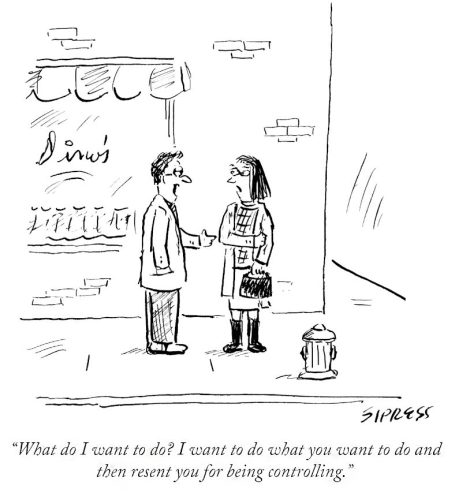 2. Our own Stephanie Philips was onto something. When she reviewed Heather Havrilesky’s new memoir, Foreverland last month, she not only appreciated the book’s low anthropology, but marveled at the widespread response of indignation to book’s low anthropology. Becca Rothfiled, reviewing the book for the New Yorker, noticed the same thing. In her memoir, Havrilesky pulls back the curtain and allows everyone to see the bad and the ugly behind the good of her marriage. Readers are going to either feel understood, finding their own marriages mirrored in the book’s realistic depiction of commitment, or attacked because their romantic aspirations are made to look so silly. Rothfiled writes:
A standoff with a nine-year-old over a board game presents one of many opportunities for self-mockery, and Havrilesky avails herself of all of them with aplomb. She has a gift for getting at emotional truth by way of comedic exaggeration. “Do I hate my husband? For sure, yes, definitely,” she reports, in a chapter that was adapted into an essay for the New York Times this past winter, much to the chagrin of moralists in the comments section and professional offendees on social media. “You do hope that the editors at the NYT read the submission and said, ‘Yes sure it’ll engage our readers, and we’ll publish it if you really want us to, but you do understand you are filing your divorce papers in front of millions of people, right?’ ” the Atlantic pundit David Frum tweeted, apparently referring to the piece. Tired critiques in this vein were recycled more recently, by sensationalists at the New York Post (“Wife calls marriage ‘insane,’ hates her husband”), and by commentators on “The View,” who admitted that they hadn’t read “Foreverland” but still went on to denounce it. “We got snippets of this book,” one of them confessed, before another launched into elaborate speculation about Havrilesky’s frame of mind. […]
For the most part, “Foreverland” displays a formidable emotional intelligence despite its chatty tone — and because, in part, of its extravagant rhetoric. How could an ordeal as insane and heroic as marriage merit anything less than the most baroque emotions, and how could anyone withstand another person for decades without finding much to dislike? If Havrilesky’s descriptions of marital exasperation are extreme, it is because choosing to remain in close quarters with another person for a lifetime is extreme. What Dostoyevsky’s misfit knows too well is that all of us are unlikable and unattractive when imbibed in great enough doses.
3. It’s not easy to touch on matters of Diversity, Equity, and Inclusion (DEI) without riling up a number of impassioned responses. This brief from Connor Fridersdorf in the Atlantic on Chloé Valdary’s Theory of Enchantment, however, strikes a resonant chord. Or at least it does with me, as one who sat through a former employer’s mandatory DEI class and left feeling belittled and angry, just as Valdary describes. It wasn’t just me either: my entire workplace rolled their eyes at the seminar, describing it as waste of time and morally objectionable. To hear those concerns affirmed from a sympathetic but opposing voice was refreshing.
In 2018, after two years of delivering lectures on her framework in the U.S. and abroad, she saw that her Theory of Enchantment could be applied to efforts to manage diversity and fight racism within institutions, so she launched a business, targeting educational institutions and corporations. Three principles guide all of the coursework her company offers:
Treat people like human beings, not political abstractions.
Criticize to uplift and empower, never to tear down, never to destroy.
Root everything you do in love and compassion. […]While attuned to what ails us — alarmed by it, in fact — she insists that it is within our power to overcome if we love with urgency. “Right now we are dealing with mass unemployment, poverty, inequality, a pandemic, and abuses of power,” she lamented on Twitter. “We have no idea what traumas and fears our neighbors carry, and they have no idea which of those we carry.” Nevertheless, she said, we’re all afflicted by the same fears because we’re human, never mind “racialists” caught up in “hyper-identitarian ideology” who urge us to treat one another with contempt. “This is madness,” Valdary objected. “It is the African American tradition to use soul power to wage a war of unconditional love against hatred, discord, and bigotry. This is my birthright. If you are an American — regardless of where you come from — it is your birthright too.”
Amen! I too want to wage a war of unconditional love against hatred, discord, and bigotry. But what a tall order! Her vision for something “beyond law” to change the social order is laudable and the best change we have, I think, at moving the needle. At the same time, I am finishing up an introduction to South African author/writer Alan Paton for the upcoming “Success and Failure” edition of The Mockingbird magazine. He believed the same thing in his own fight against apartheid in South Africa, but found few people had ears to hear. Whether the Theory of Enchantment is able to do more than Paton or others like him have tried remains to be seen. After all, they crucified the last guy who successfully waged a war of unconditional love.
4. Reductress brings the “oof” this week with “How to Weaponize the DSM-5 When Your Ex Comes Up in Casual Conversation.” Reader be warned. “Thoughts I Had During My Failed Attempts to Enjoy Nature” from the New Yorker was particularly spicy this week.
Wow! The petals on this flower are falling out. Kind of like my hair.
The colors of the leaves are changing. Unlike literally any part of my life.
What a gorgeous butterfly. Why can’t I, too, emerge from my cocoon of loneliness, despair, and utter stagnation, both professional and emotional? Why did I think that spending three months alone with no phone service would solve all my problems? Why do I always, always, always make the wrong choice? And why am I so unprepared to handle this trail? Is it because some people spend years prepping, and I devoted all of forty-five minutes? Or am I just inherently worthless?
In entertainment, I do wonder when the Prequels stopped being ridiculed. Maybe the kids who watched them growing up have the same fondness as Gen X did in 1977 for A New Hope? Regardless, the new trailer for Disney’s Obi-Wan Kenobi miniseries strikes the right notes.
5. Are we done with COVID-19 now? Maybe … please? In my region, the masks are gone, the gatherings are back, and life feels somewhat normal again, Cold War II not withstanding. Still, two important retrospectives about human psychology and COVID recovery dropped this week, and both are worth consideration.
First, in the New York Times, Alzheimer’s researcher Scott Small articulates the importance of forgetting much of what we’ve been through these past two years. Look past the provocative title, We Will Forget Much of the Pandemic, and see the grace built into our bodies that allows us to manage all the traumas of life.
Forgetting protects us from this debilitating anxiety not by deleting memories but by quieting their emotional scream. The same is true for more run-of-the-mill emotions. Intuitively, it makes sense that we sometimes need to let go of hurt and resentment to preserve close friendships and that we need to forget in order to forgive. “Letting go” is just one of the many colloquialisms that implicitly nod in recognition and gratitude toward our brain’s forgetting mechanisms.
In the Atlantic, Joe Pinsker talks narrative psychology and the difficulties of constructing a glory story around the pandemic. There is no tangible villain to oppose during Covid, he argues, so we find other (usually political) enemies. If there’s no villain to fight and defeat, we’re stuck in a limbo of unknowing, struggling to make sense of victory in a time when the enemy is oftentimes us.
The coronavirus’s volatile arc has thwarted a basic human impulse to storify reality —instinctively, people tend to try to make sense of events in the world and in their lives by mapping them onto a narrative. If we struggle to do that, researchers who study the psychology of narratives told me, a number of unpleasant consequences might result: stress, anxiety, depression, a sense of fatalism, and, as one expert put it, “feeling kind of crummy.” […]
When you want reality to match a story line you’re accustomed to, but reality doesn’t comply, that’s stressful. McAdams told me that people, and perhaps Americans especially, have a strong desire for, even an expectation of, “redemptive” narratives —stories that go from bad to good. In sermons, commencement speeches, and national myths, people constantly hear tales of triumphing over adversity, but the pandemic’s story has withheld that positive resolution and refused to end, let alone end well. This narrative rupture helps explain why Delta’s emergence particularly stung — it punctured the happy ending that people have come to expect and that seemed for a moment to be within our grasp.
Of course, we could always follow Paul Zahl’s advice, and quit trying to find narratives for our lives. We might just be happier in the long run.
6. Professor Michael Hanby at the Catholic Institute of America went back home to Arkansas last summer to take a vacation and buy funeral plots. A wild juxtaposition of ideas, certainly, but maybe the discomfort is on our end and not his. Hanby writes about the experience for Lamp Magazine, reflecting on how the lack of geographic roots may be exacerbating the ills of our time. What starts off as a pastoral reflection on his family history of football and small town life ends as a reflection on the grace of existing. Also: MBird favorite Thornton Wilder makes an appearance. Discussing the isolating effects of radical political ideologies, Hanby writes:
This isolation only reinforces the illusion that we are made rather than born, that we can therefore become the authors of our own existence, making — or unmaking — ourselves, our past, and our future. Americans are not practiced in the art of memento mori, and many have observed that modern American life is predicated on the frenetic attempt to deny death. Yet it seems to me that the denial of death is deeply intertwined with the denial of birth, the denial that our lives are something we first receive. How can we know that our lives are given to us, that we belong to something that precedes us, something that we owe, if we have no real experience of home? And how can we really remember that we are dust, that all our striving and all our folly will someday come to naught, if we give no thought to the dust to which we shall return?
The point is not that we are condemned to meaningless lives, devoid of interior drama and depth — just the opposite. The amazing thing about the stories entombed in this cemetery, the thing that amazes me after all these years about the tribute to my grandfather, is that one story or one event can be so intense, so rich in meaning to some and insignificant or even invisible to the eyes of the world. […]
[Human existence] is not so much a matter of right as a matter of grace. That’s the difference between being born, being received into being, and being made. Our lives are circumscribed by times, people, and places that we do not choose. We are named by others. We often experience these limits as burdens, but they denote the more primordial truth that our existence is a gift we receive entirely from without, by surprise, as it were. We can only apprehend this from a perspective of ontological gratitude; that is, viewing our history from within as a gift and not just from without as a story of systems, forces, and striving. Only from this perspective can we really begin to approximate the whole truth about ourselves, much less hope that our attempt to shoulder the burden of our history might amount to something in the face of what we do not make and cannot fix.
Strays:
- Extending from Burkeman’s post above, see CT‘s coverage of Christians loving, serving, and dying in the war to know better how to pray for the country.
- “Is the war with Russia a prophetic moment for Biblical end times?“ Probably not. But I do hope Jesus comes back soon nonetheless. I’m grateful, by the way, for a number of Christians who helped pull me out of dispensational end-times theology. Seeing the apocalypse in every global event can often be a way of denying difficult emotions like fear and feelings of helplessness. Thankfully, faith in Jesus means it’ll all work out in the end, apocalypse or not.
- Nineteen Incredible Facts About the Giant Squid.
- Happy Daylight Savings Time this weekend:








[…] Here is last week’s reflection […]
[…] quickly forgets most of its intake. This is what Scott Small was exploring in his Times article, “We Will Forget Much of the Pandemic. That’s a Good Thing.” Forgetfulness can often be a gateway to letting go and to peace of […]