




1. A while back, news of Britain’s “Quiet Revival” gave a brief flicker of hope to those resigned to a continuing church decline. Overnight it seemed the narratives had shifted. Gen Z was fed up with nihilism, looking for enchantment, looking for God amid the technological dystopia of modernity. Perhaps we had reached the high tide of nonbelief? Alas, the news this week is that the data was wrong, and we are left again with the forlorn reality of empty churches that won’t be saved by an influx of twentysomethings.
Cue the most recent article by the indomitable theologian Karen Kilby, who calmly shoots down a number of poor ways of thinking about ecclesial decline. No this isn’t kenosis. Nor is it a return to a pre–Constantinian ideal. No, identifying and undoing what went wrong won’t bring back the glory days. Better instead to think of decline as akin to collective suffering that mustn’t be either embraced or run from.
The “diagnose and cure” response to church decline can be a form of flight from suffering. It is difficult to contemplate the fact that the project in which you are involved, the church you love, is on the wane, that the enormously rich, long, fascinating spiritual and intellectual tradition in which you are immersed is increasingly marginal and irrelevant. Perhaps the hunt for the theological moment where it all went wrong, and the theological pivot which will make it all OK, is a way of looking away, of suppressing the pain, of not facing the grimness and difficulty of the moment.
But the Saul Goodman approach, the Constantinian and kenotic themes, are aligned with a potentially dangerous temptation to embrace suffering. The smaller the church gets, the more irrelevant it seems, the more we can rejoice, because the more secretly holy it will turn out to be. If we look through sufficiently spiritual eyes, we will see that loss can be embraced as gain – it’s all good, man. […]
When a person dies, sometimes it is his own “fault” – he didn’t exercise enough, she didn’t watch her cholesterol, he didn’t look before he crossed the street. But we all know that death, even early death, is not always the fault of the one who dies. People may die after bringing to a graceful conclusion all their major life projects and longings, fulfilling all the potential that was in them. But we all know that death does not always wait for that moment: often enough, death interrupts a life not yet lived fully, projects that were not completed, potentials that could never be realized. […]
Alongside the sadness and mourning, there must always be a recognition that loss is not the whole of the story. In some parts of the world, the church is in growth, not decline. Even where it is not growing, new things emerge, new movements, new possibilities, new ways of giving witness. And surely we trust that the grace of God is at work in ways we do not know and cannot imagine outside the boundaries of what we recognize as “church.” […]
I think this is a proper Christian disposition. It’s not all good, man. It’s sad, dispiriting, and depressing at times to see diminishment in the churches around us. But sadness and bleakness can never be the whole story. We do what we have it in us to do, we appreciate and rejoice in the elements of new growth and possibility we can detect even in the midst of diminishment, and finally, we trust that the Holy Spirit will not abandon the church. We know that its ultimate future, together with the future of all things and all manner of things, does not depend on our own best analyses and strategies.
We might say that data needs a narrative to be understood, but that’s only partially correct, because it also provides for the narrator a disingenuous degree of control. In this case, the narratives of decline invariably leave God out of the picture. The meaning of history is only known at its end, and it’s fair to say we haven’t arrived there yet.
2. The decline, however, is real. And in the place of religion, many have turned to politics to give their lives meaning. Or so say Russell Lackey and Mark Mattes this week in the Public Discourse: “[Politics] offers comprehensive narratives of good and evil, communal rituals of participation, and promises of national restoration or social deliverance. In a culture where religion becomes optional, politics begins to carry a moral and emotional weight it cannot sustain.” They continue:
The danger arises when politics is asked to save us. At that point, politics becomes a false gospel. The Christian tradition, at its best, resists this temptation. It insists on a distinction between ultimate and penultimate things. Faith cannot be reduced to a moral program or political strategy. The Gospel is not a blueprint for Utopia, but a promise of mercy. Politics matters deeply. But it is not ultimate.
In City of God, St. Augustine reminded the Church that even the best earthly city remains incomplete, marked by sin and longing. Christians are called to seek justice, but never to confuse any political project with the Kingdom of God.
Religion may indeed become optional in modern America. But the longings it once shaped remain. The question is whether Americans will continue leaning on politics to save them, will recover a renewed sense of proportion, remembering that politics is necessary, important, and limited. A healthier political culture may begin not with greater ideological fervor, but with deeper humility about what can and cannot redeem. For when politics becomes our highest love, it will also become our cruelest disappointment, leaving our homes colder, our holidays lonelier, and our common life harder to sustain.
And only when our hopes are rightly ordered can our shared life endure without demanding from Caesar what belongs only to God.
Perhaps I’m too convinced of their alternative good news, but I find equating politics with religion (rather than akin to religion) to dampen the effect of the comparison. Or at least the only people I know who actually profess their religion to be political involvement are card-carrying clergy of (many) mainline churches (heh).
What’s likely happening is more interesting, where politics is religion-like in the way an unhealthy fandom is religion-like. See also, the one friend who is so into baseball/Disney/LoTR they made it their entire personality. That we’re all doing this to politics doesn’t make it any less weird. Good and bad news events affect our moods, we collect memorability, hate the other side, and blindly accept that whatever our team does is awesome. As Amanda Mull notes, “We’re All Just ‘Monitoring the Situation,’” keeping score while watching 24/7 political theater.
3. After three-plus years, my tolerance for AI think pieces is well below zero. The whole discourse is getting repetitive, with both AI-Doomers and AI-Boomers saying the very same things they did in 2023 — just more loudly — prognosticating grand futures on the basis of paltry data. As if it were up to us consumerist plebes to determine the fate of humanity. (For good and ill, it is decidedly not up to us.) As with most everything, wisdom on the issue is not to be found in the present, which is why I found it refreshing to read Carl Trueman’s recent article on the mid-century philosopher Günther Anders, who observed what he called the “Promethean gradient,” defined as “the disproportionality between human faculties: we can achieve things in the sphere of technology that far outstrip the ability of our moral imagination to comprehend them.”
There can be no moral accountability [for modern tech bros] — indeed, they cannot even imagine what that would look like — because they are engaged in technological innovations beyond anything the current moral imagination can grasp. As Hans Jonas observed in the early 1970s, the advent of technology that was not simply external to human beings (steam, the internal combustion engine) but that touched on the nature of existence at both a profound and highly abstract level — for Jonas, chemistry; for us now, genetic engineering — grants the technological revolution theoretically limitless power to destabilize what it means to be human. And we cannot imagine what that might look like. Add to that the implications of social acceleration — that technology develops at a faster pace than can be assimilated into the moral imagination — and the problem Anders calls the Promethean gradient is set to become worse. Our technology liberates us from any sense of the authority of natural limits (let alone God-given ends), yet in itself it provides no new moral norms for how such liberation is to be exercised.
While Trueman is making a case for AI Doomerism, I’d argue that both sides of the debate suffer from the same deficiencies of moral imagination. Inescapably so. To take a classic example, Johannes Gutenberg (the late medieval inventor of the printing press) was a devout Catholic. The Bibles he printed were in Latin; he also printed indulgences. Neither he, nor anyone else for that matter, could have imagined his new technology would be used to upend the unity of the very church he sought to serve. For now at least, it’s a helpful reminder that initial hot takes are almost always misguided.
4. The last time we checked in on elderly parents and their adult children, the byword was family estrangement. And that’s still a salient topic. For those relationships still intact, there’s another phenomenon (trend?) worth keeping an eye on: the Boomer Hospital Reveal. “Oh, didn’t I tell you? I was in the hospital last week after little dizzy spell. It’s nothing to worry about, really. The doctors are running tests now, but I probably don’t have cancer.” Not the kind of news anyone wants to hear, in passing, days after the fact. Over at Bustle, David Mack dives in on what might be going on. He offers a few possible explanations, but there are a couple that rang particularly true:
The most common justification for hospital omissions that came up in interviews was the idea that, like Timmy’s mother, their parents didn’t want to intrude on their lives — either because they imagine their child is too busy to assist or because they don’t want to worry them unnecessarily (until the time becomes necessary). This concept, known as protective buffering, is often representative of a parent failing to recognize their children as true adults, Khalid says. (And speaks to another millennial stereotype: the busy overachiever on the brink of burnout.) “There’s a disconnect where parents assume, ‘Oh no, my child will be so overwhelmed, and they will not understand,’” […]
For other parents, a hospital omission might be rooted in fears of being seen as weak or infirm — something Coleman speculates is more common among men, who are more primed to tie their health up in their masculinity. Sarah in Los Angeles believes this was the case with her father when he was admitted to a hospital in 2008; he and her mother didn’t tell Sarah for three days. Her father was only 50 when he experienced losing all sensation in his legs, and his relatively young age must have compounded this mindset, Sarah, now 40, thinks. “My dad was pretty old school and did not want to be seen as weak or needing help,” she says. “He was scared and didn’t want to let anyone know that he was that vulnerable.”
It is a stark role reversal, Mack notes, when it’s the parents who need to be taken care of. There’s certainly a great deal of humility to asking for help. But no one truly knows when the end will arrive, and that unexpected hospital visit might be your last.
5. On the subject of parent-child relationships, Taffy Brodesser-Akner writes “I Taught My Son Everything, Except How to Take a Vacation.” Yes, they had gone on trips before, but they were always related to something Brodesser-Akner was writing about for work. So she decided to book a trip to the Bahamas for the duo before he headed off to college. Predictably, she learns in the process about how to take a vacation herself:
I’m skeptical of the version of vacation that gets marketed to me …. It goes like this: Beneath my skin is supposedly a version of me that is so tired of civilized living and wants, needs, to break out and dress in nearly nothing and eat nearly everything and watch people be naked and get so drunk that you’d have to replace my plasma with, I don’t know, plasma — a version of me that is a caged animal barely holding it together until a real vacation comes along to let it out. […]
Who says I am supposed to prefer these things — lounge chairs, umbrellas in drinks, massages, Muzakicated music rerecorded by laconically uninvested singers that gets piped into a pool area or a hotel, music that reminds me of music I’ve heard but is stripped of its emotion and soul — to my life? Who says that a preferred state of being is one in which all movement stops and I can hear my spiraling thoughts even louder, only now I hate myself because of the bucolic environment I’m in?
If I’m honest, our lack of real vacations wasn’t just about time or money; it was also about me. The few times we did go on trips with no agenda, I would become paralyzed. How exactly is one supposed to be at a place when one is so unaccustomed to just being in the first place?
If this sounds like rhetorical throat clearing, you’d be right. This is a story that moves from skepticism to unexpected revelation. They go snorkeling and see cool fish, tour the island’s sights, and go out to eat. Still nothing. But a trip to the beach proves insightful:
On vacation, instead of having directed conversations, you can have ones of happenstance, backing into things instead of being purposeful about your communication. On vacation, you take turns saying a certain phrase in a different accent and try to make the other person guess the accent you were going for, and always be wrong. On vacation, you sit back in the sand, and, for what seems like the first time in forever, you upward-tilt your head that has ossified in its downward position. The convex nature of the sky makes it feel unending. The night before, there was something about the volume of stars, how it went forever, that scared us but also dazzled and comforted us. In the daytime, on vacation, you look up at the clouds. Thunder rumbled in the distance. On vacation, particularly here, there is so little to do on this island that the only available metaphors are from nature. […]
And then he stood up and brushed sand off his shorts, and I realized that even if you’ve inherited some or all of your mother’s neuroses, being on vacation isn’t something you learn. It’s something you unlearn. Somewhere along the line, I had become like this, but Ezra still knew how to just be, just exist, just enjoy, just look up at the sky — the sky, which forgives me for my neglect after all these years.
There is no point to a vacation, otherwise it’s just work by a different name, just another quest for optimization. In irony of ironies, for Brodesser-Akner this trip was just like all the other non-vacations, taken to write a story for work. That it was still a success I think counts as a miracle.
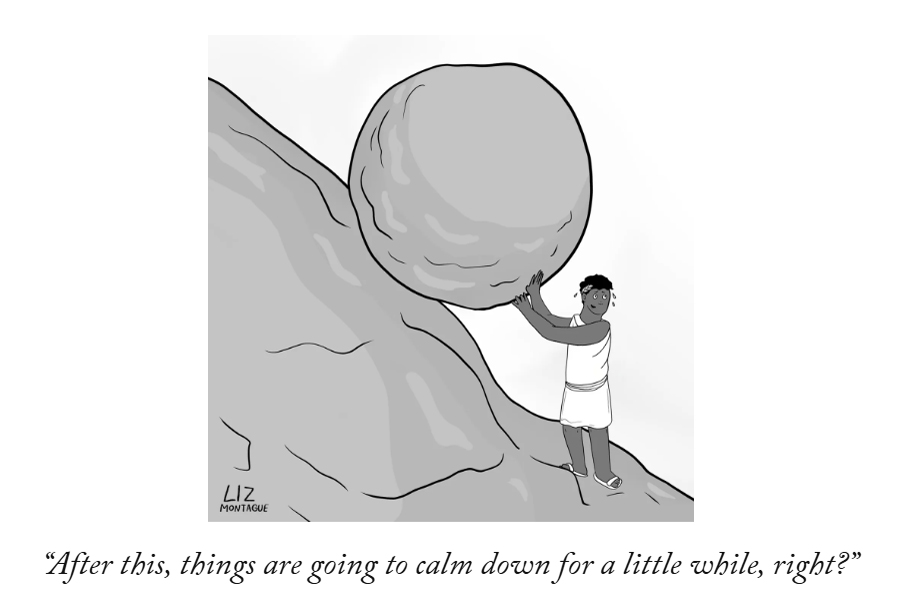
6. For humor this week, there’s Beaverton’s “Flexible Hours Company Lets Bosses Email Employees Any Time,” NewsThump’s “Man Enters Fourth Hour Watching Reels Warning of the Addictive Nature of Social Media,” and the little too close to home, “Don’t Mind Me, I’m Just Lurking in the Google Doc to See if You’re Left Me Comments Yet.”
But the funniest satire I’ve read in a long time comes from the Hard Times: “Worst Person You Know Discovers Phrase ‘Living My Truth’“:
When asked about their alleged sociopathic tendencies since learning of the phrase, the worst person you know was quick to respond.
“First of all, your accusation isn’t in alignment with me, okay? It makes me feel dysregulated and that’s literally violence. Second of all, I didn’t hear that from therapy because therapy is for pussies and also backed by big pharma. Also, I don’t know who you’ve been talking to about me, but I’m going to find out and then I’m gonna slash their tires because anyone with anything negative to say about me is trying to use their toxicity to dull my shine. Now if you’ll excuse me, I have an entrepreneur’s conference to attend.”
Former clinical psychologist Amanda Ruthkin has had just about enough of these types of phrases.
“Regrettably, this is all too common behavior,” said Ruthkin. “I actually had to quit my job over this garbage because it’s become very fashionable to not do any meaningful inner work at all, grab the nearest distilled nonsense that already agrees with your terrible personality but is phrased in a way that sounds like growth, and then just use it to become an even shittier person while simultaneously thinking that you’re an enlightened being. I’m not surprised at all to learn that the worst person I know is up to this behavior.”
At press time, the worst person you know was seen adding “empath” to their Instagram bio.
7. To close out, let’s turn to Elizabeth Bruenig’s moving essay entitled “The Evidence That God Exists,” published this week in the Atlantic. In it, she tells the story of how the “steady dimming” of her childhood faith was reignited while also taking issue with recent scientific attempts to prove the existence of God.
The unevenly paved lane where I waited was a quiet one-way street tucked away in a clutch of trees. I gazed down the road, preoccupied with other things — midterm exams, campus-club minutiae — and expecting the bus to trundle around the bend. A sudden icy wind tore around the corner instead, sweeping into gray branches and climbing ivy to send a spray of golden birch leaves spiraling into the sky, taking my breath along with them. And I knew that my soul was bared to something indescribably majestic and bracing — something that overwhelmed me with the unmistakable sensation of eye contact. What I saw, I felt, also saw me. Before I could rationally account for what had happened, a verse of poetry from John Ashbery came to mind:
A look of glass stops you
And you walk on shaken: was I the perceived?That seemed to explain things perfectly, jarringly so. I was dazed in class as afternoon darkened to evening.
Bruenig then turns to a recent book within a burgeoning genre of books that aim establish — scientifically — the existence of God, thereby “transforming faith into fact.” The difficulties of this enterprise are twofold: (1) “There is always a risk that today’s proof will be undone by tomorrow’s evidence;” and (2) “Trusting in the existence of God largely involves deciding not to operate strictly within the confines of reason as we know it, a choice that usually emerges from sentiment rather than argument.” Both result in bad theology:
To imagine that one might find traces of the divine strewn throughout the universe, or that earthly methods of inquiry might uncover some of those signs, isn’t ridiculous. But this latest round of arguments in favor of intelligent design seems aimed mostly at establishing that God could or should exist within the rational frameworks we already employ. This is both weak grounds for belief and a fundamental misunderstanding of faith. The route to durable faith in God often runs not through logical proofs or the sciences, but through awe, wonder, and an attunement to the beauty and poetry of the world, natural and otherwise.
This was not always apparent to me. I came to this understanding through trial, error, and my own brushes with scientific rebuttals to the existence of God. […]
I’m still sorting through the ramifications. In my years of working out exactly what I believe, I have been relieved to learn that faith does not in fact demand the surrender of logic and vigorous intellectual inquiry — a case Bolloré and Bonnassies convincingly bolster with numerous testimonials from award-winning scientists. Still, to trust in the existence of God is to accept both the appearance and the possibility of being naive or delusional. No accumulation of promising developments in our analytical understanding of the world can delay confrontation with that essential fact. Having faith is a vulnerable thing.
Along these lines, the disproofs of God offered long ago by the New Atheists are as unconvincing as the recent proofs of him. But to put a finer Christological point on the matter, there is a stark difference between the kind of God one constructs solely on the basis of the evidence of the cosmos and the one revealed in a crucified Jesus. These are not opposed, of course, but the order or inquiry immeasurably matters. In that blustery fall day, Bruenig did not observe the hand of a god who dispassionately ordered the universe but the eye of One intimately concerned with her.
Strays:








Perhaps instead of “AI Doomerism” we could borrow Karen Kilby’s view of church decline, and see it as, in your words, “akin to collective suffering” through which light still shines and through which, by the grace of God, some good will still come about.
In any case, a “Promethean gradient” in which technological achievement outpaces our ability (and sometimes willingness) to grasp its effects in moral terms, is a fabulously crystallizing concept. Thank you.