




1. About ChatGPT, the line I hear most and the one I’m least convinced by is “It’s helpful for some things.” I may not love what it will do to education, the environment, critical thinking skills, isolation, or people with addictive personalities, but A.I. helped me do x faster. It did this mindless task that would have taken me forever. It sped things up … to what end? The standards for full-time work haven’t changed — if you can work faster, it just means, congrats, now you work faster. It raises the bar for what’s normal.
It’s a familiar trend. In the name of efficiency, tech has always created new forms of work. Lately this means hoops to jump through: update your app, reconnect to Bluetooth, strengthen your password, verify your identity, verify your identity again, fact-check the answers the chatbot gave you because it’s designed to generate content not report it…
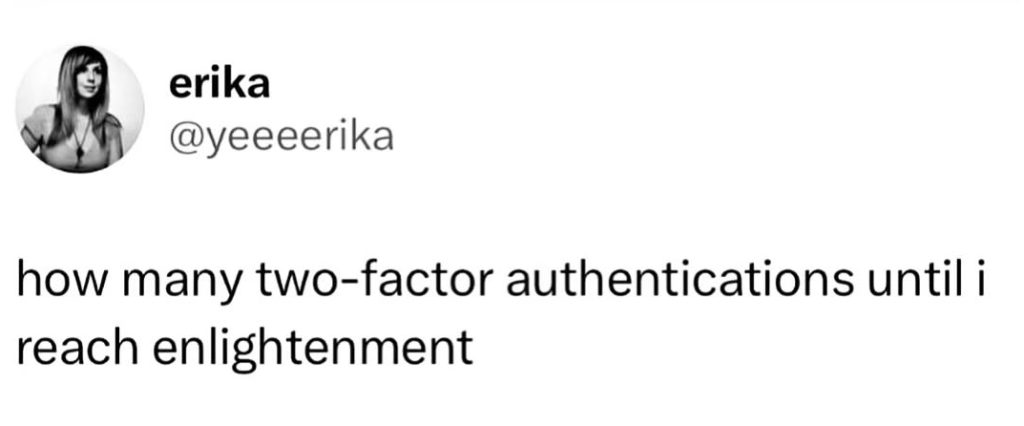
For many, the perpetual rollout of “time-saving innovations” is exhausting; and in fact the time saved is negligible according to the New York Times. This week journalist Jessica Grose reported on “granular time-use data” from the “American Time Use Survey” of the last 20 years. Despite countless technological leaps, we’re working as much as ever.
If anything, we spend more time doing domestic work and roughly the same amount of time doing paid labor… Fully employed men are doing slightly less work than they did in 2004. Fully employed women are doing slightly more work. Both men and women are doing more child care, regardless of work status, and everybody is doing much more overall domestic work, like cooking, cleaning and house maintenance. Leisure time is basically unchanged. […]
The ante on time spent on domestic work and child care keeps increasing, for both men and women. “More Work for Mother,” a book by the historian Ruth Schwartz Cowan that was published in the mid-80s, explains why. Cowan argues that for every new technology introduced, expectations of time spent on cleanliness, care and food preparation were heightened. […]
A lot of the rules we live by are governed by fear of not keeping up, and that fear is exploited by corporations. “If we can learn to select among the rules only those that make sense for us in the present, we can begin to control household technology instead of letting it control us,” Cowan wrote.
But at this point controlling technology seems laughable. At the very least, we are strangely compliant when it comes to the dopamine rush of speedy, frictionless transactions. Beyond the limitations of the human brain, the problem is structural too — short of leaving society, it’s almost impossible to opt out.
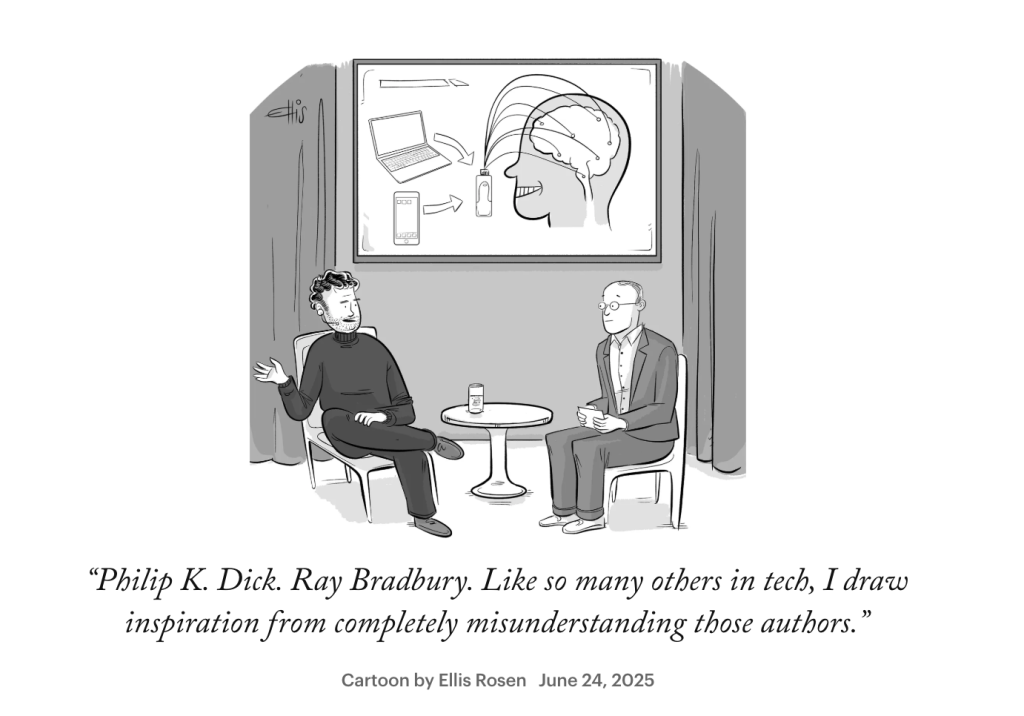
Cartoon from the New Yorker.
The problem with the technologies of 2025 — household, work or personal — is that we don’t have control over whether we use them, which perhaps is part of why we don’t see Americans gaining any more leisure time despite the wild advances of the past two decades.
I can’t opt out of the system that requires me to have an authorization code to pick up my child for this particular camp, just as most parents can’t opt out of an online grade book or communication app used by their school system, even though they often create more hassle and time suckage than they prevent. At work, we can’t just refuse to stop answering multiple messaging systems or reject the use of A.I. out of hand if our employers insist on it. The fantasy of a perfectly efficient world that also delivers more quality time is perpetually out of reach.
2. A similar word to “efficiency” is “optimization” — the desire to make something faster, smarter, stronger, better. In the latest issue of Plough, David Zahl writes against this instinct, which is often enshrined as an unquestioned good. As above, he identifies annoyances (“Optimization promises to cure headaches, but then it gives them”) but Zahl goes a few steps further, pointing toward a spiritual dilemma.
The lingo of optimization sneaks the idea that we are machines into our common language and self-understanding. This should go without saying but it bears repeating: you and I are human beings, not machines. We are created, not manufactured. We are not “wired” in a certain way. There is no code in our veins. The heart cannot be hacked any more than the mind can be downloaded. These metaphors can be useful, but when we default to them, we risk enshrining productivity as the be all and end all of human existence…
[Machines] are essentially instrumental; they exist to produce specific outcomes. But when a human being’s value is reduced to the output he may or may not produce, dignity is the casualty.
Christians have an added reason to decry this sort of optimization, namely that efficiency is foreign to Jesus. His time management was abysmal; he did not make strategic use of the resources at his disposal. I cannot imagine an individual with a less machine-like modus operandi. Jesus took breaks, sometimes at inopportune times. … Jesus never succumbed to the hurry and hard-nosed calculation that characterizes a culture of optimization – sometimes to the detriment of those in need of healing. … The pattern of the spiritual life, if we take Christ as our model, is not one of nonstop productivity or engagement. …
But I find one last damning piece of evidence in my case against self-optimization: the despair it instills in those who internalize its goals most deeply. The entire pursuit of optimization implies that our graphs of personal metrics will slope endlessly upward. Therein lies its cruelest delusion. Every one of our life-logging charts will eventually trail off. Age will rob us of our faculties. No matter how many supplements we chug, retreats we attend, or lifestyle coaches we hire, our bodies will break down. Self-optimization is a law without any possible fulfillment, and therefore a recipe for despair. It pits us in a battle against time that no one can win. As a Christian I write against optimization because I write against despair.
Read the whole thing — plenty of gems therein.
3. Stephen Colbert was interviewed about his Catholic faith by Jesuit priest James Martin this week. “I’m not looking to the crucifix for the victory,” Colbert says. “I’m looking at it for the suffering … I really just don’t want to be alone in my suffering.” It’s a powerful sentiment, especially after a week like this, with such devastation in Texas (see item #7).
In college, [Colbert] embraced atheism. In my [Martin’s] own college years, after a close friend died in an accident, I, too, found atheism to be the more rational approach to life’s problems. What brought me back was a friend inviting me to be grateful to God for my late friend’s life, rather than being angry about his death.
For Stephen, the turnabout, or rather return-about, came in an even more unusual way. Someone handed him a Gideon Bible, and, on one freezing cold day, he took out the Bible and cracked it open. It had been frozen shut. He opened to the Gospel story of the Sermon on the Mount and was transfixed by what he read. “It spoke off the page to me,” he told me. “There was no effort. I wasn’t doing anything. I was being spoken to directly by Christ.”
He describes this moment as one of profound recognition, rather than novelty. That is, it felt like coming home, hearing an echo of the faith given to him by his parents. Even today, he carries the Bible that was given to him by a stranger: It’s underlined, dog-eared and well-worn.
As a spiritual director (or just as a believer), I find these kinds of quasi-mystical experiences fascinating. In her conversation with us on “The Spiritual Life” last week, Mary Karr, for example, spoke of going into a church and “conceiving a hatred” for all the people she saw, and then, after leaving Mass, loving them. The ways that God reaches out to us, sometimes in an unmistakable way, are fascinating to me.
4. Few articles have exhausted me as much as this one by Jennifer Senior about insomnia. Yet my reward is to share the nuggets I imagine to be most useful here. The biggie:
Greater awareness of sleep deprivation’s consequences hasn’t translated into a better-rested populace. Data from the CDC show that the proportion of Americans reporting insufficient sleep held constant from 2013 through 2022, at roughly 35 percent. (From 2020 to 2022, as anxiety about the pandemic eased, the percentage actually climbed.)
So here’s the first question I have: In 2025, exactly how much of our “sleep opportunity,” as the experts call it, is under our control?
Not much, it turns out. Whether due to work arrangements, disruptions by children/housemates, blue light exposure, or the general disordering of circadian rhythms, the human will is noticeably unfree on a sleepless night.
Looking at Senior’s language, insomnia is a problem of religious proportions. Sometimes wryly, sometimes assuredly, she uses words like “sermon” to categorize a sleep expert’s TED Talk, “catechism” and “dogma” to describe his solutions, and “gospel” for the relief of a fresh idea (the perfect eight hours might be a myth!). Calvinism is even invoked regarding one’s view of medication. Most of all, the psychology of blame and shame underpins everything. The prevailing sentiment is that with a powerful enough will, you can opt in for an optimal night’s sleep; which leads to feelings of wrongdoing or culpability, which then compounds one’s sleeplessness. (And which is why we at Mockingbird published a Sleep Issue a few years back, to accompany readers through the long lonely nights, not with shame, but grace.)
If the burden of getting enough sleep is on us, should we consider chronic insomniacs — for whom sleep is a nightly gladiatorial struggle — the biggest failures in the armies of the underslept? […]
Insomniacs frequently feel shame about the solutions they’ve sought for relief — namely, medication — likely because they can detect a subtle, judgmental undertone about this decision, even from their loved ones. … Might I suggest that these views are unenlightened? “In some respects, chronic insomnia is similar to where depression was in the past.” […]
The tips one commonly reads to get better sleep are as insipid as they sound. “Making sure that your bedroom is cool and comfortable, your bed is soft, you have a new mattress and a nice pillow — it’s unusual that those things are really the culprit… Most people self-regulate anyway. If they’re cold, they put on an extra blanket. If they’re too warm, they throw off the blanket.”
And if all else fails? If research, medication, acupuncture, and CBT therapy don’t help? There’s always “acceptance and commitment therapy, or ACT.”
The basic idea is exactly what the name suggests. You accept your lot. You change exactly nothing. If you can’t sleep, or you can’t sleep enough, or you can sleep only in a broken line, you say, This is one of those things I can’t control. (One could see how such a mantra might help a person sleep, paradoxically.)
5. In humor, a perfect summertime zinger: “Man With $5,000 Grill Pretty Much Just Doing Hot Dogs” from The Hard Times:
Local husband and father of three Brett Spalding proudly showed off his expensive new grill to friends and neighbors at a cookout, but appeared to have nothing to put on it except hot dogs.
I also loved “Acts of Rebellion for the Middle-Aged” (“Answering ‘Unknown Caller,'” “Walking your dog on uneven sidewalks”) from McSweeney’s. And Reductress explains that saying “I don’t care, you pick,” is an act of psychological warfare. Agree!
6. For something lit’rary, I enjoyed Jonathan Rowlands’ reflections on reading Don Quixote for the first time:
I had heard that it was deeply funny, and a work of genius; neither aspect of the text has been a surprise to me. But there’s something about [Edith] Grossman’s translation in particular that has caught me off guard: the mistakes.
Not any mistakes by Grossman. … No: I mean the mistakes by Cervantes himself. Early on, a footnote from Grossman points out that Sancho Panza (Don Quixote’s long-suffering squire) refers to his wife using several different names throughout the text. Without Grossman’s footnotes, I’m sure I would have overthought this. What is the author trying to say…?
Grossman’s assessment? It’s just “an oversight”. A mistake. And quite a basic one, at that. Later on… the chapter summaries are a mess, frankly…
Here is a text that is human; completely and utterly human. And so, naturally, here is a text with mistakes; text that is imperfect and flawed. And therein lies its part of its charm. It is rough and coarse, and I love it for that. The mistakes in Don Quixote haven’t detracted from my enjoyment of the text, they’ve enhanced it. …
The Christian Bible is at pains to tell me that I am “fearfully and wonderfully made,” as the Psalmist puts it. I can be so quick to forget this when I focus all my attention on my limitations, and flaws, and missteps. … Don Quixote is helping me to recognise the inherent beauty of my limitations as a creature. In doing so, it’s helping me to recognise the inherent beauty of the One who created me… who sent His Son to Earth to become human like me, to revel in and live alongside me in my humanity. Warts and all.
7. I had to first lay out all the above in order to land on what is really on all of our minds. Of course, what this week will be remembered for is the acute crisis, the unannounced nightmare in Texas. Mockingbirds near and far are connected to Camp Mystic and to the lives lost. On this website, Emily Newton wrote a deeply affecting tribute to the camp and all who died there. PZ’s Podcast also addressed the tragedy through a little-known movie and the Mr. Mister song below.
For me, I returned to David Bentley Hart’s short book The Doors of the Sea, published after the 2004 Indian Ocean tsunami. Like so many theodicies, it’s probably too many words for those embroiled in deepest grief/shock, but for those wanting words, you could do worse than Hart’s. (Most of the book cautions against too much theologizing.)
But as with Colbert above, Hart sees Jesus not outside the suffering or, worse, orchestrating it, but in the middle of it, positioned as its most vehement enemy. The following is “central to the gospel”:
… the knowledge of the evil of death, its intrinsic falsity, its unjust dominion over the world, its ultimate nullity; the knowledge that God is not pleased or nourished by our deaths, that he is not the secret architect of evil, that he is the conqueror of hell, that he has condemned all these things by the power of the cross; the knowledge that God is life and light and infinite love, and that the path that leads through nature and history to his Kingdom does not simply follow the contours of either nature or history, or obey the logic immanent to them, but is opened to us by way of the natural and historical absurdity — or outrage — of the empty tomb.
However — fortunately, I think — we Christians are not obliged (and perhaps not even allowed) to look upon the devastation of that day … and to attempt to console ourselves or others with vacuous cant about the ultimate meaning or purpose residing in all that misery. Ours, after all, is a religion of salvation. Our faith is in a God who has come to rescue his creation from the absurdity of sin, the emptiness and waste of death, the forces — whether calculating malevolence or imbecile chance — that shatter living souls; and so we are permitted to hate these things with a perfect hatred. And we are not only permitted but required to believe that cosmic time as we know it, through all the immensity of its geological ages and historical epochs, is only a shadow of true time, and this world only a shadow of the fuller, richer, more substantial, more glorious creation that God intends; and to believe also that all of nature is a shattered mirror of divine beauty, still full of light, but riven by darkness…
When, however, we learn in Christ the nature of our first estate, and the divine destiny to which we are called, we begin to see — more clearly the more we are able to look upon the world with the eye of charity — that there is in all the things of earth a hidden glory waiting to be revealed, more radiant than a million suns, more beautiful than the most generous imagination or most ardent desire can now conceive. Or, rather, it is a glory not entirely hidden: veiled, rather, but shining in and through and upon all things. The imperishable goodness of all being does in fact show itself in all that is. … At such times, to see the goodness indwelling all creation requires a labor of vision that only a faith in Easter can sustain; but it is there, effulgent, unfading, innocent, but languishing in bondage to corruption, groaning in anticipation of a glory yet to be revealed, both a promise of the Kingdom yet to come and a portent of its beauty.
Strays:
- Anthony Robinson wrote a sweet review of David Zahl’s new book The Big Relief.
- Ken Sundet Jones wrote on Freedom Beyond Strength.
- Heads up: the new Natalie Bergman album releases next week! Amazingly titled My Home Is Not In This World.
- Also Waxahatchee & Kevin Morby cover this deeply resonant the Fray classic.








Firing on all cylinders as per uzh, CJ! (Just went down a rabbit hole of how best to spell out the shortened version of as per usual, with no definitive answers.) Excellent finds!
Regarding “I don’t care, you pick” as psychological warfare: Christopher Lasch, in “Heaven in a Heartless World,” makes almost the exact same point—but in much more convoluted and academic language. Interesting!