1. Starting off this week with everyone’s favorite topic — money! Or, more specifically, the act of wagering your money in the hopes of gaining more money. The cacophony of slot machines, dice rolls, and card shuffles is what usually comes to mind when people think of gambling (either that or horse race betting à la the Peaky Blinders). The less stereotypical, but perhaps more pervasive, way to gamble that has become more popular over the years is with your cellphone.
The computers in our pockets provide us with 24/7 access to sites and apps that facilitate our bets for us. My roommate can’t even turn on the Devils (don’t come for me) hockey game without being inundated with ads for fantasy sports platforms. Why not combine phone addiction with gambling? What’s the worst that could happen? Christine Emba, for the Atlantic, anticipates the dreadful impact:
Some people might argue that this is simply the way of the market — and not particularly sinister, because consumers can always choose not to gamble. Technically, this is true. But that reasoning becomes a bit less convincing when you consider the technology most people now carry in their pockets.
In a sense, Americans have been training themselves for years to become eager users of gambling tech. Smartphone-app design, as has been amply reported, relies on the “variable reward” method of habit formation to get people hooked — the same mechanism that casinos use to keep people playing games and pulling levers. When Instagram sends notifications about likes or worthwhile posts, people are impelled to open the app and start scrolling; when sports-betting apps send push alerts about fantastic parlays, people are coaxed into placing one more bet.
Smartphones have thus habituated people to an expectation of stimulation — and potential reward — at every moment. “You’re constantly surrounded by the ability to change your neurochemistry by a simple click,” Timothy Fong, a UCLA psychiatry professor and a co-director of the university’s gambling-studies program, told me. “There’s this idea that we have to have excessive dopamine with every experience in our life.”
The frictionless ease of mobile sports betting takes advantage of this. It has become easy, even ordinary, to experience the “excitement” of gambling everywhere. “Bet on the election, bet on how long your co-worker stays employed in the job … what kind of grades your kids get, when Grandma dies,” Fong said. “I hate to be so flippant about it, but that’s exactly what [apps are] priming people to do. It’s to say that any unknown outcome in your life, we can gamify. We can make it more interesting.”
It isn’t enough anymore to be anxious about the final score of the Saturday night football game — let’s up the ante and bet on the winning team! But at what cost? Indeed, what happens when we begin to think of every scenario in our lives in terms of risk/reward and the dispassionate calculations of probability? As Emba notes, this can turn life itself into some cosmic game, twisting relationships into scenarios we scheme and manipulate as we chase the dopamine rush of a winning bet. The easy accessibility to gambling won’t just affect us personally, for it can also change the culture around us. Just one bet is enough to make friend into foe.
2. Next up is a refreshing interview between Anne Helen Petersen and Soray Chemaly about Chemaly’s new book, The Resilience Myth: New Thinking on Grit, Strength, and Growth After Trauma. Her husband’s diagnosis with cancer challenged her notion of resilience and belief in the power of the individual:
Over years I had really absorbed the idea that resilience was 9/10th the ability to persevere, be gritty, try to stay optimistic, etc. and 1/10th having a supportive social circle. When my family was thrown into the deep end of a crisis, it became clear that nothing I could do as an individual could compare to what we all needed, which was a combination of love, friendship, compassionate listeners, and actual material resources, such as access to good health care and medicine.
What I concluded, after that experience and through writing this book, is that that our individual/collective resilience ratios should really be reversed or, a better formulation, that the more accurate and helpful way to think of “supportive social circles” is broadly: as the connections, material resources, and political entitlements that serve as the foundation for our individual strengths and capacities.
This new understanding of resilience knocked self-sufficiency and hyper-individualism right off its pedestal:
The word toxic gets thrown around a lot these day, which is a shame because it is really very useful! Toxic individualism is a good way to sum up our cultural obsession with the power of one person to persevere against all odds. That model means we have created a survival of the fittest ideal of resilience that impoverishes us all, both as individuals and as a society. It’s the model, I argue in the book, that undermines public health, political equality, and greater collective goods.
The danger of thinking that you and you alone are responsible for adapting positively to crisis — and today that means crises after crisis after crisis — is that you will almost certainly fail to meet your own expectations. No one is resilient alone, at all times, and in all situations. Resilience is a dynamic process and it is healthier and more accurate to say that we take turns being resilient for one another.
The crux of the cult of individualism is the belief in a hyper-masculinized self-sufficiency that ends up making being human — having needs (being needy), needing to be cared for (being dependent), being vulnerable (being “weak”) — impossible.
“Resilience” looks like a word that would be posted above a classroom door alongside other words like “readiness” and “refine.” “The Big Three ‘R’s” — thought to encourage us in our educational pursuits and our engagement with the world. These words, at first used for motivation, soon become words of law the more you pass under the threshold. And despite what Kelly Clarkson sings in her hit single from 2011, what doesn’t kill you doesn’t always make you stronger. An emphasis on individual resilience might also make you more alone, less interdependent on those offering a hug and helping hand, whether it be a friend, a neighbor, or God.
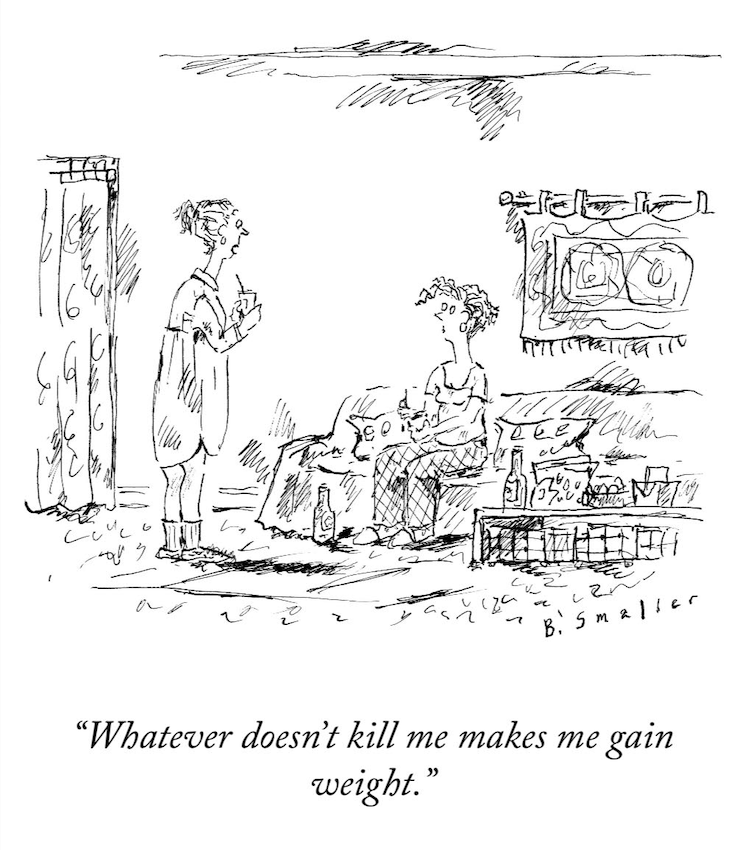
3. Speaking of resilience (and loneliness), there may be nothing that tests our patience more than the people who annoy us. Contrary to what our self-help books or TikTok therapists say, Cecilia Rabess (via the Wall Street Journal) contends that “Not Everyone In Your Life Has to Spark Joy.”
A subtle (not so subtle?) reference to Marie Kondo, Rabess discovered that purging your life of annoying people was not as beneficial as throwing out your old high school student council t-shirt or the denim shorts that stopped fitting you two summers ago. In fact, after ridding herself of annoying acquaintances and family members, she didn’t feel relief, she felt lonely:
The loneliness epidemic — the much-discussed phenomenon of social isolation brought on by a lack of in-person, interpersonal connections — had come for me. Despite the fact that I had a number of strong relationships, there was a certain base level of human interaction that I was missing. I realized that I had friends but lacked community. And because community is organic, dynamic and expansive, it wasn’t something I could curate perfectly to my taste.
I decided to embrace annoying people in my life, not because I became more generous or understanding (though, to be fair, very few people are actually the sum total of everything annoying about them), but because I reached the conclusion that a life well lived necessarily includes a lot of annoying people.
For many years I worked as a data scientist, and in that line of work, I would have described annoying people as a leading indicator. The more annoying people in one’s orbit, the more likely true friendships, meaningful connection and strong community are to follow. You have to kiss a lot of frogs before you meet a prince, in other words. In my current line of work, as a novelist, I take a more magnanimous view. Annoying people are akin to unlikable characters — the ones we love to hate, whose charms are buried far beneath the surface.
This is not to say that every annoying person secretly has something to offer. Some people truly are difficult or toxic or outright cruel. In my embrace of annoying people, however, I’ve made space for them too. Not out of the goodness of my heart but because they’re necessary parts of the ecosystem, like poisonous snakes or tornadoes, the unfortunate byproduct of something bigger and more meaningful.
If nothing else, there is at least one tangible benefit that annoying people confer: permission. Permission to be imperfect. Permission to be human. Even permission to be annoying ourselves.
If we distance ourselves from everyone who annoys us, will there be anyone left? We have as much propensity for being annoying as we do for being annoyed. Our fate to be cringe is inescapable — but at least we’re all in this together.
4. For kicks and giggles, take a gander at the New Yorker‘s “We Regret to Inform You That You’re Still Just a Person“:
Congrats on your Pulitzer Prize! Unfortunately, the automated D.M.V. queue doesn’t have an appreciation for nuanced storytelling about generational trauma. […]
Eight hours of sleep yesterday? Surely you won’t mind being woken up multiple times tonight replaying that non-even-so-bad conversation you had with your not-that-recent ex.
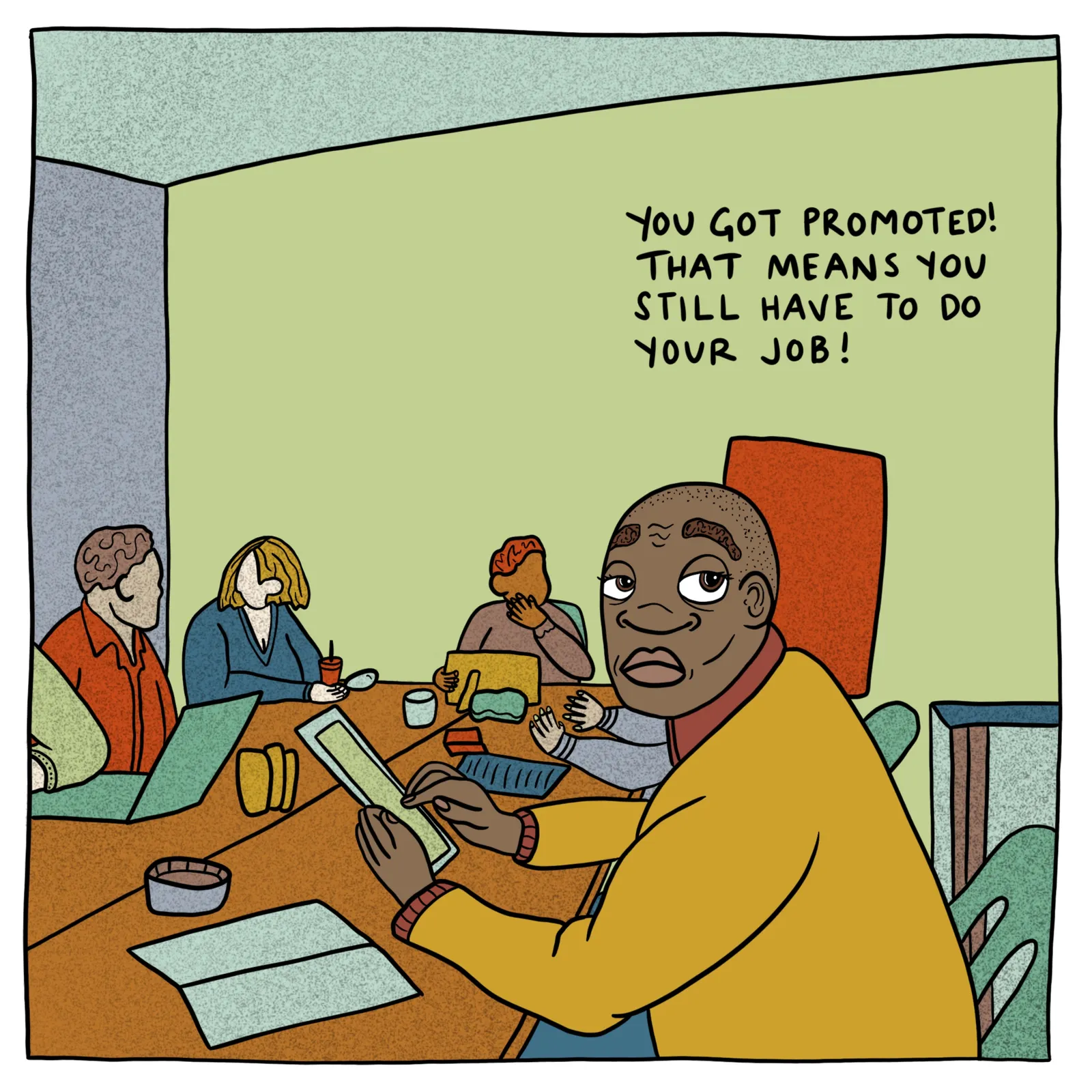
By Annah Feinberg for the New Yorker
For all the phone addicts out there, take note of Reductress‘ “How I Finally Cut Down My Screen Time by Getting Really Into God.”
And last but not least, to the grammar police, here’s Babylon Bee‘s “Man Successfully Corrects Someone’s Grammar But Oh No! Now He Doesn’t Have Any Friends!” You know who you are!
5. The bond between parents and their adult children is apparently stronger than ever (for some). Recent research reveals how current young adults have a greater dependence upon their parents than previous generations for connection, advice, money, and housing.
At first glance, these studies can seem alarming. After all, the typical task of child-rearing is to raise children who are functioning, self-sufficient members of society. Birds have to leave the nest at some point, right? But Faith Hill, writing for the Atlantic, suggests that the assignment has evolved:
The transition to adulthood is taking longer, at least by the traditional milestones and markers of maturity; people are marrying and having children at later ages. Yet these young adults still need what Karen Fingerman, a human-development professor at the University of Texas at Austin, calls a “guaranteed relationship” — someone they automatically know will be there for them. Thus, parents, Fingerman told me, are beginning to take on roles a spouse previously might have, cheering on their kids or acting as a confidant. […]
So many people in American society are stuck on the idea that too much closeness gets in the way of growth — when in fact closeness can help build a future. “If I develop my identity as a person simply by sort of rejecting my affiliation with family and other systems,” Goldsmith said, “I’m sort of developing myself in a vacuum. And that’s not actually desirable.”
If Americans should worry about anyone in this cultural shift, it’s not the adults who rely on parents — it’s the adults who don’t have a parent to rely on at all. “If we’re living in a society where the parents are a huge safety net,” Fingerman said, “where is that safety net” for people whose parents aren’t present, emotionally equipped, or alive? Some people have friendships — chosen family — so unconditional that they really are “guaranteed.” Not everyone does.
One wonders what will bring adult children back to the nest if they are raised to be guardedly independent. Do resilient children have any need of home? And unlike the classic caricature of the 30-year-old guy who still lives in his parents’ basement, perhaps it’s actually our extreme self-reliance that makes it difficult for prospective romantic partners to breach the fortified walls of our hearts.
6. To close, here’s an excerpt from Chad Bird’s brilliant new book, Hitchhiking With Prophets, published by 1517:
[W]e might suppose that David, like, say, Alexander the Great, was the son of a renowned leader, under the tutelage of famous scholars from boyhood. He was the kind of kid whom onlookers would point to and say, “See that boy? There goes the future of our nation.” But no, that wasn’t David at all. Gifted though he was, David was an unknown country boy, tucked away in a backwater village in the Judean hill country, the youngest of eight boys fathered by a man named Jesse. His dad raised sheep, of which the teenager David was the shepherd. Presumably, his life would have been no different than the lives of tens of thousands of others in Israel whose names historians had no reason to record. But one day, the prophet Samuel showed up in his village of Bethlehem. From that moment, David’s life, and our lives still today, were forever changed. […]
The Lord’s choice of David is a crucial lesson in his divinely backward way of doing things. In story after story, the Lord passes over the obvious candidates. He will use old, infertile women to bear promised sons, not newlywed 20-year-olds. Frequently, it will be non-Israelites like Ruth or Rahab who exhibit a fidelity to God that outshines the Israelites. The Lord repeatedly bypasses firstborn sons to choose the younger or, as in David’s case, the youngest in the family.
God does this not just to keep us on our toes, but to show us that his ways are not our ways, that he tends to hide himself beneath his opposite. This upside-down way of God finds its ultimate fulfillment in Jesus, who also is born in Bethlehem, who is raised in the rural village of Nazareth, who looked no different outwardly than other people, and who was publicly executed by the Roman state in a manner purposefully designed to be shameful and horrific. Yet who is Jesus? He is God in the flesh, the extraordinary concealed in the ordinary, even in the shame and seeming foolishness of the cross.
Strays:
- Sophie McBain, for the New Statesman, ventures “Inside the Teenage Mind.”
- Eliane Glaser talks OCD, procrastination, and self-sabotage at Aeon.
- Griffin Gooch grasps for status in Christianity Today.
- ‘Twas an act of resilience on my part to leave this in the strays: Helen Lewis, via the Atlantic, on the core appeal of Taylor Swift. Two words: Millennial cringe.