




1. Move over tarot card readers, Magic 8 Balls, and Zoltar the fortune teller — there’s a new mystic in town. Etsy witches are the hot new commodity according to Chavie Lieber for the Wall Street Journal. If you don’t know, Etsy is an online marketplace from which people can purchase antiques, crafts, and (apparently) witchcraft. But why would someone pay $8.48 for a love spell? Lieber has an idea:
Faced with economic uncertainty and vapid dating apps, some people are putting their beliefs — and disposable income — into love spells, career charms and spirit cleansers…
The concept of hiring an Etsy witch hit a fever pitch when influencer Jaz Smith told her TikTok followers that she had paid one to make sure the weather was perfect during her Memorial Day Weekend wedding. The blue skies and warm temperature have inspired TikTok audiences to find Etsy witches of their own. […]
Ibalio, 21, believes more people her age are willing to gamble on witchcraft for careers, income and love.
“Like, we are young, dumb and broke,” said Ibalio. “It’s out of desperation.”
In our scramble for control when life feels like too much, it is nicer to have someone to blame if the outcome doesn’t go our way. Who better to hold accountable for our discontent than an Etsy witch who lives hundreds of miles away. But it isn’t just about finding someone to blame, it’s also about searching for hope. The young people purchasing the services of Etsy witches are longing for love, connection, joy, and comfort — something outside of themselves.
2. Young people aren’t the only ones looking for connection, of course. The search for community is universal. Brooke Allen, for the New Yorker, wrote a fantastic essay entitled “Teaching Men Who Will Never Leave Prison.”
Allen, a teacher at Great Meadow Correctional Facility (a maximum-security state prison) started a program that taught on subjects such as History of Thought: The Enlightenment and Origins of the English Novel. Great Meadow unfortunately closed last year, but the impact of the program on the lives of those incarcerated is lasting:
Many states expressly bar lifers, and virtual lifers, from rehabilitation programs, college education, and any opportunity beyond their cells, favoring those who will one day be released into society and might contribute to it … But for some people, both on the inside and the out, cultivating the life of the mind is less transactional: it fulfills a profound spiritual need, as urgent as a religious vocation is for others. […]
The benefits of education for individual lifers are evident, but I am often asked what good it does for anyone else, much less for society at large. The answer is simple: the college courses create a community, and the culture of that community radiates outward to the larger culture of the prison. “Even outside of class,” Eric wrote, “you’re talking about what you read, your ideas, his views on it, your views on it. It builds a community, and everybody in that community enjoys learning.”
When such a community contains lifers, the influence widens. There are a lot of them: one in seven prisoners in the United States is serving fifty years to life. Among people of color in prisons, the number is one in five. And, as Roger commented, “Lifers are influential in prison. In many ways they are the makers of the ‘prison code’ by which inmates and guards live. . . . So when a lifer chooses a different way of life, and they do so successfully, they weaken the chains of antisocial prison codes. They become beacons of light to the men around them.”
In the program, the men are heard, understood, and valued. They could take their time studying literature, earning bachelor’s degrees, or entering writing competitions. Brooke Allen, later on in the article, shares a testimonial of a man reading Leo Tolstoy’s War and Peace:
Another student with a remarkable capacity for work was Liam, who was of Irish descent, and had been reincarcerated on a parole violation. He had learned enough Russian from another inmate to read “War and Peace” in both the original and the translation, side by side, when we offered a class on it. He had first read the novel in English twenty-five years earlier, while in solitary confinement. In the vacuum of the cell, he wrote Annabel [another teacher in the program], “the characters and scenes in the book, aristocratic drawing rooms and battle fields, so vividly rendered by Tolstoy, so rich and detailed and colorful, seemed realer than my own life, which was a drab, monotonous blur.” The prospect of revisiting Tolstoy’s classic in a P.E.I. class filled him with joy. “Dangling before me is the dazzling prospect of reading Tolstoy’s great novel in the original,” he wrote. “I view this as nothing less than cosmic grace.”
3. Katelyn Beaty wrote on her Substack this week about deconstruction, which she claims has become just another brand, another way to sell consumers books and merchandise and conferences. The susceptibility of #exvangelicals to consumer culture is not surprising, nor out of the ordinary. It seems like everything these days is vulnerable to commodification (looking at you, Etsy witches).
Daniel Vaca, a religious historian at Brown, wrote a great book on this called Evangelicals Incorporated: Books and the Business of Religion in America that I found helpful for my own book on celebrity. He writes,
“Evangelicalism exemplifies what I describe as ‘commercial religion.’ Religion that takes shape through the ideas, activities, and strategies that typify commercial capitalism.”
That is, one way we can understand evangelicalism is as a consumer marketplace. One way evangelicals practice faith is through buying, selling, and consuming content tailored to their felt needs.
In this way, it seems to me that the deconstruction world is at risk of becoming like the very thing it’s rejecting. The content may be different, but in many cases, the form — easy, and easily shareable, answers from experts (some credentialed, others less so) — remain the same.
I’m not sure what the solution to this capitalism is, if there even is one that humanity is able to impart. But I agree with Beaty when she says, “There should be moments, and experiences, that are off-limits to quickly produced Internet content.” Likewise, I think of “third spaces” — social places in which people can gather outside of home and work, environments that spark community that are free and don’t encourage spending (like libraries and churches!). Such places feel few and far between, but how special they are when discovered.
4. For kicks and giggles here’s Points in Case with “Why Isn’t That Thing I’ve Been Putting Off Doing Already Done?“:
For hours today, I have been thinking about doing the thing. And yet I have made zero progress on doing the thing. How is this possible? […]
I have opened the file and looked at what I have to do. I deserve a break now, because looking at the thing I have to do is very tiring. Sometimes, if my break is very long, it is also tiring, and I need to take a break-break from the break in order to conserve my energy for eventually doing the thing. Somehow, despite using this technique to conserve my energy, I am very tired, and the thing still isn’t done.
See also Reductress‘ “This Woman Knows She’s Doomscrolling But Just Doesn’t Have Anything More Interesting to Do,” which was quite the gut punch but provided some chuckles.
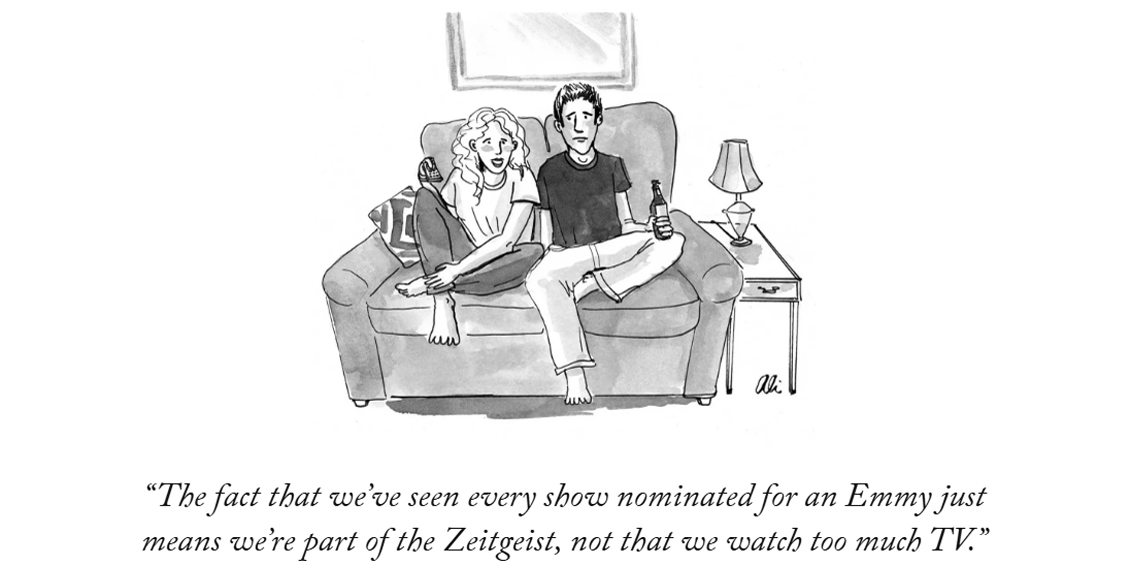
And in light of the recent release of Emmy nominations, here’s a New Yorker cartoon:
5. It’s unfortunately too easy to come across diet and wellness culture on most sides of the Internet. Whether you’re on the side of the online world that preaches body positivity, intuitive eating, intermittent fasting, the Mediterranean diet, or cortisol-lowering supplements, they all have one common goal: to control how our bodies look. Even the most well-intentioned health advice amidst the dieting muck gets us thinking about what we need to do in order to fix ourselves.
Diet and exercise aren’t the only ways in which we try to mold our perfect shape — plastic surgery has been around for millennia and continues to be a steady business, promising to deliver the results you are looking for. Nick Dothée, having dealt with body image issues from a very young age, fell into the traps of plastic surgery and discovered that none of his three surgeries could fix what he wanted them to:
I was trying to get back to that person. The one who could laugh without calculating angles. The one who could walk into a room without first tugging down his shirt twice. If the surgeries could fix what I hated, I’d feel more like myself…
I told myself it was the right thing — one more step toward being someone I could love. But somewhere under the rehearsed hope, a quieter thought had started whispering: What if this doesn’t fix anything? What if it’s worse?
“You’re done, sweetheart. You did great,” the nurse said.
My body felt foreign. Like someone else’s bad decision. The scar ran hip to hip, angry, raised, and nothing like what I’d pictured. […]
Walker told me once, “You don’t have to look like a cologne ad to be loved.” I didn’t believe him then. I’m trying to now, though I still struggle. In the months after I recovered, I started seeing my own therapist. When I get too self-obsessed, I go speak at my old rehab or take one of the residents to the grocery store. That kind of service keeps my feet underneath me and my head out of my ass. It reminds me who I actually am.
I think it’s true that negative thoughts surrounding our own bodies would lessen and lose their stronghold if we didn’t consume as much Internet and social media as we do (and if we never commented on each other’s bodies to begin with). But it’s also true that those patterns of thinking have been ingrained through generations of insecurities despite the current online chatter. No alterations or diets or surgeries will completely erase our insecurities, no matter how much time, effort, or money we put into such endeavors. Maybe the answer, as Dothée aptly put, is to keep our feet underneath us and well … you know the rest.
6. To close, Nick Cave made some poignant and vulnerable observations in his most recent post on Red Hand Files. It’s been ten years since the death of his son Arthur and a reader wonders: “Does the pain last forever?”
It’s hard to embrace life in all of its difficulties, and it’s near impossible to do so if you are in the thick of it. But there is hope, Cave writes, that the pain (which still remains) will evolve over time:
I discovered that the initial trauma of Arthur’s death was the coded cypher through which God spoke, and that God had less to do with faith or belief, and more to do with a way of seeing. I came to understand that God was a form of perception, a means of being alert to the poetic resonance of being. I found God to be woven into all things, even the greatest evils and our deepest despair. Sometimes I feel the world pulsating with a rich, lyrical energy, at other times it feels flat, void, and malevolent. I came to realise that God was present and active in both experiences.
These days, I am neither distrustful nor suspicious of the world, even though my heart breaks for it, and I am not despairing, depressed or embittered. Indeed, I see heartbreak as the most proportional response to the state of the world – to say I love you is to say my heart breaks for you, and this sentiment resonates within all things, bringing a clarity to both the world before us and the world beyond the veil. Sorrow becomes a way of life, part laughter, part tears, with very little space between. It is a way of conducting oneself in the world, of loving it, of worshipping it.
Strays:
- AI’s solution to loneliness in the New Yorker.
- New York Times’ “The New Way to Game Elite College Applications”
- Essentia Foundation on existentialism and meaning.
- The Atlantic on the need for free play and parks.








Thanks heaps for putting this together.