




1a. Where did you first hear the big news? Instagram? A friend’s cousin’s girlfriend? A push notification from ESPN? No matter what niche of the internet you hermit in, you’ve probably heard of Taylor Swift and Travis Kelce’s engagement.
Say what you will about Tayvis (Traylor?), but to the countless fans who grew up dancing and crying to her music this announcement has been such sweet news. After many albums, tours, tabloids, and heartbreaks, Taylor Swift is finally marrying a man who loves her unabashedly. Helen Lewis, for the Atlantic, observes why fans are so happy for a celebrity they’ve never even met:
Swifties also love Kelce because he displays no trace of resentment that his future wife is so successful. (The kind of men who have dismissed Swift as an ingenue, a mere pop star, or a flighty strumpet are a regular target of her songs.) In the GQ profile, Kelce compared her performances on the Eras Tour to his own career as tight end for the Kansas City Chiefs: Both of them are stadium-level entertainers. “I hadn’t experienced somebody in the same shoes as me, having a partner who understands the scrutiny, the ups and downs of being in front of millions,” he said. Three hours of dancing and singing on a giant, illuminated stage at a stadium in Singapore, he said, was “arguably more exhausting than how much I put in on a Sunday, and she’s doing it three, four, five days in a row.” […]
A big hunk. A supportive partner. A man who is sensitive and good with kids but can also chug a beer and dance in public. A man who has reached the top of his own profession and is happy to be with a woman at the top of hers. I mean, come on. Kelce represents a romantic ideal, the idea that you don’t have to compromise. You can have someone who looks perfect on paper, someone of whom your family approves, someone who is hot but not arrogant, someone you love. A woman can have it all.
Is their romance a bit cheesy, cringey, and PR-y? Perhaps. Maybe. But amidst the glitz and glamour of pop-stardom and football legends, there is no denying that Travis loves Taylor openly, boldly, and selflessly. There is also something to be said about a love outside of judgment. A love that out-rivals the silly noise of gossip magazines, Reddit threads, and social media discourse.
1b. While we’re on the topic of love, David Brooks wrote a fascinating essay for the New York Times entitled “The Wrong Definition of Love.” Society’s definition of love, Brooks argues, has become incredibly self-focused. That love centers around how the other person makes them feel seen and understood — it’s about them and what they’re given, not about what they give to the other person. Brooks believes that our culture’s move toward therapeutic values has distorted what love is:
In other, less self-oriented cultures, and in other times, love was seen as something closer to self-abnegation than to self-comfort. It was seen as a force so powerful that it could overcome our natural selfishness. Such love begins with admiration, a glimpse of another person who seems beautiful, good and true…
Falling in love in this view is not a decision you make for your own benefit, but a submission, a poetic surrender you assent to, often without counting the cost. It is not empowering, but rather it involves a loss of self-control.
He goes on,
Love is not an emotion (though it kicks up a lot of emotions); it is a motivational state — a desire to be close to and serve another. It blurs the boundary between one person and another.
This blending of one whole person with another whole person reduces the distinction between giving and receiving, because when you give to your beloved it feels like you are giving to a piece of yourself, and this giving is more pleasurable than receiving. The goal of this giving, the goal of love, is to enhance the life of another.
In his 1956 book, “The Art of Loving,” the psychoanalyst and philosopher Erich Fromm argued that love is not a feeling; it’s a practice, an art form. He wrote, “Love is the active concern for the life and growth of that which we love.” It’s a series of actions that requires discipline, care, respect, knowledge and the overcoming of narcissism.
To be seen and understood by those we love is important. But I wonder if there is freedom in loving someone despite how they make you feel. A la Taylor Swift’s lyrics in Folklore‘s “Peace”: But I’m a fire, and I’ll keep your brittle heart warm / If your cascade ocean wave blues come / All these people think love’s for show / But I would die for you in secret. If our love was locked away and only awarded to those we thought deserved it, would it ever be shared?
2. Next is a moving testimony by George Owers in The Critic. Owers grew up in a secular household but went to a school in which they sang hymns and spoke the Lord’s Prayer. To Owers, Christianity “seemed to be either slightly sinister and obscure, or in its Anglican guise too often nice but beige and a bit stupid.” It wasn’t until he happened upon The Book of Common Prayer at the secondhand bookstore where he worked that Owers had a crisis of faith:
I was particularly struck by the general confession said at something called “morning” and “evening prayer”, with its talk of how we had “followed too much the devices and desires of our own hearts” and “left undone those things which we ought to have done” and “done those things which ought not to have done”. I suppose I had become unsatisfied with the emptiness of many aspects of my life and unable to account for or give voice to a deep, visceral sorrow at my own unworthiness and the sinful actions that I was acutely conscious of having committed.
Owers found himself dissatisfied with the liberal humanist orthodoxy to which he subscribed. What he has to say next is very low anthropology:
It was all too airy, unreal and silly, I suddenly felt. I was a sinner, I just felt it in my guts. There was something deeply crooked in my nature, and when I did things that I knew were selfish or stupid or greedy I didn’t want to be told that I was fretting over nothing and should just get on with “living my best life” and enjoying being “who I was”. I didn’t much like “who I was”. Suddenly, liberal secular bromides about how humans were really good and could all be nice to each other if they dropped silly superstitions like belief in God seemed ridiculous to me, profoundly unrealistic. I began to have, in short, a crisis of faith, but it was a crisis of a previously completely unexamined faith that I had swallowed as unthinkingly as any medieval peasant might have taken for granted the dominance of the Catholic Church: secular humanist materialism. […]
I also began to perceive the fundamental mystery lurking under everything that no atheist or agnostic can wish away. Why should there be something rather than nothing? Why are we here anyway? Didn’t other people suddenly, at the most quotidian times — going down stairs or while brushing their teeth — get this sudden sense of how extraordinary and odd and inexplicable that I was here at all. A sense that something — something I could not systematise or see or dissect, but which shimmered there, just out of sight but not out of sense — was underneath it all, sustaining it all, labouring to prevent the forces of entropy and decay from returning us to our original state of non-being.
3. Amidst all the parenting articles this week, Meagan Francis takes the cake with “How Parents Hijacked the College Dorm” in the Atlantic. Maybe you haven’t seen it, but all over social media (specifically TikTok) college students have been sharing their dorm room transformations.
The video starts out by scanning over a sad beige room complete with drab lofted beds, lonely navy blue mattresses, and cold tile flooring. It then transitions to reveal a pale pink and white paradise — ruffled linens wrap the beds, floral makeshift headboards hide the dark wood, and a massive rug ties the whole room together. When I went to college, I taped old photos and postcards above my desk as decor and double checked that I ordered XL twin sheets to fit the dorm mattresses.
The expectations of what a dorm room should look like have changed: and so has the merchandise. More and more companies, Francis notes, have dorm categories and “whole displays devoted to the gear.” Such expectations aren’t only for the stores or the products or the kids going to school, but also their parents:
[T]here’s the influence of intensive-parenting culture, which typically demands that parents spend more on and do more for their kids. “We raise the bar, raise the bar, raise the bar for parents,” Asha Dornfest, the author of the Substack newsletter Parent of Adults, told me. Expectations “ratchet up in high school,” when many parents help with the college process, she said. A growing number of parents are entwined in their adult children’s life as well. Seen in this light, it’s perhaps obvious why many take an active role in college move-in.
Francis poses the question that many parent self-help books aim to answer: Is too much parent involvement getting in the way of their child’s budding autonomy? The answer, of course, is yes. But she also provides a gracious view of parents who are just trying to help:
Granted, most parents aren’t hiring professional designers; they’re just trying to prepare their kids as best as they can while facing down what, for many, will be their longest stretch of life apart from their child. Fixing up dorms may be one way some of them are tempering the anxieties that naturally come along with this transition. In the “Dorm Room Mamas” Facebook group, sandwiched among the photo ops, plenty of parents shared deeper concerns. One member sought suggestions for a small, inconspicuous safe for stashing prescription medications; another asked if her daughter’s sudden anger and attitude before move-in was normal. Their devotion to interior design might have surpassed mine, but their care for their kids was relatable.
4. Unfortunately a little light on humor this week, but hopefully the following will provide some much-needed kicks and giggles.
Letters Live recently posted a YouTube video in which Richard Ayoade “reads a stream of anxious letters by Franz Kafka.”
November 4th, 1912
It is now 10:30 on Monday morning. I have been waiting for a letter since 10:30 on Saturday morning, but again nothing has come. I have written every day but don’t I deserve even a word? One single word? Even if it were only to say “I never want to hear from you again.” Had a letter arrived, I would have answered it at once, and the answer would be bound to have begun with a complaint about the length of those two endless days. But you leave me sitting wretchedly at my wretched desk!
My favorite remarks in the comment section: “Rip Kafka, you would’ve loved being left on read,” and “In today’s words I feel Franz would say ‘R u mad at me?'”
Elsewhere, the New Yorker supplies some laughs with “Your Midlife Girls’ Trip: A Waiver“:
You “Participant” acknowledge that, despite all social-media posts to the contrary, embarking on a Midlife Girl’s Trip holds many risks, just some of which are outlined below. By signing this waiver, you accept that going on this outing is voluntary, even if your group chat made it not feel that way.
This cartoon by Lynn Hsu (also from the New Yorker) ties nicely into the next article:
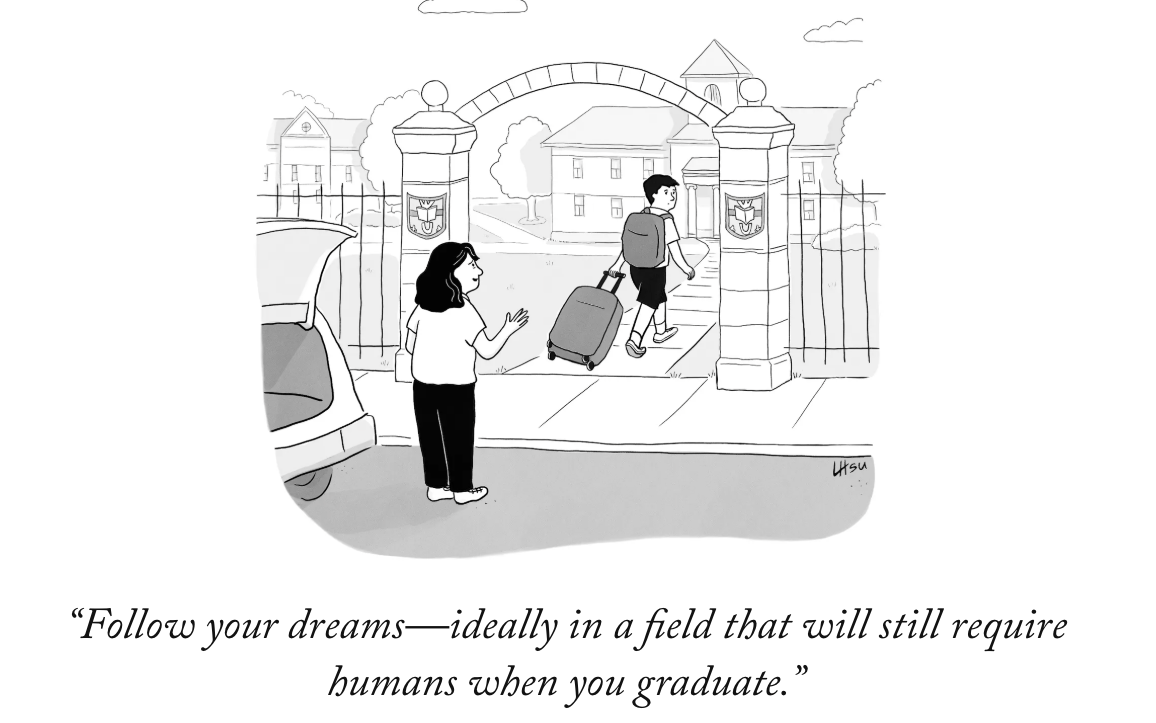
5. Sociologist Marion Fourcade doesn’t hold back with her essay for Aeon on “The Sovereign Individual and the Paradox of the Digital Age.” What starts off as a history of IBM’s Model 650 computer turns into a reflection on the effects of its ever-present, “spiritual descendent” – otherwise known as our phone. More specifically, how phones have enforced a data-driven, dopamine-addicted, and hyperindividualistic culture (which could also be one of the reasons society has a distorted definition of love, as David Brooks’ pointed out earlier).
Fourcade defines an “ordinal society” where “nearly every aspect of our lives is measured, ranked, and processed into discrete, standardized units of digital information.” What is an ordinal society really after?
Beyond identifiability, the more insistent question is one of authentic identity: who are you, really? The ordinateurs want to know. To help us unlock this information, they have transformed it into a matter of public record, to be shared proudly and widely. Social media companies skillfully exploit our thirst for sociability and our romantic ideals of self-realisation. They relentlessly encourage individuals (and organisations, too) to publicly express their core commitments and enroll allies to validate them.
It goes further than authenticity. The presence of Generative AI takes it a step further:
All of this has the effect of shifting emphasis from authenticity to authentication, from demonstrating the truth of one’s identity to proving the reality of one’s testimony. The question is no longer whether an identity is genuine (‘Is that really you?’) or even authentic (‘Who is the real you?’) but whether each element of your digital presence is unmediated by artificial intelligence (‘Is it really you?’) This emergent regime of authentication transforms interactions from a set of performances to be judged into a series of actions to be verified by machines at every step.
Being a legitimate self now requires one to be publicly identifiable, authentic and, increasingly, fully authenticated. What began as a celebration of individual uniqueness that avidly encouraged the production of digital evidence is evolving into an elaborate system of verification that will treat any trace as a potentially suspect record.
Our digital footprints are more significant and more out of our control than ever before.
6. To close, Nigel Halliday wrote a beautiful meditation for ArtWay on Michelangelo’s Pieta. The drawing was a gift from Michelangelo to Vittoria Colonna. Both Michelangelo and Vittoria attended a Bible study (of sorts) once a week “to hear a sermon based on one of Paul’s letters, and then sit and talk, almost always on the subject of salvation by faith alone.”
Through the study they became close friends, and according to Halliday, “It is clear from Michelangelo’s poetry and his correspondence with Colonna that, through her, he too came to believe and accept salvation by faith — and this came to be reflected not only in the subjects of drawings that he made for her, but in their very approach to this art.”
Halliday’s reflection on the illustration itself is extensive and meaningful — I recommend reading the whole essay, but I’ll leave you with this:
The line that runs vertically up the centre of the cross from the top of Mary’s head is a quotation from Dante, one of Michelangelo’s favourite authors: Non vi si pensa quanto sangue costa (“There they don’t think of how much blood it costs”). This is taken from Canto 29 of the Paradiso, the third book of the Divine Comedy, in which Beatrice is lamenting how people do not appreciate the sacrifice of martyrs. Michelangelo takes this lament but applies it to the death of Jesus himself: transactional religion, which seeks to earn salvation by human means, misses the enormity of what God has done through the death of his Son, as the only sacrificial offering that can suffice for our sin.
The drawing is one of those now referred to as ‘presentation’ drawings. Artists’ drawings were already a focus of interest for art collectors, but these were means to an end, preparatory sketches for a sculpture or painting. ‘Presentation drawings’ were a new idea, an end in themselves. They were also, at least in Michelangelo’s case, created explicitly as gifts, and therefore separate from the art economy.
Alexander Nagel, in Michelangelo and the Reform of Art, explores how Michelangelo and Colonna were conscious of the nature of gifts.4 In their correspondence accompanying these gifts they underline that the inspiration for this new approach to art was the gospel itself: salvation has been given to me, irresistibly and unearned, and in response I can bless others with gifts that are beautiful, unearned, and unexpected….
Those of us who know that our salvation cannot be earned still can be tempted to feel that we must do something post facto to merit it, or even to pay it back. But that would be a denial of the nature of grace.
Strays:
- The Daily‘s “How America Got Obsessed With Protein” — the last five minutes are pure #Seculosity
- “Murder We Wrote: How Cosy Crime and Psycho Thrillers Carve Our Minds” from Seen & Unseen
- “Splitsville” Plays Infidelity for Laughs; “A Little Prayer” Shows What’s Really at Stake








For some reason, “dorm room mamas” brings to mind Alice Roosevelt Longworth’s comment about her father:
“My father always wanted to be the corpse at every funeral, the bride at every wedding and the baby at every christening.”
Not to allow new (and not-so-new) college students to enjoy and savor the ups and downs of their new experiences seems so…selfish.
I will never understand the Mockingbird affection for David Brooks. The man was utterly wrongheaded over the Iraq war, could not see that his preferred political party had gone full-on fascist until this year, and scolds poor people on their private lives, while divorcing and marrying a younger woman who worked as his research assistant. And he has the gall to talk about “the wrong definition of love.”
My issue is not that Brooks is undeserving of grace. It is that he is undeserving of serious consideration as a writer and a thinker. Please reconsider giving a hack this kind of attention.
I recently saw similar news about dorm room interior designers pulling down tens of thousands of dollars for their work with college housing students. That part of the week in review was seriously on point.