




1. “Being from Tennessee, you learn about Dolly the same time you learn about Jesus.” So said someone on Instagram this past Tuesday after the news hit of sweet Dolly Parton’s passing. It’s difficult to encapsulate all the love this country has for Dolly — the music she made, the laughter she sparked, and the compassion she had for those around her. There was something different about Dolly. For Russell Moore at Christianity Today, Dolly was different because she didn’t take herself too seriously:
In another interview with the late Larry King, Parton said people asked her if she was offended when people assume she’s a “dumb blonde.” She replied, “I say no because I know I’m not dumb and I know I’m not blonde.” She was often quoted as saying, “It costs a fortune to look this cheap.”
That was more than just good media training. Parton showed she was more cunning than those who looked down on her: She didn’t seem the least bit offended by the questions, nor did she seem to be the least bit shaken in who she was.
When people think others look down on them because of their background, they typically respond in one of two ways: shame or resentment. Shame works itself out with a kind of desperation to get away from one’s roots so as not to be lumped in with whatever is made fun of back there. Resentment expresses itself as “If you dare think you’re better than me, I’ll make you pay.”
Parton knew some people would find lots of things about her embarrassing and uncultured — her accent, her appearance, her background in mountain poverty, her religion rooted in Southern revivalism. What made her different is what she did with that awareness, and that was to avoid even the slightest bit of impersonating shame or resentful defensiveness.
But Dolly wasn’t completely shameless:
People say shamelessness is a superpower, and there’s a lot of evidence for that. We live in a time ready-made for sociopaths — people who are invulnerable to what others think of them, who refuse to apologize or even to acknowledge their own vice or hackery or foolishness or cruelty. What made Parton different is that she was unashamed but she was not shameless. She could laugh about herself because she knew what mattered to her and what didn’t. […]
Dolly Parton didn’t need us to love her, and that’s why almost all of us did.
Rest in peace, St. Dolly.
2. Therapy speak is nothing new, nor is the criticism surrounding it. And rightfully so — words like “trauma” or “gaslighting” or “depressed” seem to be thrown around today without consideration for their validity. Everywhere on social media you can find people diagnosing themselves with ADHD, OCD, among other acronyms.
That isn’t to say someone’s feelings are not valid when they use such terms or that their experiences of hardship are not concrete realities. But we used to go to therapists or psychologists, not TikTok, for diagnoses. Psychiatrist Suzanne Garfinkle-Crowell sees this trend from the young women she treats:
One girl told me she had assigned herself a diagnosis of depression, which she later acknowledged she thought would make me care about her. Another girl was stuck on an A.D.H.D. diagnosis, mostly because it made her feel less alone by connecting her to a vocal and vibrant online community.
Several young women insisted they fit the clinical definition for anxiety, because it was less scary to blame an inherent flaw in their brains than to explore the causes of their very real discomfort — which turned out to be a mix of anger toward their loved ones and guilt for having those feelings. Another girl said she used her various self-diagnoses as a container for whatever felt like “too much” about her, allowing her to fulfill what she thought was the teenage female’s highest calling: to be chill.
In some cases, my patients’ self-diagnoses were spot on. In many others, however, the psychiatric label seemed more like a compromise between uncomfortable feelings and the desire for social acceptance. Are these labels a source of strength or a straitjacket? Are they helping young women find help and acceptance or standing in the way? The answer isn’t so simple.
Young women aren’t the only contributors to this phenomenon, but they are its most dedicated subscribers.
What is the solution to therapy speak? According to countless news articles, the answer is talking about how dangerous it is. But it ignores the very real hurt that people are attempting to describe. As Garfinkle-Crowell charitably writes, young women need
an environment in which girls can stop blaming their own brains for every problem and where they don’t feel they have to be sick to be heard. Until they have access to a more nuanced lexicon of human troubles, however, we need to listen differently.
3. Did you know that they are growing teeny tiny chia-seed-sized human brains in labs?! Insane! Not incompletely unfathomable, of course, but I just had to share this next piece by Claire L. Evans for Wired: “AI Is Dead. Organoids Are Alive.”
Created by biologists around the world, human brain organoids are “kept at a womblike 98.6 degrees Fahrenheit for eight months” in order to produce brain waves. They are essentially “neural guinea pigs,” designed to be tested on for pharmaceutical and disease research. Plus they respond to stimulus, Evans discovered:
I’m sitting on the fire escape of my office building, peering at a grid of 59 squares on my laptop screen. I’ve been told that each of the squares represents an electrode in the Melbourne laboratory of the biocomputing startup Cortical Labs. And on each of those electrodes is a tiny culture of living human neurons. At the moment, my screen is registering fleeting spikes from those neurons—the spontaneous activity of brain matter in a vacuum. I click a square, zapping off an electrical hello to neurons 8,000 miles away. In response, all 59 electrodes spike at once.
For a moment, I’m giddy with a feeling of new power. I click around, sending those distant neurons hopping; my screen fills with the peaks and valleys of their electrical pulses. I page over to the neurons’ environmental settings. If I wanted to, I could drop their onboard temperature or nuke their precise gas mix of oxygen and CO2. If I did that, they’d certainly die. It’s about as significant a paradigm shift as I can imagine for computing: No matter how badly you mess up your code, things on the computer don’t normally die in real life.
I’m not sure what to say of the bioethics of it all, only that the uncertainty exists over whether or not these organoids could be considered sentient beings. Evans explains:
When I set out to report this story, I was sure it was about consciousness: the eerie moment a quarter-peanut of flesh sparks with self-knowledge, and what that precipice means for the researchers responsible. I imagined long dark nights of the cell and tiny funerals for spent neurons. What I found, however, was that nearly all scientists who keep organoids see the consciousness question as a distraction.
Most bristle when asked. They gesture to the organoids themselves — tiny balls bobbing in liquid solution like droplets of olive oil in vinegar — as if to say, give me a break. “Consciousness is so qualitative,” complained Annie Kathuria, an organoid researcher, when I visited her lab at Johns Hopkins. “How am I supposed to measure something qualitative on a tissue that’s floating in a dish? Someone has to define it. That’s what I say to everyone: Define to me what consciousness is, in quantitative terms.”
The request is rhetorical, of course. Humans have been trying to define consciousness since the days of Plato and nobody’s come close to nailing down the general idea, let alone a list of quantitative metrics. But it reflects a strong tendency in biology labs to want to focus on the practical, rather than the philosophical.
4. The Club dei Brutti, the World Association of Ugly People, just held its annual festival in Italy last month. The yearly celebration was created to commemorate the ugliness of its constituents and elect a new club president (the latter of which is a rigorous process). It’s also a difficult induction process for newbies, who wait to have their “ugliness painstakingly assessed.” For Harper’s Magazine, Barrett Swanson reports directly from the room where it happens:
At the back of the headquarters, evaluations and inductions are boisterously under way. I soon learn that ugly assessments can be executed by any standing member, which in this case means a trio of brash teenagers. Each wears a set of glinting braces and a Club dei Brutti T-shirt. I watch as one fiftysomething man named Maurizio — who is dark-eyed and whippet-thin, a poor man’s Adrien Brody — performs a little runway spin for this squad of unsmiling judges. One of the boys rubs his chin contemplatively, and then, with an auctioneer’s velocity, distills Maurizio’s deficits to a swift “excellent” rating, “because,” as the boy alleges, “you are really and truly ugly.” At first, Maurizio’s posture deflates, and he plods back to his waiting partner like some sort of jilted Charlie Brown […] The onlookers around me seem cowed and guilty, as if they were all somehow complicit in this wounding evaluation. But then something wonderful happens. Because it turns out that old Maurizio was stunting. He’d been feigning desolation. His shamefaced posture soon utterly reverses, and he offers us an impish grin, pointing at all the onlookers, as if to say, Ha, I got you, man! The room now explodes with a glissando of laughter, and old Maurizio repeats gleefully, as though in a trance, “I’m really and truly ugly! I am really and truly ugly.”
It’s uncertain whether we would all react to an examination of our ugliness in the same way as Maurizio. But for its members, the club offers freedom:
The most crucial part of the Club dei Brutti ethos is their belief in the spiritual equality of every human being — that beneath the frivolities of appearance, a common dignity should belong to both the beautiful and the ugly. We all give this idea lip service, of course, but how many of us actually believe it? […]
In any event, standing at the world’s Ugly People Festival, you can’t help getting the sense that far from simply celebrating their ugliness, what these Italians are really doing is enacting their good humor. And it may well be that their peals of silvery laughter are indisputable evidence of their true communal achievement — of establishing a complex and nuanced internal self apart from their appearance.
5. For kicks and giggles, here’s McSweeney’s with “Relax, if Food Is No Longer Safe to Eat, Just Eat Cake“:
Admittedly, lots of pantry staples are currently unsafe to eat — everything from fresh produce (because of cyclospora) to eggs (because of salmonella) to bread (because there are literally bits of glass in it). Other foods, like ground beef, have gotten expensive thanks, in part, to infections like New World screwworm […] But there is one food that hasn’t been recalled: cake. […]
Thanks to simple, shelf-stable ingredients and high-temperature baking, cake remains relatively safe to eat (as long as you don’t eat carrot cake made with actual carrots — they’re riddled with E. coli). Who cares if everyday Americans can no longer eat bread without chipping a tooth or bleeding internally from all those shards of glass? They can eat cake. The same goes for fresh greens. We have it on good authority that a layer cake is considered a salad in most of the Midwest.
See also Points in Case’s “Your Dad’s Itinerary for This Relaxing Family Vacation, Dammit,” and The Beaverton‘s “Polyamorous Vegan Baristas and Conservative Uncles Unite in Memory of Dolly Parton.”
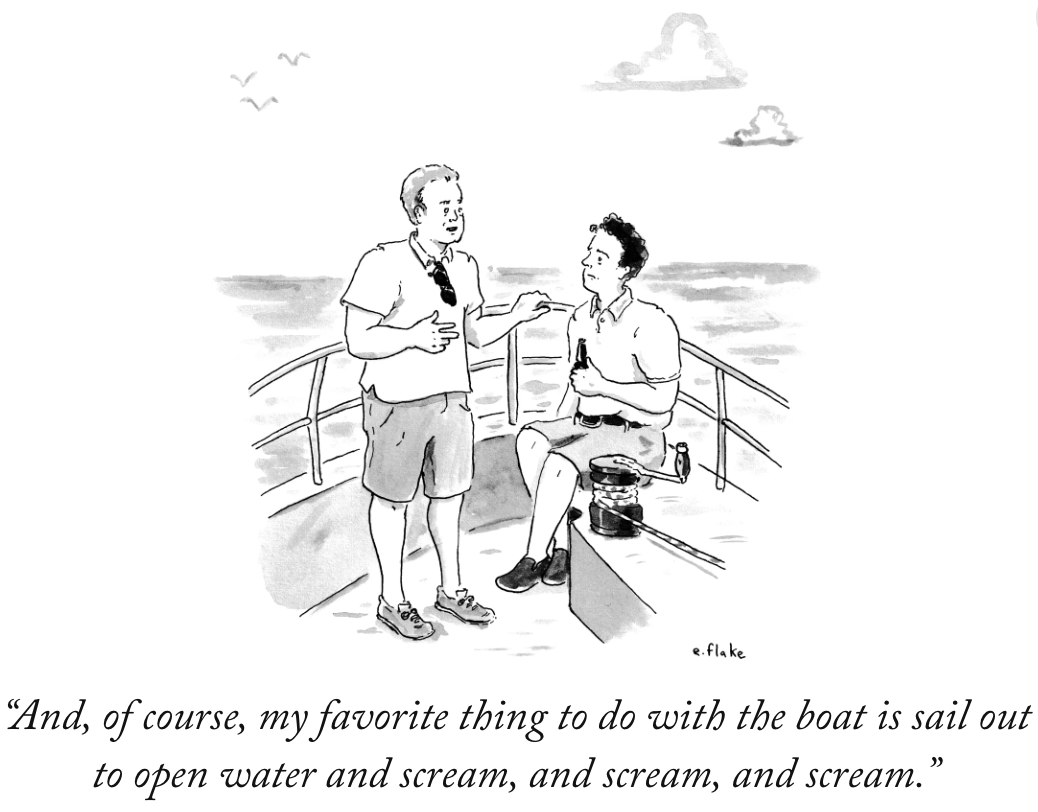
Cartoon by Emily Flake for the New Yorker
6. Get your copy of Law and Gospel: A Theology for Saints (and Sinners) out for this last one. Earnest L. Corbett writes about the “Architecture of Guilt,” how the secular age’s disposal of religious law has failed to deliver its supposed promise: to free us from guilt and shame.
The modern individual feels a low-grade, persistent fever of the soul. We see this in the explosion of impostor syndrome, a psychological phenomenon where high-achieving individuals live in constant terror of being found out. We see it in the frantic need to justify one’s existence through hyper-productivity, social activism, or the curation of a morally pristine digital avatar. We feel we are in deficit, but having erased the theology of sin, we have lost the vocabulary to name the Creditor.
This is the great paradox of the secular age: We have removed the Judge, yet the courtroom remains. We have boarded up the confessional booths, but the line of penitents stretches around the block, waiting for absolution from a silent sky.
Forensic theology proposes that this anxiety is not a malfunction of evolution or a misfiring of brain chemistry. It is a sensor. It is the smoke detector going off because there is, in fact, a fire. The debt is not a feeling; it is an ontological status. The modern man feels guilty because, in a very real, structural sense, he is guilty.
Corbett uses imagery to drive home this point. The universe is a living cathedral, and sin is the vandalism of its structure: “Guilt is a legal standing.”
Left to our own defenses against this “infinite debt,” we search for something or someone to clear the slate. And it has Seculosity written all over it:
The secular response to this infinite debt is performative justification. Having removed the atonement, the secular man must atone for himself. This is the engine behind the “workism” religion of Silicon Valley and the “activism” religion of the modern academy. We try to balance the ledger with the currency of good personhood. We volunteer, we post the correct political opinions, we recycle, we work 80 hours a week to prove our utility.
We are desperately trying to pay an infinite mortgage with Monopoly money. This creates the exhaustion of the modern age. We are running on a treadmill, trying to outpace a debt that compounds faster than our righteousness can accrue. […]
But the most critical failure of the secular court is the lack of a mechanism for restoration. In the Christian forensic system, there is a penalty (death) and a payment (the cross), followed by restoration (resurrection). In the secular court, there is only the penalty. Once “cancelled,” there is no ritual for return. There is no blood that can wash the digital record clean. The secular sinner is exiled to the outer darkness, with no priest to hear their confession and no altar to absorb their guilt.
7. Happy John Van Deusen new album release day!!! Here’s his latest, featuring Andy Squyres:
Strays:
- “How to Stop Being Self-Obsessed” in The Dispatch
- On Ted Lasso, G. K. Chesterton, and Christianity in Common Good
- Seen & Unseen‘s Graham Tomlin on why we are all so exhausted








People, especially young people, can’t afford mental health care, even though many of them know they need help, so they self-diagnose and self-treat. This is not going to change any time soon, because people are getting less and less able to afford mental health care, or health care of any kind.
One, people do not need a therapist; it has never helped. They need a translator; they are rare.
Two, guilt and shame are sheer self-pity.