




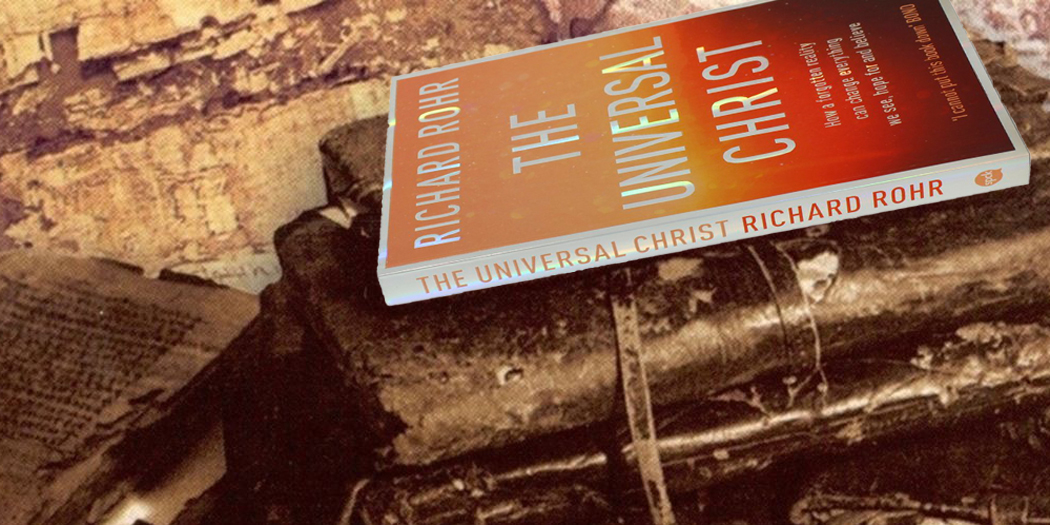
With a book blurb from Bono and interviews with Oprah, it’s fair to say that Richard Rohr is something of a Christian superstar. A Franciscan friar for 50+ years, Rohr’s thought begins from within Christian orthodoxy and pushes it beyond its usual boundaries. He practices a new kind of mysticism, which taps into cultural needs while creatively thinking outside of the box of traditional Christianity.
In his latest book, Rohr offers a Christian mindfulness that tempers its narcissistic potential with an emphasis on love of neighbor and practical service of others. He preaches a Christianity free of judgment alongside a hopeful, loving embrace of the world: an embrace that mirrors God’s own. Erasing the distinction between God and creation, he preaches a God who is found within creation, whose unremitting presence knows no bounds. The person of Jesus was the revelation of the Universal Christ already within all of creation, whom we encounter everywhere in daily life.
As told by Fred Bahnson recently in Harpers, Rohr appeals to those who find themselves on the fringes of modern Christianity, particularly former evangelicals disillusioned by the shallow certainty of their upbringing. Bahnson’s account of the 2019 Rohr conference is a wild journey into a strange land of cannabis, Buddhism, and pagan ritual: all under the banner of Christ.
Rohr is cognizant that his theological trailblazing may appear to have wandered away from orthodoxy. He writes: “This is not heresy, universalism, or a cheap version of Unitarianism. This is the Cosmic Christ, who always was, who became incarnate in time, and who is still being revealed” (p. 48). If Rohr bristles at the heretical label (which far from clear), I’d argue that there is another category that more helpfully captures his theological vision: apocryphal.
What we now call apocryphal texts circulated with varying degrees of success within early Christianity. Some were wildly popular, while others skirted around the fringes. Some were firmly orthodox, while others were more radical. Their stars rose to prominence by reflecting (and answering) cultural questions, but faded once those social winds changed. All of them met the needs of those who read them, but nearly all of them were eventually forgotten, buried in the sands of Egypt.
Many apocryphal texts are not inherently, or even principally, heretical. They are speculative forays from broadly accepted narratives or beliefs, attempting to fill in the gaps of what is believed and infer new possibilities of existing concepts. They offer creative readings of sacred scriptures and theological explorations of underdeveloped concepts. Apocryphal thought is as imaginative as it is precarious.
The more I read of Rohr, the more I am struck by how much he reminds me of the apocryphal literature I’ve studied in early Christianity.
The universal and ubiquitous Christ within creation, for Rohr, builds upon his distinction between the pre-existent Christ and human Jesus. Jesus is the concrete, Christ is universal: “instead of saying that God came into the world through Jesus, maybe it would be better to say that Jesus came out of an already Christ-soaked world. The second incarnation flowed out of the first, out of God’s loving union with physical creation” (p. 15). Rohr admits that this might sound strange, but it’s familiar territory for those who know the Gospel of Philip, which routinely contrasts the particularity of Jesus with the universality of Christ. For Philip, the name “Jesus” is irreducibly particular to Judaism, while the name “Messiah” or “Christ” is universal, being translated across all languages.
The sacredness of everything is hiding everywhere in plain sight, according to Rohr, waiting to be discovered for those with eyes to see Christ in it all. Likewise for Philip, “truth existed since the beginning, it is sown everywhere. And many see it being sown, but few are they who see it being reaped.” Rohr believes that the dualisms of good and evil, heaven and hell, sin and righteousness, are imperial distortions of Christianity. Philip likewise claims, “Light and Darkness, life and death, right and left, are brothers of one another. They are inseparable. Because of this neither are the good, good; nor evil, evil; nor is life, life; nor death, death.”
The contemplative practice of Rohr is a process of self-discovery, “The Christian life is simply a matter of becoming who we already are. But we have to awaken, allow, and advance this core identity by saying a conscious yes to it and drawing upon it as a reliable and Absolute Source” (p. 65). The word “already” is the one that stands out, making the process of becoming inwardly focused. You’d be hard pressed to find the Church Fathers preaching such a message, but this journey of self-discovery neatly mirrors that of the Gospel of Thomas: “When you might know yourselves, then you will be known and understand that you are sons of the living father.” The discovery of one’s “inner light” is the discovery of the hidden kingdom that brings salvation. To reformational ears, “becoming who we already are” sounds more than a little strange (and for good reason).

Fr. Rohr believes his contemplative beliefs trace back within Christianity to the desert monks of the 4th century who sought to distance themselves from Constantinian Christianity. This comparison is perhaps more illuminating than the casual references suggest. These otherwise impeccably orthodox monks are likely the very same monks who read and copied the Gospels of Philip and Thomas.
Like Rohr’s The Universal Christ, apocryphal texts did not usually have overtly revolutionary intent. Their goals appeared more modest: seeking to explain what seemed inconsistent, correcting misunderstandings, cultivating forgotten themes. But at the same time, they take recognizably Christian motifs and stretch their customary meanings in ways that feel familiar and yet radically new, as if what one had been taught about Christianity were a shadow of some deeper, concealed truth. Rohr’s own rhetoric deploys a similar strategy. The adherents of apocryphal texts would have seen them as innovators. To detractors like Irenaeus, they were false prophets: wolves in sheep’s clothing.
Rohr often speaks authoritatively on the damaging effects of the law and beautifully about the wonders of grace, but that’s where similarities between him reformational Christianity both begin and end. By utilizing these classical themes toward the journey of discovering one’s innate true self, Rohr has written his own apocryphal gospel — embedding a modern gospel of self-actualization in old, familiar clothing.
Given his widespread popularity, it’s clear that Rohr is scratching an itch that many people feel. Amid a frenzied world of unrelenting performancism, anxiety, and self-obsession, the contemplative tradition of Christianity could be a powerful antidote. A tradition that draws us out of ourselves and points to Another who does not merely heal our infirmities, but kills and makes us alive into who we were meant to be. If only such a contemplative Christianity were more prominent in Rohr’s writings.
People are genuinely searching for a Christian faith that does not shy away from the realities of life and its many loves, disappointments, joys, and judgments. We need language to make sense of ourselves and the world. We need to see a God who forgives without hesitation in the vision of a bloody cross, where our sin is held by God and redeemed. The kind of God who saves lost sheep, regular church-goers, religious outcasts, and mystic writers: even apocryphal ones.








Rohr has certainly scratched my itch at times, but I can’t abide a personal faith that requires me to cross my fingers behind my back when I publicly declare the creeds. However, perhaps I don’t mind standing next to someone in fellowship that feels that they “do” have to cross their fingers behind their back. Do I as a minister of the Gospel serve bread and wine to that person? It’s a tough one, but if they come to the table “by faith alone” …. it’s hard for me to deny it….Simeon Zahl’s work on “original sin” is compelling to many of his here, and I think it’s an important compare/contrast to Rohr’s nudging of Reformation faith toward the mysticism of Genesis 1, and away from Genesis 3, which is a monumental shift to consider. I wonder if there is synthesis there, but I have no idea so far.
Fascinating! I’m not gonna lie: I love me some Richard Rohr. But I think you’ve totally got a point here and I love how you draw connections to the apocryphal texts. You’ve clearly done some research! Rohr does seem to play rather fast and loose with theology, dabbling in a lot of New Age ideas — or the old school versions of them. I think if I were going to mount a defense of his writing it would probably be on the basis of his approach in terms of therapy, psychology, or spiritual direction rather than theology. I haven’t read any of his most recent stuff but I did enjoy Falling Upwards, Everything Belongs, and the half of From Wild Man to Wise Man I read. Anyway, I do think that within the Christian contemplative or mystic traditions some very counterintuitive and ostensibly heretical ideas have often popped up, and part of me wonders if the voices of the mystics don’t ultimately provide helpful counter narratives to the dominant strains of theology. I’m not saying they’re not problematic or potentially dangerous, but I think they can still be useful. It’s nice to see the world from both sides sometimes. Anyway, I’m done! Thanks Todd!
Hey Ben, I tend to think of mystical theology not as a weird “other” in the history of Christianity, but as a theology that has its feet on the ground, attentive to the the interplay between God and human experience. Such an approach is expressed by no less than thinkers like Augustine, Thomas, and (yes) Luther.
Love these posts, and the thoughtful comments here!
Excellent and very helpful!
Thanks for this, Todd.
I love Rohr’s concept of the true versus false self. If we are indeed new creations in Christ (2 Cor 5: 17), then our true identities are the people God in his forgiveness sees us as being. This encourages me. It’s not a process of discovery that leads me to contemplate and study myself, but a recognition of God’s grace, of what he accomplished on the cross, of where my interests when I make choices — of what is truly natural to me as a redeemed human being, and of what, in the life to come, when actually be instinctive, when our wills are fully at God’s command.
Of where my interests _lie_, that is. And of my abilities to see mistakes when I dictate into my phone!
In regards to becoming who we are already, I like what Robert W Jenson says in his essay, “Thinking Love”: “That we ‘little children’ should ‘love one another,’ is not so much a command as a reminder of what we are in this unprecedented society. The church is the home of love in this world.”
Jenson is isn’t bad on this issue, but the orientation has everything to do with the future self, one the other side of the resurrection. Rohr flips the equation around entirely, which may seem small, but makes all the difference. His comments on Luther or the idea of original sin are particularly revealing.
Was it not huMANs who constructed our theology?
That came to bother Luther who started as an Augustinian monk. Of course theology has evolved, developed over 2+
Millennia. Haven’t we all?
I’ve listen to all his stuff and I agree with you. Although he is doing a better job than most orthodox christians.
So, this is a question for your team: why don’t you sweat drops of blood and really deal with reality?
Have you ever read Ernest Becker or Otto Rank or Capon or Webster, have you really been to AA?
You guys are too clean, preppy and smooth.
You’ve got the platform, start writing real stuff….
Maybe you need to create a audio segment for Paul Zahl and let him ripp…………
What Rohr teaches sounds like a new Gnosticism.
I try to be a bit circumspect when it comes to the gnostic label, but yes, he does have a strong resemblance to those who espouse a new gnosticism.
I only know this. Rohr’s writings have waked up this old mans spiritual life. Thank you Fr. Rohr.