




A year after we moved to a little cottage on the edge of an Adirondack river, a windstorm rushed in, catching itself on the small island across from our home. As it blew, it broke off the tops of box elders and beeches, birch and willows, a few maples and at least one poplar tree that I can see. On an early spring morning, before the buds have burst and the leaves have filled in the gaps, the hundred bare trees left on the island are all broken at the same point. A skyward fault line.

The poet W.H. Auden wrote that “a culture is no better than its woods,” and I think of this line often when I stare out my home office window, the one that faces the river and island. When one reads the morning news or watches the evening views or even takes a personal inventory of one’s own life these days, it would be easy to believe the fault lines are the foundational type, great shifts and chasms that change the topography of our world. But when I think of my own life these days, I think less of cracks in the earth and more of toppled trees. After recent years there is almost nothing in my life that remains untoppled, and sometimes the grief feels too much to bear.
On days when the river is particularly high, from snowmelt or a rainstorm, one can paddle a kayak or canoe through the submerged island itself, and work through bowing river willows and every type of hawthorn known to humankind. I have paddled this route several times myself, and it is not just the rooted river trees that I’ve needed to navigate; it is the treetops that have all fallen every which way, rerouting the water and wildlife — and even the ground level of the island itself.
Scientists in one of the world’s most primal ecosystems, the H.J. Andrews Experimental Forest in Oregon, say that of all the nutrient-rich qualities in a forest — lichen and mycelia, leaves and forest litter — it is fallen logs themselves that “are the most overlooked of the critical components of the living ecosystem” (from The Hidden Forest by Jon R. Luoma). In his novel The Overstory, Richard Powers wrote, “A person has only to look, to see that dead logs are far more alive than living ones.”
To look, it seems, especially at what appears to be dead and long gone, is difficult work. It’s often easier to look at what’s left behind instead of at the absence of what once was.
***
I said that we moved here, but what I didn’t say is that this isn’t my first time living here. I called this place home for most of my twenties, and, despite having lived in seven other states in my forty years, I have mostly always thought of this place as home. And yet, despite that title, I resonate with Wendell Berry’s own assessment of what it means to come back home to live: “Here, in the place I love more than any other and where I have chosen among all other places to live my life, I am more painfully divided within myself than I could be in any other place” (from The Art of the Commonplace).
Painfully divided is one way to put it. I have felt chopped off in my prime. When I look out at the landscape of my life, I see bare branches and dying trees, a clear diving line of before-and-after certain events from the past few years. Not every story is mine to tell in totality, so we must exercise trust with one another. My work is not to write about grief and make you think of mine, but to write about grief and help you think of your own.[1] My grief is specific, but grief is also universal. I hold my own and you hold your own. The point is that we all feel it acutely in some way. We all feel chopped off in our prime — and if you don’t yet, look up-river: The windstorm is coming for you.
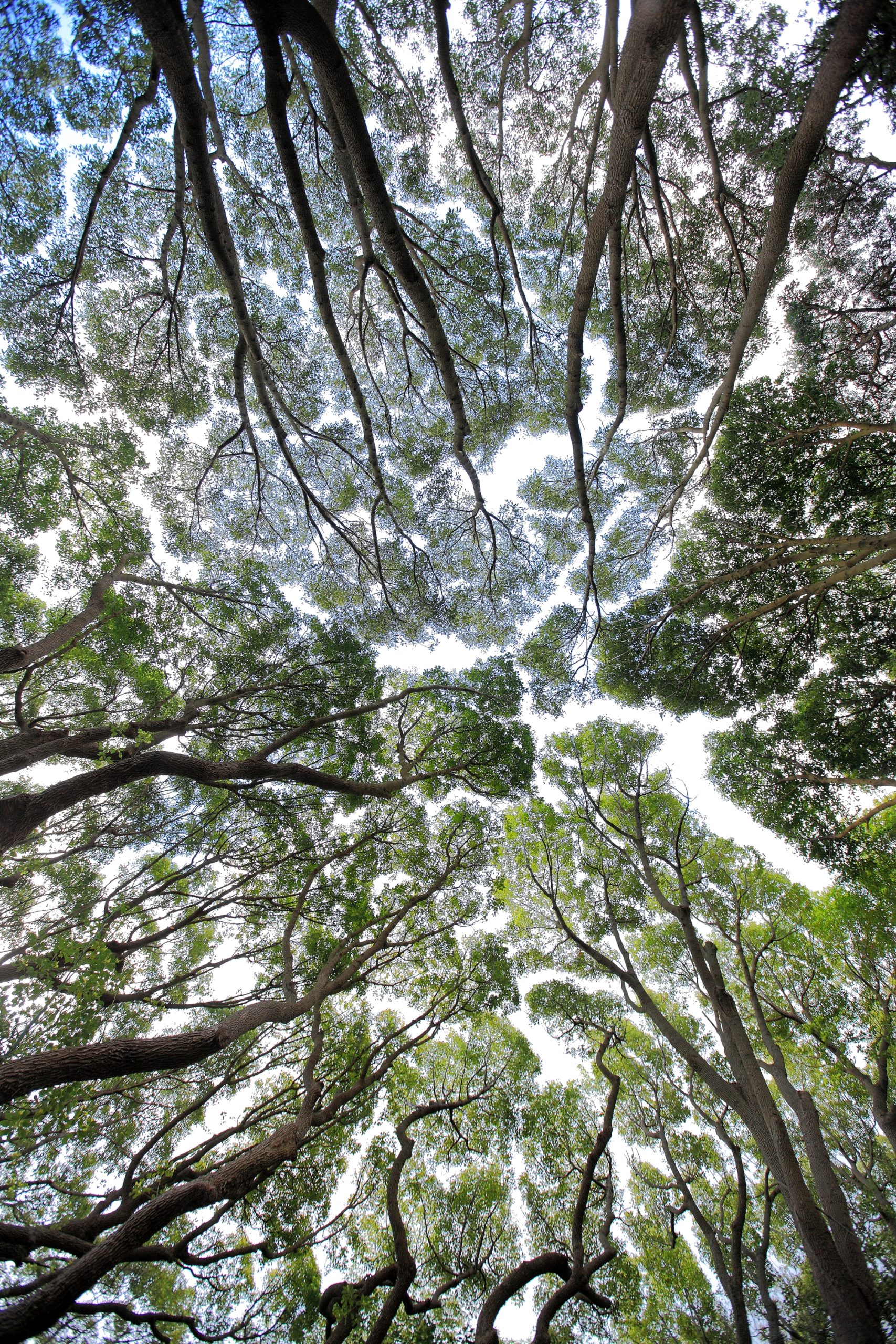
Clint Strydom, Light between the leaves, 2021. C-Type print on Diasec, 82 7/10 × 55 1/10 × 2 in. Edition of 10.
Coming home after spending much of my adult life away means needing to face the ways I’ve changed, the ways I’ve grown and matured, but also the things I’ve left behind or the things I’ve let die. It means facing the former self — for me, that means a self that was afraid of conflict, a self that capitulated to the strongest or loudest opinion in any room, a self that hid her true self until the disintegration within me disintegrated me. But it also means looking at the absence of what once was, the space that has been left behind when all that felt normal and comfortable about home has fallen apart.
It also means, I am learning, to pay close attention to what fell, and to not view it as trash but, perhaps, treasure. To look at what seems to be outwardly wasting away and trust there is an inward work still happening.
If I only view the island from my home office, it looks dead and dying. Every year the leafing branches grow sparser and the colors change earlier and earlier, signs of a sure early death. The piles of fallen trees and branches grows higher and higher. In her essay collection Upstream, Mary Oliver says of such fallen trees and branches: “They lie on the ground and do nothing. They are travelers on the way to oblivion.” But is it really oblivion? One Andrews scientist says they “can prove that a fallen tree in an advanced stage of rot can hold far more mass of living tissue than a live and standing and apparently thriving one.” The singular purpose of that living tissue is to give life to the next generation of growth. When I inch my kayak through the high waters, I see how very much alive it all still is. Those fallen branches and logs are building up the foundation for a future generation of trees, creating a nutrient-rich environment for wildlife and plants to find a home again.
***
In 1846, Henry David Thoreau visited an old-growth forest in the remote Katahdin and called it “grim and wild … savage and dreary.” He was not alone in this estimation of the virgin American forest. When early American pilgrim William Bradford first saw an East Coast forest, he said it was “hideous and desolate … [with a] wild and savage hue.” French philosopher and scientist Alexis de Tocqueville called the American woods “forsaken” and “primaeval.” There is indeed a wildness in old growth that, in the right light, can seem almost otherworldly.
Lichen covers trees and branches; mosses drape over rocks and fallen logs like lush carpets. William Wordsworth once said of such rocks that they were “fleeced with moss.” The moisture in the air and beneath one’s feet brings a softness to the experience of walking in old growth. The canopy overhead lets in streams of light sparingly, and when their beams do come through, they seem to dance from the air particles moving through them. One rarely feels the need to shout in old growth; a whisper will almost always do.
Almost half of the 2.5 billion acres that comprise the United States were once entirely old growth. Today there are fewer than 32 million acres of old growth forests in the United States. Despite what the politicians and pundits say, trees are not a renewable resource, at least not in the same way those landscapes full of untouched fallen logs would be. What old-growth forests provide in terms of carbon and carbon storage, oxygen, and nitrogen cannot be replaced in our lifetime. What they provide when they fall from natural old age and then sink into the earth below for centuries cannot be replicated. Similar to how fields that never experience crop rotation become depleted of necessary minerals and nutrients, causing erosion or more devastating effects, the clear-cut forest whose trees are hauled away to a sawmill is robbed of what is essential to make this resource truly renewable. It won’t take three or four hundred years to heal a clear-cut forest deep down beneath the roots; it will take a thousand.
***
In the same windstorm that split the trees across from my house, the tallest tree in New York state fell, not far from where we live. It was a white pine, at home in a grove of other white pines that the locals call Elders Grove. A friend (who was the first to discover her fallen after the storm) and I hiked back to her last year — to her giant golden nimbus, stark and bright amidst the darkness of the old growth forest, her broken body fallen beside her, the scent of fresh, ripped pine still ripe around. I felt like mourning there beside her, my hands on her giant stump. I felt like weeping for the more than three hundred years of history she’d stood sentry; I felt like weeping for her death. But I remembered reading something nearby forestry professor, Justin Waskiewicz, said about her: “Dead, yes, but I prefer to think she’s just not vertical anymore.”

I moved my hand to the great fallen trunk, stretched so deep into the forest I couldn’t see where her branches began. I leaned there against her and breathed in the scent of her, felt the sun shine down through the space she’d left above. Just not vertical anymore, yes, and alive — more alive than she’d ever been when she stood tall and resolute and immoveable. She will take a few more centuries to become one with the soil beneath her, and what she will give to those who come after her is immeasurable by human standards.
Later, as I come home, the river is high. I take my kayak out to the surrounding islands in the riverway, and instead of looking up, I pull my kayak alongside a fallen log and look down.
A two-inch balsam fir is just beginning to sprout from the carpet of spongy moss covering the nursemaid, in addition to orange jewelweed, a baby white pine, and another coniferous tree I don’t know the name of yet. Fiddleheads are sprouting around the log, ready to provide a protective canopy for the perfect ecosystem below. Fungi cling to the sides of the fallen tree like nurses in neonatal intensive care units hovering around the babies, answering to their beck and call. The log is lush and spring green, wet to the touch, and beautiful in the eyes of this beholder.
What appears at first to be dead and dying, divided from the source and from its own self, is actually more alive than the rooted tree from which it came. It is the still standing tree that is actually more dead than its fallen parts.
***
The poet Gerard Manley Hopkins wrote once, “And for all this, nature is never spent; / There lives the dearest freshness deep down things.” These logs, spent from the world’s perspective, are teeming with life amidst what looks dead — fresh with deep down things. I think of St. Paul’s words to the Corinthians: “So then, death is at work in us, but life is at work in you … Therefore we do not lose heart. Though outwardly we are wasting away, yet inwardly we are being renewed day by day.”
The process of grief is learning to live without the thing that has been taken away or the thing we have left behind. It is learning to live in subtraction. Even if another good is added eventually, what was subtracted is never added in again. The former life has gone.
There is a new normal now. But that does not mean that the old normal is destined for oblivion. What is being rooted and grown and cared for now is nourished by what has come before, its nutrients feeding, providing for, and sheltering what is coming now. This is how grief changes us, reorders us at a cellular level, making us and everything around us into something entirely new, never before seen or experienced.
I am learning to come home again, to let my grief lead the way, to let what seems dead only be a new cellular arrangement of something glorious and new, to make my home where death is at work and life is on its way. I am learning to not lose heart when I see the line of branches cut off in their prime. Their prime is, after all, only a matter of perspective.








I felt at home in this piece Lore. Love the metaphor of nurse logs. Going to think about that as I grieve and see what new can emerge.
What a beautiful piece! Thank you for articulating this experience so well.
Beautiful piece. It got me thinking of Job 14 – ‘there is hope for a tree, if it is cut down, that it will sprout again’.