




Sometimes I just have a feeling. Like a sense of being loved by God, almost. But it’s not really something that can be explained. — Sally Rooney, Intermezzo
The third member of the Trinity has always been a mystery to me. I remember hearing about the Holy Ghost when I was a kid and wanting to sleep with the light on. I read The Shack in my twenties and imagined a diminutive South Asian woman creeping around my subconscious.

I think it’s fair to say that in their dance of three, the Holy Spirit gets far less attention than the Father or Son, and I would venture a guess that this inattention is in direct correlation with the Spirit’s mysterious nature: what is less defined is often avoided, and a spirit, by its very nature, is a bit blurry around the edges (at least that’s what the paranormal podcasts tell me). But with age, and the realization that comes with it of not knowing everything, I’ve grown more comfortable with the blurred edges and question marks that accompany uncertainty. This means I’ve learned to, if not embrace mystery, then at least not run full-tilt away from it — which leaves me considering the Spirit with more curiosity than trepidation.
As I think about the Holy Spirit, I keep coming back to the New Testament’s use of the Greek word pneuma, translated as wind, breath, or air in motion — things that can’t be seen, though their presence is evident. So it is with the Spirit: it is both invisible and recognizable. Or to paraphrase a certain Christmas movie, “If you look for it, I’ve got a sneaky feeling that the Spirit actually is all around.”
WIND OF CHANGE
The wind blows wherever it pleases. You hear its sound, but you cannot tell where it comes from or where it is going. So it is with everyone born of the Spirit. — John 3:8
In the eight years since my family moved to Australia, I’ve embarked upon identities that, a decade ago, would have sounded like the setup for a joke about walking into a bar: ocean swimmer, disability advocate, and, most recently, aspiring doctorate-level linguist. None of these roles were on my radar prior to 2016, or a part of the careful cartography of my life plan, but seemed, rather, to be deviations from that plan. Moving to Australia was, itself, God’s temporary little joke (my former interpretation) which has turned into his lasting great gift (my present reality).
I was carried on an unplanned wind of change from Alabama to New York, where I was introduced to the man who would become my husband, at church of all places. This wind carried us and our boys to Australia. This wind has dropped me in the world of the neurodivergent; has led me to understand my son’s brain and my own brain better; has led me, in fact, to a career change and a purpose I never imagined.
My initial response to unexpected blow-abouts is shock at the upending of my own sense of autonomy. Shock was my reaction to the Pacific Ocean the first time I dipped into it my Alabama-raised toes, which were calibrated to the Gulf of Mexico’s tepid temperatures. Shock was how I responded when the developmental pediatrician told me our older son was autistic. It’s my default posture anytime I get feedback on something I’ve written in my research. This is not what was planned and I am uncomfortable! my ego cries out, no matter how many times I’ve done this dance. Shock is quickly followed by panic: I must escape what is new and unfamiliar and get back to the safety of what I’d expected.
We have a global map hanging in our house next to the kitchen sink. Not realizing it was a cross-stitch exercise when I found it online as a gift for my husband, I growled my way through working the needle across its surface, devoid as I am of seamstress skills. I glance at it often while cleaning up dinner, surveying the criss-crossing threads that connect the places we’ve been. In my hands, it should have come out as a chaotic jumble, but, somehow, it’s not. The Holy Spirit, within and around me for all these journeys, has transformed the threads into a story. It has blown apart my borders with its utter, unplanned-for expansiveness.
BREATH OF LIFE
Therefore, by his Holy Spirit, he assures me of my salvation, and makes me heartily willing and ready from now on to live for him. — Heidelberg Catechism
The winter I started ocean-swimming year-round, returning to the wild, changing tides rather than the predictable comfort of the local indoor pool, I learned even more about the breath-snatching abilities of frigid water. Namely, that it is breathlessness that teaches us to fully breathe.
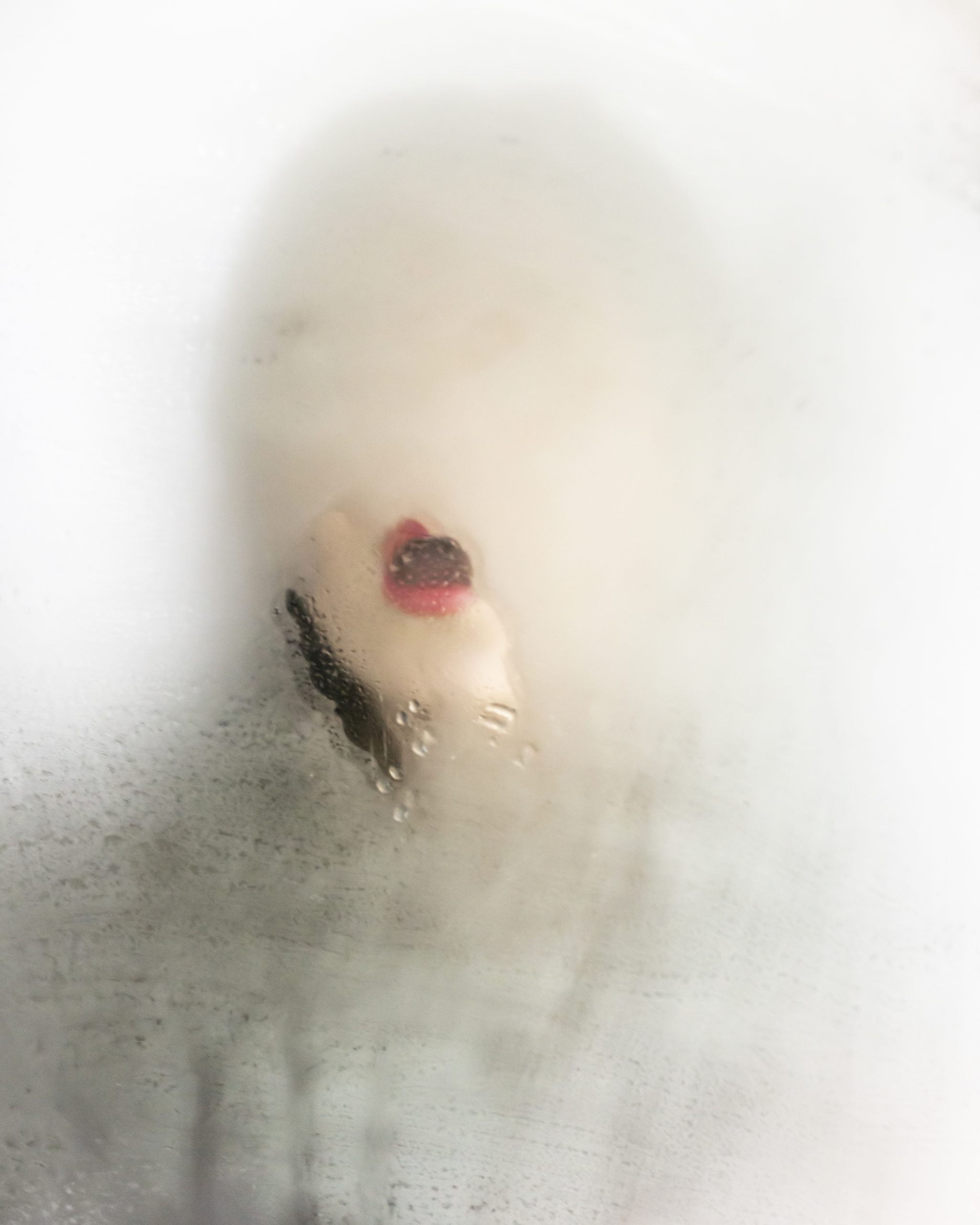
Cig Harvey, Breath, 2019. Archival pigment print, 20 x 16 in. Forthcoming book: Emerald Drifters (Monacelli Press, 2025).
I’ve since swum my way through the winter in a discount, half-body wetsuit, a legitimate full-body one, and, for the past two years, no wetsuit at all, just some handy neoprene swim socks that keep me from losing my toes (even as they render me looking like your granddad). I’ve glided through water murky and clear, rocky and calm, alongside fish, above stingrays, and, once and memorably, behind an ancient sea turtle, its aqua flippers jutting out from its shell, the giant being paddling languidly a foot ahead of me, the previously unknown growing familiar with each of our strokes.
But panic can return even when you’re where you’re meant to be. Mid-swim, rising swells demand an early return to the shore. At home, I witness, and experience myself, anxiety expressed through neurological meltdowns; I’m hurled back into my childhood, when yelling was a more common form of communication and I never knew when it would erupt toward me. In these moments, I’ve read, I must breathe: oxygen redirects me from my lower, reflexive brain to my frontal lobe, where empathy and nuance reside. I know all too well what happens without that breath.
Once, I visited Mexico with a friend. Together we did scuba training in a pool before heading to the open water. I tipped myself over the side of the boat into the sea along with everyone else, adjusted my equipment like everyone else, went underwater like everyone else; and, moments later, I re-emerged, alone. Finally my friend came up beside me and asked what was wrong. I couldn’t breathe — not solely through my mouth, not for that long. I couldn’t breathe like that. Now, a few times a week, I breathe solely through my mouth, this time above water, alternating sides like I finally learned to do. I had to learn how to breathe in the place I was meant to do it. I was made not to sink, but to float.
I learn to breathe daily, anew. When I forget, or just don’t, my meltdown matches my son’s, and we both devolve into the reptilian versions of ourselves, limbic systems calling the shots: shallow breaths, minimal air. But when I do breathe — when the air flows — the burgeoning neurological pathways light up, firm up, and we mirror each other in a new way, breath fueling growth. These neurons fire, and lungs expand, in line with biology, yes; but also, they are spirit-directed. Primarily, they are spirit-driven, and I know this because I do my best breathing when I’m not even thinking about it. I can’t even breathe on my own, not really.
Being depends on breathing, and I need help with mine. Genesis says this: The Lord God formed a man from the dust of the ground and breathed into his nostrils the breath of life, and the man became a living being. The wind that brought me to this moment is the breath that keeps me in it: in the now, not the childhood in which I used to be, or the future where anxiety tries to place me, but now, where the God-given, Spirit-driven breath that first formed life keeps me fully alive.
SIGH OF RELIEF
The Spirit himself testifies with our spirit that we are God’s children. — Romans 8:16
It’s October in Sydney now, which means it’s spring, the season in which, as the days lengthen, we celebrate Halloween and think ahead to the heat of Christmas. Ten years ago that sentence, that reality, would have sounded like a fever dream to me. Something I would run full-tilt away from. Now it’s part of my rhythm, my being. I anticipate Christmas twice a year now, in two startlingly different temperatures, and this doesn’t feel illogical, but expansive. It feels like I get more.
This year, in grad school, I’m trying not to connect my worth to my output. But still, when feedback arrives to my inbox with suggestions for improvement, I wonder if they even like me, if I’m just an idiot, if all of this was The Worst Idea Ever.
Then I breathe. In the breathing comes life, and recognition.
I tell my boys about how I feel, at my age, about my still needing to improve, still not getting it right, and my younger son — the perfectionist — his eyes light up at the revelation. “You mean…you sometimes feel that way too?” When I say yes, his sigh of relief fills the whole car, buoys us home. Later, I go through the list of comments from my supervisor, put my head in my hands, and breathe, which is also, somehow, praying. In these moments I register how many corrections my older son gets for being different, how it must feel to be the recipient of only critique, and how I might begin to change that, at home at least. With the breath, with the Spirit, comes the revelation that this new professional path is connecting me to my own children: my flailing mirrors theirs and creates space for recognition, and understanding. The realization changes me, and I think about what a relief it is to be different myself this time around. Sometimes the best kind of breathing is the exhale, the surrender of what I held onto, so that I can surrender to what holds me.
When the boys were babies, their cries would be what I woke up to — not my favorite thing about that time — and now, occasionally, I’ll wake up to the sound of their breathing. They’ve lugged their blankets and pillows into our room in the middle of the night and now we’re all sleeping in the same room, along with the dog, and the relief of our rhythmic inhales and exhales rocks me back to sleep. It reminds me of when I met their dad, those early days of friendship that transformed into something deeper, and one night we looked at each other and recognized: Oh, it’s YOU.
I think this must be what love, real love, feels like: relief. The exhalation that comes with recognition, knowing you’re where, and with whom, you’re meant to be. I imagine this is what it will be like when we finally arrive to our forever home and see what is Father and Son and Spirit — Oh, it’s YOU. The One who pervades every cell of our beings, who inspires every inhale and exhale and the moment between, who surrounds us and flows through us and between us to connect us: Spirit. Breath, wind, air.
“The words I have spoken to you — they are full of the Spirit and life,” said Jesus, the Word himself. The Spirit breathes that life into me and translates these words into a love that surrounds me, a love that I recognize in upheaval, in connection, in mystery. A love that is forever present, for we cannot be separated from the very air we occupy, are carried on, breathe in and out. A love as expansive as eternity.








This is beautiful…really…ever write any poetry? And I have lived this; “when yelling was a more common form of communication and I never knew when it would erupt toward me.” It’s amazing how hearing it from someone else helps me to breathe, realizing I have company. It’s feels like, “oh! You too?!” Kinship, my tribe. Debunks the lie the adversary tries to plant that “oh you were a special kind of royal pain, and NO ONE else was a bad as YOU! Better keep that to yourself. And the breathing part, amen. Margaret Becker has a song on an old album of hers called “Grace”, and the title is “Feel It All”. Give it a listen. Wonderful…thanks for your article.