




This essay appears in the upcoming Home Issue of The Mockingbird magazine. To receive your copy as soon as it’s available, order through our store, or subscribe here!
 It’s an old story. A woman cuts off the ends of her ham before she sets it in the pan to bake it, just like her mother taught her. Her mother cut off the ends of her ham before she set it in the pan to bake it, just as the grandmother did. When asked why she cut off the ends of the ham before baking it, the grandmother replied, “Because my pan was too small.”
Traditions are often born out of necessity, and in moments of deep distress or overwork, it’s easy to seek comfort in nostalgia. As we often ask ourselves: How did the previous generations survive? How did they get everything done?
Everything is supposedly quick and easy now. The invention of “TV dinners” and the microwave revolutionized homemaking. When women aren’t spending hours a day preparing food, they have time to do many other things.
My grandmother was a working mother of seven. She worked as a psychiatric nurse to help support the family since my grandfather’s wages were modest as a church planter/pastor. She loved instant anything. To her, it was the helping hand she needed. She fully embraced the technology of food you could just buy and heat up.
My mom shared a similar attitude. After her divorce with my dad, she was sling-shotted into the workforce, and quickly worked to finish her degree so she could support our family. A latchkey kid of the 80s, I did my fair share of heating up a pound of ground beef to be ready for her to make Hamburger Helper when she got home from work.
As for me, I married a farmer. I have a garden. I had always wanted to be a homemaker. But once I became one, I had no idea what I was doing.
***
There was one conversation when my mother-in-law took me to the local farm supply store to get seeds for my garden. She was going to show me the ropes. She told me to buy the Green Arrow variety of peas. I asked what made the Green Arrow variety better than other varieties. She looked stunned by the question. “Because it’s what my mother-in-law told me to get.”
Thinking it was like the story of cutting off the ends of the ham, I said, “Are they more disease-resistant? Do they produce more pods? Are the peas bigger?”
“I don’t know,” she replied. “It’s just what I was told to get. And it’s what I’m telling you to get. This is the best seed.”
I’m a curious, mischievous person, so I bought some of each variety of pea seeds. I would plant them all, take notes, and decide which pea I liked the best. It would be my little experiment. My mother-in-law was not amused. Why would I waste garden space like that? Just do as you’re told.
I spent the whole summer on my experiment. My conclusion: Green Arrow peas were totally the best for our soil. They produced longer pods, and were less work when it came to shelling. This saved me time in the kitchen. She was right. I had just wanted to know why.
***
I got in trouble a lot that first year that we were farming (and honestly, I continue to do so). Once, I was upset with my husband when he didn’t send me a text that he’d get home six hours later than anticipated. He said he couldn’t always anticipate what needs would arise at work. I told him that’s why he has a cell phone. I understood sometimes needing to stay late. I didn’t understand not telling me about it.
When they heard of this discussion, some of the wives on the farm criticized me for being too demanding — my husband worked so hard, he shouldn’t have to keep checking in with me. But one pondered aloud, “You know, I suppose we never expected it from our husbands because there was never a way to easily get ahold of us without stopping work. Now that we all have cell phones, I think I’ll ask my husband to text me if he’ll be late as well. That would be helpful.” It was quite the scandal at the time that I would push such a progressive marriage mindset.
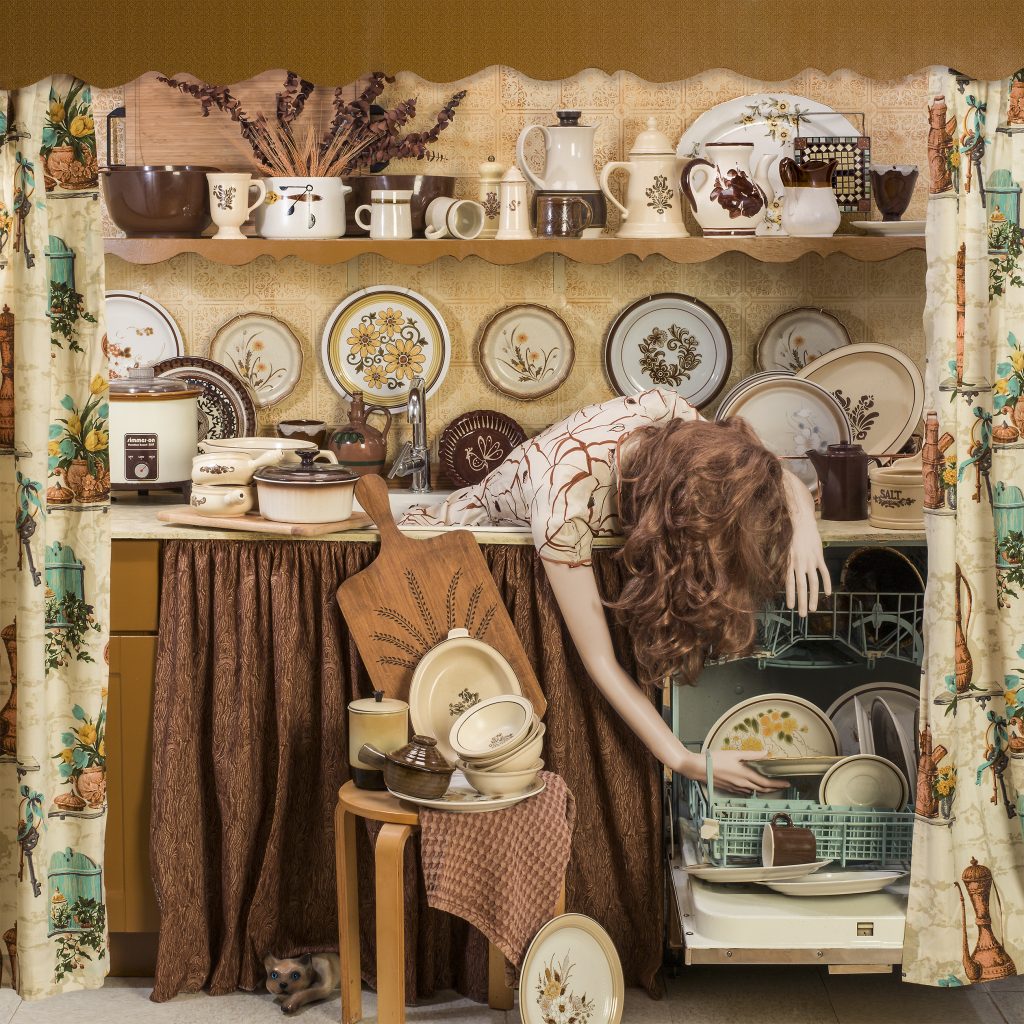
Patty Carroll, Duller than Dishwater, 2023. From the series Anonymous Women: Domestic Demise. © Patty Carroll
Back then, Martha Stewart was my generation’s teacher. For women who wanted to return to the home, she brought traditions back from the time before women had left the home. She brought beauty back into the idea of what a home is. A divorced businesswoman, she taught us to bake from scratch and organize a house. She didn’t just say what to do, she showed the purpose behind doing it that way. She called each of her tips “a good thing.”
As I studied my new vocation as homemaker, I came across a gem of a book, The Hidden Art of Homemaking, by Edith Schaeffer, wife of Christian philosopher Francis Schaeffer. For Edith, homemaking wasn’t just about making food; it was about nourishing your family. It wasn’t just about keeping a home clean; it was about helping the people in your household relax. She has a chapter in there on how to write encouraging letters, and how to put on family plays, giving roles to your children in order to teach them empathy. She writes about holistic caring.
In one of those chapters, she gives instructions on how to feed the homeless who come to your door. She said that of course they needn’t come inside, but you should set up a place outside where they can feel comfortable, but not feel like they’re intruding. Then when you bring them a tray, put a clean linen cloth on it, polish the silverware, and add a vase with a flower on it. She points out that the point of the meal isn’t just to feed their bellies but to feed their souls. She said it is not just our duty to give from what we have, but to show them that they are humans made in the image of God. Everything you do should remind them of that truth.
***
That chapter, more than any of the others, taught me the purpose of homemaking: to remind people of their humanity. That description is not just for men or for women, but for us all. A home is where we rest and receive care, can be vulnerable, and find intimacy.
As the longing for such nourishment rises in an instant world, a reactionary movement has risen up: the “tradwife” movement. But “tradwives” aren’t like traditional wives. They don’t fit the description of any of my grandmothers, or their grandmothers, according to the stories and journals they have left behind. You’re most likely to encounter a tradwife on TikTok, YouTube, or Instagram, taking the nostalgia for past generations and making it “hardcore.” Above serving and loving your neighbor (including your family), the modern tradwife is obsessed over the concept of roles and role-play. She takes Martha Stewart’s “good things” and makes them gods.
Performing your “role” becomes your salvation — and more importantly, the salvation of your family. If we all just play the roles we are supposed to play, everything will turn out fine. The tradwife movement promises healthy children, healthy marriages, and beautiful homes if women just fall in line. The most intense tradwives reject women’s right to vote. They attempt to showcase their morality by not working outside the home and by cooking all their meals from scratch.
They speak in soft voices, wear dresses and, often, head-coverings. None of these things are bad things until they become your identity. And for the tradwife, her works are her identity. What’s more, the religious sects holding up this salvation present the “tradwife life” as extolling beauty. It’s beautiful to stay at home. It’s beautiful to make homemade food. Surround yourself with beauty. Of the three Transcendentals (truth, goodness, and beauty) beauty is considered paramount, and what is ugly, hard, and broken is dismissed — even when it’s real. In the home, intimacy and vulnerability become shamed; it’s all about appearing the right way, presenting only the beautiful side of family to the world, that the world might see their goodness and worship God. There is no space for struggle.
To me, this movement is hilarious on several fronts. I live close enough to the Amish to know they have pantries filled with Cheetos. My husband’s late grandmother, who kept her house so clean that a wild pheasant once flew into her porch window and broke its neck, took one look at that pheasant and decided to pluck it and gut it and cook it up for dinner. And she and her husband even voted in different political parties. I remember seeing them holding hands on the way to the voting booth saying, “We’re off to cancel out each other’s vote!”
The difference then, between a tradwife and a homemaker, is the difference between the law and the gospel. Tradwives focus on what to do and what not to do as their identity and the source of their goodness. Do the right thing, and you’ll get the right result.
But homemaking isn’t about role-play or fulfilling some nostalgic ideal that never was. It’s about loving the actual people in your actual home, not the ideal people in your ideal home. It’s about providing a nourishing retreat from the pressures of the world, and giving and receiving grace as lavishly as it’s been given to us.
***
Examples of this lavish feasting for the soul can be found in Robert Capon’s book The Supper of the Lamb. Reading that is like going over to a favorite eccentric professor’s house and watching him cook you supper as he goes down every rabbit trail imaginable about the soul impact of home-cooked food. Capon talks about cooking as though meat and wine can show us who we are and how we are loved. He talks about “ferial” eating and “festal” eating. There’s everyday food, and then there’s feasting. He explains in great detail all the ways to cook the different parts of a leg of lamb, for everything from soups and sauces to the tender cuts of meat. He talks as though this is the baseline knowledge for life.
I recently came home from a speaking engagement up in Canada and promptly made broth with beef bones saved from the last steer we bought from our neighbors. With the rich broth, I made a soup and filled it with vegetables and meat, and, at supper, when my husband and I each tasted the first bite, we looked at each other with a sigh, the way we do whenever I take the time to make the homemade broth. It’s so good, you feel like every cell in your body is relaxing with the profound nourishment of having every need met. There’s a lavishness to home-cooked food. There’s a lavishness to garden produce, as expressed through overwhelming harvests of zucchini and rhubarb. Their purpose is to point to the lavishness of grace, not to show off our works.
This is what Robert Capon addresses when he writes this prayer, which pleads not only for grace, but for our ability to see the grace:
O Lord, refresh our sensibilities. Give us this day our daily taste. Restore to us soups that spoons will not sink in, and sauces which are never the same twice. Raise up among us stews with more gravy than we have bread to blot it with, and casseroles that put starch and substance in our limp modernity. Take away our fear of fat, and make us glad of the oil which ran upon Aaron’s beard. Give us pasta with a hundred fillings, and rice in a thousand variations. Above all, give us grace to live as true men — to fast till we come to a refreshed sense of what we have and then to dine gratefully on all that comes to hand. Drive far from us, O Most Bountiful, all creatures of air and darkness; cast out the demons that possess us; deliver us from the fear of calories and the bonding of nutrition; and set us free once more in our own land, where we shall serve thee as thou hast blessed us — with the dew of heaven, the fatness of the earth, and the plenty of corn and wine. Amen.








This was a very interesting
This was so beautifully put, thank you.
I loved this.
First, I wasn’t quite sure what a “tradwife’ was – now I know. And secondly, the article is a beautiful description of making a home, not a house. That it is okay to enjoy caring for yourself and your family. That creating beauty has great purpose.
Thank you for this reminder for us all.
This was a wonderful article. I am especially interested in the books referenced. They intrigue me, and I plan to find them at least in my library. It was refreshing to read this, thank you.
Thank you for reminding me how much I loved reading, The Supper of the Lamb, and for framing homemaking as a way to love the people with whom we live rather than impress the people who don’t.
[…] “Edith Schaeffer Versus the Tradwives.” Gretchen Ronnevik describes how Edith Schaeffer “taught me the purpose of homemaking: to remind people of their humanity. That description is not just for men or for women, but for us all. A home is where we rest and receive care, can be vulnerable, and find intimacy.” Hence, contra some online influencers, “homemaking isn’t about role-play or fulfilling some nostalgic ideal that never was. It’s about loving the actual people in your actual home, not the ideal people in your ideal home.” […]
Excellent article, though possibly portraying the “influencers” as if they represent all Tradwives. My wife and I “look” as if we cloned Francis and Edith Schaeffer–having been mentored by a physics professor whose faith was transformed when he stumbled into L’Abri while doing post-doctoral research in Switzerland in the 50’s. My wife was mentored by a woman who could have been the prototype that Edith Schaeffer later wrote about. But our lifestyle actually precedes the “movement”; and many others back then critiqued Edith Schaeffer as being a superficial Tradwife influencer!
I think your article and writings are excellent! But who’s to say that 20 years from now someone won’t criticize the Ronnevikites because of their rigid adherence to form over function?
But I think you and Edith and Mrs. Jones and the Tradwives are all nudging churchgoers in the right–and the same–direction. Keep up the good work.
[…] Edith Schaeffer Versus the Tradwives by Gretchen Ronnevik. Homemaking isn’t some fancy cosplay, but loving those whom God has given you. […]