Oliver Burkeman’s new book is Meditation for Mortals is available now. This essay was first published in 2021 in The Mockingbird’s Surprise Issue.
If you’re a sucker for self-help books, like I am, you’ll presumably have encountered that subsection of the genre dedicated to the power of planning. The key to a productive and fulfilling life, such titles insist, lies above all in mapping it out — in “timeboxing” your day into thirty-minute chunks, devising weekly and monthly plans to connect your Daily Actions to your Core Values, and in adopting the “30,000-foot view” of your mortal passage as a whole. We self-help obsessives know the intoxicating promise of all such schemes, the heady sense that at last one is seizing control of a life left too long untamed, drawing up a guaranteed strategy for future success, so that all that remains is to check off the relevant to-dos. We also know how quickly the promise fades: The ink is barely dry in the overpriced notebook I’ve invariably purchased for the project before the idea of following through with my formerly thrilling new life plan seems stale and oppressive, and I find myself resenting whichever jerk it was who ever imagined this might be a meaningful way to live. (The jerk was me.)
 At least I think I can say I come by it honestly. I come from a family of compulsive planners, people who like to have their ducks in a row well ahead of time, and who get antsy and anxious when obliged to collaborate with those more inclined to take life as it comes. I was raised to regard anyone who booked a flight less than about four months before the proposed date of departure as living life on the edge to an inexcusable degree. (“Dad Suggests Arriving at Airport 14 Hours Early,” reads a headline in the Onion, apparently inspired by my childhood.) A psychoanalyst might trace the tendency to my paternal grandmother, who was a fifteen-year-old Jewish girl in Berlin when her stepfather, surveying the wreckage of Kristallnacht, finally made plans to get his family to Hamburg, and thence on board a ship bound for England. It’s not hard to see how that experience might give rise to the conviction that some terrible fate might befall you if you didn’t make sure to plan things exactly right.
The trouble with being too invested in planning for the future, though, is that while it might very occasionally prevent a catastrophe, the rest of the time it simply exacerbates the very anxiety it was intended to allay. The obsessive planner, in effect, is demanding certain reassurances from the future; but the future isn’t the sort of thing that can ever provide the reassurance he craves — for the obvious reason that it’s still in the future. Contrary to the promises of countless books on productivity, you can never know that any sequence of actions will result in the professional success or the satisfying relationship you desire, just as there’s no number of additional hours you can build into your vacation departure plans so as to be certain you’ll make your flight. Or rather, you can be certain, but only once you’ve arrived at the airport, and you’re cooling your heels in the terminal, at which point the certainty you previously craved is worthless, and there’s something new to fret about instead: will the plane land at your destination in time for the train you need to catch there? And so on, and so on, until the hour of your death. This, I think, is what worry is, at its core: the experience of a mind attempting to generate a feeling of security about the future, failing, and then trying again and again — as if the very effort of worrying might itself somehow forestall disaster.
We shouldn’t berate ourselves too severely for seeking to make the future dependable like this. After all, the alternative is to face the terrifying fact that anything could happen, at any moment. “Planning disguises impermanence,” is how the meditation teacher Shaila Catherine puts it. To make a detailed plan is to obscure the panic-inducing fact that everything changes, and that one’s own demise is inevitable, with the comforting feeling of throwing a lasso around reality so as to bring it under your authority; to switch metaphors, it’s like directing the course of your life from an air traffic control tower located safely outside it.
This kind of security about the future has felt especially unattainable during the coronavirus pandemic, when it’s often been impossible to picture life much beyond the end of next week. But the truth is that it has always been unattainable; what we think of as our peculiarly uncertain times are peculiar only insofar as we’re finally seeing this truth. Writing in 1939, C. S. Lewis observed that “The war creates no absolutely new situation: it simply aggravates the permanent human situation so that we can no longer ignore it. Human life has always been lived on the edge of a precipice.”
A disclaimer: None of this ought to be taken as an endorsement of the compulsive planner’s opposite, the personality type irritatingly committed to spontaneity at all costs, who skips through life free of any plans, carpe-ing the diem to the maximum, and from whom a promise to meet at six p.m. for a drink can never be taken as a guarantee that they actually intend to show up. On the contrary, making plans is often useful; the problem is what we demand of them. There’s nothing wrong with wanting to get to the airport on time, or to get the promotion at work, and then taking the necessary steps to increase the probability of that happening. The trouble lies in needing to know, from our vantage point in the present, that this is what the future will definitely bring. We forget, as the American Buddhist Joseph Goldstein says, that “a plan is just a thought”: a present-moment statement of one human being’s intent, with which the future is under no obligation to comply.
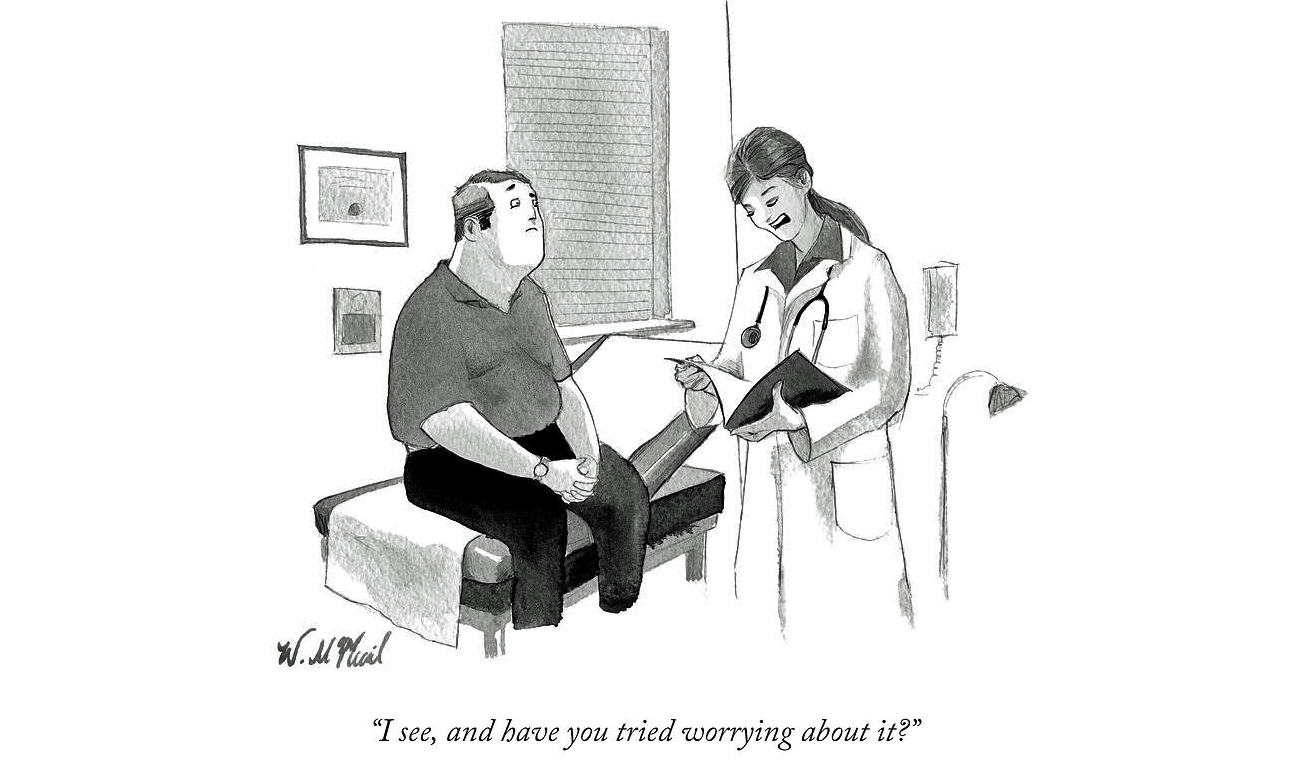
There is a different and deeper kind of security, though, to be found in appreciating the futility of all this attempted control. (This is the point at which my religious friends start talking in religious terms. I won’t pretend to have that facility.) It means the end of living in denial; the end of striving for a certainty you subconsciously knew all along you would never attain; the end of struggling to somehow get out of or on top of or out in front of the life that, in fact, you inescapably are; the end of attempting, as Baron von Munchausen did, to pull yourself out of a swamp by your own hair. In the words of the poet David Whyte, it means replacing the ego’s desire “to have power over experience, to control all events and consequences,” with “the soul’s wish to have power through experience, no matter what that may be.”
On a good day — I wouldn’t like to give the impression that I’m never still seduced by the call of the 90-day plan in the overpriced notebook — it means seeing that, far from my needing an elaborate plan to ensure that everything turns out all right, there is a sense in which everything already has. By which I mean, I think, that from our perspective here — from inside the life that we are — there’s simply no possibility of an external yardstick against which things could be deemed to have turned out badly, just as there’s no air traffic control tower from which you could dictate the course of your future. The truth that comes as such a relief, to the obsessive planner who glimpses it, is that life just unfolds as it unfolds. And that if we have made it this far without the kind of control we thought we needed, what reason is there to assume that our good fortune is about to run out?