PAW Patrol: The Movie got it all wrong.
In the 2021 animated film based on the really-popular-with-young-kids TV series, the human chief of paw-lice Rider explains to Chase, the German Shepherd, why he adopted him. Chase has begun questioning whether he has what it takes to be a member of the elite canine rescue team, PAW Patrol. He’s wounded by doubts — doubts that trace back to his past as an orphaned pup. Rider tries to calm him by telling him his adoption story. In a flashback sequence, we see Chase crossing a busy intersection. He’s about to be run over by a truck. Then Rider appears. He steps in between Chase and the truck with an outstretched arm and open palm, commanding the truck to halt. Chase looks up at his rescuer with big, brown, puppy dog eyes.

“You saw me and took pity on me,” Chase says, hanging his head in shame.
“Not at all,” replies Rider. “What I saw was a brave, heroic pup. Even though you were too small to look after yourself and you were up against all those scary things, you got back up and kept going. I didn’t adopt you because I felt sorry for you. I chose you because you were the bravest pup I had ever seen… I know that you were born to be a hero.”
I’m a dad of three kids under the age of 11. I’ve watched my fair share of PAW Patrol, and our kids have consumed their fair share of toys and swag. I tolerate it. It’s fine. There are other, more banal or problematic pieces of intellectual property that my kids could be into. But the first time I saw the scene described above, I looked at my kids and said, “That’s not what adoption is about.”
They needed to hear this. Because they, too, are adopted. From 2016 to 2020, God built our family through adoption via the foster care system in our county in Colorado. By the time our kids were placed with us, they had experienced trauma and disrupted attachment. They had come from hard places.
I understand what the PAW Patrol writers were trying to do. In pushing a message of self-sufficiency, they were trying to establish some intrinsic quality in Chase that made him worth adopting. That he was always made of The Right Stuff — he just needed a change in scenery. But by attaching Chase’s adoption to a set of conditions that merited his adoption, Rider isn’t really showing love.
This is antithetical to the deepest mystery in the universe — that all who are in Christ have been adopted by the Father. Christians have received the Spirit of adoption, as St. Paul tells us in Romans 8:15 and Galatians 4:5–6. And there was nothing in ourselves that qualified us for such an honor. The Father, our adoptive Father, qualified us to share in his inheritance (Colossians 1:12). He chose us in him before the creation of the world just because.
***
Chase’s use of the word “pity” is a loaded one. The writers of the show no doubt used it intentionally. Pity as patronizing sympathy, as “feeling sorry” for. But this is a poor use of such a rich word.
In the Anglican Book of Common Prayer, it is used in several prayers, perhaps most famously in this collect for use during Evening Prayer, or Compline:
Keep watch, dear Lord, with those who work, or watch, or weep this night, and give your angels charge over those who sleep. Tend the sick, Lord Christ; give rest to the weary, bless the dying, soothe the suffering, pity the afflicted, shield the joyous; and all for your love’s sake. Amen.
Proper 11 begins with this supplication: “O God, you declare your almighty power chiefly in showing mercy and pity…”
The term is used throughout the Psalms, oftentimes translated as “compassion,” which means to suffer with. In Psalm 69 of the Coverdale Psalter, the psalmist is actually looking “for some to have pity on [him]” and to “comfort [him]” as his enemies crash down on him. In Psalm 103, we’re told that “the Lord [is] merciful unto them that fear him” in the same way that “a father pitieth his own children.” In Psalm 106, God “pitied” his people “according unto the multitude of his mercies.”
In Matthew 20, we’re given an account of Jesus healing two blind men. The text tells us that Jesus “in pity touched their eyes, and immediately they recovered their sight and followed him.” In the Greek, “in pity” is a figure of speech that’s translated as “to have the bowels yearn.” Rather than patronizing, Jesus’s pity was deeply felt and bodily, and it moved him to action. Jesus opened the eyes of the blind, making them at home in the world. Restored, they followed the Lord, in whose light are we able to see light (Ps 36:9).
Pity. Mercy. Compassion. Three terms all pulling on the same thread. Or, rather, weaving together a fabric of grace, in which God clothes us as his own adopted children.
***
To be a foster child is to be torn from the God-ordained swaddling clothes of family; to be a foster care provider or adoptive parent is to be open to receiving the riven threads of the human condition. Christians can sometimes gloss over these disordered realities when we talk about our adoption in Christ. Sentimentality can creep in. What a pleasant thought, to be adopted; what a beautiful thing, to welcome a child in need of a home.
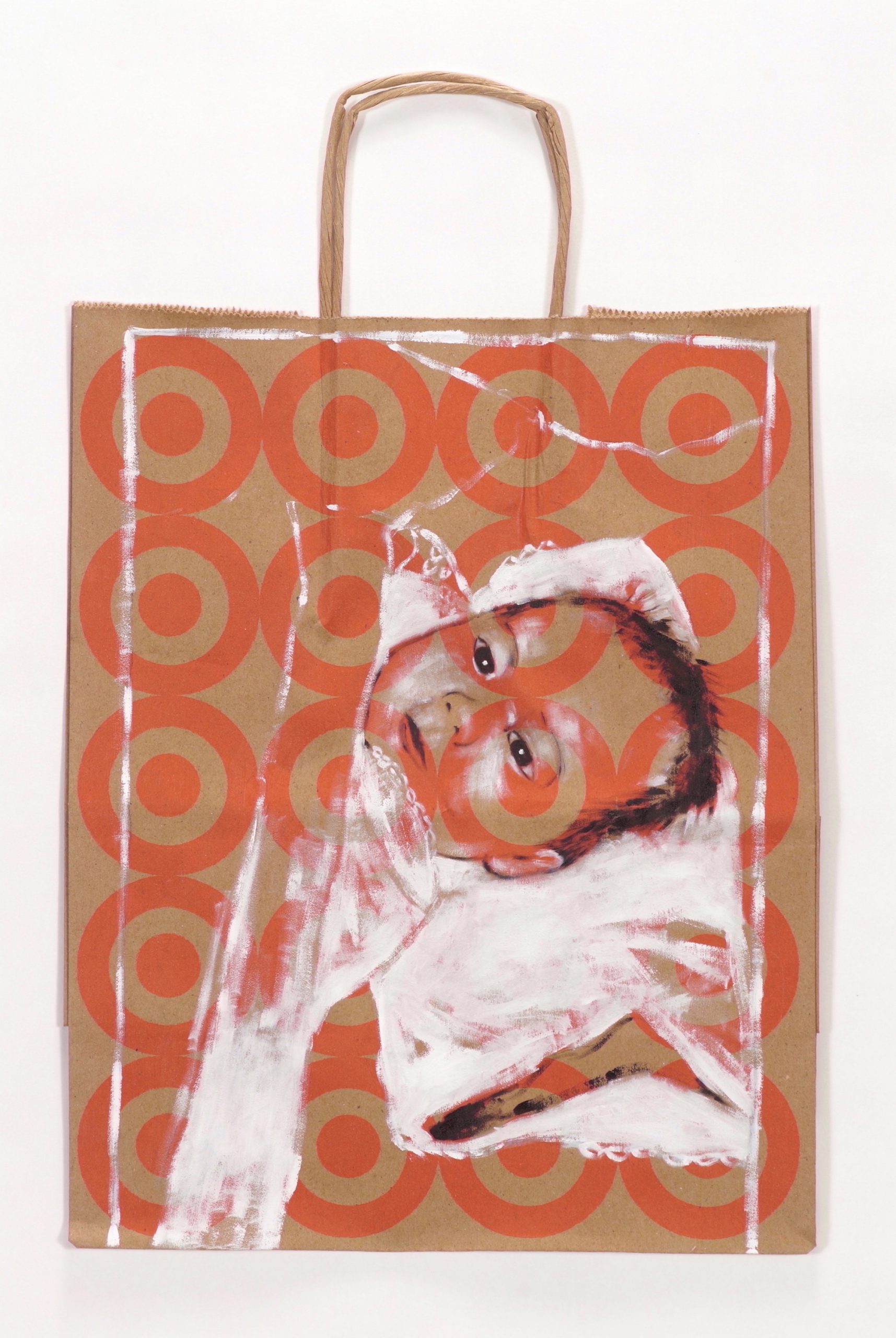
Megan Rye, Sarah, 2017, oil on paper, 19×12 inches
© Megan Rye, courtesy of Forum Gallery, New York, NY
Yet if adoption is anything, it is everything. It is beautiful — and it is broken. It is joyous and sorrowful. It is hopeful and turbulent. It is gain and loss. It is life and death. It is, as Margaret Pope put it in a past issue of this publication, cruciform.
This is as true for the foster or adoptive parents as it is the children. Because of this, foster and adoptive parents are also in need of pity and compassion.
***
When prospective foster parents are completing their home study process, one of the things they are required to do is fill out a child “preferences” worksheet. County governments and placement agencies will use the answers provided to help them match children in need of a home with prospective parents. This is by far one of the most awkward and revealing parts of the foster care journey. Because in this preferences checklist, you’re asked to clarify which characteristics of a potential placement you are “willing to accept.” And they’re not talking about personality traits.
Are you willing to accept a child with prenatal alcohol syndrome? Or a child who tested positive for other illicit substances at birth, such as methamphetamines? Yes? No? All of the above?
Are you willing to accept a child with severe medical conditions or disabilities? If yes, which ones?
Are you willing to accept a child with mental disabilities or mental health diagnoses, like autism or bipolar disorder? No? Okay, but what about something “mild” like ADHD?
Are you willing to accept a child of a different ethnicity than your own? If yes, which ethnicity or ethnicities? And yes, you have to specify which ones.
Rinse and repeat. It’s all terribly subjective, and it forces you to consider many pitiable things about the fallen, broken mess of a world in which we live. Most of all, the worksheet works you. It shows a great deal about what you’re comfortable with and vice versa. It reveals how much pity, love, grace, and energy you think you’re capable of giving — and how much you yourself still need.
This is not to say that everyone is called to say yes to the most intense or special-needs placements. Nor is it true that everyone has an accurate assessment of how much grace and compassion they’re capable of giving to a theoretical future child. And it definitely does not mean that “normal” foster or foster-to-adoption placements are void of unique and challenging issues. Kids from hard places — or even those adopted as newborn infants — will almost always have some bedrock of trauma or loss or neglect that will need tremendous amounts of love and prayer and pity and work to overcome. And it is overcome-able. My therapist used to say that God called us to this, and because of that calling, I am qualified. And I am learning, slowly and imperfectly, to show myself grace and patience and pity as I grow into the father that God has called me to be.
But you don’t learn that until you get there, until you open the door and accept the craziness. What’s crazier still is that God does not hem and haw over his “preferences.” He checks all the boxes, and more besides. All the wrongs and injustices we’ve done, all the wrongs and injustices doneto us — none of these can disqualify us. Sin and its disastrous effects cannot abide the all-reconciling, peace-making power of the blood of the Cross (Col 1:20). God says “Yes!” no matter our condition, no matter how hard or dark or traumatic the backstory. He calls us and welcomes us to our forever home because he loves us — because he first loved us.
***
My wife and I used to say that we were “fifteen percent terrified” in the days leading up to the placement of the children we welcomed into our home. It’s hard to describe that blend of excitement and fear, that totalizing realization that you have no idea what you’re getting into. This is especially true when accepting older foster kids. There are so many dynamics and forces at work. There’s so much you don’t know. You don’t know the child, you don’t know what they like or what they don’t like — but here they are, walking and talking and doing all they can to survive. You don’t know all the details of why they were removed from their home in the first place. You don’t know what the outcome of the case will be. You don’t know how you will respond to the stress, the demands, the upheaval to life as you know it — or your own unattended attachment issues with your parents. Everything familiar is torn away, and you’ve entered into a world with case workers and attorneys and judges and biological parents and kids who are so desperate for love and safety but oftentimes don’t know how to receive those things because of the instability they’ve experienced, the unpredictability of life, and the loss of so many things that so many of us take for granted every single day.
“Permanency” is the term case workers, attorneys, judges, and other licensed professionals in the foster and adoptive world use when talking about the (hopefully) final placement for a given child. The permanency goal of essentially every county in the United States is to return the foster children home to their biological parents or parent.[1] If this is not in the best interest of the child, the governing county will move to terminate the rights of the biological parents.
This is the situation in which my wife and I found ourselves when we said yes to a two-and-a-half-year-old boy whom we would eventually adopt as our first child. We had battled infertility, and our desire for a family had gone unmet. We had just begun exploring adoption as a means to building our family when God presented this situation to us.

And we were pitifully unprepared. We found ourselves unexpectedly caught up in an adventure that at times felt much too big and wild for us. What was supposed to be a two-day termination of parental rights (TPR) hearing turned into a multi-month saga. It was an excruciatingly stressful time. Our son lived in our home for almost an entire year before we had any bit of certainty that he’d be ours forever. I don’t know how we made it except that God — through our family, neighbors, and church — showed us untold amounts of love and mercy and pity.
Three months after his adoption, the two girl siblings who would eventually become our daughters were placed with us. The legal circumstances were much less stressful, but it still took almost two years from placement to adoption as we wrangled with the county over the support we needed for our girls and their special needs.
In both cases, permanency was reached. God, by his grace, made our home our children’s forever home. In the early years of our adoption journey, we latched onto Psalm 84. We sang it to each other at bedtime: “Blessed are those who dwell in your house, ever singing your praise!” We believed that God would make a home for our kids, with us, just like he did for the sparrows (84:3). We trusted that the pools of tears we encountered in the valley of weeping and heartache would become, by God’s grace, the sustaining strength of our sojourn (84:6–7).
As we walked this road, God gave us “mile markers” by which to better remember his faithfulness. The foster-to-adoption journey has its own liturgical calendar. There’s Happy Home Day: the day in which the child is placed in your home. There’s Gotcha Day: the day in which foster parents hoping to adopt learn that the child will become adoptable. Then there’s the Adoption Day: the day of the adoption proceedings in a courtroom before a judge. After the adoption becomes official, a new birth certificate is generated, and the child’s last name becomes yours. On all of our children’s birth certificates, my wife and I are listed as the birth parents.
This is a total change in identity. It is a total transfer of place. So it is for those in Christ. We were once spiritual orphans — uprooted, alienated, comfortless, blind. But because of our older brother Jesus, God, the “Father of the fatherless and protector of widows,” has settled “the solitary in a home” (Ps 68:5–6). And it is an eternal, unrendable one.